
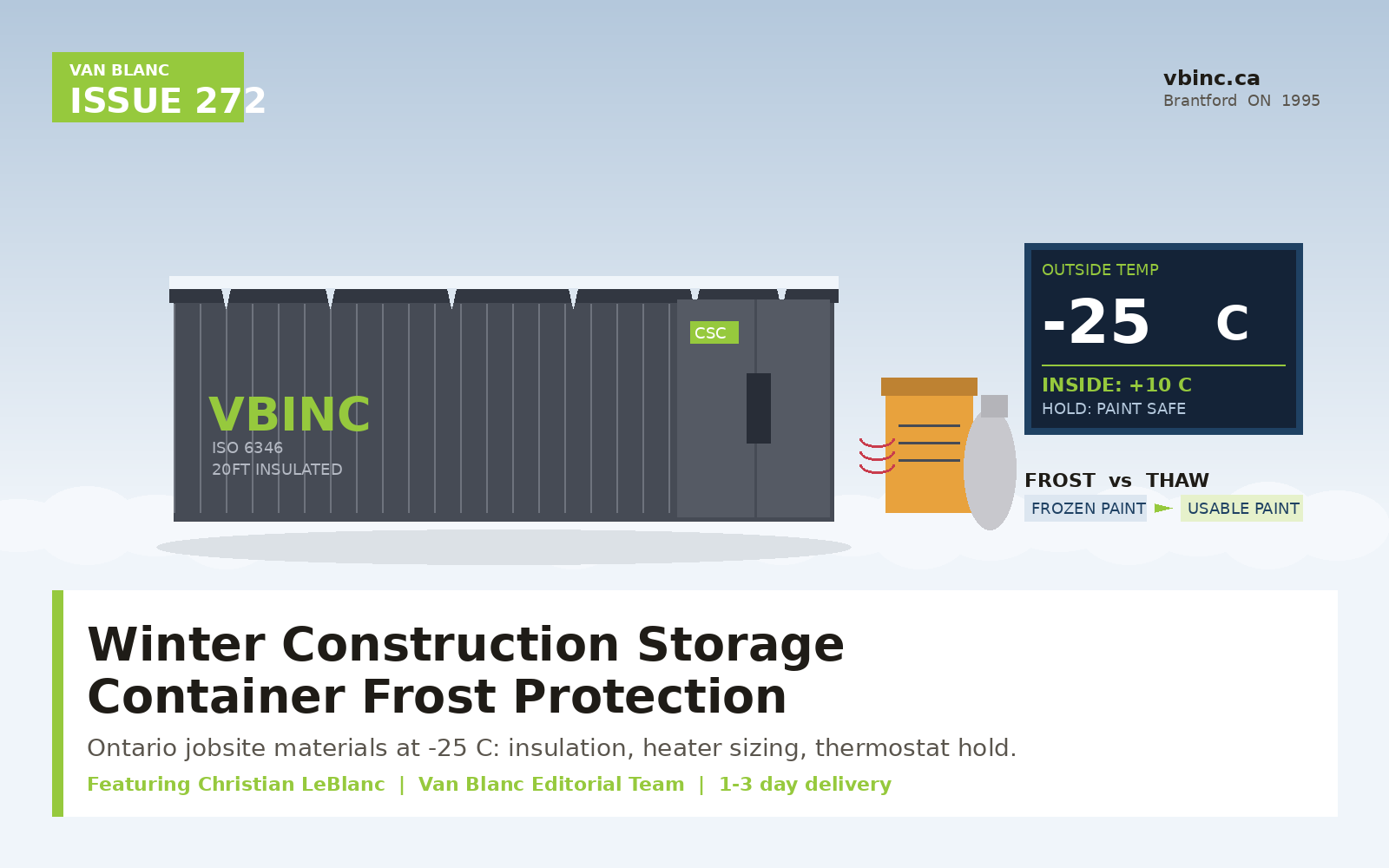
Quick Answer: An insulated 20-foot shipping container with a 1,500-watt electric heater holds +5 to +15 degrees Celsius inside through an Ontario -25 degree night, protecting paint, caulk, adhesives, and PVC primer from a destroyed cure. Closed-cell spray foam to R-20, a thermostat with a low-temp alarm, and propane stored outside the bin are the three non-negotiables. Cold-weather material storage guidance is published by Natural Resources Canada. Real Brantford yards, real reviews (4.9 / 140+), real 1-3 day delivery. Family-operated since 1995.
In This Guide
- What materials does frost actually ruin on a jobsite?
- What temperature should an Ontario winter container hold inside?
- How do you insulate a shipping container for Ontario winter?
- Electric or propane: which heater works at -25?
- How do you monitor a heated container so it never fails?
- What belongs inside the heated bin (and what does not)?
- What does a cold-season jobsite storage routine look like?
- Can Van Blanc deliver a winter container from Brantford in January?
- What do GTA crews actually do with winter containers?
- FAQs
Reading time: about 14 minutes.
What materials does frost actually ruin on a jobsite?
Frost ruins water-based jobsite materials and leaves metal and dry goods alone. Water-based paint, latex caulk, acrylic sealant, PVC primer, solvent cement, construction adhesives, premixed drywall mud, and mixed tile thinset are destroyed by a single hard freeze. Tools, lumber, steel, fasteners, and dry bagged cement shrug off the cold. A heated bin only has to protect the first list. A farm or cottage water system belongs on that first list too, and the heated room that keeps a well’s pressure tank from freezing is a job a small steel box can do.
Most contractors who call us in November already know they need a bin. The question they have not answered is which materials freezing actually destroys and which materials they have been worrying about for no reason. A heated bin costs money to run, and you only want to heat what you have to heat. This article sits inside how a full winter jobsite yard gets organised, where the same crews break their inventory across heated and unheated bins.
The destroyed-by-frost list is short but expensive. Water-based paint freezes and never recovers its film integrity, even after a slow thaw. Latex caulk and acrylic sealants do the same. PVC primer and solvent cement thicken into glue below 4 degrees Celsius and the solvent-weld chemistry is gone. Construction adhesives in tubes (PL Premium, Loctite PL, anything water- or latex-borne) lose their bond strength permanently after a hard freeze. Drywall mud freezes solid and shears apart on thaw. Tile thinset that has been mixed with water and frozen is finished. Bagged Portland cement that gets damp and then frozen turns to brick.
The shrugs-it-off list is longer than you would guess. Hand tools and power tools handle Canadian winters fine if they are dry. Lumber, steel framing, copper pipe, fittings, fasteners, tile, brick, and dimensional stone do not care about cold. Lithium-ion batteries lose runtime in the cold but recover when they warm back up.
Most real crews run two bins for exactly this reason: a heated one for the paint locker, drywall mud, adhesives, and primers, and an unheated one for tools and steel. That split is the backbone of any winter project larger than a single trade. Two bins also split the theft risk, and locking down an idle construction site over the holidays covers the perimeter and what insurers expect.
What temperature should an Ontario winter container hold inside?
The target for a paint-and-adhesive jobsite locker is +5 to +15 degrees Celsius held continuously. Below +5 the paint is technically safe but the caulk is not; below 0 you start losing adhesive cure even if the can never freezes solid. Above +15 you waste electricity and the bin sweats more on the cold-wall interfaces.
Paul LeBlanc, owner: “Every November a contractor tells me he heated his bin and the paint froze anyway. Nine times out of ten he picked a number that felt warm to walk into instead of the number the material needs. Hold +10 at the cold end of the box, not at the heater, and you will get through a Brantford winter without throwing out a single can. I have watched that mistake repeat for thirty years in the container trade.”
What manufacturers actually say about storage temperature
Most paint and sealant manufacturers print their storage range as 4 to 27 degrees Celsius (40 to 80 Fahrenheit) on the can. The Pecora Technical Bulletin 65 on cold-weather caulking specifies a 40 to 80 Fahrenheit storage range, with the warning that even high-performance silicones flow poorly until the tube itself sits at 18 Celsius or warmer for an hour before the gun. Aim for +10 to +15 inside the heated bin as the all-purpose setpoint, then bring the tube of caulk into the cab of the truck for the half hour before you shoot it.
Holding a bin at +20 because it feels nicer when you walk in costs roughly double what +10 costs over a December-to-March season. The math is linear with delta-T. Pick the lowest temperature your most-sensitive material tolerates, set the thermostat one degree above that, and walk away.
How do you insulate a shipping container for Ontario winter?
Insulating a shipping container for Ontario winter means closed-cell spray foam on the walls and ceiling to R-20, sealed vapour-barrier penetrations, inspected door gaskets, and a rigid panel under the floor. An uninsulated 20-foot steel container with a single 1,500-watt heater going hard will hold maybe -3 to 0 degrees inside when it is -25 outside. The heater runs continuously. The hydro bill is brutal. The paint cans on the floor still freeze because the steel walls behave like a refrigerator panel.
The fix is closed-cell spray polyurethane foam, applied to the interior walls and ceiling to a thickness that yields R-19 to R-25. R-20 is the practical sweet spot for an Ontario jobsite container that will see -30 nights. Below R-15 the heater struggles; above R-25 the marginal gain on a steel box is not worth the foam cost.
The four-layer winter container build
- Closed-cell spray foam to R-20: walls and ceiling, applied directly to the interior steel. Closed-cell air pockets are sealed and double as a vapour barrier. Open-cell absorbs condensation moisture and degrades.
- Door gaskets inspected and replaced: EPDM gaskets harden and crack after 10 to 15 years. A 3-millimetre gap drops your effective R-value by a third. Inspect, replace, lubricate with silicone (not oil, which freezes).
- Vapour-barrier sealing at penetrations: every electrical knock-out, vent, and thermostat-probe hole gets sealed with closed-cell foam or polyurethane sealant. Warm interior air finds cold steel and condenses.
- Floor insulation: a 20-millimetre XPS rigid panel over the marine-plywood floor, then OSB on top, gives you a working surface that does not pull heat out of every paint can sitting on it.
The biggest mistake we see is contractors who buy an uninsulated bin in October, throw a heater into it, and call us in January wondering why the paint froze anyway. The bin was not the problem. We carry standard bins, the insulated build gets finished at the yard, and the foam, gaskets, and electrical that go into it are covered in what goes into a properly outfitted cold-weather box. If a heated winter use case is on the table at the quote stage we walk you through which makes economic sense for the project length.
Electric or propane: which heater works at -25?
Electric is the heater that works at -25 unattended; propane is the heater that works fast but only with someone watching it. Electric is the safe default and the only thing you should leave running unattended overnight. Propane is the heavy-lift option for daytime work in a freshly-delivered uninsulated bin or for a cold-snap power outage. Wood belongs in the off-grid bunkhouse rather than the materials locker.
The 1,500-watt rule of thumb
A 1,500-watt electric heater (oil-filled radiator or ceramic forced-air) holds a 20-foot R-20 insulated bin at +10 Celsius through a -25 Celsius night with the heater running maybe 60 to 70 percent of the time. Running cost tracks the Ontario time-of-use electricity rate you pay, the colder the outdoor low and the lower your R-value, the more hours the element runs and the more a 100-night Brantford winter adds to the hydro bill. A 40-foot bin needs two 1,500-watt heaters or one 3,000-watt unit on a 240-volt circuit.
Propane heaters make heat fast but they make water and carbon monoxide too. A Mr. Heater Big Buddy will warm a cold bin from -15 to +10 in about 25 minutes, which is what you want when you are doing day-only work. What you do not want is propane running unattended in a sealed insulated container, because you are combining a confined space, a CO source, and a heat source while you sleep. The Propane Education and Research Council guidance: maximum 100-pound cylinder indoors, only heaters with full safety shut-off valves, never overnight unattended.
The propane detail that catches first-time winter buyers: propane does not vapourise reliably below about -20 Celsius. The tank that lived outside all night will refuse to feed the regulator at 7 a.m. on a -25 morning because the liquid in the tank is too cold to boil off into gas. Keep the cylinder you are actively using in a covered space overnight (truck cab, vestibule) or bring it inside the heated bin one hour before lighting the heater. Do not store extra cylinders inside the bin: one cylinder, in use, regulator hooked up.
How do you monitor a heated container so it never fails?
Monitoring a heated container means stacking three independent layers so a heater failure texts you before the paint freezes: a min-max thermometer, a WiFi logger with a low-temp alarm, and a cellular logger for long or high-value jobs. Heated bins fail in two ways. The heater quits and the temperature drops below your destroy-the-paint threshold before anyone notices. Or the heater runs away and the temperature climbs to +35 (rare but real with a stuck contactor on a forced-air unit). Both failures are catchable for the price of a sensor.
The three monitoring layers we recommend
Layer one (always): a digital min-max thermometer sitting on the same shelf as the paint cans. Tells you whether last night’s setpoint actually held. Layer two (projects longer than two weeks): a WiFi temperature logger like the SensorPush HT.W1 or Govee H5179. Logs every 10 minutes and sends a push alert if the bin drops below your low setpoint. The site lead gets a 3 a.m. text when the heater quits. Layer three (projects over six months or high-value inventory): a cellular logger like the Monnit ALTA plus monthly cell). Independent of jobsite WiFi.
Set the low alarm at +3 Celsius, high at +25. Stick the sensor halfway up an interior wall, away from the steel and off the floor. When the heater hiccups on a Tuesday at 2 a.m., the site lead has six hours of warning before materials are at risk.
The unsexy detail: the heater’s own thermostat lies. It reads the air right at the heater body, which is the warmest air in the bin. A bin that says +12 at the heater might be -2 at the far end. The independent sensor on the opposite wall is what you trust. A Burlington crew lost two cases of PL Premium in 2024 to this: the heater showed +8, the tube four metres away was at -4. They thought the bin was working until they tried to gun it Monday and got a frozen blob.
What belongs inside the heated bin (and what does not)?
A 20-foot insulated heated container holds about 33 cubic metres. Small enough that you have to decide what gets the heated real estate and what stores outside in an unheated bin or under a tarp.
| Material | Heated bin? | Notes |
|---|---|---|
| Latex / water-based paint | Yes | Single hard freeze ruins it. |
| Oil-based / alkyd paint | Yes | Tolerates more cold but viscosity goes high. |
| PVC primer, solvent cement | Yes | Chemistry breaks below 4 Celsius. |
| Construction adhesives (PL family) | Yes | Permanent bond loss after freeze. |
| Latex caulk, acrylic sealant | Yes | Same as latex paint. |
| Silicone, polyurethane sealants | Preferred but tolerant | Survive most cold; flow improves with warmth. |
| Drywall mud (premixed) | Yes | Freeze ruins texture. |
| Tile thinset (mixed) | Yes | Bag form is fine cold; mixed is not. |
| Bagged cement, mortar, grout | Dry shelf only | Cold OK; moisture + cold = brick. |
| Power tools, hand tools | Optional | Cold is fine; condensation on warm-up is the risk. |
| Lithium-ion batteries | Recommended | Runtime recovery on warm-up. |
| Dimensional lumber, plywood | No | Stores fine outside under tarp. |
| Steel, fasteners, fittings | No | Indifferent to cold. |
| Propane cylinders (spare) | Never | Safety regulation; one in-use only, regulator hooked. |
| Gasoline, kerosene | Never | Flammable storage; outside, separate. |
Frost-sensitive, chemistry-driven materials live in the heated bin. Dumb materials (steel, lumber, fasteners) live outside under a wrap. Flammable liquids and pressurized gas never share heated air with paint or with each other.
One more layer: condensation. A heated bin holding +15 inside while it is -20 outside has interior air full of water vapour. Open the doors at 7 a.m. and that warm wet air meets the cold steel door frame and condenses. Over a winter the film either drips onto the floor or freezes overnight into a thin ice glaze. The fixes are good vapour-barrier sealing, a small low-temp dehumidifier, and a habit of cracking the door for two minutes before you walk in fully.
What does a cold-season jobsite storage routine look like?
A cold-season jobsite storage routine assumes a 7 a.m. start, a 5 p.m. close, and overnight storage that runs unattended on its own thermostat. It is shaped by what an Ontario winter morning actually feels like at -25, when frozen fingers do not want to do six extra steps before the work starts. The same rhythm carries through the broader cold-weather storage workflow the crews we supply follow across longer multi-trade builds.
The 7 a.m. winter container open
- Check the logger phone alert first: overnight minimum and current temperature. If the low alarm fired at 3 a.m., investigate before opening anything.
- Crack the door for two minutes: let pressure equalize before walking in fully.
- Walk-around inside: floor dry? Heater face clear? Far-wall thermometer above +3?
- Pull only what you need for the morning: heated bin doors closed within five minutes of opening.
- End-of-day reset at 4:30: returnable material back inside, doors closed, lockbox engaged, thermostat confirmed at setpoint.
The pattern that fails every Ontario winter is bin doors staying open for 40 minutes during morning material breakdown. Forty minutes of -25 air drops the interior to where the heater spends the next four hours catching up while paint cans on the floor sit below their freeze line. The site lead who treats the bin like a freezer (in and out fast, doors closed between trips) saves money and materials.
Can Van Blanc deliver a winter container from Brantford in January?
Van Blanc delivers winter containers from our Brantford yards in 1 to 3 days through the deepest part of an Ontario January, across every region of the province. The other question contractors ask in November is whether we can still deliver once the snow flies. Yes, from our 4 Brantford yards. Winter delivery has three real constraints we walk through before we book.
Constraint one is site access. A tilt-deck trailer needs roughly 80 feet of straight pull-out room and a path wide enough for an 8-foot bin. Snowbanks in a January residential driveway will push that math; an industrial lot rarely will. If the access changes between order and delivery because of a fresh dump, we reschedule rather than damage your bin or the carrier’s trailer.
Constraint two is ground frost. A bin landed on bare frozen ground is fine for the winter. A bin landed on a half-frozen, half-thawed surface in early December or late March can sink unevenly when spring lifts the frost. We recommend either six pressure-treated 4×4 blocks under the corners or a level gravel pad poured in October.
Constraint three is the bin condition itself. An uninsulated bin that sits outside in Brantford from December to March picks up a steel-grade chill that takes 48 hours to warm out once the heater is in. Plan the heater for delivery day rather than the day after, because even a January delivery lands a box that needs a day of heat to shed the yard chill. Every quote comes with a real lead time.
Christian LeBlanc, second-generation operator: “Winter deliveries are where you find out who actually has Ontario yards and who is shipping a bin in from out of province. We are pulling from our 4 Brantford yards every week in February. The crew that called us Tuesday morning had a bin at their Mississauga site by Thursday at noon with a heater inside, paint and adhesives off the truck and in the bin before the warehouse pickup hit -20 that night. That is the routine. Not heroic. Just 30 years of doing it.”
What do GTA crews actually do with winter containers?
GTA crews run winter containers in three repeatable shapes: the interior-fit-out renovator with one heated bin, the multi-trade GC with a heated and an unheated bin, and the seasonal exterior contractor who parks rolling inventory in a heated bin until spring. One thing thirty years of family delivery teaches is how the buyer routine actually looks at the jobsite, rather than how the brochure says it should look. The pattern from GTA contractors in the dead of winter has three shapes.
The first shape is the renovation contractor doing an interior fit-out: drywall, paint, trim, tile. He needs a heated 20-foot bin parked beside the side door, holding +10, with the paint and the mud and the caulk and the PL Premium sitting where he can pull what he needs without driving home for it. The bin pays for itself by week three because his morning ramp-up time drops from 40 minutes to 10. He carries the same heated bin from site to site across the winter, sometimes for three different projects between November and March.
The second shape is the GC running a multi-trade build with framing happening outside and finishing trades wrapping up inside. He has two bins: an unheated bin holding lumber, steel, the rough-in plumbing, and the tools the framers grab at 6:45 a.m. while he is still in the truck, and a heated bin holding the finishing-trade materials that show up on the second-stage delivery in January. Two bins, one heater, sharp inventory split between them. The heated bin is the smaller one because the finishing material does not take up much space; the unheated one is the workhorse.
The third shape is the seasonal exterior contractor (siding, eavestroughs, roofing patch work) who runs through November and then parks his rolling inventory in a heated bin until April. He is not on site every day. The bin is at his shop or on a long-term jobsite. The heater holds +5, the inventory sleeps, and he avoids ordering fresh material in March because last fall’s caulk and adhesive came through the winter intact.
All three shapes share the same operational reality: the cheapest delivered bin from a Facebook ad with no insulation and no heater is the most expensive purchase a winter contractor makes, because he has to add the foam, the heater, the gaskets, and replace the destroyed first round of inventory before he gets to where a properly-specced bin would have started him. Many people call us saying a marketplace listing is priced far below the market, and the bin that looks suspiciously cheap on Facebook is almost always the bin that never arrives. Two weeks later they call back, scammed or stuck with a bare uninsulated box, asking what insulation costs to add after the fact.
The order is: research the bin you actually need, ask whoever you order from to walk you through insulation, gaskets, and heater specs, and accept that a real winter container costs more upfront and saves money before March. For a contractor running renovations winter after winter, ordering a one-trip bin with the insulation fitted at the yard before delivery skips the retrofit entirely and holds its resale value the longest. We carry the full grade range (one-trip, cargo-worthy, wind-and-watertight, and as-is) and we can talk through which makes sense for a heated winter use case at quote time. The conversation is the same whether it is one bin for one renovation or eight bins for a Sudbury mining project: what is going inside, what temperature does it need, how long is the project.
Frequently asked questions
What temperature should I hold inside a winter jobsite container?
Between +5 and +15 degrees Celsius. The low end protects paint, adhesives, and caulk from freeze damage; the high end is the point where you start wasting electricity and producing condensation. For a paint-and-adhesive locker we recommend +10 as the all-purpose setpoint, and the thermostat should sit on the wall opposite the heater so it reads the cold end rather than the warm one.
Can I leave a propane heater running overnight in a sealed container?
No. Propane combustion produces carbon monoxide and water vapour, and a sealed insulated bin is a confined space. The Propane Education and Research Council guidance is clear: never unattended, never overnight, only heaters with 100 percent safety shut-off valves, maximum 100 pounds of propane indoors. Use propane for daytime fast warm-ups; use electric for unattended overnight hold.
What size heater does a 20-foot insulated container need?
A single 1,500-watt electric heater holds a 20-foot R-20 insulated bin at +10 Celsius through a -25 Celsius Ontario night, running roughly 60 to 70 percent of the time. A 40-foot bin needs 3,000 watts total (two 1,500-watt units or one 240-volt heater). Uninsulated bins double or triple the heater load and still struggle to hold setpoint.
Will paint freeze inside an insulated unheated container in Ontario winter?
Yes, eventually. Insulation slows heat loss but does not generate heat. A well-insulated bin with no heater in Brantford in January will reach the outdoor low (around -20) within 24 to 36 hours of the doors being closed. Water-based paint freezes at roughly -1 Celsius. Insulation alone does not protect frost-sensitive materials; you need a heat source.
Does my propane tank work below -20 Celsius?
Barely. Propane vapourises poorly below about -20 because the liquid is too cold to boil off into gas. Tanks stored overnight at -25 will refuse to feed the regulator the next morning. The workaround is to bring the cylinder into a covered space (truck cab, vestibule) overnight, or to warm it for an hour before lighting the heater. Never warm a cylinder with an open flame.
How do I prevent condensation inside a heated container?
Three steps. Seal every penetration through the steel walls with closed-cell foam or polyurethane sealant so warm wet air cannot reach a cold surface. Inspect and replace cracked door gaskets so cold air does not pour in. Crack the doors for two minutes before walking in fully on a cold morning so pressure equalises gradually instead of dumping moist air onto cold steel.
What insulation R-value do I need for an Ontario winter jobsite container?
R-20 is the practical sweet spot for a 20-foot bin that will see -25 to -30 nights. Below R-15 your heater struggles to hold setpoint and your hydro bill climbs. Above R-25 the marginal gain on a steel box is not worth the foam cost. Closed-cell spray polyurethane foam at roughly 75 millimetres thickness delivers R-20 to R-22 on container walls.
Can Van Blanc deliver a heated container to my Ontario jobsite in January?
Yes. Van Blanc delivers in 1 to 3 days from our 4 Brantford yards, year-round. We carry bins in stock and quote the insulated build finished at the yard. Winter delivery has three constraints worth talking through at quote time: site access through snowbanks, ground conditions for placement, and the time the bin needs to warm out of yard chill before you load it. Every quote includes a real lead time.
Should I rent or buy a winter jobsite container?
Van Blanc sells containers outright and does not rent, lease, or offer rent-to-own. For a winter renovation or anything past a few months, buying a wind-and-watertight or one-trip 20-foot bin normally costs less than renting one, the insulated build is finished at the yard so there is no retrofit, and the box holds resale value; ask about buyback when the project ends.
What is the cheapest winter-ready container setup that actually works?
A wind-and-watertight 20-foot bin delivered, retrofit closed-cell spray foam to R-20 installed, inspected door gaskets, one 1,500-watt oil-filled radiator heater, and a WiFi temperature logger. The foam retrofit is the single largest line item, with the bin itself close behind and the heater and logger almost a rounding error against them. This is what most Ontario renovation contractors actually run, and it holds frost-sensitive materials safely through a Brantford January.
Sources
- Propane Education and Research Council. (2024). 17 Tips for Using Propane Heaters on a Winter Jobsite. forconstructionpros.com
- Pecora Corporation. Technical Bulletin 65: Caulking and Glazing at Temperatures Below 40 Degrees F. buildsite.com
- International Organization for Standardization. (2022). ISO 6346:2022 Freight containers, Coding, identification and marking. iso.org
- InSoFast Insulation. (2025). Shipping Container Insulation for Sale in Ontario. insofast.com
Reach Van Blanc in Brantford
We have been supplying shipping containers across Ontario since 1995. Our warehouse is at 90 Morton Avenue E in Brantford, and we deliver right across the province on a cash-on-delivery basis. No surprise fees, no chase-the-paperwork.
Van Blanc Ent. Inc. 90 Morton Ave E Unit 1B, Brantford, ON N3R 7J7 +1 888-509-6658
If you have a winter renovation or a frost-sensitive material problem to solve, call us before you order anything. We will walk through the bin size, the insulation specs, the heater sizing, and the realistic delivery window for your site. Worth the drive for the quality, family customer service with thirty years of experience.
Related Reading
Ready to price your container?
Tell us the size and your postal code and we’ll send back an all-in number, container, delivery, and placement, usually within 1-3 days. No pressure, no mystery fees.
Family-run in Brantford since 1995 · 200+ containers in stock · 4.9★ across 140+ Google reviews · every box graded by a person, walk it before it lands.