
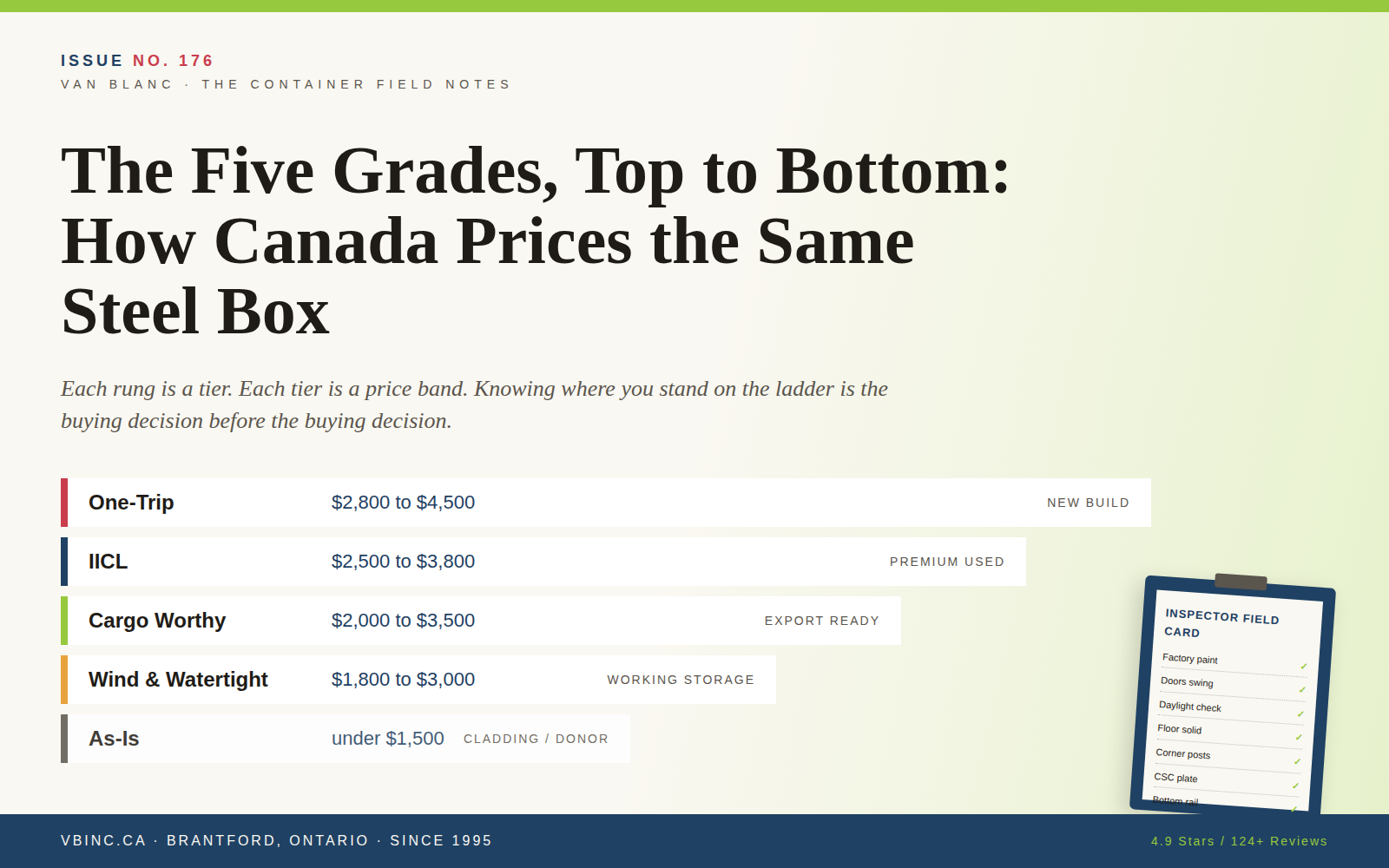
Quick Answer: The shipping container condition grading system in Canada uses five tiers in price-descending order: One-Trip, IICL, Cargo Worthy, Wind and Watertight, and As-Is. Each tier maps to its own 2026 Ontario price band, drawing on the inspection standards published by the Institute of International Container Lessors. A 20ft One-Trip sits at the top of the ladder, and a 20ft WWT lands well below it. Grade picks the price, not the other way. Bands move with grade, size, and freight zone, so call Christian or Paul for a same-day quote.
In This Guide
- Why is grade a pricing frame and not a quality stamp?
- What are the five tiers of the Canadian grading ladder?
- What is a One-Trip shipping container?
- What is IICL grade and why do most Canadians never hear about it?
- What does Cargo Worthy grade mean?
- What does Wind and Watertight grade guarantee?
- What is an As-Is shipping container?
- What do the five grades cost in Ontario in 2026?
- How do you match container grade to your actual use?
- What does the yard conversation sound like?
- FAQs
Reading Time: 13 minutes
Why is grade a pricing frame and not a quality stamp?
A shipping container condition grade is a pricing frame the Canadian industry runs on, not a quality stamp painted on the steel. The grade marks where a container sits on a five-step ladder, from new One-Trip stock down to structurally questioned As-Is units, and that position sets the price band before size or freight is discussed.
Every shipping container in Canada lives somewhere on a five-step ladder. The ladder is a pricing frame the whole industry runs on, and once you understand the frame, every quote you receive starts to make sense. A top-tier 20ft sea can and a bottom-tier 20ft sea can are not the same product priced differently. They are different grades of the same eight-foot-wide steel box, and the gap between them is doing real work.
Most buyers who phone Van Blanc already know that used costs less than new. What they often do not know is that the used category alone has three internal tiers, each with its own price band, its own typical buyer, and its own application. When a buyer asks “how much is a 20ft container,” the real answer is always another question: which grade, for what job, in what condition. The frame answers all three at once.
Van Blanc has been supplying containers from our 4 Brantford yards since 1995. Paul has run it since 1995. Christian grew up in the yard and works it now with him. Across 30 years of operating, we have watched buyers chase a Facebook listing only to discover the bin was never coming. Both mistakes trace back to the same gap, which is not knowing how the grading frame actually works in Canada. As Paul puts it, “Nobody walks in asking for a grade. They ask for a price. My whole job is turning that backwards, because once you know which tier fits the job, the price stops being a mystery.” This guide closes that gap. For the inspection side of the same decision, our walkthrough on checking a used bin before you pay puts these tiers inside the full purchasing flow.
What this guide is not
This is not an inspection checklist, and it is not a lifespan calculator. We have separate pieces on what to check at the bin and how long each grade lasts in Canadian weather. This guide stays on the pricing-frame question: what each tier means, what it costs in Ontario in 2026, and how to know which tier fits your use before you call for a quote.
What are the five tiers of the Canadian grading ladder?
The Canadian container grading ladder uses five tiers in price-descending order. The Institute of International Container Lessors, a global trade body founded in 1971 that sets the technical standards the leasing industry runs on, publishes the IICL-6 inspection manual that most of these tiers reference. American and Canadian retailers have layered consumer-friendly labels on top, and the result is the ladder you will see quoted at Van Blanc and at every reputable Canadian dealer. If you want each label defined side by side before reading on, we keep a plain-language reference to what every container grade and type really means.
The ladder reads top to bottom: One-Trip at the top, IICL just below it as the premium-used tier, Cargo Worthy in the middle, Wind and Watertight below that as the working-storage standard, and As-Is at the bottom. Each step down typically drops the price by 15 to 25 percent for the same size and size category. A 20ft One-Trip sits at the top, a 20ft IICL lands a notch below it, a 20ft Cargo Worthy holds the middle, a 20ft WWT comes in under that, and a 20ft As-Is anchors the bottom. The exact numbers move with the steel market, but the proportions hold.
| Grade tier | Position on the ladder | Step down from the tier above | Typical buyer |
|---|---|---|---|
| One-Trip | Top of the ladder (reference point) | Highest band | Retail conversion, office, residential garage extension |
| IICL | Premium-used, just below One-Trip | About 15 percent lower | Bulk lessors, export resellers, premium-used buyers |
| Cargo Worthy | Middle of the ladder | About 20 percent lower | Export shippers, high-density industrial storage |
| Wind and Watertight | Working-storage standard | Another 15 to 20 percent lower | Farm storage, equipment shelter, household reno overflow |
| As-Is | Bottom of the ladder | The steepest drop, 30 to 40 percent lower | Cladding, scrap, modification donor, low-stakes storage |
Treat the table as a starting frame, not a quote. Your actual delivered price depends on size, age, current steel market, condition specifics, and delivery distance from our 4 Brantford yards to your site. Every quote we write at Van Blanc comes with a real lead time, not a hopeful one, and the same applies to pricing: a number on the phone is a number against your specific bin, not a market average.
What is a One-Trip shipping container?
A One-Trip shipping container is the simplest tier to understand because it is essentially new. A container manufacturer in China, Vietnam, or occasionally India builds the box, sells it to a freight forwarder who loads it with cargo bound for North America, and the box makes a single ocean crossing. By the time it lands in a Canadian yard, it has been on a ship once. The factory paint is intact. The doors swing clean. There are minor cosmetic scuffs from the single voyage, occasionally a small scratch from cargo loading, but no rust, no dents, no panel pitting. A One-Trip 20ft will outlast most buildings if it is sited on proper sleepers under a tarp.
In Ontario for 2026, a One-Trip 20ft dry container sits at the top of the ladder, and a 40ft High Cube One-Trip carries the largest band of all because of its size and near-new condition. The variance inside each band is driven by the manufacturer, the original cargo type, the colour (RAL paint codes carry small premiums in some cases), and current ocean freight conditions. When global steel prices climb and ocean freight tightens, One-Trip pricing climbs first. When the steel market eases, One-Trip drops faster than the used tiers because the new-build supply is more elastic. Buyers who have already settled on a near-new box can see the One-Trip stock we keep on the lot in Ontario and request a band for the exact size they need.
When One-Trip is the right call
One-Trip is the right grade for buyers who plan to convert, brand, or display the container. Retail pop-ups, container offices visible from the road, residential garage extensions, container homes, backyard studios, and craft brewery taprooms all fit. The premium pays for original factory paint that takes branding cleanly, doors that close perfectly on the first try, and a structural shell with 25-plus years of functional life ahead of it.
What is IICL grade and why do most Canadians never hear about it?
IICL grade is the premium-used tier defined by the Institute of International Container Lessors, a global trade body that has been writing the technical standards for container leasing since 1971. Major lessors, ports, and inspection bodies use the IICL-6 manual as the global standard for what counts as an acceptable container in international circulation. When a leasing company retires a container from active service, the IICL grade is the tier the container reaches if it passes the most rigorous re-inspection. The result is a used container that is structurally indistinguishable from new for working purposes.
In Canada, IICL is the quietest tier on the ladder. Most consumer retailers do not advertise IICL grade because the language is procurement-speak that scares retail buyers. Bulk lessors and large-scale resellers are the ones who actually price IICL into their books, and the units typically move through wholesale channels before they ever hit a yard like ours. When an IICL 20ft does land in Brantford, it sits roughly halfway between Cargo Worthy and One-Trip on the ladder. A 40ft HC IICL follows the same pattern, landing just under the One-Trip band for that size.
If a Canadian dealer quotes you an IICL container, the unit has passed the strictest inspection criteria for a used box: dent tolerances measured in millimetres, no panel pitting through, all four corner castings to specification, doors that swing on certified gaskets, and a CSC plate that is either current or recently re-validated. The cosmetic condition will be close to a One-Trip, but the unit has had multiple ocean crossings rather than one. You are paying a small premium over Cargo Worthy for the certification depth and the closer-to-new visual condition.
Where IICL lives in the Canadian flow
Most Canadian retailers carry One-Trip and Cargo Worthy as the consumer-facing top tiers because those two cover 80 percent of buyer demand. IICL is most often a wholesale-channel product moving between lessors and resellers, but the grade does exist in the retail conversation if you ask for it. Christian says it best: “If a buyer wants a used bin that looks almost new and they want the inspection certainty, that is what IICL is. We will source one when the use case calls for it.”
What does Cargo Worthy grade mean?
Cargo Worthy (CW) grade means a used container certified to be loaded back onto a ship for further international cargo, and it is the used grade with the broadest application in the Canadian market. A CW container has made multiple ocean crossings, carries visible cosmetic wear including surface rust spots and paint variance, and may show occasional small dents from yard handling. The structural frame and the floor have been inspected for heavy-duty load capacity, and the box is certified to be loaded back onto a ship for further international cargo movement. The CSC plate, required for international shipping under the 1972 Container Safety Convention administered by the International Maritime Organization, is current or recently re-validated.
In Ontario for 2026, a 20ft Cargo Worthy holds the middle of the ladder, and a 40ft HC Cargo Worthy carries a proportionally larger band for the bigger box. The premium over WWT, which typically runs 15 to 20 percent on a 20ft, is paying for the export certification: the structural depth, the inspection paperwork, and the operational confidence that the box can take another decade of heavy use without compromise. For Canadian buyers who never plan to put the container back on a ship, that premium is often wasted. For buyers who plan high-density industrial storage, equipment cycling, or eventual export resale, the premium is the right call.
The CW vs WWT question
If you are buying for stationary land storage and the box will sit on sleepers behind a barn for the next twenty years, WWT does the job and saves you the Cargo Worthy premium. If you are running a logistics operation, a high-cycle equipment yard, or planning to export the box eventually, the CW premium pays back. Christian on the call: “We will tell you which one fits your use before you write the cheque. The wrong grade is the most expensive mistake in this whole conversation.”
What does Wind and Watertight grade guarantee?
Wind and Watertight (WWT) grade guarantees a container that is weather-resistant and rodent-proof, and it is the most common used grade in Canadian land-storage applications, the tier most buyers actually want without realising it. A WWT container has doors that close and seal. The roof and sidewalls show no daylight when the doors are closed. The cosmetic condition shows visible wear: surface rust on panels, occasional small dents, faded paint, paint variance from prior owners. The CSC plate may be expired, which is acceptable for storage because the box will not be loaded back onto a ship.
In Ontario for 2026, a 20ft WWT sits comfortably below the Cargo Worthy band, and a 40ft HC WWT follows the same step down for the larger size. The variance inside the band tracks cosmetic specifics: a WWT bin with recently replaced door gaskets, fresh paint on the outside, and a clean interior reads near the top of the band. A WWT bin with heavy panel pitting on the windward side, faded original paint, and a previous owner’s logo still ghosted on the side reads near the bottom. Both pass the WWT criteria. The price spread reflects what the buyer’s eye sees, not what the box can do.
The WWT working use case
Norfolk County dairy farmers, Wellington construction contractors, Brant County hobby farms, Niagara wineries, Muskoka cottage owners, and Brantford homeowners doing a basement reno are all WWT buyers. The bin lives stationary, takes weather, holds equipment or feed or tools, and the cosmetic wear does not matter because the box is not on display. WWT is the right grade for 60 to 70 percent of Ontario container demand, and it is the tier we sell most often from our 4 Brantford yards.
What is an As-Is shipping container?
An As-Is shipping container is the bottom tier on the ladder, a unit with open structural questions sold cheap for cladding, scrap, or modification donor work rather than dependable storage. As-Is is the fourth used tier, often called the fifth grade total when counted against One-Trip and IICL above the line. The Canadian industry sometimes leaves As-Is off the public grade list because the average buyer should not be shopping at this tier, but leaving it out makes the ladder look incomplete and the brand look like it is hiding the cheap option. We list As-Is. We carry As-Is units. We rarely recommend them unless the buyer has a specific reason to walk into that tier.
An As-Is container has structural questions. Floor damage is the most common reason a box drops to As-Is: years of forklift wear on the plywood, water intrusion that softened the floor, or in worst cases an actual broken plank. Frame issues, twisted corner posts from a bad lift, or doors that no longer seal cleanly are the other paths to As-Is. The box is sold cheap for cladding (architectural projects that strip the steel and reuse the panels), scrap-metal recovery, custom modification donor work (cutting up two As-Is boxes to build one mod), or extremely low-stakes storage where the buyer does not care that the box is not weather-tight.
The Ontario 2026 As-Is band sits at the bottom of the ladder for both a 20ft and a 40ft HC. The wide variance reflects the variance in actual condition: an As-Is with one bad floor plank and otherwise sound panels reads near the top of the band; an As-Is with a twisted frame and rotted floor reads near the bottom. If the price quoted to you falls well below even the As-Is band for a 20ft, that is either a genuine As-Is unit or it is the Facebook scam tier we have been warning Ontario buyers about for years. Many people call us saying they found a bin far cheaper on Facebook. Two weeks later they call back, scammed, because the bin that is suspiciously cheaper than the market is the bin that never arrives. Don’t fall for it.
Christian LeBlanc, second-generation operator: “As-Is has a real use case. A guy building a backyard workshop out of cladded container steel does not need WWT. A modification shop building a tiny home out of three donor boxes does not need Cargo Worthy. We will sell you As-Is when As-Is is right. We will also tell you when WWT is the smarter call.”
What do the five grades cost in Ontario in 2026?
The Ontario 2026 cost picture across the five-tier ladder, for the two most common sizes, lays out as follows. The proportions reflect market conditions in May 2026 from our 4 Brantford yards. Northern Ontario routes carry premium freight that adds to the delivered price.
| Grade | Where it sits on the SW Ontario ladder | Relative cost vs the One-Trip top tier | What you are paying for |
|---|---|---|---|
| One-Trip | Top band for both 20ft and 40ft HC | The reference point, 100 percent | Original factory paint, single voyage, full structural life |
| IICL | Just below One-Trip | Roughly 85 percent of the One-Trip band | Strictest used inspection, close-to-new visuals, current CSC |
| Cargo Worthy | Middle of the ladder | Roughly 65 to 70 percent of the One-Trip band | Export certification, structural inspection, CSC valid |
| Wind and Watertight | Working-storage band | Roughly 50 to 60 percent of the One-Trip band | Weather and rodent seal, doors close, cosmetic wear acceptable |
| As-Is | Bottom band for both sizes | Roughly 30 to 40 percent of the One-Trip band | Structural questions, sold for cladding, scrap, or modification donor |
The shape of the ladder tells you something important. The drop from One-Trip to IICL is about 15 percent. The drop from IICL to Cargo Worthy is about 20 percent. The drop from Cargo Worthy to WWT is another 15 to 20 percent. The drop from WWT to As-Is is the steepest, often 30 to 40 percent, because the tier change crosses the line from “guaranteed serviceable” to “structurally questioned.” That last cliff is where most Canadian retailers stop talking, because once the box drops below WWT, the buyer needs to know exactly what they are buying for and why.
Compared to 2024 pricing, the bands have softened roughly 8 to 12 percent across the board. The post-pandemic steel surge that pushed 40ft HC One-Trip pricing to its peak in 2022 has fully unwound, and current pricing reflects a normalised market. The same proportional bands show up across the Canadian market within a few percentage points either way. The grading frame is the market consensus rather than anything Van Blanc invented, and we price inside it. If you want the same bands broken out by size rather than by grade, our companion piece walks through what the 20ft, 40ft, and 53ft sizes run nationally.
How do you match container grade to your actual use?
You match container grade to your actual use by starting from the job, not the budget: the pricing frame makes the buying decision a use-case question rather than a budget question. Once you know which tier fits your job, the price band falls out automatically. The frame is the answer; the budget just confirms it. Here is how the tiers map to common Ontario buyer profiles we see at our Brantford yard.
Retail conversion or container office on display. One-Trip is the only sensible call. The factory paint takes branding cleanly. The doors operate without sticking on the first cold morning of November. The structural life supports a 20-year branded retail asset. Buyers in this category are usually Toronto, Mississauga, Hamilton, or Brantford small-business owners building a craft brewery taproom, a pop-up retail kiosk, or a branded site office for a multi-year construction project.
Bulk used inventory, high-density industrial storage, or planned export. Cargo Worthy is the tier. The CSC certification carries operational confidence that the box can take another decade of heavy use, and the resale value at the end of the cycle holds better than WWT. Buyers in this category are usually logistics companies, large-scale farms running multi-bin storage operations, and export resellers.
Stationary land storage, farm equipment shelter, household reno overflow, or hobby workshop. Wind and Watertight is the right call and the most common one we write quotes for. The cosmetic wear does not matter because the box lives behind a barn, beside a driveway, or at the back of a property. The savings over Cargo Worthy on a 20ft, that 15 to 20 percent step down the ladder, often covers your site preparation, delivery, and a tarp. The structural life on a WWT bin sitting on proper sleepers is still 15 to 20 years.
Architectural cladding, scrap recovery, modification donor work, or rough non-weather storage. As-Is is the tier, and it is sold cheap precisely because the structural questions are real. Buyers in this category know exactly what they need the steel for and they are not buying for storage performance. If you are not sure whether your use fits As-Is, it probably does not.
Used bin that looks almost new and you want certification depth. IICL is the rare-but-real call. Most Canadian retailers do not stock IICL on the retail floor, but we will source one through our wholesale channels if the use case calls for it. Common applications are corporate procurement buyers who need a paper-trail inspection certificate, premium residential conversion projects where the buyer wants close-to-new cosmetics without paying the One-Trip premium, and bulk operations that are running used fleets and want the certification consistency.
The five-question filter
- Will the bin be visible from a road or driveway? If yes, lean toward One-Trip or IICL. If no, drop to Cargo Worthy or WWT.
- Will the bin ever be loaded onto a ship again? If yes, Cargo Worthy minimum. If no, WWT or As-Is opens up.
- Will you brand or paint the bin? If yes, lean One-Trip for the clean factory finish. If you plan to repaint anyway, WWT works.
- Will the bin live stationary on land? If yes, WWT is the most common answer.
- Are you using the steel rather than the box? If yes, As-Is is the right tier and saves you serious money.
What does the yard conversation sound like?
The yard conversation is the back-and-forth that aligns grade with use, and most buyers who call us start it in the wrong tier. A Wellington dairy farmer phones asking about a 20ft One-Trip because he assumed the cheapest “new” container is what he needs for feed storage. After two minutes on the phone, Christian will walk him down to WWT and save him a full tier on the ladder. A Mississauga entrepreneur phones asking about a used 20ft for a coffee-bar pop-up. Two minutes later he is looking at One-Trip because the cosmetic wear on WWT will not hold his branding. The grading frame is the conversation the yard has with the buyer to align grade with use.
That conversation is one of the reasons Brantford is worth the drive for buyers from across Ontario. You walk into our yard, you see One-Trip stock next to WWT stock next to As-Is stock, and the price difference becomes visible at eye level. The cosmetic wear on a WWT bin tells you in three seconds whether it works for your job. The factory paint on a One-Trip tells you why the premium exists. Christian or Paul will walk the rows with you, point out the grade tags, and let you read the CSC plates before you commit. That is the experience a pool supplier cannot replicate from a website, and we lay out the full trade-off in our look at reading a bin in person versus trusting a listing photo. It is why every kind of Ontario buyer ends up at the same family business that has been doing this since 1995.
Why buyers drive to Brantford
Walking the yard is the single best way to internalise the grading frame. Photographs lie. Listing copy lies. Five minutes with your hand on a WWT bin’s bottom rail tells you everything the spec sheet was hiding. We have customers drive in from Sudbury, Ottawa, Windsor, and beyond because the yard answers the grading question in a way a phone call cannot. Worth the drive for unbeatable quality, family customer service with 30 years of experience.
If you cannot drive in, the next-best thing is a phone call with real photos. Send Christian a photo of the bin you want to grade or the use case you are trying to solve, and he will tell you which tier fits and what the Ontario 2026 price band looks like for your specific situation. Every quote comes with a real lead time, not a hopeful one, and the same applies to grade recommendation: an answer from someone who has spent thirty years in containers is the answer that saves you the wrong-grade mistake. The grading frame is the framework Ontario buyers see at the yard, and the yard is what makes the framework real.
Frequently Asked Questions
How many grades are there in the Canadian shipping container grading system?
Five tiers: One-Trip at the top, IICL just below it as the premium-used standard, Cargo Worthy in the middle, Wind and Watertight as the working-storage tier, and As-Is at the bottom. The Canadian industry sometimes counts only four (skipping IICL because most retailers do not advertise it on the public floor), but the full ladder has five.
What is the price difference between Cargo Worthy and Wind and Watertight in Ontario?
Cargo Worthy typically runs about 15 to 20 percent above WWT on a 20ft, with a proportionally similar step on a 40ft HC. Cargo Worthy carries the export certification that WWT does not, so the premium reflects the inspection depth and the operational confidence to load the box back onto a ship. For Ontario buyers who plan stationary land storage, the premium is usually not worth paying.
Is IICL grade the same as One-Trip?
No. One-Trip is essentially new with a single ocean voyage from the manufacturer. IICL is a used container that has passed the strictest re-inspection criteria from the Institute of International Container Lessors. IICL units are close to One-Trip in cosmetic condition but have had multiple ocean crossings, and they price about 15 percent below One-Trip in Ontario 2026.
Why is the grading system called One-Trip if the container made one trip?
That is exactly the origin. A new container is built in Asia, loaded with cargo for its first paying journey, and crosses the Pacific to a North American port. After unloading, the container enters the resale market. Because it has made only one paying trip, the cosmetic and structural condition is essentially new, and the industry settled on “One-Trip” as the marketing label.
What does Wind and Watertight actually guarantee?
WWT guarantees that the doors close and seal, no daylight comes through the roof or sidewalls, and the container is weather-resistant and rodent-proof. It does not guarantee cosmetic appearance, current CSC certification, or suitability for international shipping. A WWT bin will hold equipment and feed dry for 15 to 20 years on proper sleepers.
Can a Canadian buyer order an IICL-grade container?
Yes, but you usually have to ask for it specifically. Most retail yards in Canada stock One-Trip and Cargo Worthy as the consumer-facing top tiers. IICL inventory moves through wholesale channels between lessors, and dealers like Van Blanc will source IICL when a buyer has a specific use case that justifies the certification depth.
How much does an As-Is 20ft container cost in Ontario?
As-Is sits at the bottom of the Ontario ladder, well below the WWT band, and the lowest As-Is units carry significant structural issues. If the price quoted to you on a 20ft falls far below even the As-Is band and the seller is not openly tagging the unit As-Is, you are looking at either an undisclosed As-Is or a Facebook Marketplace scam. Walk the bin before you pay.
Does the grading system change across Canadian provinces?
The five-tier ladder is industry-wide, but the price bands shift by province based on rail intermodal access, regional steel demand, and delivery distance from port. Ontario sits in the middle of the national pricing spread because of GTA intermodal proximity and Brantford’s central position in southwestern Ontario. Alberta and BC tend to run slightly higher on the same grades; Quebec runs similar to Ontario.
Why does WWT have such a wide price band?
The WWT criteria covers a wide range of cosmetic conditions. A WWT bin with fresh paint and replaced door gaskets reads near the top of the band for a 20ft. A WWT bin with heavy panel pitting, faded paint, and a previous owner’s logo ghosted on the side reads near the bottom. Both pass the WWT inspection. The price spread is the buyer’s eye, not the box’s function.
Can I trust a dealer who only carries One-Trip and WWT and skips the middle tiers?
Most Canadian dealers carry One-Trip, Cargo Worthy, and WWT as the three main consumer tiers. A dealer who skips Cargo Worthy is either a small operation that does not have export-resale customers, or they are simplifying the conversation for retail buyers. Neither is dishonest, but ask the dealer to explain the tier structure they use so you know what you are buying.
Sources
- Institute of International Container Lessors. (current). IICL-6 Guide for Container Equipment Inspection. iicl.org
- International Maritime Organization. (1972, amended). International Convention for Safe Containers (CSC). imo.org
- Ontario Construction News. (2026). Shipping container pricing in Canada: A 2026 guide for construction professionals. ontarioconstructionnews.com
Reach Van Blanc in Brantford
We have been supplying shipping containers across Ontario since 1995. Our warehouse is at 90 Morton Avenue E in Brantford, and we deliver right across the province on a cash-on-delivery basis. No surprise fees, no chase-the-paperwork.
Van Blanc Ent. Inc., 90 Morton Ave E Unit 1B, Brantford, ON N3R 7J7. +1 888-509-6658
Walk our yard and read the grade tags on real bins before you commit. Christian or Paul will walk the rows with you and price each tier against your actual use case.
Related Reading
Ready to price your container?
Tell us the size and your postal code and we’ll send back an all-in number, container, delivery, and placement, usually within 1-3 days. No pressure, no mystery fees.
Family-run in Brantford since 1995 · 200+ containers in stock · 4.9★ across 140+ Google reviews · every box graded by a person, walk it before it lands.