
Quick Answer: A snowbird checklist covers time away, insurance and the empty house. Ontario says you may have to reapply for OHIP after more than 212 days outside the province in 12 months. Read your policy’s vacancy wording, shut off and drain the water, hold the mail, and lock up outdoor gear.
What This Snowbird Checklist Covers
- Snowbird Checklist, Week by Week
- How Long Can Canadian Snowbirds Stay Away?
- Travel Medical Insurance and OHIP Limits
- Home Insurance Vacancy Clauses
- Water Shut-Off Before You Leave
- Heat Settings for an Empty House
- Mail, Banking and Snow Clearing
- Leaving Home for Winter: Outdoor Gear
- Driveway 20ft: What Fits Inside
- 10ft Container for a Tighter Driveway
- Packing the Box for Five Months
- Locking a Container While You’re South
- Container Grades for a Snowbird Box
- Delivery to London, Niagara and Barrie Driveways
- Coming Home in Spring
- Snowbird FAQs
Reading Time: 15 minutes
Snowbird Checklist, Week by Week
A snowbird is a Canadian who spends the cold months somewhere warm and comes home in spring. Search for snowbirds Canada and you mostly get the air force jets, so this guide is about the other kind. A snowbird checklist is the list of jobs that protects your health coverage, your home insurance and the house itself while you are gone. Most of it takes a phone call or an afternoon. Missing one item, such as a policy condition on house checks, can cost far more than the trip.
Paul LeBlanc started Van Blanc in Brantford in 1995. This checklist ends where our work starts: the boat, trailer and patio set that stay behind. A locked 20ft steel box on the driveway is one answer to that. First, the house.
| When | Job | Who to call or check |
|---|---|---|
| 8 weeks out | Count your days away against OHIP’s limits and the US visit rules | Ontario.ca, travel.gc.ca |
| 6 weeks out | Buy or renew travel medical insurance, with full medical disclosure | Your insurer or broker |
| 4 weeks out | Read the home policy’s vacancy and house-check wording; tell the insurer | Your home insurer |
| 3 weeks out | Book snow clearing and the person who will check the house | A neighbour, family or a service |
| 2 weeks out | Order mail holding or forwarding; set bills to pay themselves | Canada Post, your bank |
| 2 weeks out | Store the boat, trailer, golf cart and patio set; lock the box | Garage, or a graded used box set beside the drive |
| Last 2 days | Shut off and drain the water, set the heat, unplug, then a final walkthrough of every room | You, with the plumber’s notes |
The timeline runs backward from your flight or your drive south. If you leave in early December, the first job lands in October. The sections below take each row in turn, with the rule or the wording behind it. Van Blanc’s part is the second-to-last row. It is the one row that can be done a month early, with a tilt-deck drop onto the driveway in October.
How Long Can Canadian Snowbirds Stay Away?
Canadian snowbirds can stay away as long as Ontario’s health rules and the destination’s visitor rules allow. Van Blanc sells and delivers inside Ontario only, so the health rules here are Ontario’s.
OHIP and the 212-Day Line
Ontario’s OHIP page says a resident must be physically in Ontario for 153 days in any 12-month period. It also says that if you’ve been outside of Ontario for more than 212 days in any 12 month period, you may have to reapply. Ontario words it as “may”, so treat 212 days as the line not to cross without checking first. The page counts it over any 12-month period.
Extended Absence of 7 Months or More
Ontario lets you keep OHIP for up to 2 years if you plan to be outside Canada more than 7 months in any 12-month period. You must meet its conditions. One is having been in Ontario for at least 153 days in each of the two 12-month periods before you leave. Before you leave, the page says to take your health card and proof of residency to a ServiceOntario centre. Two winters away means two winters for anything left outside, and a trailer parked that long needs its weight taken off the tires.
US Visits, Registration and 183 Days
Canada’s travel page for the United States says Canadian visitors can usually stay 6 months without a visa. It also says visitors staying longer than 30 days must be registered. For taxes, the IRS substantial presence test looks at 31 days in the current year and 183 days over three years. It counts every day this year, 1/3 of last year’s days and 1/6 of the year before.
A snowbird who meets that test may still be treated as a nonresident under the IRS closer connection exception. The IRS sets conditions, including fewer than 183 days in the US that year and a tax home in Canada all year. The claim is filed on IRS Form 8840. Its deadline and details belong with a cross-border accountant. Log every crossing, because all three rules run on days. That count also sets how long the boat and cart sit at home, the question a locked twenty on the driveway answers.
Travel Medical Insurance and OHIP Limits
Travel medical insurance fills the gap between what OHIP pays outside Canada and what a hospital bills. Ontario’s out-of-country page lists fixed daily amounts OHIP pays for emergency care abroad. Ontario recommends buying private health insurance “to cover any uninsured services you may need” before you leave. The federal travel page adds that coverage should include medical evacuation and hospital stays.
A stability clause is the part of a travel policy that excludes a pre-existing condition unless it stayed unchanged for a set period before departure. Snowbird Advisor Insurance’s checklist says many standard policies use 90, 180 or 365 days. A medication change or tests for a possible new condition can affect stability, it says. If a medical question on the form is unclear, the same checklist says to ask your doctor before answering.
Van Blanc sells no insurance, and none of this is advice on a specific policy. It is what the province and an insurer publish. Our part of the checklist comes later, starting with cleaning and drying the patio set before it goes away.
Travel Policy Habits Before You Fly
- Give full and accurate answers on the medical questions; a gap can put a claim at risk.
- Report any health change before you leave.
- Carry the policy number and the emergency line on paper and in your phone.
- Top up coverage before it runs out.
Home Insurance Vacancy Clauses
Home insurance vacancy clauses are the policy conditions that change coverage while nobody lives in the house. The Insurance Bureau of Canada’s January 23, 2026 release puts the policy first. If you plan on being away from home, it says, check your insurance policy first. Most insurance policies exclude frozen pipes and water damage if your home is vacant, IBC said, even with permission for vacancy.
A TD Insurance survey by Leger, published October 6, 2026, asked 1,505 adults what they do before leaving a property empty. Only 15% would check what their policy requires. Just 7% would notify their insurer, and 53% would arrange for someone to check on the place. When you call, ask about the boat too, because boat policies set their own winter layup terms.
Unoccupied or Vacant: Why the Word Matters
Insurers use two words for an empty house, and they carry different rules. Square One, an insurer that writes snowbird guidance, says that if you plan to return, your home is unoccupied, not vacant. Insurance Business reported in October 2026 that the General Insurance OmbudService says most insurers consider a home vacant after 30 consecutive days, depending on the policy. Your own policy’s definitions decide which applies.
House Checks Your Policy Expects
Policies spell out how often a competent person must check the house, according to IBC. Square One goes further. Most policies, it says, require daily visits starting the day after you leave, unless you drain your pipes. Ask your insurer these questions and write the answers down.
- How often must someone enter the house, and does the visit need a log?
- Does draining the plumbing change the visit rule?
- Do I need an endorsement for the length of this trip?
- Are contents in a detached building, such as a small steel box beside the drive, covered while I’m away?
The person doing the checks should have keys, your contact details and the plumber’s number. Square One also notes they could be held liable if they find a problem and do nothing, so pick someone who will act.
Water Shut-Off Before You Leave
Shutting off and draining the water guards against frozen and burst pipes, which Square One calls the most common cold-weather damage. IBC tells homeowners to know where the water shut-off valves are. For a vacant home, it says to shut off the supply and drain the lines. Square One lays out the steps for snowbirds, close to the drain-down a cottage gets at Thanksgiving.
- Close the main water valve where the line enters the house.
- Open the faucets, upstairs and down, to let the pipes drain.
- Check the traps under the sinks, where water sits in the bend.
- Turn off the water heater; shut the gas valve on a gas unit, or the breaker on an electric one, then drain it.
- Flush the toilets, then add non-toxic antifreeze rated for plumbing to the bowls and tanks.
- On a well, drain the pressure tank too.
Square One adds that dry traps can let sewer gas into the house, which is why the antifreeze goes in after the flush. Square One also suggests blowing air through the lines with a compressor. Tape a list of the closed valves by the main, for the house checker and for you in April.
Outdoor taps and hoses come first, before the main goes off. Disconnect the hoses, drain them and coil them. Hoses and sprinklers then go into storage with the patio gear, inside a box with vents to keep it dry or the garage.
Heat Settings for an Empty House
An empty house still needs heat, even with the water drained. Square One says that if you don’t drain the pipes, keep the thermostat at least 13 degrees Celsius. This Old House gives the same floor as 55 degrees Fahrenheit (13 degrees Celsius). IBC adds that if you are away, maintain heat and have someone regularly check the property.
- Leave interior doors open so warm air circulates, as Square One suggests.
- Open the cabinet doors under sinks on outside walls.
- Turn off the supply valves to the washer and dishwasher so their hoses can’t freeze.
- Book a furnace service before you go, and give the checker the company’s number.
- Consider a sensor that sends a low-temperature alert to your phone.
If the furnace fails in a cold snap, the house checks are what catch it. Your checker should know where the breaker panel and the furnace switch are. Paint, wine and canned goods shouldn’t freeze, so they stay in the heated house or go into an insulated box with a small heater.
Mail, Banking and Snow Clearing
Mail, snow and dark windows tell a passer-by that a house is empty. Canada Post’s Hold Mail service stops delivery while you are away, and it typically begins 3 business days after you order. Temporary forwarding can reach a US or international address, for 3 months at minimum.
- Stop the newspaper, and ask a neighbour to clear flyers from the door.
- Set bills, property tax and utilities to pay automatically, and tell your bank and card issuers where you will be.
- Set up mail and communication: leave the checker your numbers, the insurer’s claim line and a way to reach you.
- Book snow clearing for the driveway and the walk; Square One says an unshovelled drive tells people nobody is home.
- Put two or three lamps on timers in different rooms.
- Unplug small appliances, and empty and unplug the spare fridge, as Square One advises.
The driveway itself matters here. A snow contractor needs a clear lane, so plan where anything parked outside will sit, ideally on a gravel pad clear of the plow’s path. A boat on its trailer in the middle of the drive is also the thing every passer-by notices. The next sections cover where that gear goes and what Van Blanc can supply for it.
Leaving Home for Winter: Outdoor Gear
Leaving home for winter means leaving the yard too, and the yard holds the things that walk away easiest. A fishing boat on a trailer, a golf cart, the patio set and the barbecue all sit outside the checklist above. So does a garage overflowing with summer gear. A house checker looks inside once a day; nobody watches the trailer at 3 a.m.
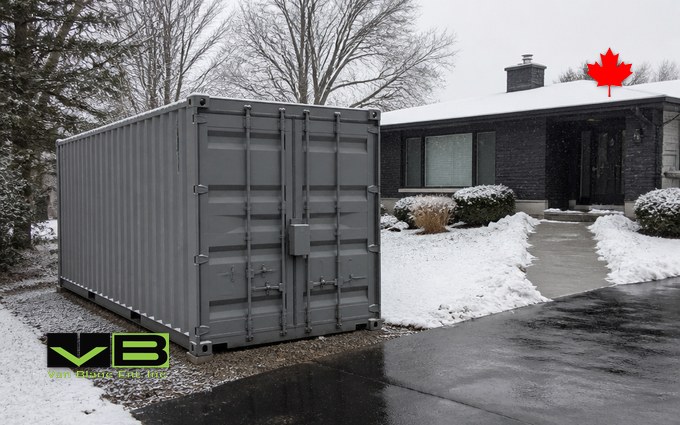
Van Blanc sells shipping containers, and one container on a gravel pad beside the driveway handles most of it. The steel box locks, sits on the property, and holds the outdoor gear in one place from November to April. The snow contractor plows around one rectangle instead of a trailer, a cart and stacked chairs.
The patio set alone has its own page, getting chairs, cushions and umbrellas through an Ontario winter. So does putting a boat away for the cold months. A snowbird usually has both, plus a cart and tools, and wants them handled in one afternoon. If an RV or camper is staying behind, the camper’s antifreeze and battery routine belongs on the same list.
A shipping container for snowbird storage is a lockable steel box set on firm ground at home, sized to the largest item going in. A 20ft suits a small boat on its trailer with the patio set beside it. A 10ft suits a cart, furniture and tools on a short driveway.
Driveway 20ft: What Fits Inside
A 20ft container on the driveway is the size that takes a small boat on its trailer. Van Blanc’s published spec table for the twenty gives the inside length as 19 ft 4 in (5.898 m). The inside width is 7 ft 8 in (2.352 m). That comes to 1,172 cubic feet in all. The door is the tighter number. Hapag-Lloyd lists the standard 20ft door opening as 2,340 x 2,292 mm, about 7 ft 8 in wide and 7 ft 6 in high.
| Item | Measure this | Check it against |
|---|---|---|
| Boat on its trailer | Overall length, hitch coupler to stern or motor | 19 ft 4 in (5.898 m) inside length |
| Boat on its trailer | Widest point: hull, rub rail or trailer fenders | 2,340 mm door width |
| Boat on its trailer | Height to the top of the windshield, motor or bimini | 2,292 mm standard door; 2,597 mm high cube door |
| Golf cart | Length and the roof height | The space left beside or behind the boat |
| Patio set, barbecue, bikes | Stacked footprint | The side aisle and the nose of the box |
Measure before you call. A boat that clears on paper still needs a few inches to steer through the doors, as the doorway test for a trailered boat explains. If the windshield or motor sits above the standard door, a 20ft high cube adds a foot of height. Hapag-Lloyd lists its high cube door at 2,340 x 2,597 mm, measured on its 40ft high cube. Van Blanc carries every size in both standard and high cube, the 20ft included.
A boat and a golf cart together can fill the length. Lay it out on the driveway with chalk at full size first. If the cart won’t fit beside the boat, a 40ft or a second, smaller box takes the overflow, and the yard can talk through both. Stock sits across our rows of every size and grade we carry, so you can see the 20ft and the high cube side by side.
10ft Container for a Tighter Driveway
A 10ft container is the box for a snowbird with no boat and a short driveway. Van Blanc’s 10ft page puts its inside volume at about 560 cubic feet, on an 8 by 10 pad. The published spec sheet that page cites gives an inside length of 2,840 mm. That usually takes a patio set, a barbecue, bikes, the lawn tools and the golf clubs, with room for shelving.
A golf cart is the item to measure for a ten. Check the cart’s length, with the bumper, against the inside length and the roof height against the door. A man door or a roll-up door beside the cargo doors makes a weekly look easier for the house checker. Ask the yard about a ten with one. The compact ten on its half-stall pad page explains the door options and the difference between a factory ten and a cut-down.
A ten also suits townhouse and semi lots where a 20ft would block the garage. It sits in the side yard or at the end of the drive and leaves the snow lane open.
Packing the Box for Five Months
Packing a storage container for a winter away is mostly about order and moisture. The boat goes in first, because it comes out last in spring. The cart and the things you may need to reach go by the doors. The house habits apply to the box too: nothing plugged in, nothing that can leak.
- Back the trailer in, chock the wheels, and set jack stands under the frame to unload the tires.
- Pull the drain plug, empty the bilge and dry the boat before the doors close.
- Take the batteries out of the boat and the cart, or disconnect them, as their makers’ storage instructions say.
- Clean and dry the patio cushions, then bag them; stack the frames on a pallet off the floor.
- Leave an aisle to the back wall so the checker can see the whole box with a flashlight.
Fuel stays out of the box. Portable gas cans and barbecue propane cylinders never go inside a closed steel container. Store them as their makers and Ontario’s fuel rules say. The barbecue goes in with its tank disconnected and left outside. Portable outboard tanks stay out too. A boat or golf cart with a built-in gas tank should have it drained, following the maker’s storage instructions, before it goes in.
Moisture is the other enemy. A closed box sitting through freeze and thaw collects condensation, and wet cushions mildew. Wall vents that keep damp air moving are a small add Van Blanc fits when the box is ordered.
Locking a Container While You’re South
A container left for five months needs a lock nobody can cut in a minute. Van Blanc fits lockboxes at the yard before delivery: a welded steel shroud around the padlock that shields it from bolt cutters. A puck lock inside the shroud is the usual pairing, and how a puck lock sits inside the lockbox covers the hardware.
Point the doors toward the house or a window, where a neighbour sees them. Give the house checker a key and ask them to try the doors on each visit. A motion light over the doors helps more than a camera nobody watches. The full list of what the yard can add, from vents to shelving, is on the yard’s modifications list.
Container Grades for a Snowbird Box
Container grades describe the box’s age and condition, and the choice is yours. A snowbird box sits on a driveway in plain view, so paint and dents may matter more than they do on a farm. Van Blanc’s product pages give the grade notes.
- New (one-trip): the industry calls it one-trip because it crossed the ocean loaded once. Factory paint and crisp doors suit a new box parked where the street can see it, and it holds resale value longest.
- Cargo worthy (CW): a box used 8 to 15 years, still certified for shipping, with surface rust and doors that close on a full seal.
- Wind and watertight (WWT): a box used 12+ years that keeps weather out. Expect more rust on the panels and a CSC plate that may have lapsed.
- As-Is: a project shell with its defects listed in writing, sold for cutting and builds.
The doors, the floor and the seals decide a storage box. Walk the unit in the yard or ask for photos of its container number before you choose. What moves the number, from grade to delivery distance, is set out on the published price list.
Price a Driveway Box Before You Fly
Tell us what has to go in, the boat’s length and height on its trailer, and your postal code. We will tell you which size fits and send one all-in number with a real lead time, usually the same day.
Family-run in Brantford since 1995 · 4 Brantford yards · 4.9★ across 140+ Google reviews.
Delivery to London, Niagara and Barrie Driveways
Van Blanc delivers across Ontario in 1 to 3 days from 4 Brantford yards, so book the box two or three weeks before you leave. That gives a day to load it without rushing. Every quote comes with a real lead time. Three routes out of Brantford cover a lot of snowbird country.
- West along the 403 and the 401 to London and the Forest City’s suburbs, about 96 km by road.
- East to Niagara Falls and the river towns, about 109.7 km.
- North to Barrie and the Simcoe shoreline, about 177.6 km.
The truck is a tilt-deck that slides the box off at a low angle. It needs a straight run behind the spot and open sky above it. A box on a driveway sits best on a level base. Packed gravel under the corner castings keeps it level through the thaw, and a drop onto frozen ground in December works once the path is clear. Permits are managed by your municipality, so check with your local building or planning department before you order.
Point the doors where the trailer can back straight in, because a placed box is hard to turn. Send a photo of your driveway with the quote form and the yard will say what the truck needs.
Coming Home in Spring
Coming home in spring reverses the checklist, and the order matters. Turn the main water valve on slowly, with one faucet open, and watch the floor around the heater, the washer and under the sinks for drips. Relight the water heater only once its tank is full. Flush the antifreeze out of the toilets.
A closed house needs air, so open a few windows on a mild day and run the bathroom and kitchen fans. Check the basement and the attic for damp or a musty smell, and call your insurer the day you find water. Restart the mail and cancel the forwarding.
The driveway box opens last. Air it for an afternoon, put the batteries back in the boat and the cart, and set the patio out once the frost is done. A Van Blanc box stays where it is for next November, and through the summer it holds the snowblower and the winter tires instead. Our page on keeping a utility or boat trailer stored right has the tire and bearing notes for spring.
Frequently Asked Questions
How long can Canadian snowbirds stay out of the country?
For Ontario health coverage, Ontario says you may have to reapply for OHIP after more than 212 days outside the province in any 12 months. A planned absence of over 7 months can keep OHIP for up to 2 years if you meet the conditions. Canada’s travel page says Canadian visitors can usually stay in the US for 6 months.
What should I do if I’m leaving my house for 3 months?
Call your home insurer and ask about vacancy wording and how often the house must be checked. Keep the heat at 13 degrees Celsius or more, and shut off and drain the water or arrange the checks your policy needs. Hold or forward the mail, book snow clearing, and lock up outdoor gear.
How cold can I keep my house in the winter while I’m away?
Square One and This Old House both give 13 degrees Celsius as the lowest setting when the pipes stay full. Leave interior doors and sink cabinets open so the heat reaches the plumbing. Your insurer’s wording on heat and house checks still decides coverage.
Do you leave faucets open when winterizing a house?
Yes, after the main valve is closed. Open the faucets to drain the lines, check the traps, drain the water heater, then add non-toxic plumbing antifreeze to the toilets. In spring, close them all but one and turn the main back on slowly.
Does home insurance cover an empty house over the winter?
It depends on your policy’s wording. IBC says most policies exclude frozen pipes and water damage if a home is vacant, even with permission for vacancy. Square One, an insurer, calls a home unoccupied, not vacant, when you plan to return, but insurers may still require regular checks. Ask before you leave.
Can a boat on its trailer fit in a 20ft shipping container?
A small one can. Van Blanc’s 20ft is 19 ft 4 in long inside, and the standard door opening is 2,340 x 2,292 mm. Measure the boat on its trailer, hitch to motor, plus its widest and tallest points. A high cube adds door height for a windshield or console.
Sources
- Government of Ontario. Apply for OHIP and get a health card: minimum qualifications and reapplying, checked November 2026.
- Government of Ontario. OHIP coverage while outside Canada, updated January 16, 2026, checked November 2026.
- Government of Canada. Travel advice and advisories: United States, checked November 2026.
- Internal Revenue Service. Substantial presence test, Closer connection exception to the substantial presence test and About Form 8840, Closer Connection Exception Statement for Aliens, checked November 2026.
- Snowbird Advisor Insurance. Travel Insurance Checklist, checked November 2026.
- Insurance Bureau of Canada. (2026, January 23). Winter storm warning: what homeowners should do now to protect their property. CNW, checked November 2026.
- Square One Insurance. Snowbird’s guide to winterizing your home, updated September 10, 2026, checked November 2026.
- Recamara, J. (2026, October 6). Few Canadians check home insurance before leaving properties empty, survey finds. Insurance Business Canada, checked November 2026.
- This Old House. How To Winterize Your Vacant Home, updated May 28, 2026, checked November 2026.
- Canada Post. Hold Mail and Mail Forwarding, checked November 2026.
- Hapag-Lloyd. 20′ General Purpose container specification and 40′ High Cube specification, checked November 2026.
- Project OSRM. OSRM routing engine: Brantford to London, Niagara Falls and Barrie road distances, checked November 2026.
Walk a Driveway Box Before You Leave
We have been supplying shipping containers across Ontario since 1995. Our public yard is at 90 Morton Avenue East, one of our 4 Brantford yards.
Van Blanc Ent. Inc., 90 Morton Ave E Unit 1B, Brantford, ON N3R 7J7, 519-754-6844.
Bring the boat’s length and height on its trailer and a list of what else is going in. Hours run 9:30 to 5 Monday to Thursday, and 9:30 to 4 on Friday. You can stand inside a twenty before you decide, or ask about a ten. Worth the drive for unbeatable quality, family customer service with 30 years of experience.