
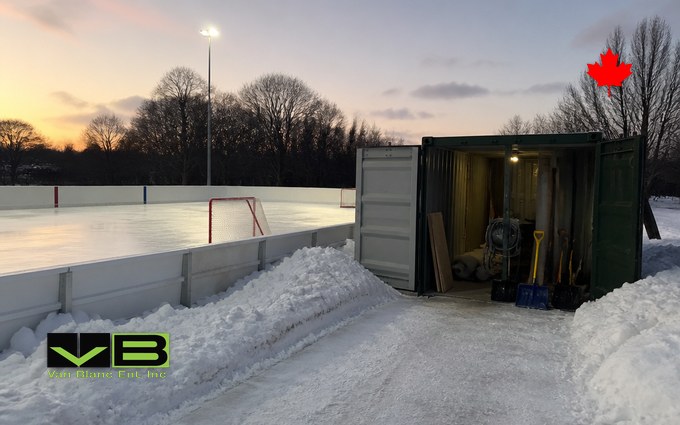
Quick Answer: To build a backyard rink, set level boards, lay a white liner and fill it once the ground freezes. Flood only below -4°C, in thin coats from a nozzle, until two to three inches of ice is down. Store boards, liner and nets dry and locked from March to December.
What This Backyard Rink Guide Covers
- Backyard rink basics
- How do you build a backyard rink?
- When Ontario gets cold enough
- Rink size, slope and site
- Rink boards: lumber, puck board, poly
- Liner or tarp, and why white
- First fill and ice depth
- Flooding the surface
- Snow-base rinks with no liner
- Cracks, shell ice and thaws
- Community outdoor rinks in Ontario
- Spring teardown, piece by piece
- Rink gear storage, March to December
- Loading a 20ft for one rink
- Rink box delivery: Ottawa, Barrie, Kitchener, Guelph
- Buying a box for rink gear
- Backyard rink FAQs
Reading Time: 19 minutes
Backyard Rink Basics
A backyard rink is a sheet of natural ice on a lawn, held in by boards or a snow bank and frozen by winter air. An outdoor rink is the same thing on a bigger scale, built by a town crew or a neighbourhood group in a park. The kit-built version is the liner rink: a frame of boards, a white plastic liner inside it, and water added once the ground freezes. The older method skips the liner. You pack the snow, spray it, and build ice up in thin layers. Both depend on the weather, and both leave a pile of boards, plastic and hose behind when the thaw comes. That last part is where a container yard comes in, and it’s the same off-season problem a winter-and-summer storage plan solves for other gear.
This guide comes from Van Blanc Ent. Inc., the Brantford container business Paul LeBlanc started in 1995 and runs with his son, Christian. Van Blanc sells new one-trip steel boxes and used ones. Rink groups and families keep boards, nets and liners in them between seasons, in whichever storage grade, new one-trip, cargo worthy or wind and watertight, suits the site. The build and flooding advice below comes from people who make ice for a living. They include the City of Toronto’s rink crews, the Town of Innisfil’s parks staff and the City of London’s rink program. The Ontario Minor Hockey Association and RinkMaster, a rink-liner company in Guelph, round out the list.
Christian LeBlanc, second-generation operator, Van Blanc Ent. Inc.: “When a rink group calls about a box, I ask for the length of the longest board. That number picks the size. A 16-foot two-by-ten lies flat in a twenty with room to walk past it, the liner goes in a tote on a shelf, and the nets hang on the wall where nobody steps on them.”
How Do You Build a Backyard Rink?
A backyard rink goes up in a fixed order, and most failures come from doing a step early. The frame can go up in fall. The liner and water wait for winter. RinkMaster’s advice is blunt: set up when winter has arrived to stay. Frost changes container drops too, which a guide to delivering onto frozen ground covers. The steps below follow the makers and municipal crews named in each line.
- Pick a flat, shaded spot close to an outdoor tap, and measure it. The City of London asks for a flat, level surface large enough to lay out the whole rink. Stake the corners and run string, the way you would mark out the spot for a container drop.
- Build and brace the boards. RinkMaster says a wooden frame can go up any time in autumn, which keeps cold-weather work short. Fall is also the easy season for a tilt-deck drop of the box that will hold the gear.
- Wait for frozen ground. Toronto’s instructions say to wait until frost is at least 2 inches into the ground and the forecast stays below -4°C for several days.
- Lay a white liner on a calm day, with helpers carrying it so it never drags across lumber corners.
- Tuck the liner down where the boards meet the ground, so the boards carry the water’s weight.
- Fill. RinkMaster recommends an initial layer, then repeating the fill daily.
- Flood thin coats with a nozzle until there are two to three inches of ice, the depth the OMHA calls ready.
- Shovel after every snowfall and flood again after heavy use.
The sections below take each step apart, with the numbers that decide it. Once the rink is skating, it needs the same off-season thinking curling clubs give their rocks and brooms.
When Ontario Gets Cold Enough
An Ontario backyard rink lives or dies on January. RinkMaster looks for a cold spell of at least a few days with nights well below -5°C and daytime highs below 0°C. Toronto’s program says never to flood when it’s above -4°C, because the water won’t freeze fast enough. Environment and Climate Change Canada’s 1981-2010 climate normals show how much room each region has.
| January at the station | Mean daily temperature | Days with a high at or below 0°C | Nights below -10°C |
|---|---|---|---|
| Ottawa Macdonald-Cartier airport | -10.3°C | 23.7 | 22.7 |
| Barrie WPCC | -7.7°C | 21.0 | 17.0 |
| Waterloo Wellington airport, between Kitchener and Guelph | -6.5°C | 20.7 | 15.1 |
| Brantford MOE | -6.0°C | 18.8 | 14.7 |
Ottawa has the most margin of the four stations. Brantford, where all four Van Blanc yards sit, and Grand River cities such as Kitchener run closer to the line. A rink there gets more freeze-thaw cycles and more patch jobs. Even Ottawa has bad years. In February 2024 a Barrhaven rink volunteer told CBC Ottawa he estimated about 30 skating days that season. He put the year before at about 15.
The long-term picture is mixed, and the studies say so. A 2023 paper in Canadian Geographies by Robert McLeman and colleagues looks ahead. Under current emissions, it projects January will be too mild for outdoor rinks in most winters across much of eastern North America by the 2050s. Looking back, Yao and Fassnacht modelled a rink at Dorset, in south-central Ontario, in 2025. They found no clear trend over four decades from 1978. Build for the winter you get, and keep the gear dry for the next one. Condensation inside a steel box is the storage risk worth planning around.
Rink Size, Slope and Site
Rink size is set by the yard, the slope and the hose. Common backyard frames run 16′ x 32′, 20′ x 40′ and 24′ x 44′, the sizes RinkMaster lists in its liner chart. A level spot saves lumber and water. On a slope, the low end needs taller boards. RinkMaster puts board height at the lowest point at often 8 to 16 inches in sloped yards. Its tube kit levels out up to 8 inches of slope with styrofoam blocks under the frame.
A rink on a lawn also needs a parking spot for its gear once the boards come down. That’s easiest to plan in fall, while a raked gravel pad for a steel box can still go in before the frost. Shade helps the ice itself. Both the OMHA and the City of London point builders to shaded ground, because shade keeps the ice from softening on bright days. Keep the rink close to a water source, and think about where the melt goes in March. London asks volunteers to consider drainage when the ice melts. Toronto’s sheet asks for the water drained and the site made safe.
Rink Boards: Lumber, Puck Board, Poly
Rink boards hold the water in, protect the liner and stop pucks. Backyard boards come in three main kinds, and the choice decides how much there is to store each spring.
| Board type | What it is | Published figures | Off-season pieces |
|---|---|---|---|
| Lumber frame | Treated 2×8 or 2×10 boards on edge, joined end to end and braced at the corners | The Montreal Gazette builder used 2-by-8s joined with one-foot splice blocks; RinkMaster sizes its liner chart off 2×10 lumber | Long boards, splice blocks, stakes and screws, all kept out of the weather in a used box graded for dry storage |
| Lumber with puck board | The same frame faced with white plastic sheets, often with a kickplate strip at the ice line | RinkMaster puck board is 1/4 inch thick in 48 by 16 inch or 48 by 24 inch sheets; its kickplate is six inches high in 50′ rolls | Faced boards, spare sheets, kickplate rolls |
| Bracket or poly steel kit | Steel brackets that hold lumber upright, or ready-made plastic panels on a steel channel | Iron Sleek’s Poly Steel boards are 48 inches wide by 20 inches tall, and its flat steel brackets hold up to 18 inches of water | Panels, brackets, channels, hardware bins |
Lumber is the easiest frame to repair, one board at a time. It keeps straight stored flat on a container’s marine plywood floor instead of leaning on a fence. Puck board makes the rink look like an arena and saves the liner from skates, which is why RinkMaster pairs it with the kickplate. Kits trade lumber-yard trips for matched parts, and Iron Sleek describes its design as easy to store in the off-season. Community rinks go further. Agorasport, a rink-board maker, builds systems for municipalities, schools and homeowners, from modular residential boards up to galvanized steel for permanent arenas.
Brace boards from the outside every few feet, and keep screws and sharp edges off the inside face. RinkMaster’s board advice is to step the height up gradually toward the low end of the yard. A tall low-end board bowing out under water is the classic “blowout”, and a split liner empties the rink overnight. Number each board as it goes up. In March it comes down in order and lies flat in a 20-foot box with a 19’4″ floor.
Liner or Tarp, and Why White
A rink liner is a single sheet of white polyethylene laid inside the boards to hold the water until it freezes. RinkMaster and Iron Sleek both sell 6 mil liners, and RinkMaster describes its 6 mil sheet as 20% thicker than a standard 5 mil liner. White matters. RinkMaster’s FAQ says dark hardware-store tarps soften the ice on sunny days, and that even painted lines and logos can melt holes in it.
A liner must be bigger than the rink. RinkMaster’s rule of thumb is board height plus one foot on all four sides. On a standard 20′ x 40′ frame built from 2×10 lumber, that works out to a 24′ x 45′ liner. A foot too long folds over the boards; a foot short can’t be fixed once the rink is up. The Montreal Gazette’s René Bruemmer ordered his tarp five feet wider and five feet longer than the rink. It lasted four years before it leaked too much. A liner, its boards and the nets are once-a-year gear, the kind stored by season in one steel box.
Liners fail in predictable places. RinkMaster says most tears are skate cuts in spring, when the ice starts to thaw, so stop skating when the surface goes soft. Small holes take light-coloured tape. A liner with multiple tears won’t hold water and needs replacing. Storage is the other risk: RinkMaster warns that a used liner is bulkier once folded, and should be kept where garden tools can’t tear it.
Liner Care Between Seasons
- Lift the liner once the snow is gone, rinse off grit and let both sides dry in the sun.
- Fold it loosely, with no sharp creases at the patched spots.
- Pack it in a lidded tote, away from shovels, rakes and the mower.
- Keep the tote on a shelf off the floor, in a small steel box with room for a shelf or the rink’s main Van Blanc container.
First Fill and Ice Depth
The first fill is where backyard rink advice splits. RinkMaster recommends filling in stages, with one exception: a one-shot fill from a water truck. The OMHA’s tips say the opposite, to fill all at once so the water levels out, since freezing in layers can leave an uneven surface. The Montreal Gazette builder adds a couple of inches at a time. He notes that after a few nights below -10C, the water freezes right through. Pick the method that suits your water supply and the forecast.
Ice depth has a clearer answer. The OMHA says the rink is ready once you have two to three inches of ice. Deeper water takes longer to freeze and pushes harder on the boards. That’s why Iron Sleek rates its brackets in inches of water, and why a sloped yard needs taller boards at its low end. Levelling is the same job for anything heavy on a lawn, and levelling gravel under a container’s four corners follows the same logic. In a RinkMaster photo of a frame set on styrofoam over a slope, the ice was about 6 inches thick.
The hose comes inside every night
Toronto’s sheet warns against leaving a hose outside with the nozzle shut, because it freezes and can take several hours to thaw. Shut the water off, roll the hose up somewhere warm with the nozzle open to drain it, and keep the nozzle with it. The same hose and nozzle go into storage in spring, dry, on a hook beside the man door of the rink’s gear box.
Flooding the Surface
Flooding is the nightly coat that makes rink ice smooth. Toronto’s instruction sheet sets out the method step by step. Start at the far end from the water supply and apply light fogs or spray across the whole surface. Always spray up and outward, never straight down at the ice. Don’t add water until the last coat is completely frozen. If a coat takes more than 15-20 minutes to freeze, the next one should be thinner.
Very cold nights have their own rule. Toronto advises against flooding a good surface at -23°C or colder, because the warmer water cracks the ice. Toronto’s sheet also says to flood with a nozzle only, never an open hose. Hot water is optional. The City of London says cold water works fine, but hot water, if available, gives a better surface. The OMHA’s backyard builders lean the same way. A Van Blanc rink box can be insulated so a heater can keep the hose reel above freezing; ask about it on the quote call.
A rink in regular use needs more flooding than a rink kept for show. RinkMaster’s FAQ puts a well-used rink at a couple of floods per week, plus one after a busy Saturday. A flooder is a pipe that drags a terry cloth behind it. RinkMaster says its FloodMaster gives even water distribution and a bubble-free layer. These tools pile up by the back door all winter. In a rink box, a roll-up door wide enough for the flooder and shovels, where one is cut in, keeps them a few steps away.
Snow-Base Rinks With No Liner
A snow-base rink is the old way: no boards, no liner, only packed snow. The Town of Innisfil’s parks crew says a sturdy base needs at least five centimetres of firmly packed snow. Unpacked snow gives soft, lumpy ice and collapsing sections. Snow left over makes the perimeter wall, sealed against leaks.
With no snow on the ground, Innisfil’s advice is to wait for frost at least five centimetres into the ground and a forecast below -4°C. That typically takes seven to 10 consecutive days at -10°C or colder. Large amounts of water draw frost out of the ground and soak in, so the first coats are light. Innisfil also notes that if a coat takes more than 15 minutes to freeze, the next flood should be smaller. The Montreal Gazette’s writer says snow rinks work but disappear in a thaw, while a liner rink holds its water and refreezes. On a farm field or a cottage lot, a snow rink and a container brought down a rural lane can share the same open ground.
Cracks, Shell Ice and Thaws
Rink damage is repaired with the rink’s own materials. Innisfil’s crew fixes shell ice, an air pocket just under the surface, along with cracks, chips and holes the same way. Clean them out and pack them with a slush of snow and water. Level it with a shovel, sprinkle it lightly and block off the patch until it freezes.
Thaws are harder. Snow left on the ice melts into bumps, so the OMHA says to clear it after every snowfall. During a long mild spell, stay off the soft ice to protect the liner, and watch where the runoff goes. Toronto’s program warns never to leave a hose running into a ditch, because ice built there can flood the area in a thaw. Snow cleared off the ice piles up beside whatever stands next to the rink. How much snow a container roof carries is covered on its own page. When a thaw ends the season, the teardown starts.
Community Outdoor Rinks in Ontario
Ontario’s community outdoor rinks run on volunteers, and each city sets its own program. In February 2024, CBC Ottawa reported that the City supported 260 outdoor rinks, most built and maintained by more than 1,000 community volunteers. One Barrhaven rink lead told CBC a typical season runs from the week before New Year’s Eve to March Break. Containers for sale in Ottawa reach those community associations from Brantford, and the Ottawa row in the delivery table below gives the lead time.
London’s program is written out in detail. Its neighbourhood-managed rinks are natural ice, generally open January to March, and each needs at least 6 dedicated volunteers aged 18 or older. Volunteers supply their own perimeter boards and tarp or liner where they want them, and the City provides a hose, nozzle, shovels and garbage bins. Applications for the 2026/2027 season close on November 1, 2026. The guide also lists storage among a group’s needs. It asks for space to store the ice-making equipment and supplies, with a heated area best but not necessary. A rink group asking its city for a permanent box in a park can start with new one-trip steel in clean factory paint.
Toronto runs a Community Natural Ice Rink Program, the source of the flooding sheet quoted here. Rink groups across Toronto’s parks get delivery in 1 to 3 days. Smaller towns build their own, and Innisfil’s staff told InnisfilToday that its Town Square and Cookstown surfaces use refrigeration. Across these programs, one thing is constant. The boards, the liner and the tools belong to a volunteer group with no arena behind it. Keeping a volunteer group’s event gear locked between uses is the same problem in a different season.
Spring Teardown, Piece by Piece
A backyard rink comes down when the ice goes soft, and the order matters for next year. RinkMaster says the rink does no harm to the grass, as long as the liner comes off in spring once the snow has melted. Here is a teardown order built from the makers’ care advice.
- Stop skating once the surface softens; spring skate cuts are the main cause of liner tears.
- Let the ice melt and drain toward a safe spot, then lift the liner before the grass yellows under it.
- Rinse and dry the liner fully before folding it, since a damp liner adds to the moisture that makes a steel box sweat. RinkMaster says a used liner folds bulkier than a new one.
- Patch small holes now with light-coloured tape, while you can see them.
- Unscrew boards, number them by position and bundle the hardware in one bin.
- Drain and coil hoses, and dry the nozzle and flooder cloth.
- Take down the backstop netting and its 4×4 posts before the spring winds.
Every item on that list then needs a dry, locked place for about nine months, and that’s the gap a Van Blanc box fills. Without one spot, the gear gets split between a garage wall, a shed and a basement. A community rink’s gear can sit in one volunteer’s garage, which works until that volunteer moves. A public works yard faces the same problem, covered in containers for a municipality’s seasonal gear.
Rink Gear Storage, March to December
Rink gear storage is the step after teardown, and the City of London’s guide lists storage space among the things a rink site should have. It’s where a shipping container fits. A shipping container is a steel box with a wood floor and lockable cargo doors at one end. It sits on gravel by the rink, in the park or at the edge of the yard. It holds everything from the teardown list until December. Van Blanc sells containers outright and delivers them from our 4 Brantford yards. The vents, lockboxes and extra doors to ask about are listed on their own page.
As a rule of thumb, one community rink fills one box. The 20ft dry container we sell most measures 19’4″ long, 7’8″ wide and 7’10” high inside. It holds 1,172 cubic feet and gives about 148 square feet of floor. That length matters for rinks. A 16-foot board lies flat on the floor, the way Christian describes it, with no cutting.
A family rink with a 20′ x 40′ frame of 8-foot boards packs smaller. A 10ft that takes a family rink’s boards holds about 560 cubic feet. Its footprint is 8 ft x 10 ft, half a parking stall. Those are rules of thumb, so measure the longest piece first. Neighbours with backyard rinks on the same street can also share one box.
Loading a 20ft for One Rink
A rink box works best packed in the order it comes out in December. The table is a guide built from the makers’ published sizes and the 20ft’s inside dimensions on Van Blanc’s product page.
| Where in the 20ft | What goes there | Sizes to plan around |
|---|---|---|
| Floor, along one wall | Lumber boards, puck-board panels, splice blocks | Boards up to 16 ft lie flat in a 19’4″ floor; Iron Sleek panels are 48 inches by 20 inches |
| Shelf at the back wall | Liner in a lidded tote, patch tape, kickplate rolls | A 24′ x 45′ liner for a 20′ x 40′ rink, folded dry and kept dry by vents that stop drips from roof condensation; kickplate in 50-foot lengths |
| Wall hooks | Pond nets, backstop netting, hoses | RinkMaster’s steel pond net weighs 25 lbs; netting comes as large as 10′ x 30′ |
| Near the doors | Shovels, scrapers, flooder, nozzle, lights, daily log | The first items out when the frost comes back |
Two details keep the gear in shape. Vents let damp air out, which matters for a folded liner and wood boards. Our 10ft product page notes that on spring and fall nights the steel cools faster than the air inside, and condensation forms on the roof. And the doors should face the rink, so a placement mark with a cone at the door end is worth setting before the truck arrives. A plain steel box follows the outside temperature, so it suits boards, liners, nets and dry tools. If a group wants London’s heated area for hoses, ask Van Blanc about an insulated box on the quote call. A licensed electrician makes any power connection on site.
Grades for a Rink Box
Van Blanc sells four grades, and three of them are storage grades for a rink box. New (one-trip) has made a single loaded voyage from the factory and arrives with clean paint. It suits a box that sits in a park or in view of the house all summer. Cargo worthy is used steel re-inspected for more shipping, used 8 to 15 years. Wind and watertight is used 12+ years, and keeps weather and rodents out. As-is units have declared floor, frame or door questions and sell as project or donor boxes. Van Blanc’s used rows, graded cargo worthy, wind and watertight or as-is, list each box by grade. The as-is rows are donor stock, sold for cut-and-weld builds. To compare every size and grade from new to as-is on one page, start there before calling.
Lock and Doors
A rink box in a public park needs a lock that a pair of bolt cutters can’t reach. A steel shroud that hides the padlock covers that, and Van Blanc can quote one with the box. For the nightly shovel run, a steel man door cut into the side wall beats swinging the full cargo doors in a snowbank. The cargo doors can then stay shut until March.
Pricing a Box for the Rink Gear
Tell us the longest board, how many rinks share the box, whether it sits in a park or a backyard, and the delivery postal code. We’ll say which sizes are on the ground and send one all-in number. Every quote comes with a real lead time, not a hopeful one. The fastest answer is a phone call.
Family-run in Brantford since 1995 · four Brantford yards · 4.9★ across 140+ Google reviews.
Rink Box Delivery: Ottawa, Barrie, Kitchener, Guelph
Van Blanc delivers rink boxes across Ontario from our 4 Brantford yards. Most of the province gets 1 to 3 days, Eastern Ontario runs such as Ottawa included. Fall is the easy window, before the rink goes in and before the ground freezes hard. The table gives road distance and drive time from east Brantford to each city hall.
| Where the box lands | By road from east Brantford | Drive time | Delivery window |
|---|---|---|---|
| Kitchener City Hall | 49.0 km | 56 min | 1 to 3 days |
| Guelph City Hall | 50.7 km | 60 min | 1 to 3 days |
| Barrie City Hall | 178.1 km | 131 min | 1 to 3 days |
| Ottawa City Hall | 549.8 km | 388 min | 1 to 3 days |
Rink families in Waterloo Region can look over the boxes we sell into Kitchener and its suburbs. In the Royal City, home of RinkMaster, Guelph buyers’ size and grade list covers the 10ft and 20ft. North on Highway 400, containers sold to Barrie and the Lake Simcoe shore cover the city, and the same trucks reach the rinks around Innisfil. A delivery booked after New Year’s lands on frozen ground. What a January delivery onto frozen soil involves is explained separately.
Buying a Box for Rink Gear
Van Blanc Ent. Inc. sells every container outright, so the box belongs to the rink group or the family for as many seasons as the rink runs. Each unit can be picked by container number on a visit to the rows or on a video call. Walking the rows before you buy lets the rink group check the floor and doors first. A Van Blanc quote puts the box, any lockbox, vents or man door, and delivery into one all-in figure. Stock moves, so call 519-754-6844 for what’s on the ground this week, and book the drop before the frame goes up in November.
Backyard Rink FAQs
How deep should a backyard rink be?
The OMHA says a backyard rink is ready once it has two to three inches of ice. Build it in thin layers or a single fill, depending on your water supply. On a sloped yard the low end runs deeper, so the boards there must be taller and well braced. Iron Sleek rates its steel brackets for up to 18 inches of water.
How much does it cost to build a DIY backyard rink?
The cost of a DIY rink moves with its size, the board type and the liner. A lumber frame, a puck-board face and a poly steel kit each sit at a different level. A white 6 mil liner is replaced once it has several tears. Water and a flooder add to it. Price the frame and liner for your exact size first.
What are the boards called in a hockey rink?
The boards around a hockey rink are called dasher boards. In a backyard they are usually treated lumber on edge, sometimes faced with white plastic puck board and a kickplate at the ice line. Community rinks can use modular board systems from makers such as Agorasport, which also builds aluminum and galvanized steel systems for arenas.
What to use for rink boards?
Treated 2×8 or 2×10 lumber on edge is the standard backyard board, braced from the outside. Facing it with 1/4 inch puck board takes shots and protects the liner. Bracket kits hold lumber upright with steel, and poly steel panels replace lumber entirely. Step the height up toward the low end of a sloped yard.
What temperature do you need to flood an outdoor rink?
Toronto’s natural rink program says never to flood above -4°C, and to wait for frozen ground and several days below that before the first flood. RinkMaster looks for nights well below -5°C and highs below freezing. On nights of -23°C or colder, Toronto advises against flooding a good surface, because warm water cracks it.
How can I make my own hockey rink in my backyard?
Build a level, braced frame in fall and lay a white liner once the ground freezes. Fill and flood in cold weather until there are two to three inches of ice. Add puck board and a kickplate for the hockey feel, steel pond nets, and backstop netting behind each goal. In spring, dry and store everything locked.
Where do you store rink boards and a liner over the summer?
Somewhere dry, locked and off the ground, with the liner folded dry in a lidded tote away from garden tools. Families use a garage wall or shed. A community rink can keep a steel container beside the rink, where a 20ft takes 16-foot boards flat. Van Blanc delivers 10ft and 20ft boxes from our 4 Brantford yards.
Sources
- City of Toronto. Community Natural Ice Rink Program: Ice Preparation Instruction. City of Toronto Natural Ice Rink Flooding Instructions (PDF). Checked October 2026.
- City of London. Neighbourhood-Managed Ice Rinks and Neighbourhood-Managed Ice Rink Guide. City of London Neighbourhood-Managed Ice Rink Guide. Checked October 2026.
- InnisfilToday. Outdoor rink 101: Your guide to building a solid sheet of ice, with Town of Innisfil parks staff. InnisfilToday Outdoor Rink 101. Checked October 2026.
- CBC News Ottawa. (2024). Outdoor rinks facing another abnormally short season. CBC Ottawa Outdoor Rinks Short Season. Checked October 2026.
- Ontario Minor Hockey Association. (2023). The Do’s and Don’ts of Backyard Rink Building. OMHA Backyard Rink Building. Checked October 2026.
- RinkMaster. Ice Rink Liners, Puck Board, FAQ and Dealing with a Sloped Yard. RinkMaster Rink Building FAQ. Checked October 2026.
- Iron Sleek. Poly Steel Rink Boards and Flat Steel Brackets. Iron Sleek Canada Rink Boards. Checked October 2026.
- Bruemmer, R. Montreal Gazette. (2015, updated 2020). How to build a skating rink. Montreal Gazette How to Build a Skating Rink. Checked October 2026.
- Agorasport. Rink Boards. Agorasport Rink Board Systems. Checked October 2026.
- Environment and Climate Change Canada. Canadian Climate Normals 1981-2010, January values for Ottawa Macdonald-Cartier, Barrie WPCC, Waterloo Wellington and Brantford MOE. ECCC Climate Normals Data Collection. Checked October 2026.
- Yao, H. and Fassnacht, S. R. (2025). Outdoor Ice Rinks in Ontario, Canada: An Oversimplified Model for Ice Water Equivalent and Operational Duration to Evaluate Changing Climate. Hydrology 12(10), 263. Hydrology Ontario Outdoor Ice Rink Model. Checked October 2026.
- McLeman, R., Golian, S., Murphy, C. and Robertson, C. (2023). Future prospects for backyard skating rinks look bleak in a warming climate. Canadian Geographies 68(2). Canadian Geographies Backyard Skating Rinks Study. Checked October 2026.
- Project OSRM. Open Source Routing Machine demo server, driving routes from 43.1525,-80.2370 to the Kitchener, Guelph, Barrie and Ottawa city halls. OSRM Driving Route, Brantford to Ottawa City Hall. Checked October 2026.
Rink Gear Boxes, Sold From Brantford
We have been supplying shipping containers across Ontario since 1995. Our office is at 90 Morton Avenue East in Brantford. All four of our yards are in Brantford, and every box is paid for on arrival.
Van Blanc Ent. Inc., 90 Morton Ave E Unit 1B, Brantford, ON N3R 7J7, 519-754-6844.
Measure the longest board and count the nets before you call, and tell us whether the box goes in a park or a backyard. We’ll say on the phone which size fits and when it can land. Worth the drive for unbeatable quality, family customer service with 30 years of experience.