
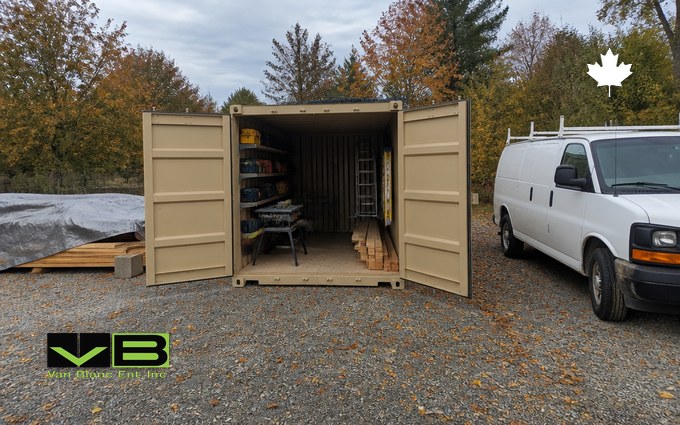
Quick Answer: To start a construction company in Ontario, choose a structure, register the name, then set up the CRA business number, GST/HST, WSIB and insurance. In construction, WSIB coverage usually extends to the owners themselves. A Van Blanc 20ft or 40ft container becomes the company’s first contractor yard and site lockup.
Inside This Contractor Startup Guide
- How Do You Start a Construction Company in Ontario?
- Construction Business Plan and Funding
- Construction Company Structures in Ontario
- Company Name, BIN and Business Number
- HST Registration and the Small Supplier Test
- Construction Owners and WSIB
- Contractor Insurance Beyond WSIB
- Contractor Licences in Ontario
- Construction Act Payment Clock
- First Hires: Payroll, Posters, Training
- Contractor Yard in One or Two Containers
- Sizing the First Box: 20ft or 40ft
- Site Lockup on the First Jobs
- Picking a Grade: New, Used or As-Is
- Delivery to Toronto, Brampton, Ajax and Ottawa
- Paying for the First Box
- Startup Checklist for the First Year
- FAQs
Reading Time: 18 minutes
How Do You Start a Construction Company in Ontario?
A construction company is a business that builds, renovates or repairs structures for paying clients. It works as the general contractor or as a trade under one. In Ontario, starting one means a handful of provincial and federal registrations before the first invoice goes out. Van Blanc Ent. Inc., a family firm selling shipping containers since 1995, works out of 4 Brantford yards. For a look at a working trade’s storage, see a licensed electrician’s van-and-box setup. This guide covers how to start a construction company first, and the steel box last.
The Government of Ontario publishes its own 10 steps for starting any business, from market research to funding. A construction company follows the same path with a few extra stops. Here is a workable order for a new contractor:
- Pick the work: residential renovation, new homes, commercial fit-outs, or a trade you subcontract to builders.
- Choose one of Ontario’s four types of business structure.
- Register the name through the Ontario Business Registry, if it differs from your own.
- Get a CRA business number, then the GST/HST and payroll accounts you need.
- Register with WSIB, which in construction usually covers the owner too.
- Buy liability and tools insurance before the first job.
- Check licences for your trade and for new-home building.
- Set up invoicing that meets the Construction Act’s payment rules.
- Hire, with payroll deductions, the ESA poster and safety training in place.
- Give the tools and materials a locked home: the contractor yard, with shelving, vents and a lockbox on the options list.
Most sections below take one step and report what the authority itself says. Christian LeBlanc, who works our yards with his father Paul, puts the tenth step this way.
Christian LeBlanc, Van Blanc Ent. Inc.: “Most new contractors call us once the garage is full and the truck has turned into a rolling shed. Put the shelving down one wall, keep the door end clear, and the compressor is out in a minute on Monday.”
Construction Business Plan and Funding
A construction business plan sets out what the company builds, for whom, and how it pays its way until the invoices clear. Ontario’s guide describes a business plan as your idea, your short and long-term goals and the resources you have to start. It points owners to their local Small Business Enterprise Centre for help, and to BDC and Futurpreneur for sample plans.
For a contractor, three parts of the plan carry most of the weight:
- The work and the client: renovation for homeowners, commercial fit-outs, or subcontracting to builders, like the trades on subdivision sites going up around Ajax. Each brings different insurance, licences and payment terms.
- Cash flow: the Construction Act’s payment clock and holdback, covered below, decide when money arrives after the work is done.
- Equipment and storage: what you own on day one, what you buy as jobs come in, and where it all lives between jobs. Shelving anchored to a container’s ribs and corner posts is worth planning before the first purchase.
Ontario’s guide also lists help for the start. The Starter Company Plus program offers training, mentoring and a grant, and Pro Bono Ontario gives free legal advice to small businesses. Your bank can walk you through its own start-up tools. Put the first Van Blanc box in the plan as a line item. The plain-language walk-through for small firms buying their first container covers that purchase from the owner’s desk.
Marketing comes last on most checklists and first in practice. Put the registered name on the truck, the trailer and a yard box in new steel painted in the company colours. That lettering advertises every day the crew is on a street.
Construction Company Structures in Ontario
Ontario’s start-a-business guide lists four types of business structure: sole proprietorship, partnership, corporation and co-operative. The choice decides who carries the debts, how income is taxed and what you file each year.
| Structure | Who owns it | What the Ontario guide flags |
|---|---|---|
| Sole proprietorship | One person | Easiest to set up; the owner is responsible for all debts, and creditors can reach personal assets |
| Partnership | Two or more people | Partners share costs and skills, and all partners are responsible for all debts |
| Corporation | A separate legal entity | Limited liability, easier access to capital, more complex tax rules and annual filings |
| Co-operative | Its members | One member, one vote; slower decisions |
A sole proprietor can incorporate later, as the Ontario guide notes. It also tells owners to consult a lawyer or professional advisor before incorporating. The structure changes WSIB’s answer for the owner too.
Whatever you choose, keep the company’s tools and equipment on the company’s books from the first purchase. The trailer, the compressor and a twenty-foot Van Blanc box with its serial number on the invoice all belong on the asset list.
Company Name, BIN and Business Number
Under Ontario’s Business Names Act, an individual who trades under any name other than their own must register that name. Partners must register the firm name, and a corporation must register any name other than its corporate name. A trade name like “Smith Renovations” needs registering.
Once you register through the Ontario Business Registry, ServiceOntario issues a 9-digit Ontario Business Identification Number, the BIN. A corporation using a word name also needs an Ontario-biased Nuans name search report first. The Act makes a name registration effective for five years. A late renewal is still allowed within 60 days after it expires.
The BIN is a provincial number. The Canada Revenue Agency issues a separate business number, the BN. The CRA says an unincorporated business needs a BN only when it registers for a program account, such as GST/HST or payroll. When you incorporate in Ontario, the BN comes with the incorporation.
A company name painted on a one-trip unit fresh off its only voyage from Van Blanc looks like a business that plans to stay.
HST Registration and the Small Supplier Test
GST/HST registration turns on the CRA’s small supplier test. A business stops being a small supplier when its taxable sales pass the CRA’s threshold in a single calendar quarter. It also stops when sales pass the threshold over the previous four consecutive calendar quarters. The CRA page carries the current figure.
The CRA sets the timing for each case:
- Over the threshold in a single quarter: your effective date of registration is no later than the day of the sale that took you over. You charge GST/HST on that sale.
- Over the threshold across four quarters: your effective date is no later than the day of the first sale after you stopped being a small supplier.
- In both cases you have to register within 29 days of your effective date of registration.
Below the threshold, the CRA lets a business register voluntarily. Builders and commercial clients may want a GST/HST number on the invoice, for a Hamilton basement or an office fit-out in Ottawa. Ask your accountant which route suits your first year.
Keep the receipts from day one, including the one for the yard box. A cargo worthy or wind and watertight box from our used rows is equipment on the company’s books. The invoice Van Blanc supplies carries the grade and the container number.
Construction Owners and WSIB
WSIB is Ontario’s workplace insurance board. A business that must register has 10 calendar days from the day it hires its first employee. WSIB lists construction among the industries that must register, and its construction rules reach further.
WSIB’s construction FAQ says people who own or run a business in construction, with or without employees, must have coverage and register, with some exceptions. WSIB calls this expanded compulsory coverage.
WSIB lists two narrow exceptions.
- Home renovation only: individuals, partnerships or corporations doing home renovation work only, hired and paid directly by the homeowner or resident, are exempt. If that business has employees, it must still register to insure them.
- One executive officer or one partner may apply for an exemption, but only if that person does no construction work. Occasional site visits are allowed.
A renovator whose book is mostly homeowner work, such as kitchen and basement jobs in Toronto houses, should ask WSIB about the home renovation exemption by name.
WSIB also defines the independent operator in construction. It is someone who performs or manages Class G construction work and has no employees. They work as a contractor or subcontractor for more than one person during an 18-month period. They also report as self-employed to a government agency such as the CRA. Your classification and premium are WSIB’s call, so phone them before the first job.
Clearance Certificates on Every Job
Under WSIB policy 14-02-19, a contractor must not perform construction work for a principal without a clearance. The principal must obtain one before the contractor begins. A clearance is valid for up to 90 calendar days, depending on the issue date, and it is renewable. Principals and contractors must keep records of clearances for at least three years.
In practice, a new company is on both sides of this. The builder asks you for a clearance, and you ask each sub for theirs. Subs will also want a site box wired to the temporary service for charging. A sign-out sheet on its door keeps company tools and theirs from mixing.
Contractor Insurance Beyond WSIB
WSIB covers workplace injury. It does not cover damage your crew does to a client’s house, or the tools stolen from your truck. That is the job of private insurance.
The Ontario guide says business insurance isn’t mandatory but is highly recommended. It suggests getting at least 3 quotes from a local agent or broker. The Insurance Bureau of Canada lists commercial general liability, known as CGL, among the common commercial policies. Apollo Cover’s contractor guide adds these to the list:
- Commercial general liability, for injury or damage to other people and their property.
- Tools and equipment insurance, for the kit itself.
- Builder’s risk, for a building while it is under construction.
- Professional liability and pollution liability, for firms whose work calls for them.
Tell the broker where the tools spend the night. A locked steel box on your own lot is a good answer. Ask about a welded lockbox shrouding the padlock, and a hidden-shackle puck lock on the cargo doors completes the setup.
A builder or commercial client may also set insurance minimums in the contract, and some licences require coverage too. ESA, for example, makes public liability and property damage coverage a condition of an electrical contractor licence.
Contractor Licences in Ontario
Licensing depends on the work. Ontario’s start-a-business guide sends owners to BizPaL, a free online tool that filters federal, provincial and municipal licences and permits by location, industry and activity.
Some trades carry their own licence rules:
- Electrical work: ESA states that in Ontario only electrical contractors licensed by ESA may do electrical work for hire. A licensed contractor must be a Master Electrician or employ one at all times.
- Compulsory trades: Skilled Trades Ontario lists 23 compulsory trades, including plumber and electrician. To work in one, a person must hold a valid Certificate of Qualification, a Provisional Certificate of Qualification or a Registered Training Agreement.
Licensed trades carry a different stock profile from framers. Van Blanc’s trade guides show how an ESA-licensed shop racks wire spools inside a container. A crew that keeps long stock can borrow the arm-and-column racking that lumber yards use inside a twenty or a forty.
Builders, Renovators and the HCRA
New homes are their own category. The Home Construction Regulatory Authority says every builder and seller of new homes in Ontario must be licensed by the HCRA. A builder who also sells must hold a builder/vendor licence. The HCRA adds that renovations or upgrades to an existing home do not make the home new. That work does not need an HCRA licence.
So a renovator and a new-home builder start from different places. A licensed builder working new subdivisions on Brampton’s northern edge answers to the HCRA; a renovator on the next street does not. The HCRA also tells buyers to confirm a new home is enrolled in Tarion’s warranty plan.
Construction Act Payment Clock
Ontario’s Construction Act sets a payment clock that new owners should build their invoicing around. An owner must pay a proper invoice no later than 28 days after receiving it. An owner who disputes it must give a notice of non-payment no later than 14 days after receipt.
The clock runs down the chain. A contractor who is paid in full must pay each subcontractor, whose work was in that invoice, no later than seven days after receiving payment. Each payer must also retain a holdback equal to 10 per cent of the price of the services or materials supplied. That holdback stays until the lien rights against it have expired or been dealt with.
Two things follow for a start-up. Cash arrives later than the work, so plan for it. Time big purchases, from the trailer to a forty-foot yard box for bought-ahead stock, around that clock. And the invoice has to qualify as a “proper invoice” under the Act, so get your template checked before the first job. A lawyer who works with contractors can review it.
T5018 Slips for Subcontractors
The CRA runs a contract payment reporting system for construction. A business must issue T5018 slips when more than 50% of its business income comes from construction activities. The obligation covers payments to Canadian-resident subcontractors for construction services above the CRA’s minimum total for the year. Your bookkeeper should tag every subcontractor payment from the first job. A firm that buys for several sites at once can also read the contractor’s case for ordering site boxes as a batch.
First Hires: Payroll, Posters, Training
The first employee brings a short list of new obligations. Each comes from a different authority.
- Payroll account. The CRA says you have to register for a payroll account before your first remittance due date. That date is usually the 15th day of the month after the month you began withholding deductions.
- The ESA poster. Ontario requires employers to give each employee covered by the Employment Standards Act a copy of the current poster within 30 days of the person starting. Employers with 25 or more employees must also give new hires written job information before their first day, or as soon after as is reasonably possible.
- Workplace posters. Workplaces covered by the Occupational Health and Safety Act must post the Prevention Starts Here poster and a copy of the Act. WSIB’s “In case of injury” poster, Form 82, must be displayed prominently.
- WSIB. Register within 10 calendar days of the first hire if you have not already, as above.
Show each new hire where the first-aid kit, the harnesses and a rated extinguisher mounted inside the site box are kept on day one.
Working at Heights and Awareness Training
Ontario Regulation 297/13 sets two training rules that matter on day one. Every worker must complete basic health and safety awareness training as soon as practicable. A supervisor must complete the supervisor version within one week of starting to supervise.
Working at heights training applies to construction workers who may use certain fall protection. The regulation lists six methods: travel restraint, fall restricting, fall arrest, a safety net, a work belt or a safety belt. The program must be approved by the Chief Prevention Officer. The training is valid for three years from the date the worker completes it, and the employer keeps the record. Hang harnesses and lanyards on wall-mounted racks along the inside of the box, where they stay dry and visible.
The Occupational Health and Safety Act also defines the “constructor” as the person who undertakes a project for an owner. On your own jobs, that is often you. Learn what the role carries before you take a project where no general contractor sits above you.
Contractor Yard in One or Two Containers
A contractor yard is the place a construction company keeps its tools, materials and small equipment between jobs. An established firm may run a shop with a fenced lot. A new contractor can start smaller: a container or two on their own property, a family member’s lot or a corner of an industrial yard.
A shipping container suits a first yard because it arrives finished. It lands on a pad, the doors lock, and it holds tools the same afternoon. Van Blanc sells them outright from our 4 Brantford yards, and the full list of every size and grade we stock puts the options side by side. If the company moves to a bigger yard later, the box can go with it.
Two sizes do most of the work for a new company. The standard 20ft’s full door and floor measurements suit a renovator’s tool inventory. A forty adds room for materials bought ahead and for long stock.
Tools that used to ride in the truck move into the box, and the truck carries only the day’s kit. A typical first-yard list from a renovator looks like this:
- Saws, the compressor, nailers, the generator and the shop vac.
- Ladders and staging planks, hung on one long wall.
- Leftover tile, trim, drywall and paint from finished jobs, for touch-ups and callbacks.
- Fasteners, adhesives and consumables in labelled bins.
- Safety gear: harnesses, hard hats, the first-aid kit and the fall protection that the training above covers.
Shelving goes down one wall and long stock down the other. Cantilever arms that hold lumber and pipe off the floor keep the centre aisle clear. Keep fuel cans and propane cylinders out of the closed box.
Sizing the First Box: 20ft or 40ft
A 20ft shipping container is the standard short box, about 148 square feet of floor inside. A 40ft has the same width and height at about twice the length. These figures come from Van Blanc’s own product pages, including the forty’s floor rating and every inside measurement.
| Measurement | 20ft standard | 40ft standard |
|---|---|---|
| Inside length | 19 ft 4 in (5.898 m) | 39 ft 5 in (12.029 m) |
| Inside width | 7 ft 8 in (2.352 m) | 7 ft 8 in (2.350 m) |
| Inside height | 7 ft 10 in (2.385 m) | 7 ft 10 in (2.385 m) |
| Door opening | 2.343 by 2.280 m (7 ft 8 in wide, 7 ft 5 in high) | 2.340 by 2.280 m (same in feet and inches) |
| Volume | 1,172 cu ft (33.2 m³) | 2,390 cu ft (67.7 m³) |
| Empty weight | 2,260 kg | 3,780 kg |
| 48 by 40 inch pallets, one layer | 11 | 20 to 21 |
As a rule of thumb, a 20ft usually suits a renovator or a single trade with one or two trucks. It holds the tool inventory and a modest stock of leftovers. A 40ft usually suits a general contractor who buys materials ahead for several jobs. It also suits a firm that keeps staging, scaffold frames or a small machine inside.
Lay the stock out on the garage floor first, then measure it. Sketching where each pallet and rack will go turns that floor into a size. The door height of 7 ft 5 in is the number to check for anything on wheels.
Site Lockup on the First Jobs
A site lockup is the locked storage a contractor leaves on a job while the work runs. On a renovation, it might sit on the client’s driveway. On a new build, it sits inside the fence. The box keeps tools and delivered materials dry and locked overnight, so the crew does not haul everything home each evening.
One Van Blanc box can serve as either, depending on the season and the job. A site box that doubles as a charging station needs power. A temporary service mast feeding the site box covers lights and chargers.
The ground under it matters on any lot. A level pad of compacted stone at the four corners keeps the doors square. On a client’s property, get the spot agreed in writing before the truck arrives.
As a rule of thumb, a new contracting company plans for one to three boxes in its first couple of years. A common progression looks like this:
| Stage | Boxes | Typical setup |
|---|---|---|
| First year, one crew | 1 | A 20ft at home or at a shared lot, doubling as the site box on long jobs |
| Two crews or two sites | 2 | One yard box at home base; a second 20ft at the job site |
| Materials bought ahead | 2 to 3 | A 40ft for stock at the yard, plus 20ft site boxes |
Treat the table as a starting point for the conversation. A firm planning several site boxes in one season can read how contractors structure a multi-box order across several sites before it calls.
Your First Yard Box, Quoted
Tell us what the company does, where the box will sit and what goes inside. A call is the fastest way. We will tell you twenty or forty, which grade and which doors, with one all-in number and a real lead time.
Family-run in Brantford since 1995 · 4.9★ across 140+ Google reviews
Picking a Grade: New, Used or As-Is
Container grade describes the box’s condition and history, and the buyer chooses it. Van Blanc sells four grades, and you can walk the rows and open the doors before you pay. Our product pages describe them this way:
| Grade | What it is | Where contractors use it |
|---|---|---|
| New (one-trip) | Made one loaded voyage from the factory; factory paint, minor handling marks possible | Branded yard box seen from the road, a box that gets an office or a workshop fit-out |
| Cargo worthy (CW) | Used 8 to 15 years; CSC re-certified; surface rust on the outside | Working yard storage and site lockup |
| Wind and watertight (WWT) | Used 12+ years; roof and floor sealed; CSC may be expired; heavier exterior rust | Stationary storage at the yard |
| As-is | Older boxes with problems in the floor, frame or doors | Donor and scrap stock for builds |
The years in that table are the box’s age, not its remaining life. A one-trip box has the longest service life ahead of it and holds its resale value best. A used box has the same inside dimensions as a new one of the same size. Walk Van Blanc’s graded used stock, row by row, to see the paint and rust before you choose.
Roll-up doors, man doors, vents, shelving and lockboxes appear on the options list for doors and add-ons. Ask about them when you call for the quote.
Delivery to Toronto, Brampton, Ajax and Ottawa
Van Blanc delivers across Ontario from our 4 Brantford yards. Most runs take 1-3 days, Eastern Ontario runs such as Ottawa included. Every quote comes with a real lead time, not a hopeful one.
| Where the first jobs are | Delivery window |
|---|---|
| Toronto | 1-3 days |
| Brampton | 1-3 days |
| Ajax and Durham | 1-3 days |
| Ottawa | 1-3 days |
A renovator taking on semi-detached and laneway jobs across Toronto may need the box on a client’s driveway, so measure the approach first. On the warehouse and subdivision sites around Brampton, ask the site super where the box can sit inside the fence. The same 1-3 day window covers basement and addition work across Ajax. For a new contracting firm based in the Ottawa area, book a little earlier for the longer run.
The truck needs room to tilt the deck and pull away. The open ground a tilt-deck needs to set a box down is the check to make first. How the deck slides a box onto its pad shows the drop itself. Permits are managed by your municipality, so check with your local building or planning department before you order.
Paying for the First Box
Van Blanc sells containers outright. We accept draft cheque, cash and wire transfer, and credit cards through an authorization form. A new company that wants to spread the cost can do it through its own bank or an equipment lender. Van Blanc’s invoice lists the grade and the container number, which is what a lender usually wants to see.
Walk the yard, or ask for a video call that shows the box and its container number. Treat a listing priced far under every Ontario yard, with a deposit demanded up front, as the scam pattern Van Blanc warns buyers about. The paperwork checks to run before any money moves apply to any seller, us included.
Visiting in person is easy to arrange. Seeing the steel in a yard instead of a listing photo answers first-time questions on the spot.
Startup Checklist for the First Year
- Decide the work and the structure; book a lawyer if you will incorporate.
- Register the name in the Ontario Business Registry and note the BIN.
- Get the CRA business number; add GST/HST, voluntarily if you are under the threshold.
- Call WSIB about your classification and register before the first job.
- Collect at least 3 insurance quotes covering liability and tools.
- Run the business through BizPaL and check any trade licence.
- Have the invoice template checked against the Construction Act.
- Ask every sub for a WSIB clearance and set up T5018 tracking.
- Before the first hire: payroll account, ESA poster, awareness and working at heights training.
- Lay out the tools on a floor, then order the yard box that fits them, starting from a single twenty sized for one crew’s tools.
Call Van Blanc at 519-754-6844 with the company’s address and the tool list. You’ll get a size, a grade and a delivery date back, usually the same day.
Frequently Asked Questions
How do I start a construction company in Canada?
Choose a business structure, register the name in your province, and get a CRA business number with GST/HST and payroll accounts. Then sort out workplace insurance, liability insurance and any trade licence. In Ontario that means the Ontario Business Registry, WSIB and BizPaL. Provincial rules differ, so check your province’s own registry and workers’ compensation board.
Do I need a licence to be a general contractor in Ontario?
It depends on the work. Builders and sellers of new homes must be licensed by the HCRA, and renovations to existing homes do not need that licence. Electrical work for hire needs an ESA electrical contractor licence, and the 23 compulsory trades need certified workers. BizPaL lists the licences and permits for your location and activity.
Does a one-person construction company need WSIB in Ontario?
Usually, yes. WSIB says people who own or run a construction business, with or without employees, must have coverage, with some exceptions. One exception covers home renovation work only, paid directly by the homeowner or resident. Call WSIB to confirm your classification before the first job.
How do I start an incorporated business in Ontario?
Incorporate through the Ontario Business Registry, or federally through Corporations Canada. A provincial corporation with a word name needs an Ontario-biased Nuans name search report first. The CRA business number comes with an Ontario incorporation. Ontario’s guide recommends consulting a lawyer or professional advisor before you incorporate.
What is the difference between builders and contractors?
In Ontario, “builder” has a legal meaning for new homes: a builder of new homes must hold an HCRA licence. Contractor is the wider term for anyone hired to do construction work, including renovators and trades. The Occupational Health and Safety Act adds a third term, the “constructor”, who undertakes a project for an owner.
What is the difference between a GC and a CM?
A general contractor usually signs one contract with the owner to build the project and hires the trades under it. A common Canadian form for that is CCDC 2, the Stipulated Price Contract. A construction manager is hired to manage the project for the owner, using CCDC 5A for services or CCDC 5B for services and construction.
What size container does a new contractor need for a yard?
A 20ft usually suits a renovator or single trade with one or two trucks. It has about 148 square feet of floor and a door 7 ft 5 in high. A 40ft usually suits a general contractor buying materials ahead or storing long stock and staging. Lay your stock out on a floor and measure it before you choose.
Sources
- Government of Ontario. Start a business in Ontario: register your business online, with the steps on ownership structure and business insurance. Checked October 2026.
- Government of Ontario, e-Laws. Business Names Act, sections 2, 4 and 5; Construction Act, sections 6.4, 6.5 and 22; Occupational Health and Safety Act, section 1; O. Reg. 297/13, Occupational Health and Safety Awareness and Training. Checked October 2026.
- Government of Ontario. Your guide to the Employment Standards Act: mandatory poster and information sheets for employers and Posters required in the workplace. Checked October 2026.
- Canada Revenue Agency. When to register for and start charging the GST/HST; When you need a business number or program account; Payroll: determine if you need to register; T5018 slip, Statement of contract payments. Checked October 2026.
- Workplace Safety and Insurance Board. How to register your business; Questions and answers: Expanded compulsory coverage in construction; Policy 14-02-19, Clearance Certificate in Construction. Checked October 2026.
- Skilled Trades Ontario. Work in the compulsory trades. Checked October 2026.
- Electrical Safety Authority. Licensed Electrical Contractors. Checked October 2026.
- Home Construction Regulatory Authority. HCRA licensing. Checked October 2026.
- Canadian Construction Documents Committee. CCDC contract documents. Checked October 2026.
- Insurance Bureau of Canada. Types of business insurance coverage and Apollo Cover, How to Start a Contracting Business. Checked October 2026.
Stand Inside a Twenty in Brantford
We have been supplying shipping containers across Ontario since 1995. Of our 4 Brantford yards, the public one at 90 Morton Avenue East is where buyers come to look.
Van Blanc Ent. Inc., 90 Morton Ave E Unit 1B, Brantford, ON N3R 7J7, 519-754-6844.
The public yard is open 9:30 to 5 from Monday through Thursday and 9:30 to 4 on Fridays, and nobody needs an appointment. Bring the tool list and a sketch of the lot. Our team can open a twenty and a forty side by side so you can compare them. Worth the drive for unbeatable quality, family customer service with 30 years of experience.