
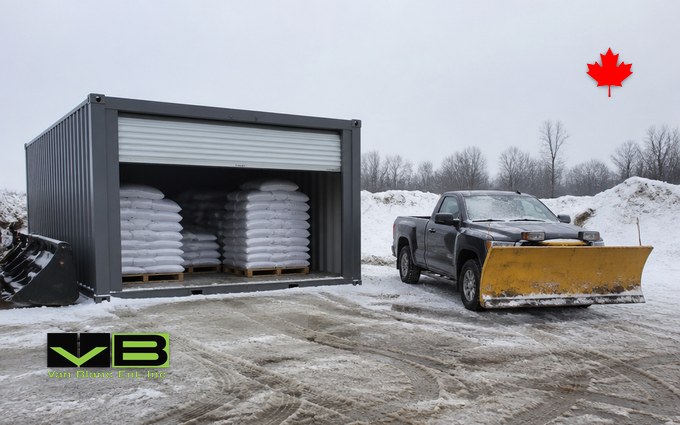
Quick Answer: A salt dome is a round, roofed building that keeps a bulk road salt pile dry, the covered storage Canada’s road salt code and Ontario’s de-icing guidelines recommend. Bagged salt and ice melt need a dry, locked room instead, and one 20ft container from Van Blanc fits 9 standard pallets.
What This Salt Storage Guide Covers
- Salt Dome: What the Building Does
- Why Does Road Salt Need a Roof?
- Canada’s Road Salt Code on Storage
- Ontario’s De-icing Storage Guidelines
- Sand Piles Get Salt, Then a Cover
- Domes, Sheds, Bins and Tarps Side by Side
- Rock Salt and Ice Melt in Storage
- Bagged Product Goes Indoors, Locked
- The 20ft as a Bag Store
- A Roll-Up for the Daily Draw
- Keeping Salt Off the Steel
- Contractor Depots, Plazas and Works Yards
- Container Grade for a Bag Store
- Siting the Box by the Loading Lane
- Delivery Before the First Storm
- Salt Storage FAQs
Reading Time: 17 minutes
Salt Dome: What the Building Does
A salt dome is the round storage building a public works yard or highway depot uses to keep bulk road salt out of the weather. Its shape follows the pile. Salt poured from a conveyor or a loader bucket settles into a cone. The Salt Institute’s Salt Storage Handbook puts that cone’s natural slope, the angle of repose, at 32 degrees. A dome lays a roof over the cone with little wasted air above it. For salt buildings in general, the handbook says door openings should be a minimum of 20 feet wide, so loaders can work.
Van Blanc does not build domes. We sell the steel room that stands beside one, with vents, lockboxes and shelving fitted at our yards when an order calls for them. That room holds the product that arrives in bags: rock salt, calcium chloride ice melt, bagged traction sand and bulk bags. A loose pile wants a loader and a wide door. A bag wants a dry floor, a lock and a door a crew can open before sunrise. Paul LeBlanc founded Van Blanc in 1995 and still runs the family’s container business in Brantford.
Paul LeBlanc, owner, Van Blanc Ent. Inc.: “Bagged salt keeps fine in a box as long as it stays in the bag. The pallets go in sealed, the torn bag gets used first, and somebody sweeps the floor before the doors close for the night.”
Why Does Road Salt Need a Roof?
Road salt needs a roof because rain and snow dissolve it, and the brine runs off toward ditches, wells and streams. Kept dry, salt keeps working. The Salt Institute’s handbook says salt never loses its ice melting power, however long it is stored. It also says salt does not absorb moisture until the humidity exceeds 75 percent. Wet salt cakes into lumps that jam a spreader, and rain washes the anticaking agent off the outer layer.
Steel has its own trouble with damp air. A closed box sweats when the dew point swings in spring and fall. A Van Blanc container holding salt bags wants louvre vents set high and low on opposite walls.
The second reason is the water supply. Environment and Climate Change Canada says that, on average, 5 million tonnes of road salts are used each year as de-icers on Canadian roadways. A federal assessment published on December 1, 2001 concluded that high releases of road salts were having an adverse effect on freshwater ecosystems, soil, vegetation and wildlife. The same text names losses at salt storage sites as one route into the environment. Chloride that leaves a pile settles on nearby steel too, which is why chloride residue gets washed off bare steel before any repaint.
Canada’s Road Salt Code on Storage
Canada’s Code of Practice for the Environmental Management of Road Salts was published in the Canada Gazette on April 3, 2004. It is voluntary. It applies to organizations that use more than 500 tonnes of road salts per year, measured as a 5-year rolling average, and to organizations with vulnerable areas in their territory. It does not apply to road salts used for domestic purposes, or for private or institutional uses. A works yard that reports under it and adds containers beside its dome should first check the overhead and side clearance a delivery truck needs at the spot.
For storage, the code sets one objective: “the prevention or control of releases from existing and new sites”. The first practice it lists is coverage of salt piles and blended salt-sand piles. It also recommends that hiring organizations make sure contractors follow the plan’s measures.
| Federal review measure | Figure |
|---|---|
| Target for road salt under a roof, on an impermeable pad, by 2019 | 100% |
| Road salt stored that way in 2019 | 97% |
| Target for treated abrasives under a roof or tarp | 75% |
| Treated abrasives covered in 2019 | 72% |
| Municipal salt storage sites reported in 2019 | 414 |
Both 2019 figures sit three points under target. Treated abrasives are blended sand and salt.
Ontario’s De-icing Storage Guidelines
Ontario’s Ministry of the Environment, Conservation and Parks covers storage in its Guidelines on Snow Disposal and De-icing Operations in Ontario. The wording is direct: “De-icing chemicals or sand/salt stockpiles shall always be protected from precipitation or surface runoff”. A container keeps sealed bags under a steel roof and walls, out of the rain and runoff. It sits on blocks or a gravel pad built a foot wider than the box.
For stockpiles, the ministry recommends permanent structures wherever possible. The pile should sit on an impervious apron, preferably asphalt, dyked to keep salt leachate out of watercourses and groundwater. Permanent structures “afford the best protection”. Polyethylene sheets and spray coatings “have generally proven to be less effective,” though they beat open storage until a permanent structure goes up.
Ontario’s source protection fact sheet on road salt and snow storage speaks to facilities with bulk salt on site and names malls and parking lots. It advises storing salt on waterproof pads under a cover, preferably a permanent roof. For plazas that keep only bagged product, TAC’s advice on bagged materials, further down, fits more closely.
Sand Piles Get Salt, Then a Cover
Salt and sand storage go together for two reasons. Winter sand is stored with a little salt in it, and bagged traction sand shares the pallets with the ice melt. Sand has a job on delivery day as well: a container drop on frozen January ground goes smoothly once the approach is sanded or salted.
The Transportation Association of Canada’s Syntheses of Best Practices: Road Salt Management (April 2013) sets the dose. Relatively dry sand stored indoors should not need more than 1-2% salt by weight. Wetter sand may need up to 5%. That small dose keeps the pile free-flowing so the spreader can move it. Ontario’s guidelines make the same point to road crews: put only enough salt in the mix to get the result.
TAC’s synthesis for private roads, parking lots and walkways says all sand and sand/salt mixtures should be covered, so salt is not washed or blown off the pile. It prefers permanent structures over tarps, on pads of impermeable asphalt or concrete.
Domes, Sheds, Bins and Tarps Side by Side
Salt storage buildings come in more shapes than the dome. TAC’s synthesis on maintenance yards lists the traditional dome, rectangular sheds or barns, high arch structures and elevated silos. Townships and contractors put steel arches over sand and salt, and how a quonset arch kit goes together has a guide of its own. The Salt Institute adds covers for outdoor piles in polyethylene, polypropylene, Hypalon or water-resistant canvas.
| Storage | Best suited to | Filled and emptied by | Cover |
|---|---|---|---|
| Salt dome | A loose pile of salt or salt-sand blend | Loader, through a door at least 20 feet wide | Permanent roof |
| Shed or barn | Loose salt, with room for sand | Loader, doors at one or both ends | Permanent roof |
| Steel or fabric arch | Loose salt and sand | Loader and delivery truck | Steel or fabric skin |
| Tarped pile | Overflow, or a site with no building yet | Loader, tarp pulled back | Weighted sheet |
| Poly bin | A few bags’ worth at one entrance | Scoop and pail | Lid |
| 20ft container | Bags, bulk bags and pails on pallets | Pallet jack or forklift, in a pallet pattern drawn before the first load | Steel roof and walls, locking doors |
The dome, the shed and the arch carry tonnage, because they take a loader. The tarp holds a pile until something better is built. The poly bin serves one doorway. The container locks like a room, and its cargo doors open with one hand once you know the order.
Rock Salt and Ice Melt in Storage
Rock salt is sodium chloride, and it made up 92% of the de-icer reported under the federal code in 2019. It stores well. Below the 75 percent humidity mark it takes on no water, and a thin crust from a damp spell breaks up easily. Windsor Safe-T-Salt, a common bagged rock salt, comes in 10 kg and 20 kg bags and melts ice and snow down to -15°C, according to its maker.
Calcium chloride behaves differently. OxyChem’s Calcium Chloride Handbook (September 2026) calls it hygroscopic and deliquescent: it pulls water from the air until the solid turns to liquid. At 30°C, a summer day, the handbook puts the point at which it liquefies at 22 percent relative humidity. OxyChem says any opened, part-used package must be tightly resealed, because humid air may lead to caking and liquid brine formation. Why a closed steel box sweats when the dew point swings explains where damp air comes from inside a container.
Ontario’s source protection fact sheet adds a use note: salt is best used between 0°C and -12°C, and below -18°C salt does not work. A walkway crew facing a colder snap needs a second product on hand, so the storage has to suit the fussier of the two. A homeowner’s few kilograms keep in their own sealed bag, a zip-top bag or a pail with a snap-on lid. OxyChem notes its plastic pails are watertight enough to stand outdoors. In a container the bags protect the paint, and rust encapsulator under fresh container paint covers any touch-up after a forklift scrape.
| Product | What moisture does | Storage advice from its source |
|---|---|---|
| Rock salt, bulk | No uptake below 75 percent humidity; rain dissolves it | Impermeable pad, under a roof or cover (Salt Institute) |
| Rock salt, 20 kg bags | A split bag cakes | Securely and indoors if possible (TAC) |
| Calcium chloride, bags | Liquefies above 22 percent humidity at 30°C | Indoors, dry, opened bags resealed (OxyChem) |
| Calcium chloride, shrouded pallet | Intact shroud keeps air out | Outdoors only on drained asphalt or concrete (OxyChem) |
| Calcium chloride, bulk bags | Usually not shrouded | Indoors or under a tarp, two high and two wide (OxyChem) |
| Sand with 1-2% salt | Wet sand freezes in the pile | Covered, on asphalt or concrete (TAC) |
Bagged Product Goes Indoors, Locked
Bagged salt and ice melt get their own line in the guidance. TAC’s synthesis for private roads, parking lots and walkways puts it in one line: “Solid bagged materials should be stored securely and indoors if possible”. Securely means locked, and a puck lock on a welded hasp is one answer on a steel box. Indoors means out of the rain and off wet ground.
OxyChem’s handbook draws the same line from the maker’s side. Palletized bags under an intact plastic shroud may be stored outdoors on a well-drained asphalt or concrete surface. Once the shroud is torn, pierced or removed, those bags should go indoors or under a waterproof tarp. Individual bags belong indoors in a dry area. On a working depot, the shroud lasts until the first morning someone needs six bags.
Quantity matters as much as cover. The Salt Institute recommends storage room for at least 100% of an average winter’s salt requirement, because resupply gets hard during back-to-back storms. The same logic sizes a bag store. A steel room stays dry as long as the rubber gasket around its doors still seals, and a Van Blanc box locks at night.
The 20ft as a Bag Store
A 20ft shipping container is a sensible first size for a bag store. It fits behind a plaza, beside a depot’s truck bay or next to a works yard dome. Our 20ft standard’s measured interior is the reference here. Every dimension and weight in the table comes from that Van Blanc page, and the pallet count is worked from its inside length and width.
| 20ft standard | Metric | Imperial |
|---|---|---|
| Inside length | 5.898 m | 19 ft 4 in |
| Inside width | 2.352 m | 7 ft 8 in |
| Inside height | 2.385 m | 7 ft 10 in |
| Door opening width | 2.343 m | 7 ft 8 in |
| Door opening height | 2.280 m | 7 ft 5 in |
| Inside volume | 33.2 m³ | 1,172 cu ft |
| Empty weight | 2,260 kg | 4,982 lb |
| Maximum payload | 21,740 kg | 47,928 lb |
| 48 by 40 inch pallets on the floor (worked out below) | 9 | |
Pallet Math for One Box
A 48 by 40 inch pallet measures 1.219 m by 1.016 m. Two rows, one turned each way, take 2.235 m of the inside width. Along the inside length, the row with its 40 inch side leading holds five pallets in 5.080 m. The other row holds four in 4.876 m, so the floor takes 9. The weight rests on a 28 mm marine plywood deck over steel cross-members. Bag counts per pallet vary by maker and by plant. One Canadian distributor’s listing shows a typical pallet of Windsor Safe-T-Salt as 63 bags of 20 kg, 1,260 kg in all. Nine of those pallets come to 567 bags and 11,340 kg, just over half the rated payload. That is arithmetic on paper, so weigh a delivered pallet before you plan around it.
A second layer depends on the loaded pallet’s height and on the forklift, and the inside height in the table is the ceiling. Weight sets the other limit: at that pallet weight, the rated payload covers 17 pallets, so a full second layer of nine would pass it. Where pallets will not stack, pallet racking anchored into the floor’s cross-members is the other way to use the height, under the same payload. Treat any stacking plan as guidance until a loaded pallet has been weighed and measured.
A Roll-Up for the Daily Draw
A roll-up door changes how a salt box works on a busy morning. Van Blanc frames a roll-up 8 or 10 feet wide into a 20ft’s long side, with a welded steel frame and header. The cargo doors stay in place unless the buyer asks otherwise. On a standard-height box, the coil above the opening leaves roughly 7 feet of clear height. Pallets come in through the cargo doors once or twice a season, and bags go out through the roll-up every storm.
The trade-off is the seal. The coil door closes on a brush seal and slide bolts, while the factory cargo doors close on a rubber gasket under four locking bars. Keeping the cargo doors means the box still closes tight over the months it sits full, and a side-by-side of coil doors and cargo doors covers the difference in detail. On width, an 8-foot door clears a pallet jack with room to spare. Wider loads want the 10, and choosing between eight and ten feet comes down to what rolls through.
Keeping Salt Off the Steel
Salt is hard on steel. Van Blanc’s own flooring guide lists road salt among the corrosive cargoes that pit the door-end cross-members under a container floor. The answer is housekeeping first and hardware second. Keep bags sealed and on pallets, never on the bare deck. Use a torn bag first. Sweep spills the day they happen.
That last habit has backing. The Salt Institute’s handbook says salt spilled during delivery or loading must be cleaned up and returned to storage as soon as possible. The federal review found that 90% of municipalities run spill clean-ups as needed. In a container, the broom is the cheapest piece of corrosion protection on site.
Hardware helps at the edges. A chemical-resistant epoxy film over the plywood makes spills easy to sweep and wash. An undercoat on the floor pan and cross-members protects the side of the box nearest the wet ground. A paint chip by the doors is worth catching early, and grinding a rust spot back to bright steel is a three-step job.
A loose pile is loader work. The federal review, the ministry and the Salt Institute put it on an impervious pad under a roof, behind doors at least 20 feet wide. The container advice in this guide is for what arrives sealed.
Contractor Depots, Plazas and Works Yards
A bag store looks a little different for each kind of winter operation. The Van Blanc box is the same steel, so the differences come down to count, doors and where it sits.
Snow Contractor Depots
A plow contractor’s depot is where trucks load before a storm and where bagged product for walkway crews waits. Size the box by counting pallets. Add up last winter’s deliveries of bagged salt and ice melt, then plan room for the whole season, the way the Salt Institute advises for bulk. If the count fits one 20ft floor, one box covers the depot. Past that, a second 20ft or a longer box does the job, and all seven sizes and four grades in one list shows the options. With several depots, a box at each one saves crews a drive across town for bags.
Plazas and Property Managers
A plaza or an office park keeps its walkway product near the doors the staff actually use. A box behind the loading area, with a roll-up facing the lane, gives the maintenance crew bags at hand without a pallet sitting in public view. Where the box can be seen from the street, a one-trip box still wearing factory paint blends in with the building.
Small Municipal Works Yards
A small municipality may run a dome for its road salt and still keep bagged product for sidewalks, arena entrances and town hall steps. That stock sits better in a locked box near the dome than on the dome floor, where the loader works. A works yard that keeps its bags in steel frees the floor of the dome for the pile.
Container Grade for a Bag Store
Van Blanc sells four grades, and the choice belongs to the buyer, ideally after walking the rows in person first. The grade sets how the box looks, what certification it carries and what history it brings.
- New (one-trip): one loaded voyage from the factory, with clean paint, tight doors and a factory CSC plate.
- Cargo worthy (CW): used 8 to 15 years, with valid re-certification, surface rust, paint variance and doors that seal fully.
- Wind and watertight (WWT): used 12+ years, with heavier surface rust, a CSC plate that may be expired and gaskets that may need replacing.
- As-Is: donor and project stock, sold with its defects written down for cutting and builds.
Graded used containers, each with its flaws named, carry a container number, so you pick the exact unit in the rows or on a video call.
Price a Salt Box for Your Depot
Tell us how many pallets of bagged salt and ice melt you carry into a winter, where the box would sit and your postal code. We will tell you which size and doors fit, and send one all-in number with a real lead time, usually the same day.
Family-run in Brantford since 1995 · 4 Brantford yards · 4.9★ across 140+ Google reviews.
Siting the Box by the Loading Lane
A salt box earns its spot by being where the crew loads. Set it beside the truck bay or the spreader-loading apron, so bags travel a few metres. Keep it level and drained, so meltwater runs away from the doors. Tell Van Blanc which way each set of doors should point when you order, because a placed container is hard to turn. Point the cargo doors at the forklift lane and the roll-up at the walkway crews.
The truck needs room as well. A tilt-deck sliding the box onto its pad backs in on a straight line. It needs straight pull-out room behind the drop spot, about 75 to 100 feet for a 20ft. Permits are managed by your municipality, so check with your local building or planning department before you order.
Delivery Before the First Storm
The Salt Institute tells salt buyers to plan early, with summer the best time, and to take delivery in summer or fall. The bag store should land before the bags do. Van Blanc delivers in 1 to 3 days across most of Ontario from our 4 Brantford yards, Eastern Ontario runs such as Ottawa included. Every quote comes with a real lead time, not a hopeful one.
| Where the box goes | Road distance from east Brantford | Car time | Delivery window |
|---|---|---|---|
| Kitchener depots and plaza lots | 49 km | 57 min | 1 to 3 days |
| Guelph plazas and plow yards | 51 km | 60 min | 1 to 3 days |
| Brampton’s industrial and retail lots | 95 km | 77 min | 1 to 3 days |
| Ottawa, the long run east | 550 km | 6 h 28 min | 1 to 3 days |
Distances run by road to each city hall, measured with the OSRM route planner. For a salt box the order belongs before the first storm, and how container stock and demand move through the year covers the rest of the calendar.
Frequently Asked Questions
What is the purpose of a salt dome?
In road maintenance, a salt dome keeps a bulk pile of road salt dry under a permanent roof. The pile stays loose for the spreader, and its chloride stays on site. The name also belongs to geology. In Bay St. George, Newfoundland and Labrador, Triple Point Resources has filed plans for the Fischells Salt Dome Power Generation Project, which would use compressed air energy storage and salt caverns.
Why are road salt storage buildings a dome shape?
Salt dropped by a conveyor or a loader settles into a cone with a fixed natural slope, its angle of repose. A round dome puts a roof over that cone with little wasted space, and its wide door lets a front-end loader work inside. Rectangular sheds and arch buildings do the same job on a different footprint.
What is the best way to store driveway salt for winter use?
Keep it in its sealed bag or a lidded pail, off a damp floor, in a garage or shed. Reseal calcium chloride after every use, because it pulls water from the air and can turn to brine. A business with pallets of bags needs a dry, locked room, such as a 20ft container, for the season’s stock.
What is the best material to store salt in?
Plastic. Sealed plastic bags, high-density pails and lidded poly bins hold salt well; OxyChem says common plastics will not corrode in calcium chloride service. For a season’s pallets, a locked steel container keeps those bags dry, with spills swept up the same day.
How much does a salt dome cost?
A salt dome is a built-to-order project, and its price turns on capacity, foundation walls, the door height a loader needs and the site work under the pad. A container for bagged product is simpler to price. Van Blanc quotes the size, the grade and delivery to your address as one all-in number, usually the same day.
Does road salt go bad in storage?
Rock salt does not lose its melting power with age, according to the Salt Institute. Moisture is the risk, since wet salt cakes into lumps. Calcium chloride is touchier: OxyChem gives its calcium chloride products an expected shelf life of 36 months when they are properly stored.
Can you keep bagged salt in a shipping container?
Yes. Sealed bags on pallets keep well in a locked, dry steel box. TAC’s synthesis says solid bagged materials should be stored securely and indoors if possible. Sweep spills promptly and fit vents so damp air can leave. Van Blanc delivers 20ft and 40ft units from 4 Brantford yards.
How many pallets of ice melt fit in a 20ft container?
Nine standard 48 by 40 inch pallets fit on a 20ft’s floor, worked out from the inside size on Van Blanc’s 20ft page. One distributor lists Windsor Safe-T-Salt at a typical 63 bags of 20 kg to a pallet. On that count, nine pallets hold 567 bags, just over half the rated payload. A second layer depends on pallet height, the forklift and the payload.
Sources
- Environment and Climate Change Canada. Code of Practice for the Environmental Management of Road Salts. Canada.ca, checked October 2026.
- Environment and Climate Change Canada. Review of Progress: Code of Practice for the Environmental Management of Road Salts 2014 to 2019. Canada.ca, checked October 2026.
- Ontario Ministry of the Environment, Conservation and Parks, Guidelines on Snow Disposal and De-icing Operations in Ontario, Ontario.ca, checked October 2026.
- Ontario Ministry of the Environment and Climate Change, Education and Outreach for Source Protection: Road Salt/Snow Storage (PIBS 9689e), hosted by Conservation Ontario, checked October 2026.
- Transportation Association of Canada. (2013). Syntheses of Best Practices: Road Salt Management, sections 7.0, 9.0 and 10.0, checked October 2026.
- Salt Institute. (2015). Salt Storage Handbook: Practical Recommendations for Storing and Handling Deicing Salt, checked October 2026.
- OxyChem. (2026). Calcium Chloride Handbook, September 2026, checked October 2026.
- Windsor Salt. Windsor Safe-T-Salt product page, checked October 2026.
- ChickenPieces.com. Windsor Safe-T-Salt Ice Melt 20 kg, pallet listing, checked October 2026.
- 100.1 BayFM. (2026, September 21). New plans submitted to government for the Fischells Salt Dome Power Generation Project, checked October 2026.
- Project OSRM. OSRM route planner, driving distances from east Brantford, checked October 2026.
Walk a Salt Box Before Winter
We have been supplying shipping containers across Ontario since 1995. Our public yard is at 90 Morton Avenue East, one of our 4 Brantford yards.
Van Blanc Ent. Inc., 90 Morton Ave E Unit 1B, Brantford, ON N3R 7J7, 519-754-6844.
Bring last winter’s pallet count and a photo of the spot beside your truck bay. The yard is open Monday to Thursday from 9:30 to 5, and Friday from 9:30 to 4. We can open a standard 20ft and a roll-up unit side by side so you can see both doors at work. Worth the drive for unbeatable quality, family customer service with 30 years of experience.