
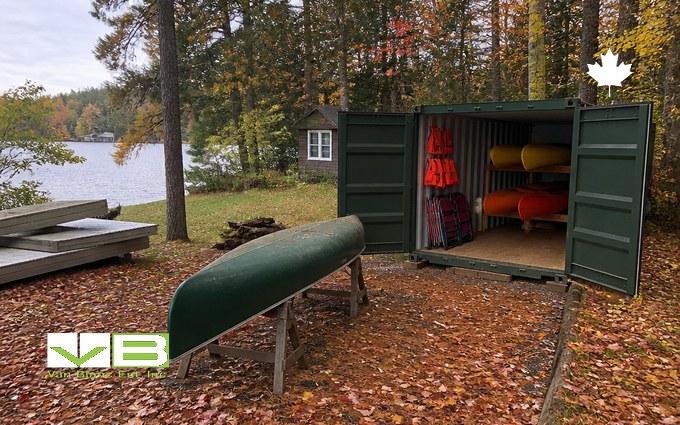
Quick Answer: A cottage closing checklist for Ontario runs in order. Remove the food, pull the docks and boats, drain the water, shut off power and propane, seal gaps, clear gutters, lock gear away. Finish by Thanksgiving: in nine falls out of ten, Muskoka Airport records its first frost by October 6.
Closing Order, Lake to Lock
- Cottage closing checklist, start to finish
- When to close: Thanksgiving or first frost
- Water lines, pump and hot water tank
- Docks out before the ice
- Boats, motors and paddle craft
- Mice, squirrels and the food rule
- Power, propane and the fridge
- Roof, gutters and winter maintenance
- Security and the off-season key-holder
- Closing weekend food and the last walk-through
- Dock storage in a 20ft at the lake
- What fits: dock sections, canoes, chairs
- A 10ft where the lane narrows
- Grades for a box beside the lake
- Delivery up the 400 and into the Kawarthas
- Setting the box on a cottage lot
- Closing questions, answered
Reading Time: 18 minutes
Cottage Closing Checklist, Start to Finish
A cottage closing checklist is the order of jobs that leaves a summer place dry, empty and locked for an Ontario winter. The order matters as much as the jobs. Food leaves before the shutters go up. The dock comes out while the lake is still warm enough to stand in. The water drains before the main breaker goes off, since a compressor blowing out the lines needs power.
Thanksgiving weekend is the traditional closing date in Ontario. This year the holiday Monday falls on October 12, 2026. Ontarians say cottage, while plenty of Canadians say cabin or camp, and the list is the same either way. If the boat is your hardest job, the boat winterizing order, haul-out to cover has its own page.
A word on who is writing. Van Blanc is the family container company Paul LeBlanc started in Brantford in 1995. We sell steel boxes out of our 4 Brantford yards, which explains the last third of this guide. That part covers where the dock sections, canoes and chairs spend the winter. The first two thirds are the closing itself, sourced and in order, with nothing to buy. The LeBlanc family’s story is on its own page.
| Job | Done when |
|---|---|
| Food, drinks and garbage | Cupboards and fridge empty, fridge door propped open, garbage gone home |
| Docks, swim raft, boat lift | Sections out of the water and stacked above the high-water line |
| Boats, motors and paddle craft | Engines winterized, batteries home, hulls off the ground |
| Water system | Pump off, pressure tank and hot water tank empty, taps open, traps protected |
| Power and propane | Breakers off except circuits that must run, propane valve closed |
| Mice and squirrels | Gaps sealed with steel wool or metal, bedding bagged, nothing edible left |
| Roof, gutters, chimney, trees | Gutters clear, chimney capped, dead limbs off the roof line |
| Valuables and lake gear | Electronics home, the rest locked, serial numbers written down |
| People | A neighbour or key-holder named for alarms, storms and animals |
Each row gets its own section below, in the order it usually happens. The lake gear row is the one that ends many weekends as a pile on the lawn. A cottage that doubles as a hunt camp once the leaves drop runs the same list a few weeks later.
When to Close: Thanksgiving or First Frost
The holiday makes a sensible deadline because the weather has usually decided things by then. Environment and Climate Change Canada keeps 1981 to 2010 climate normals for Muskoka Airport. The station sits between Gravenhurst and Bracebridge, and its frost figures beat any rule of thumb.
| Muskoka Airport normal, 1981 to 2010 | Figure | What it means for the close |
|---|---|---|
| Average date of first fall frost | September 25 | Exposed lines are at risk from late September |
| Chance the first frost has come by October 6 | 90 percent | By the holiday weekend, assume it has frozen once |
| Average October overnight low | 1.9°C | Drain the lines between visits once frost has come |
| Average November overnight low | -3.2°C | Anything still holding water is on borrowed time |
| Average date of last spring frost | May 21 | Plan the water start-up for late May |
Muskoka Airport is only one station. A lake in Haliburton County, up Highway 118, keeps its own schedule, so watch the local forecast as well as the calendar. October is the warning month. An average of 12 nights in October drop to 0°C or below at the station, and November averages 22 nights. A drained cottage ignores every one of them. A cottage with water in a crawlspace line, a toilet tank or a lake intake does not.
Splitting the close into two trips makes the weekend lighter. The first trip, in late September, takes out the dock, the swim raft and the boat. The second, on the holiday weekend, handles the water, the power and the lock-up.
Water Lines, Pump and Hot Water Tank
The water system is where one missed step costs the most. Water left in a pipe, a pump housing or a toilet tank cracks it when it freezes. The same goes for the lines to a sauna built into a steel box by the lake. Draining is how you secure the plumbing for winter. Every cottage system is a little different, so read this as the order of operations. Follow your plumber’s or the maker’s instructions for your own pump and tank.
Draining Order for a Seasonal System
- Switch off the water pump at its breaker.
- Shut off the hot water tank’s power or gas valve. Heating an empty tank burns out the element.
- Open every tap, hot and cold, inside and out, including the ones in a bunkie or an off-grid container cabin, and leave them open.
- Drain the pressure tank and the pump housing at their plugs.
- Hose the hot water tank’s drain valve to a floor drain or outside, with a hot tap open for air.
- Flush the toilets, then sponge the last water out of each bowl and tank.
- Pull filter cartridges and any treatment lamp, and store them dry indoors.
- If you blow out the lines, keep the compressor pressure low and go fixture by fixture.
- Pour plumbing antifreeze labelled for drinking water into every trap and toilet bowl. It is the pink kind that also winterizes a trailer parked at the cottage.
Lake Intake Lines and Drilled Wells
A cottage that draws from the lake has one more job. The intake line and foot valve sit in shallow water, which freezes first. Pull the line up onto shore, or drain it back through the pump. Then coil it where ice and spring breakup cannot reach it. A drilled well with a submersible pump is different, since that pump sits far below the frost. There the job is draining everything above ground. When in doubt, ask the installer which parts hold water. One warning covers both systems: automotive antifreeze is toxic and never belongs in a drain that runs to a septic bed beside a lake.
Docks Out Before the Ice
Docks belong near the top of a cottage closing checklist, because ice is hard on anything left in the water. That holds on every cottage shoreline from Simcoe up to Georgian Bay and across the Kawarthas. Lake ice expands, shifts with wind and current, and drags whatever is frozen into it at breakup. What comes out depends on the dock you have.
- Pipe and pole docks: lift the sections off, pull the legs, and stack both above the spring high-water line.
- Floating docks: take them out, or move them into a sheltered bay and anchor them loose enough to ride the ice.
- Crib docks stay in, but anything bolted on top, such as ladders and benches, comes off.
- Swim rafts: tow them to shore or to a protected corner of the bay.
- Boat lifts: raise the cradle clear of the water, or pull the lift if the maker says to.
Sectional docks come apart in pieces a crew of two can carry. The 4- and 6-foot-wide pieces fit a 20ft with room for a stack of them. Beyond Blue Docks is a North Bay maker that builds for Northern Ontario lakes. It lists standard aluminum sections 4, 6 or 8 feet wide and 10, 12 or 16 feet long. Its frames run as light as 80 pounds. Once the pieces are out, they need six months off the grass and out of the snow, which the dock storage section below covers.
One habit pays off in May. Number the sections and legs with paint or tape as they come out, and photograph the layout from the water. The person who puts the dock back next spring may not be the one who took it out. A photo saves a Victoria Day weekend of guessing.
Boats, Motors and Paddle Craft
The boat is usually the biggest single job, and its winterizing has more steps than this page can fairly hold. Fuel stabilizer, fogging, draining the lower unit and the cooling water, and batteries home to a charger all belong on the boat’s own list. The haul-out routine on our boat storage page runs it start to finish. Most hulls winter on the trailer, in the boathouse or at a marina. A small boat can roll into a 20ft on its trailer. Measure the rig first: it has to clear the 7 foot 8 inch by 7 foot 5 inch doors and fit the 19 foot 4 inch floor. Everything that comes off the boat goes in either way.
Life jackets, ropes, fenders, tubes, water skis and the cooler all need to be dry before storage. Put them away damp and they come out in May smelling of mildew. Canoes and kayaks winter best off the ground, upside down or on their sides. In a container, cleat strips bolted along the steel wall can carry the racks that hold them that way. Outboards that come off a tender go upright on a stand, the way their manuals show. Personal watercraft follow their own maker’s winterizing steps.
The same weekend is often the changeover from the summer fleet to the winter one. When the boat comes out, the snowmobile comes forward. Muskoka and Kawartha cottage owners often winter the sleds and quads in a used wind-and-watertight box behind the cottage, beside the boat gear.
Mice, Squirrels and the Food Rule
An empty cottage is a warm, quiet building in a forest full of small animals. The Public Health Agency of Canada’s hantavirus guidance gives two rules that matter at closing. Seal holes with wire screening, steel wool, metal flashing or cement. Keep food, water and garbage in containers with tight-fitting lids. At a cottage, the simplest version of the second rule is to leave nothing edible at all. Clear out the food and the trash first, because pests come for both.
- Take every opened package, pet food bag and bird seed home. Unopened cans can stay.
- Bag mattresses, pillows and cushions in sealed plastic, bring them home, or shelve them in a wind-and-watertight box with sealed doors.
- Stuff steel wool into gaps around pipes and wires where they pass through walls, then caulk over it.
- Cap the chimney and close the damper.
- Check the screens on vents, soffits and crawlspace openings for chewed corners.
Spring Cleanup, Done Safely
If May shows droppings, the same Public Health Agency of Canada page is specific. Do not sweep or vacuum them, because that puts particles in the air. Spray the droppings and nest with 1 part bleach to 9 parts water, or an approved disinfectant. Let it soak for 10 minutes, then wipe up with paper towels. Wear rubber or plastic gloves, and bag the waste twice. In a confined space, such as a crawlspace or a closed-up shed, the page also calls for an N95-level respirator.
Once the cottage is sealed, the lake gear outside it can become the next nest. Seat cushions, life jackets and sail bags are nesting material. Anything soft that stays at the lake does better in a sealed steel room. On a Van Blanc container, a fresh set of door gaskets is what keeps an older box tight.
Power, Propane and the Fridge
Power comes off after the water system is drained and blown out. Unplug everything that does not need to run, then turn off the breakers. The exceptions are whatever must keep working: a sump pump, heat cable on a line you could not drain, or an alarm. Label those breakers so a neighbour checking the place knows which ones stay on.
Propane is simple and strict. Close the valve at the tank or cylinder and shut off the pilots. The Technical Standards and Safety Authority, Ontario’s fuel regulator, says propane cylinders may not be used or stored inside any structure. The barbecue can come in for the winter. Its cylinder stays outside with the valve closed. That rule covers a shed or a small steel box beside the deck as much as the cottage.
The fridge and freezer get emptied, unplugged, wiped dry and left with the doors propped open. Closed up, they grow mould by spring. Unplug the stove, the microwave and any dehumidifier. A generator gets run dry before it is stored, the same as the outboard. Keep it out of the snow with the other motors. The vents and lockboxes that suit a box full of engines are worth a look.
Roof, Gutters and Winter Maintenance
Winter maintenance before you lock up is mostly about snow and what holds it, starting with a winter-ready roof. Muskoka Airport’s normals put the average annual snowfall at 338.1 cm, with 91.1 cm in December alone. The average February snow depth is 38 cm. That load sits on the roof, the deck and anything left on the lawn for months.
- Clear the gutters and downspouts so meltwater has somewhere to go besides under the shingles.
- Look over the roof for lifted or missing shingles, and get them fixed before the snow finds them.
- Cut back dead limbs over the roof line, the deck and the hydro service.
- Turn picnic tables and canoes upside down, or get them under cover, so they do not fill with ice.
- Arrange snow removal for the lane if anyone will need to get in over the winter.
A Van Blanc container has a flat steel roof, and snow sits on it the way it sits on a shed. Read how a container roof carries a northern snowpack before a box goes under big pines. The woodpile is the other casualty of a snowy winter. Firewood that is still dry in July starts with the cover it gets in October.
Security and the Off-Season Key-Holder
The Federation of Ontario Cottagers’ Associations names the risky months plainly. Cottages are most vulnerable to theft and vandalism from the week after Thanksgiving to the weeks before Victoria Day. FOCA’s advice is practical. Leave no valuables, lock up the sporting goods that must stay, and record serial numbers. Name a year-round key-holder for alarms, thefts, weather damage and animals.
- Electronics, good tools and anything with a battery go home, and what stays goes behind a lock that slows an off-season thief.
- Close curtains or blinds, and put up shutters if you have them.
- Photograph each room and the lake gear, and keep the photos with your insurance papers.
- Call your insurer and ask what the policy expects while the place sits empty.
- Give the key-holder the breaker labels, the alarm code and a phone number that works all winter.
The lake gear is where FOCA’s advice to lock things up meets reality. Water skis, fishing rods, paddleboards and tubes are easy to carry off a dock or out of a plywood shed in February. A locked steel room with a covered lock is a harder target. Van Blanc can weld on a cover that keeps bolt cutters off the lock before the box ships.
Closing Weekend Food and the Last Walk-Through
The food question has an easy answer on closing weekend. Bring only what the weekend will eat, and plan the meals around what is already in the fridge. A Thanksgiving dinner at the lake is a fine way to empty it. Anything opened goes home in a cooler with the garbage and the recycling.
Then walk the place once, slowly, with the list in hand:
- Every tap open, every trap and toilet bowl treated, the pump and tank off.
- Fridge open, breakers off except the labelled ones, propane valve closed.
- Windows latched, shutters up, doors locked, the key-holder texted.
- Dock, raft and boat out, and the lake gear stored and locked.
The last line decides how the spring opening goes. Dock sections under a tarp, canoes on sawhorses and a patio set against the wall all come through winter in some condition. The next section is about giving them a better one. A Van Blanc container that winters at the lake gets a quick spring look at its doors, roof and floor, the same as the cottage.
Dock Storage in a 20ft at the Lake
Dock storage is where a shipping container earns its place at a cottage. It gives you one locked room that stays dry and keeps mice out, for everything that comes out of the lake in October. A 20ft dry container usually suits the job. Van Blanc’s 20ft is 19 feet 4 inches long, 7 feet 8 inches wide and 7 feet 10 inches high inside. Its doors open 7 feet 8 inches wide by 7 feet 5 inches high.
The appeal is that nothing gets hauled home. The sections come off the water, get carried up the lawn and go in on edge. The canoe slides in beside them. The chairs, the barbecue (minus its cylinder), the tubes and the life jackets fill the door end, and one lock closes the lot. In May the order reverses. The 20ft’s own dimension table has the full numbers, including the 1,172 cubic feet inside.
Christian LeBlanc walks buyers through the rows at our Brantford yards, and he puts the cottage question this way.
Christian LeBlanc, Van Blanc Ent. Inc.: “Send us a photo of the lane before anything else. The dock sections, the canoe and the chairs tell us how big the box should be, but the lane tells us whether the truck can put it there.”
That photo matters because cottage lots are rarely flat or clear of trees. Van Blanc can send the box on a tilt-deck or a crane truck, depending on the lane, and both are covered under placement below. A Muskoka lane and a Kawartha lane are different problems. The full size chart, 10ft to 53ft, helps if you are still choosing.
What Fits: Dock Sections, Canoes, Chairs
A box is only useful if the gear goes through the doors. The fit below uses the inside dimensions from Van Blanc’s own 20ft and 10ft pages, plus the section sizes Beyond Blue Docks publishes. Measure your own sections and boats before you count on a row.
| Lake gear | 20ft box (19 ft 4 in inside) | 10ft box (2,840 mm inside) |
|---|---|---|
| 4 ft wide dock sections, 10 ft long | Yes, on edge along a wall or flat in one stack | No, longer than the box |
| 4 or 6 ft wide sections, 16 ft long | Yes, lengthwise with 3 feet 4 inches to spare | No |
| Sections 8 feet wide | Measure first: wider than the 7 ft 8 in inside, and taller on edge than the 7 ft 10 in headroom | No |
| Canoes and kayaks | Yes, up to the inside length | Only boats shorter than the inside length |
| Life jackets, tubes, ropes, paddles | Yes, on shelf brackets bolted to the corrugated walls | Yes |
| Patio furniture, barbecue (cylinder outside) | Yes | Yes |
| Push mower and trimmer (run dry), hand tools | Yes | Yes |
Width is the number that surprises people. A stack of 4-foot sections laid flat along one wall leaves 3 feet 8 inches beside it. That is room for a canoe on its side or a row of paddleboards. Standing the sections on edge, like books on a shelf, leaves most of the floor clear for everything else. Run anything with an engine dry before it goes in, and leave fuel cans and propane cylinders outside.
A 10ft Where the Lane Narrows
Some cottage lanes squeeze between rock and trees until a 20ft cannot make the turn. For those lots, a ten-foot box that fits where the lane pinches holds about 560 cubic feet of gear on half a parking stall. Our 10ft page quotes a published spec sheet’s inside length of 2,840 mm, so long dock sections stay outside. A 10ft is the box for the small, valuable, mouse-attractive things: life jackets, cushions, the outboard (run dry), the tools and the barbecue.
Two layouts work on a tight lot. One keeps the dock sections on timbers under a fitted tarp by the water. A ten-footer by the cottage then takes everything that should be locked. The other widens the lane once so a 20ft can take the whole dock. Either way, Van Blanc will tell you from the lane photo which sizes the truck can reach.
Grades for a Box Beside the Lake
Van Blanc sells containers in four grades, each explained in steel terms, and the choice is yours. They differ in age, paint and inspection history.
- New (one-trip): one loaded voyage from the factory, original paint, and the longest service life ahead of it.
- Cargo worthy: used 8 to 15 years, with surface rust and paint variance, and the structure and floor inspected.
- Wind and watertight: used 12+ years, with heavier cosmetic wear and doors that seal against wind and water.
- As-is: units with a disclosed defect, sold as donor and project stock rather than as a sealed locker.
Used boxes graded for outdoor storage come with the wear their grade describes. You can walk the Van Blanc rows and pick the exact unit. A one-trip container still in its first coat starts with factory paint and the most years ahead of it. To weigh a 10ft against a 20ft and new against used in one sitting, open the for-sale page where every stocked box is listed.
Whatever the grade, buy from a seller you can see. Many people call us about a bin on Facebook listed for far less than any Ontario yard asks. Two weeks later some of them call back, scammed. The warning signs on a too-cheap listing are worth five minutes before you pay anyone.
Delivery Up the 400 and Into the Kawarthas
Van Blanc delivers across Ontario in 1-3 days from our 4 Brantford yards, cottage country included. The table gives road distances and car times from our east Brantford yards on the OSRM route planner. Every quote comes with a real lead time, not a hopeful one.
| Cottage town | Road distance | Car time | Route |
|---|---|---|---|
| Barrie, City Hall | 178.6 km | 2 h 13 min | Highway 403, 407 and 400 |
| Peterborough | 235.4 km | 2 h 57 min | Highway 401 and 115 |
| Gravenhurst | 251.0 km | 3 h 10 min | Highway 400 and 11 |
| Bobcaygeon | 262.0 km | 3 h 30 min | Highway 115, then county roads |
| Bracebridge | 267.4 km | 3 h 23 min | Highway 400 and 11 |
| Huntsville | 301.6 km | 3 h 49 min | Highway 400 and 11 |
| Haliburton | 339.1 km | 4 h 31 min | Highway 11 and 118 |
The Muskoka run covers containers for sale from Gravenhurst through Bracebridge to Port Carling. Further up Highway 11, Huntsville and the Lake of Bays shoreline have their own page. On the Kawartha side, the lakes north of Peterborough are a regular run. Bobcaygeon has its own page for the cottages on Pigeon and Sturgeon lakes. The shortest run in the table serves Lake Simcoe cottages out of Barrie.
October is a good month to order a cottage box. The lane is still dry and the ground is firm, so the gear goes straight in at closing. Later deliveries happen too, and deliveries after the lane freezes follow their own set of rules.
Pricing a box for the dock and the lake gear?
Send a photo of the lane, the length of your longest dock section and the cottage’s postal code. We will tell you the size, the grade and how the truck gets in, with one all-in number and a real lead time. Or call, and describe the lane over the phone.
Family-run in Brantford since 1995 · 4.9★ across 140+ Google reviews.
Setting the Box on a Cottage Lot
Placement on a cottage lot comes down to how the truck gets in and what the box sits on. Most Van Blanc deliveries ride our own tilt-deck trucks: the trailer tips and the box slides off at ground height. Our new-container page sets out the room a 20ft needs. Plan on about 75 to 100 feet of straight pull-out and about 12 feet of width. Keep at least 14 feet clear of wires and branches along the approach.
A cottage lane that bends or runs under low pines may not give that. What a tilt-deck needs to line up on a lane is laid out in detail. Where the trailer cannot line up, a crane truck lifts the box in from the road instead. A standard HIAB reaches about 6 to 7 metres with an empty 20ft, which clears a ditch or a rock outcrop. How a crane drop over rock and roots works covers the truck and the reach.
- Ground: a level gravel pad that drains and runs at least 12 inches past the box on each side, or blocks under the corners on firm ground.
- Doors: facing the lane or the lawn, so the dock sections walk straight in.
- Trees: no dead limbs over the roof, which saves the paint and the snow load.
- Water: above the spring high-water line and off any low spot where meltwater pools.
Our guide to a gravel base that drains through an Ontario thaw covers pads, blocks and frost. Permits are managed by your municipality, so check with your local building or planning department before you order.
Frequently Asked Questions
How do I winterize my cottage water system?
Turn off the pump and the hot water tank, open every tap, and drain the pressure tank, pump housing and hot water tank. Flush and empty the toilets, and pull the filters. Blow out the lines at low pressure if you have a compressor. Finish with plumbing antifreeze in every trap and toilet bowl.
When should you close a cottage in Ontario?
Before the hard frosts. At Muskoka Airport the average first fall frost comes on September 25, and nine falls in ten have seen it by October 6. That makes the Thanksgiving weekend about as late as a water system should stay full. Further north, close earlier.
Can you winterize a three-season cottage?
You can close one for winter by draining it, which is what this checklist does. Using it in winter is a bigger job. It needs insulated walls and floors, a heated water line or well, and heat that runs unattended. Talk to a contractor before you plan a February weekend in a three-season building.
How much does it cost to winterize a cottage?
Doing it yourself costs a weekend and a few jugs of plumbing antifreeze. A hired closing depends on the plumbing, the number of fixtures, a lake intake or a well, and the distance from town. Whether the dock and boat are part of the job matters too. Ask for the closing and the spring opening as one quote.
What food should you bring for a cottage closing weekend?
Only what the weekend will eat. Plan meals around what is already in the fridge and cupboards, and take anything opened home in a cooler. Leave no food, pet food or bird seed behind. Unopened cans can stay; everything else is mouse bait until May.
Where do you store dock sections over the winter?
Above the spring high-water line, off the ground, and out of the snow if you can manage it. The usual homes are timbers under a fitted tarp, a boathouse, or a locked container. Van Blanc’s 20ft is 19 feet 4 inches long inside, so 4-foot-wide sections up to 16 feet long go in flat or on edge.
Can a 10ft container hold cottage dock sections?
Not standard sections: Beyond Blue Docks lists lengths of 10, 12 and 16 feet, and a 10ft box is about 2,840 mm long inside. A Van Blanc 10ft suits a lane too tight for a 20ft. It holds the small gear: life jackets, cushions, the outboard (run dry), tools and the barbecue, with the propane cylinder left outside.
Sources
- Government of Canada. (2026). Public holidays. Canada Revenue Agency. Canada Revenue Agency, Public holidays, checked October 2026.
- Environment and Climate Change Canada. (2026). Canadian Climate Normals 1981-2010, Muskoka A (Climate ID 6115525). ECCC Climate Normals, Muskoka A station, checked October 2026.
- Public Health Agency of Canada. (2026). Hantavirus: Spread, prevention and risks. Public Health Agency of Canada, Hantavirus prevention, checked October 2026.
- Technical Standards and Safety Authority. (2022). Ready… Set… Sizzle… Safely this BBQ Season! TSSA, propane cylinder safety, checked October 2026.
- Federation of Ontario Cottagers’ Associations. (2026). Policing and Rural Crime Prevention. FOCA, Policing and Rural Crime Prevention, checked October 2026.
- Beyond Blue Docks. (2026). Aluminum Pole Docks. North Bay, Ontario. Beyond Blue Docks, Aluminum Pole Docks, checked October 2026.
- OpenStreetMap contributors and Project OSRM. (2026). OSRM route planner, driving routes from east Brantford. OSRM route planner, Brantford to Huntsville, checked October 2026.
Call Morton Avenue Before Closing Weekend
We have been supplying shipping containers across Ontario since 1995, and you can walk the rows at our 4 Brantford yards before you buy; the public yard is at 90 Morton Avenue East. Call 519-754-6844 before closing weekend, and the box can be waiting by the time the dock comes out.
Van Blanc Ent. Inc., 90 Morton Ave E Unit 1B, Brantford, ON N3R 7J7, 519-754-6844.
Worth the drive for unbeatable quality, family customer service with 30 years of experience.