
Quick Answer: A 12 ft shipping container is a steel storage box about 12 feet (3,658 mm) long, sized between the ISO 10ft and 20ft. Van Blanc’s recent stock includes a repainted 12ft with cargo doors, a lockbox and forklift pockets. Stock rotates across our 4 Brantford yards; call 519-754-6844 first.
What This 12ft Container Page Covers
- 12 ft Shipping Container Size, Measured
- How Big Is a 12ft Container?
- Repainted 12ft Container in Stock
- Cargo Doors and the VB Lockbox
- Container Length Between Ten and Twenty
- What Fits on the Floor
- Ground Prep Before Delivery
- Forklift Pockets and Later Moves
- Paint, Vents and Condensation
- Twelve Foot Box Jobs in Ontario
- Grades, Repaints and What to Check
- 12ft Quote Inputs
- Frequently Asked Questions
Reading Time: 14 minutes
12 ft Shipping Container Size, Measured
A 12 ft shipping container is a steel storage box roughly twelve feet long. It has the corner castings, corrugated walls and locking cargo doors of a full-size container. Van Blanc sells small boxes like it from our 4 Brantford yards. Paul and Christian LeBlanc put one on the September 2026 stock list as a 12ft with cargo doors, a lockbox and forklift pockets, repainted inside and out. It is the longest of all our small sizes, from the minis up.
The photos of that unit include a tape measure laid along its side wall. The steel ends a little past the 145 1/2 inch mark, which sits on the 370 cm tick of the metric scale printed below. So the unit tapes at about 3,700 mm, a little over its nominal 12 feet (3,658 mm).
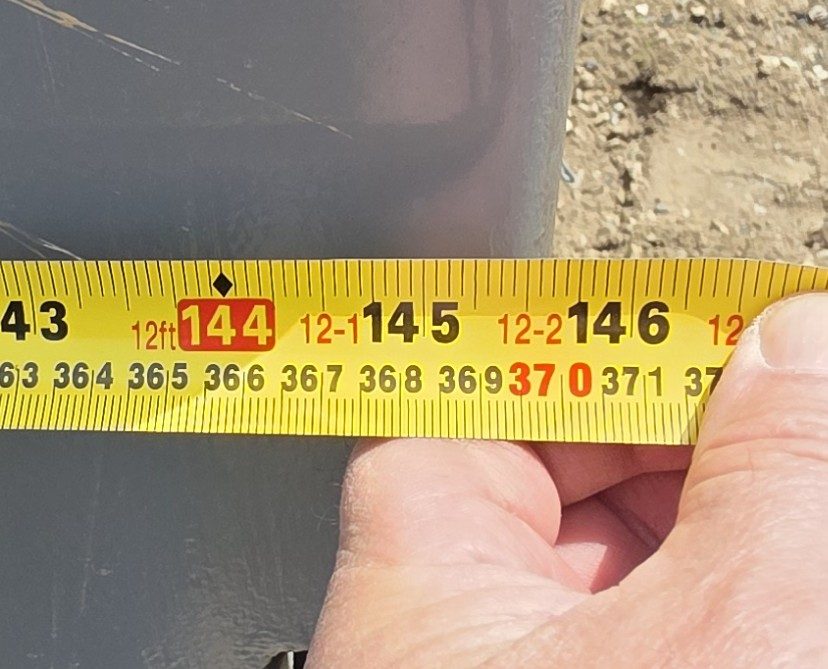
Twelve feet is a length the size codes skip. Under ISO 6346, as the Bureau International des Containers publishes it, length code 1 is 2,991 mm, the 10ft. Code 2 is 6,068 mm, the 20ft. No code sits between them, so a 12ft follows whatever length its builder chose. The same codes explain what the ISO marks on a Canadian container mean. That is why a tape photo is worth more here than a catalogue line.
Width and Height on a 12ft
Length is the measurement that changes on a 12ft. Width and height follow the box it was built from. A 12ft made from a standard container keeps the 2,438 mm (8 ft) width the BIC table gives every standard box. Its height is 2,591 mm (8 ft 6 in) if the donor was a standard dry box, or 2,895 mm (9 ft 6 in) if it was a high cube. Factory-made small boxes can use other widths, so Van Blanc confirms width and height on the actual unit when you call. Our sea can size rundown lists the common heights side by side.
How Big Is a 12ft Container?
A 12ft container at the standard 8 ft width covers 96 sq ft of ground. The table sets it beside the two ISO lengths on either side of it, using the BIC length codes and the same 2,438 mm width for all three.
| Length | Outside length | Size code on the doors | Floor footprint at 2,438 mm wide |
|---|---|---|---|
| 10ft | 2,991 mm (10 ft nominal) | Length code 1 | 7.29 sq m (78 sq ft) |
| 12ft (our unit) | 3,658 mm (12 ft nominal); taped at about 3,700 mm | No ISO length code | 8.92 sq m (96 sq ft) |
| 20ft | 6,068 mm (20 ft nominal) | Length code 2 | 14.79 sq m (159 sq ft) |
Set against a 10ft, the 12ft runs 667 mm longer, a little over 2 feet. That adds about 22% more floor. Against a 20ft, the 12ft holds about 60% of the footprint on less than two thirds of the length. The difference shows up at the gate and on the pad, and our length chart running from 10ft to 53ft has the full family in one place.
The 12ft and the CSC Area Line
The International Convention for Safe Containers, adopted in 1972, defines a container partly by area. The space inside its four outer bottom corners must be at least 14 sq m, or at least 7 sq m if the box has top corner fittings. A 12ft at 8.92 sq m clears the second line, and the unit in our photos shows castings at its top corners. So a 12ft can fall inside the convention’s definition, and a safety approval plate is possible on one. Whether a given 12ft carries a current plate depends on how it was built and inspected. Ask about the specific box, and read the way to verify a plate line by line before you rely on one for transport.
Repainted 12ft Container in Stock
The 12ft in recent Van Blanc stock is painted mid grey on every outside face. Its cargo doors fill one end. Four vertical locking bars cross them, each with its own handle near the bottom of the door. A lockbox sits on the centre seam, stamped with a small VB mark. Forklift pockets open through the bottom side rails, and castings finish all four top corners.
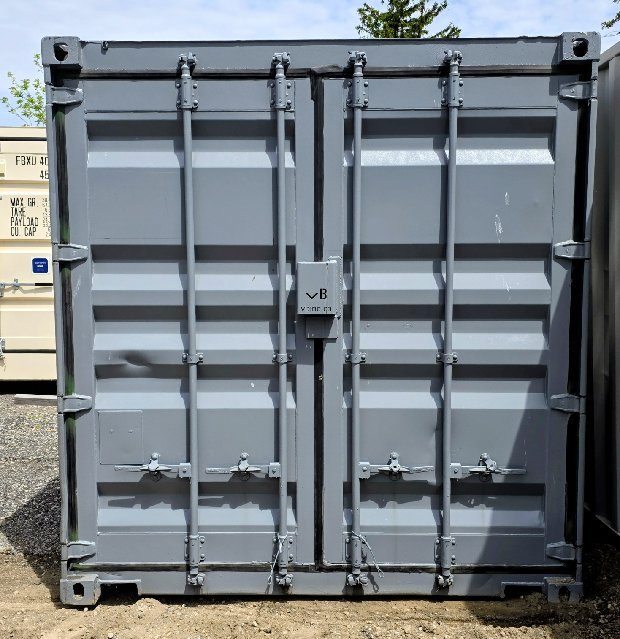
No container number or weight stencil shows on its doors in the photos. Many used boxes carry max gross, tare and payload lines on a door, and a buyer reads them before booking a forklift. On this 12ft, ask Van Blanc for the empty weight on the call. When a unit does have those lines, our rundown of container weights by length explains how tare, payload and gross fit together.
Stock at our yards turns over, and small lengths go quickly. The 12ft on this month’s list may have sold by the time you read this, and a different 12ft may be on the ground instead. A call to 519-754-6844 settles it in a minute.
Inside, Floor to Roof
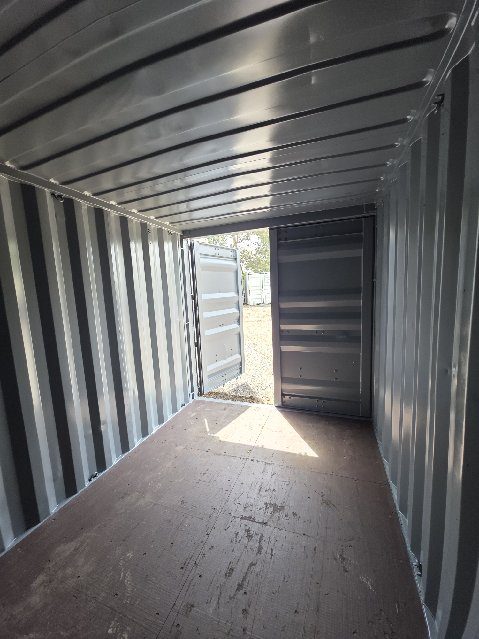
Open a door and the repaint carries through. The corrugated side walls and the roof panels are light grey. The far end is a plain corrugated steel wall, so the doors are on one end only. The floor is wood, laid in sheets with seams running across and along the box. Scuffs and scrapes mark the surface from use, and the sheets sit flat against the walls.
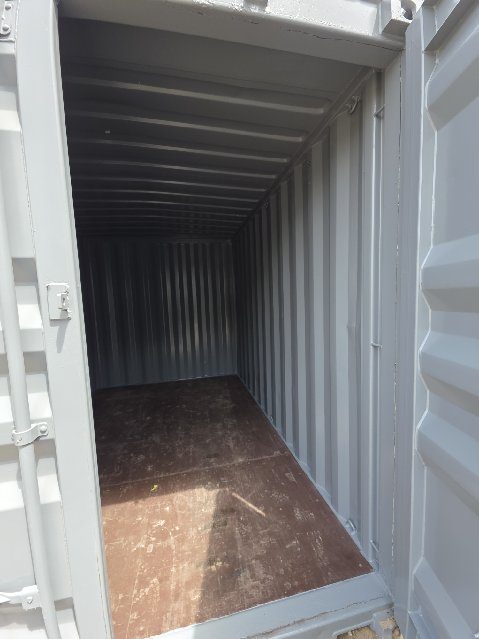
A light interior helps more than it looks. You can read labels on a shelf with the doors open and no lights wired in. If you plan to add power later, Van Blanc can rough in the electrical at our yards before delivery, and a licensed electrician makes the final connection on your site.
Cargo Doors and the VB Lockbox
Cargo doors on a container like this 12ft open the full end of the box. Each door carries two locking bars. Turning a handle rotates its bar, and cams at the top and bottom of the bar swing into keepers on the frame. The door that overlaps the centre seam has to open first, and it closes last. The steps in order are laid out in the right sequence for swinging and latching cargo doors.
Door opening size depends on the door set. On MC Containers’ spec sheet for a factory 10′ DC, the opening is 2,342 mm wide by 2,280 mm tall. That figure belongs to a standard 8 ft wide door set, and our 12ft’s opening was not measured for this listing. If a riding mower or a pallet jack has to pass through, give us its width and we will tape the opening before you buy.
The lockbox on this 12ft is a steel shroud welded around the padlock hasp. With the lock inside it, bolt cutters have no clear bite on the shackle. Van Blanc’s custom-features page states that lockboxes ship as standard on most new containers, and we add them to used ones too. For what that steel shroud stops, see how a welded lockbox shields the shackle. A short-shackle padlock suits it best, and a puck lock sized to fit inside the box is the common pick.
Swing Room for Two Doors
Each cargo door on an 8 ft wide end is about 4 ft wide, and both swing out to open the full end. Leave that much clear ground in front of the doors when you pick the drop spot. A fence post or a parked car in the swing path turns a two-door box into a one-door box. Face the doors toward your driveway or path, and read choosing the direction the doors face on delivery day before you book.
Container Length Between Ten and Twenty
A 12ft suits a site with a little more room than a 10ft needs and less room than a 20ft needs. Those extra 667 mm over a ten go into floor, which gives long items a place to lie down. Compared with a twenty, the 12ft leaves about 8 feet of yard free for a walkway, a trailer spot or a garden bed.
Van Blanc carries all three lengths, so the choice comes down to your ground and your load. The 10ft dry container page, with true 10s and cut-downs, covers the shorter box in detail. For a site with more room, our 20ft dry spec sheet lists every dimension of the twenty. On a narrow side yard, the 12ft adds floor without adding width.
Delivery length matters as much as box length. A tilt-deck truck backs up, tilts the deck and lets the box slide off onto the ground, so the truck needs a straight run behind the drop spot. The room a truck needs to set a box is worth reading before you choose the exact spot. Send us a phone photo of the approach, and we will tell you on the call whether the 12ft lands where you pictured it.
What Fits on the Floor
Floor length decides what lies flat, and that is where the 12ft earns its extra two feet. MC Containers lists 2,840 mm of inside length for a factory 10′ DC. Ten-foot lumber is 3,048 mm long, so it will not lie flat in that ten. The 12ft’s outside length beats ten feet by 610 mm, far more than its end frame and doors take up. Long stock stays tidy on the racks shown in shelving systems that suit a container.
| Item | Length | Flat on a 10ft floor (2,840 mm inside) | Flat on a 12ft floor |
|---|---|---|---|
| 8 ft lumber, 4 x 8 plywood sheets | 2,438 mm (8 ft) | Yes | Yes |
| 10 ft lumber, trim, eavestrough lengths | 3,048 mm (10 ft) | No, about 208 mm too long | Yes |
| 10 ft recreational kayak | 3,048 mm (10 ft) | No | Yes |
| Fence posts and 8 ft landscape timbers | 2,438 mm (8 ft) | Yes, with little room for anything beside them | Yes, with a walkway at the end |
Ask us to tape the inside length of the specific 12ft if an item runs close to ten feet. The inside number varies with how thick the end frame and doors are, and it takes a minute to check among the rows of stock at our yards.
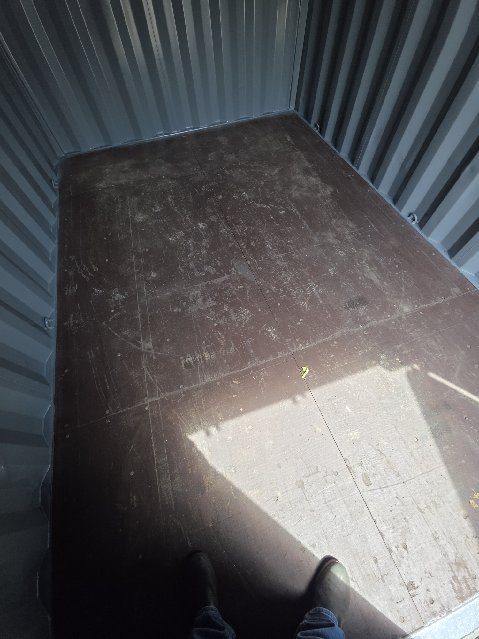
Check a container floor by walking it. Soft spots, lifted edges and dark stains near the doors are the things to look for, and a seam between sheets is normal. If a sheet ever needs to come out, replacing a marine plywood floor sheet covers the job. Shelving goes in along one long wall, and wire deck shelving on a container wall leaves the other side clear for long stock.
Ground Prep Before Delivery
Ground prep for a 12ft comes down to firm and level. A shipping container carries its weight on its corner castings and bottom rails, so it does not need a concrete slab poured under it. A compacted gravel pad works well. So do pressure-treated timbers or solid blocks set under each corner. Our step-by-step on building a compacted gravel base for a container gives the depth and size.
Level matters more on a box with cargo doors. If one corner sits low, the frame racks slightly and the doors stop lining up with their keepers. The locking bars then fight you every time you close up. A laser or a long level across the pad before delivery prevents that, and shimming a placed container back to level fixes it afterward.
Winter delivery works on frozen ground that is firm and graded. Frost heave in spring can shift a corner, so check the doors after the thaw. The details for a January drop are in notes on delivering onto frozen ground.
Forklift Pockets and Later Moves
Forklift pockets are the rectangular openings through the bottom side rails of the 12ft, sized for forklift tines. With pockets, the empty box can be lifted from the side and set down on a new spot. Van Blanc delivers the 12ft you buy with a tilt-deck drop onto your pad, placed where the truck can reach. Any move after that is yours to arrange, or a hauler’s.
The Canadian Centre for Occupational Health and Safety tells operators to know the load limit of the forklift and never exceed it. Its guidance also warns against travelling with a load raised more than 10 cm (4 in) off the floor. For a container, that means checking the empty weight against the capacity plate on the truck. It also means lifting low, with the tines all the way through both pockets.
The 12ft in our photos has no tare painted on its doors, so ask us for the figure. For scale, the spec table on our 20ft dry page lists 2,260 kg empty, and a 12ft of the same build carries far less steel. The rest of the handling side is in forklift work around a container on your own lot.
Paint, Vents and Condensation
Repainting on this 12ft covered both faces of the steel. Outside, the grey coat protects the panels from rain and road salt spray. Inside, it brightens the box and seals the walls. Before a repaint, sound prep matters most, and our article on marine epoxy paint for container steel explains what goes on under a good coat.
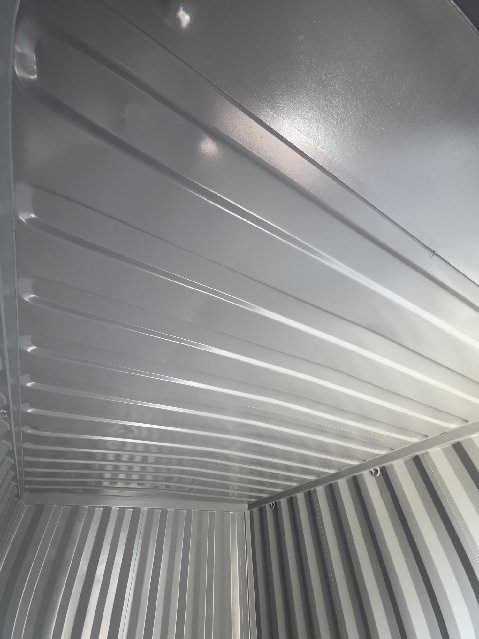
Condensation is the moisture problem any closed steel box can have. On a cool Ontario night, the roof panels drop below the dew point of the air inside, and water beads on the underside. Vents let that damp air out. Van Blanc’s custom-features page notes that most containers ship with 2 to 4 vents, and we add more at our yards for the load and the climate. The 12ft’s listing does not mention vents, so ask what it has.
Ventilation is a cheap fix for a box holding cardboard, tools or lawn equipment. When drips do start, fixing roof drip inside a container covers the causes and remedies. A small rust spot on the outside is simple to treat early, as treating a rust spot before it spreads shows.
Twelve Foot Box Jobs in Ontario
Twelve foot boxes suit jobs where the load has some length and the site has some limits. The list below matches common Ontario uses to what the 12ft does well. Each one ends in the same place: a dry, locked box that stays where it is set.
- Renovation contractors keep 10 ft trim, drywall corner bead and eavestrough lying flat, off the ground and out of the rain. The jobsite storage options across Ontario page covers the wider picture.
- Landscape crews park mowers, trimmers and blowers for winter, then swap in salt and shovels. Read about landscape crews storing equipment in steel.
- Cottage owners lay 10 ft kayaks on the floor with paddles and life jackets on a shelf. See storing kayaks and canoes over the off-season.
- Farms hold fence posts, wire rolls and parts bins beside the barn.
- Small retailers keep seasonal stock and display fixtures behind the store.
A Trim Carpenter’s Winter Setup
A trim carpenter working through a Hamilton winter needs somewhere dry for the long stuff. Baseboard, casing and crown come in 8, 10 and 12 foot lengths, and they warp if they sit damp. In a 12ft on a gravel pad behind the shop, the 10 foot stock lies flat on a rack along one wall. Mitre saw, nailers and compressor sit on shelving opposite. The lockbox keeps it closed between jobs. Farm buyers use the same layout for posts and wire, as storage on Ontario farms describes.
Is the 12ft Still in the Yard?
The fastest answer is a phone call. Tell us what the 12ft will hold, where it will sit and your postal code. We will say whether it is still on the ground, what it weighs empty and when it can land.
Grades, Repaints and What to Check
Container grades describe the condition of the steel, and paint describes the finish on top of it. The stock list calls this 12ft repainted, and it does not assign a grade. So the useful move is to know the four grades the trade uses and to check the unit itself. Our plain-language grade guide, one-trip through as-is has the long version.
| Grade | What the trade means by it | What to look at on a 12ft |
|---|---|---|
| New (one-trip) | One loaded voyage from the factory, original paint | Factory decals, clean floor, crisp door seals |
| Cargo worthy (CW) | Used and fit to go back into ocean service | Straight rails and posts, doors that seal tight |
| Wind and watertight (WWT) | Used, dry and lockable, more panel wear | No daylight with the doors shut, a dry floor |
| As-is | Sold with its defects listed, often for a build | The listed defects, checked against your plan |
Buyers who want factory paint and an untouched floor can start with new stock at Van Blanc. A repainted 12ft is judged on what the fresh coat sits on. Step inside, close the doors and look for pinholes of daylight in the roof and walls. Run a hand along the bottom rails and the door frame. Push on the floor near the doors with your heel.
Look closely at any weld line. A 12ft built from a longer box has one new end, either a welded wall or a new door set, joined to the shortened body. A clean, continuous bead with sound paint over it is what you want to see. The walk-round rust and corrosion checklist lists the other spots worth a look.
12ft Quote Inputs
Van Blanc quotes each 12ft per order and does not post prices, because the inputs move through the year. A quote for a 12ft is built from the inputs below.
- The unit itself: its build, its condition and the doors it has.
- Extras fitted at our yards, such as vents, shelving, a man door or a roll-up door.
- How far your site sits from Brantford, and how the truck gets in.
- The steel market and how many 12ft units are around at the time.
Give us the job, the drop spot and your postal code, and you get one all-in number with a lead time attached. Stocked units without modifications deliver in 1-3 days across Ontario. For how condition moves a number up or down, the grade-by-grade price ladder lays it out without a single figure to go stale.
Be careful with a cheap 12ft online. Buyers regularly call us about a bin listed a thousand dollars under ours on Facebook, then call back two weeks later after losing the deposit. The Marketplace deposit scam, step by step shows how it runs. Van Blanc has sold containers since 1995 and holds 4.9 stars across 140+ Google reviews, and you can see the actual 12ft in person before you pay.
Frequently Asked Questions
How much is a 12 foot shipping container?
Van Blanc prices each 12 foot container per quote. The number depends on the unit’s build and condition, its doors, any extras, delivery distance from Brantford and the steel market. Call 519-754-6844 or send your postal code, and you get an all-in number, usually the same day.
Are there 12 ft shipping containers?
Yes. There is no ISO length code for 12 ft, which sits between the 10ft and 20ft codes, so every 12ft is built to its maker’s own length. Van Blanc’s recent stock includes a repainted 12ft with cargo doors, a lockbox and forklift pockets.
What is the typical size of a 12ft shipping container?
About 12 ft (3,658 mm) long outside. A 12ft built from a standard box is 8 ft (2,438 mm) wide and 8 ft 6 in (2,591 mm) tall. One built from a high cube stands 9 ft 6 in. At that width it covers 96 sq ft.
How heavy is a 12 ft shipping container?
It depends on the build, and the unit in our stock has no tare painted on its doors, so ask for its empty weight. It sits well under the 2,260 kg our 20ft dry spec lists. Check that figure against the forklift’s rated capacity before any lift.
Do you need a concrete slab for a shipping container?
No. A container rests on its corner castings and bottom rails, so a compacted gravel pad or solid blocks or timbers under the corners will carry it. The base has to be firm and level, or the cargo doors stop lining up with their keepers.
Can a 12ft container get a roll-up door or a man door?
Yes. Van Blanc fits roll-up doors, steel man doors, windows with security bars and vents at our yards before delivery. A modified box ships once the work is finished, and the quote gives you that date up front.
How fast can a 12ft container be delivered in Ontario?
A stocked 12ft with no modifications delivers in 1-3 days to every region across Ontario, shipped from our 4 Brantford yards on a tilt-deck truck. Every quote comes with a real lead time, not a hopeful one.
Sources
- Bureau International des Containers, ISO 6346 size and type code tables, length and height codes, checked September 2026.
- UK Foreign, Commonwealth and Development Office, CSC 1972 treaty text, Article II definitions, checked September 2026.
- MC Containers, 10′ DC ISO shipping container spec sheet, checked September 2026.
- Canadian Centre for Occupational Health and Safety, Forklift Trucks: Professional Operator, checked September 2026.
See the 12ft at Our Brantford Yards
A 12ft is easiest to judge standing next to it. Swing both doors, walk the floor and look up at the roof with the doors shut. Paul or Christian can show you the unit, and we have been supplying shipping containers across Ontario since 1995.
Van Blanc Ent. Inc. | 90 Morton Ave. East, Unit 1-B, Brantford, ON N3R 7J7 | 519-754-6844