
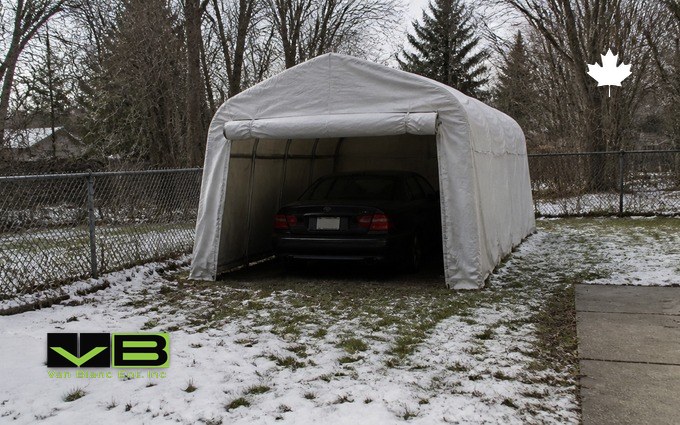
Quick Answer: A portable garage is a steel-tube frame under a fabric cover: the fastest, cheapest roof a vehicle can get. Its honest lifespan lives in the cover, one season for bargain fabric and a decade for heavy-duty laminates, and in anchoring, since an unanchored shelter is a kite patiently awaiting wind.
In This Guide
- What the Category Actually Is
- The Cover Decides Everything
- Frames, Snow Ratings, and the Specifications
- Anchoring: The Whole Ballgame
- The Assembly Afternoon
- Sizing and the Door Question
- The Ontario Winter Verdict
- Who the Tier Honestly Serves
- Teardowns, Moves, and Second Lives
- Care and Feeding
- The Ladder Up: Carport, Garage, Steel
- Portable Garage FAQs
Reading Time: 12 minutes
What the Category Actually Is
The portable garage, the fabric shelter, the instant garage, the Costco tent, the category answers to many names and one description: a frame of galvanized steel tubing, assembled with hand tools in an afternoon, wearing a tensioned fabric cover that turns it into a roof and usually walls. It is the cheapest full-vehicle shelter money buys and the fastest to exist, standing by suppertime where morning had bare grass, and both virtues are real rather than marketing. The category’s scale is real too: these shelters stand in the tens of thousands across the province’s driveways, farms, and job sites, which makes an honest review of the tier a public service rather than a niche exercise. This review takes the category seriously on its own terms, the way we reviewed its cousins across the shed and shelter world, because the Brantford yards compete with it, and every caller deserves to know what fabric does and what steel does before spending either way. The reference brand throughout is ShelterLogic, the category’s biggest name, whose published specifications make the tier’s real economics unusually easy to read. At the far end of the same material family sits the engineered tension-fabric building, and the Sprung Structures review explains what separates a fifty-year aluminum frame from a tube-and-tarp shelter.
Paul LeBlanc, Van Blanc: “I have nothing bad to say about a good fabric shelter used honestly. I own one myself for the firewood processor. What I tell customers is one sentence: you are not buying the frame, you are buying the cover and the anchoring, and the price tag usually tells you which grade of both you are getting.”
The Cover Decides Everything
The frame of a portable garage routinely outlives three covers, which means the cover is the product and the frame is its stand. The industry knows this, and the established makers say so in their warranty tiers: ShelterLogic’s own replacement-cover program runs from standard covers carrying a one-year limited warranty up through heavy-duty and ultra-duty grades carrying ten and fifteen-year prorated coverage, which is the manufacturer telling you, in writing, that the grades are different products wearing the same shape. The physics behind the tiers is fabric weight and construction, heavier polyethylene, multiple laminated layers, ripstop weaves, and UV treatment, because sunlight is the cover’s patient enemy, embrittling cheap fabric into confetti while the laminates shrug through seasons. The category’s field literature and its bargain-bin reviews agree on the resulting arithmetic: the cheapest cover can be a single-season purchase, the mid grades earn a few years, and the heavy grades genuinely deliver their decade when tensioned and maintained. The buying rule follows: read the cover’s specification, not the structure’s silhouette, since the same frame under different fabric is a different product with a different lifespan. The Canadian maker whose business is the cover, and who also builds the frames, is reviewed in the Cover-Tech review.
Frames, Snow Ratings, and the Specifications
The frame conversation is shorter but has one crucial fork: rated versus unrated. Most of the category carries no snow-load rating at all, which is not a scandal but a specification, an honest statement that the structure expects its owner to knock heavy snow off before it accumulates. The rated end exists for buyers who want engineering instead of vigilance: ShelterLogic’s ShelterTube line and its peers publish wind and snow ratings in pounds per square foot, earned with heavier-gauge square tubing, denser rib spacing, and covers designed to shed. The specifications between the ends matter more than the photos, tube gauge and diameter, rib spacing, the connection hardware, and it prices honestly, since steel is sold by weight in every industry including this one. A buyer comparing two similar-looking shelters at very different prices is almost always comparing different tube gauges and different fabric weights, and the cheaper one is cheaper the way thinner ice is cheaper. Where that fork sits inside the whole fabric-shelter category, from the box-store tent to the engineered fabric building, is mapped in the storage tents and temporary garages guide. The Quebec brand that leads the seasonal end of this market publishes a zinc weight rather than a rating, which the Tempo shelter review takes apart honestly.
Anchoring: The Whole Ballgame
Every portable-garage failure story that does not involve snow involves wind, and nearly all of them involve anchoring that was treated as a suggestion. The category’s field wisdom, echoed from manufacturer knowledge bases to the rural equipment forums, is unanimous: the structure is a sail wearing a frame, and it survives exactly as well as its connection to the ground. The kits’ included stakes serve soft soil and only soft soil; concrete and asphalt want their own anchor hardware; and the veterans over-anchor as a habit, adding augers or concrete blocks beyond the manual’s minimum because the manual was written for average wind and Ontario does not promise average. Anchoring is also a maintenance item rather than an installation item, checked seasonally as soil heaves and straps relax. The honest summary is cheerful enough: anchored diligently, the tier stays put through weather that surprises people; anchored casually, it is the neighbourhood’s most expensive tumbleweed, and no cover grade can save a structure that has left the property.
The Assembly Afternoon
The kits earn their instant-garage reputation, but the afternoon goes better with the field notes the manuals compress. It is a two-person job in truth, one to hold and one to fasten, and the solo builders who force it usually pay in racked frames and re-done sections. The base decides the building: lay the footprint out with a tape and the diagonal measurement, because a base that is even slightly out of square fights every rib that follows and leaves a cover that can never tension evenly. The cross-cables and bracing that some builders skip as cosmetic are structural, the difference between a frame that shrugs at wind and one that parallelograms in the first storm. The cover goes on in calm air, full stop, since a half-attached cover in a breeze is a sail with opinions, and it goes on snug but not final, with the real tensioning done after the fabric relaxes for a day and again after the first month. Permits are managed by your municipality, so check with your local building or planning department before you order, since even the portable tier can cross local thresholds by size or siting, and the phone call is shorter than the argument.
Sizing and the Door Question
The category prices by footprint, and the buyers who regret their sizing almost all regretted the third dimension: height. A pickup with a cap, a boat on its trailer with the windshield or tower standing, a camper with roof accessories, all of these measure taller than the memory that ordered the shelter, and the peak height in the listing is the centre of the arch, not the height at the walls where mirrors and gunwales actually live. Measure the tallest thing that will enter, add the clearance a person walking beside it wants, and buy the next size of honesty. The door question follows: the tier splits between open-ended shelters, fastest for daily in-and-out and best ventilated, and zippered or roll-up ends that close the weather out at the cost of a fabric door’s working life, since zippers and their panels are the cover’s hardest-worked and first-failing parts. Daily-driver missions usually live happiest with an open or half-panel end facing away from the weather; storage missions earn the closed ends and the patience they ask. Either way the width wants a real aisle beside the vehicle, because a shelter you can only enter by exhaling was sized for the photo, not the driveway.
Ready for the Permanent Rung?
When the fabric math stops making sense, the steel is sitting in our rows: wind-indifferent, snow-indifferent, lockable, and delivered on our own trucks with a real lead time, not a hopeful one. Fast 1-3 day delivery across Ontario from our Brantford yards, cash on delivery.
Van Blanc Ent. Inc. · Brantford, Ontario · Since 1995 · 4.9 stars across 140+ Google reviews · Cash on delivery
The Ontario Winter Verdict
Our field piece on what February actually does to fabric shelters carries the winter story in full, and the review-level summary fits in a paragraph. The tier can absolutely winter in Ontario, the province’s driveways prove it by the thousand, but it winters on terms: an unrated unit needs its snow knocked off with a broom or roof rake before accumulation compacts, its cover needs to enter winter tensioned drum-tight because a loose cover pockets snow and flogs itself to death in wind, and its placement needs to respect the roof-avalanche paths of nearby buildings for the same reason every small structure on this site does. The rated lines relax the vigilance without eliminating it. What winter mostly does to the category is compress its economics, since a cover that would have died of UV in year six dies of a missed snowfall in year two, which is why the same product earns different reviews in Windsor and in Barrie, and why the honest recommendation scales with your snowbelt.
Siting adds a winter bonus worth its own paragraph: orientation. A shelter whose open end faces the prevailing winter wind becomes a wind tunnel that stress-tests every strap, while the same unit turned ninety degrees rides the season with its closed shoulder to the weather. The veterans also site for the melt as much as the snow, on ground that drains rather than in the low spot where March turns the floor into a reflecting pool, and they leave working room on the broom-side of the roof so the snow-clearing chore stays a two-minute job instead of an expedition. Ten minutes of siting thought at delivery buys a measurably longer cover life, which in this category is the whole ledger.
Who the Tier Honestly Serves
Stripped of both the marketing and the snobbery, the portable garage is bought by four kinds of buyer. The seasonal owner leads: the boat, the bike fleet’s summer overflow, the tractor between seasons, jobs where the shelter itself can come down for the worst months or where what it shelters is gone by then. The renter and the maybe-mover follow, since the tier packs into a truck bed and leaves with you. The budget bridge is third: a household that needs the truck out of the weather this winter while it saves toward the garage or the steel. And the workspace-of-convenience is fourth, the seasonal wood-processing bay, the summer project canopy, the shelter whose whole appeal is that it can exist for one purpose and stop existing afterward. What the tier does not honestly serve is the buyer seeking security, since fabric answers to any utility knife ever made, or the buyer seeking permanence on a budget, who is really buying two or three covers on layaway. The permanent alternative most of them priced first is explained without a dollar figure in the site-built garage reality piece.
Teardowns, Moves, and Second Lives
Portability is the tier’s founding promise, and it holds better than cynics expect when the teardown is treated as the assembly run backward rather than as demolition. The cover comes off first and in calm air, gets dried fully before folding because a cover stored damp molds into abstract art, and travels in its own labelled bin with the tensioning hardware. The frame breaks into its sections with the fasteners bagged by joint, and the builders who photograph each stage during disassembly buy themselves a wordless manual for the re-build. Moved this way, a mid-grade shelter survives several relocations, which is precisely the renter’s and the cottager’s use case working as designed. The second-life market is real too: frames outlive covers so consistently that used frames circulate locally as the cheap half of a new-cover pairing, and a frame with a fresh heavy-duty cover is one of the tier’s best value plays for the buyer who checks the tube gauge before handing over the cash. The pairing rewards a little homework, since cover fit runs by frame model and generation rather than by footprint alone, and the manufacturers publish fit guides for exactly this hunt; ten minutes matching part numbers beats an afternoon discovering that a twelve-by-twenty cover comes in three incompatible shapes. The one honest caution transfers from every used market on this site: inspect in person, look for bent tubes and stripped fittings at the joints, and price the missing parts before the handshake.
Care and Feeding
The gap between the tier’s one-season horror stories and its ten-year success stories is mostly a short maintenance culture. Tension is the heart of it: the cover goes on tight with the tensioning hardware the good kits include, gets re-tensioned after its first month of settling, and gets checked at the season turns, because a taut cover sheds weather while a slack one fights it. The fabric earns a wash when grime accumulates, less for looks than because debris holds moisture against the coating, and small punctures get patched the week they appear, since fabric tears propagate like gossip. The frame wants its bolts snugged annually and its feet inspected where they meet the anchoring. And the end-of-life is part of the ownership too: covers are consumables with a genuine replacement market, the manufacturers publish fit guides and quick-install tensioning systems for exactly this moment, and a frame under its second or third cover is the category working as designed rather than failing. Owners who run this routine land in the long tail of the lifespan curve, and it costs perhaps two hours a year, spread across afternoons the owner was already outside anyway.
The routine has a calendar shape worth writing down. Spring is the big inspection, cover condition, frame bolts, anchor tension after the frost lets go of the ground. Summer is the UV season, when a wash and a patch matter most. Fall is tensioning season, the cover brought drum-tight before the first wet snow finds any slack to load. Winter is the broom. An owner who tapes that four-line calendar inside the shed door has, for free, the maintenance program the fifteen-year cover warranties assume.
The Ladder Up: Carport, Garage, Steel
| Rung | What it adds | What it costs you |
|---|---|---|
| Portable garage | Instant roof, portability, lowest entry | Cover lifecycle, vigilance, zero security |
| Steel carport | Bolted permanence, snow indifference | Fixed location, open sides |
| Garage or kit | Walls, door, full enclosure | The build project and its calendar |
| Container | Locked steel, delivered working | Industrial look, container dimensions |
The tier’s honest position is the bottom rung of a real ladder, and the climb is well mapped on this site: the bolted-steel carport it eventually argues you into answers the snow-vigilance problem permanently, the garage kits answer enclosure, and our own rows answer security and immediacy at once, particularly for the equipment, tool, and storage missions where the tall end of covered storage takes over. Many people call us saying they can get a bin for a thousand dollars less on Facebook. Two weeks later some of them call back to say they got scammed. The fabric tier has its own version, the no-name marketplace shelter whose specifications exist only in the listing’s imagination, and the defence transfers exactly: buy from names that publish specs and warranties, and treat a price that beats the physics as the warning it is.
The portable garage is an honest product with a short ledger, and the review reduces to its own two components: buy the heaviest cover the budget carries, anchor like the wind is personal, and the tier delivers cheap shelter for years. Ask it for security or permanence and it will disappoint you on schedule. Somewhere in the third cover’s price, the steel across the ladder starts winning the arithmetic, and when your math crosses that line, you know where the rows are.
Portable Garage FAQs
How long does a portable garage actually last?
The frame lasts a decade or more; the cover is the real clock. Bargain fabric can die in a season while heavy-duty laminated covers carry ten-to-fifteen-year prorated warranties from the major makers, and diligent tensioning and snow removal decide where in that range yours lands. You are buying the cover; the frame is its stand.
Can a portable garage handle Ontario snow?
Yes, on terms. Most units carry no snow rating and expect the owner to knock accumulation off before it compacts; the rated lines publish pounds-per-square-foot capacities earned with heavier tube and denser ribs. Enter winter with the cover drum-tight, keep it clear of roof-avalanche paths, and the tier winters fine.
What is the most important part of installing one?
Anchoring, without competition. The structure is a sail wearing a frame: kit stakes serve soft soil only, concrete and asphalt want dedicated anchor hardware, and veterans exceed the manual’s minimum because Ontario wind does not read manuals. Re-check anchors and strap tension seasonally; almost every non-snow failure in the category is an anchoring story.
Who is a portable garage built for?
Seasonal owners, renters and likely movers, households bridging a winter while they save for the permanent build, and anyone needing a temporary project bay. The tier goes up fast and leaves clean. It serves nobody seeking security, since fabric yields to any blade, and that job belongs to locked steel that carries the snow and keeps its resale value.
When does a container beat a portable garage?
The moment the mission includes security, contents worth locking, or a horizon past a few seasons. Steel is indifferent to wind and snow, locks like the vault the fabric tier cannot fake, and arrives working in days.
Sources
- ShelterLogic. (2026). Extend the Life of Your Garage: Replacement Covers. shelterlogic.com. The maker’s own cover grades, warranties, and tensioning guidance
- ShelterLogic. (2026). Compare Wind and Snow Load Rated Shelters. shelterlogic.com. The rated end of the category and its published capacities
- The Wearify. (2026). Best Portable Garage: Frames That Won’t Bend in Snow. thewearify.com. An independent roundup of frame gauge and fabric grades
- TractorByNet Forums. (2025). Portable Garage and Snow Load. tractorbynet.com. Rural owners’ field experience with snow and anchoring
Reach Van Blanc in Brantford
We have sold the permanent rung of this ladder since 1995, and we respect the fabric rung enough to review it straight. If your shelter math is crossing the line where steel wins, the rows at 90 Morton Avenue East are the afternoon trip that settles it.
Van Blanc Ent. Inc., 90 Morton Ave E Unit 1B, Brantford, ON N3R 7J7, 519-754-6844
Weighing fabric against steel? Call with the mission and the snowbelt.