
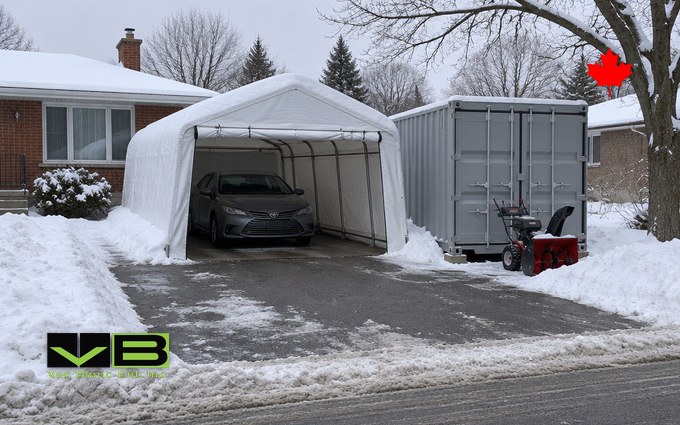
Quick Answer: Tempo has built fabric car shelters in Quebec since 1971, with 280 grams of zinc per square metre on the frame and a fabric tested for tear, UV and freeze-thaw. It is the category’s best-known name. Published specs are thin, the warranty term unstated, and Ontario towns limit the season.
In This Guide
- Who is writing this, and why
- What Tempo is, and what it makes
- Where Tempo is genuinely strong
- What the specs say, and what they leave out
- The documented trade-offs
- Tempo in Ontario: the season, the bylaw and the dealer question
- Tempo against ShelterLogic, Harnois and the box
- Tempo fit: the car, the season and the gear
- The Tempo buyer’s checklist
- Tempo car shelter FAQs
Reading Time: 11 minutes
Who is writing this, and why
Van Blanc Ent. Inc. is a shipping container yard in Brantford, Ontario. We are not a Tempo dealer, we have never been paid by Tempo or any competitor, and nobody at Tempo has read this before publication. We sell steel boxes, which compete with a fabric car shelter for one job: a dry, lockable place for a vehicle and its gear through the winter. Everything below is taken from Tempo’s own published pages, re-checked on the day this was written, with the gaps in those pages named as gaps rather than filled in with guesses. Our car shelter guide for Ontario winters is the category-level read and this is the brand-level one.
What Tempo is, and what it makes
Abris Tempo is a Laval, Quebec company that has built temporary car shelters since 1971 and calls itself the pioneer and undisputed leader of the category in Quebec and Canada, a claim that anyone who has driven a Montreal suburb in January will not argue with, because the Tempo shelter is the reason the word abri means a fabric garage to a whole province. The product line is a family of galvanized steel tube frames under a tensioned fabric: single shelters, double shelters in peak and round profiles, single-slope shelters for the side of a house, storage shelters, entrance shelters over a door, walkway and fence shelters, and an industrial and commercial line, plus replacement covers and a parts catalogue for frames already standing. The company sells throughout Canada with delivery, offers installation assistance, and runs a configurator for dimensions that are not in the standard list, with local truck delivery starting in mid-September when the season opens. A shelter goes up in the fall, stands through the winter with the car inside, and comes down in the spring, and that seasonal rhythm is the whole product. Our portable garage review covers the year-round cousin of that product, and the difference between the two is the first thing an Ontario buyer should understand.
Where Tempo is genuinely strong
Four things are documented and real. First, the frame: Tempo states that its galvanized steel is coated with 280 grams of zinc per square metre and describes that as twice the industry standard, which matters because a car shelter frame lives in road salt and meltwater for five months and a thin galvanizing is where cheap shelters rust through at the joints. Second, the fabric: Tempo says its cover is tested by the Textile Technology Centre, the CTT, for tear strength, UV resistance and freeze-thaw endurance, which is more than most shelter sellers publish about a cover and is the right set of tests for a Canadian winter. Third, longevity and support: the company says a well-maintained shelter can easily last ten years or more, and it backs that with replacement covers and a parts line, so a frame that outlives its fabric gets a new cover rather than a new shelter, which is the single most useful thing a shelter maker can offer. Fourth, the design itself: fifty-plus years of building for Quebec winters is a long feedback loop, and the peak-roof profile, the door options and the anchoring have been refined against snow that most of Ontario’s shelter buyers never see. The carport guide’s chapter on fabric and steel roofs is where those design choices are compared with the hard-roof alternatives.
What Tempo publishes that most shelter sellers do not
- A zinc weight for the galvanizing: 280 grams per square metre, stated as twice the industry standard.
- A named test lab for the fabric: the CTT, for tear, UV and freeze-thaw.
- A lifespan claim with a condition: ten years or more if maintained.
- A parts and replacement-cover line for frames already standing.
What the specs say, and what they leave out
Here is the honest gap. On the pages we read, Tempo does not publish the tube diameter or wall gauge of its frames, per-model dimensions on the collection pages, a snow-load or wind rating, or the term of the warranty it calls the best in the industry. Those are the four numbers a buyer comparing shelters most needs, and the competing ShelterLogic ShelterTube line, for one, publishes wind and snow ratings on the product page. That does not mean Tempo’s shelters are weaker; it means the buyer has to ask, use the configurator, or read the manual that comes with the box to find out, and a review that respects its subject says so rather than inventing figures. The zinc weight and the lab-tested fabric are the two specs Tempo chooses to lead with, and they are good ones, but they describe corrosion and cover life, not the load the roof carries. The buyer’s move is simple: ask the dealer or Tempo for the frame gauge and the snow rating in writing before buying, and ask for the warranty term and what it excludes, because the fabric on any tensioned shelter is a wear item and the frame is the investment. What snow load means on a steel roof is the reference for why that number matters on a fabric one.
The documented trade-offs
The trade-offs are the category’s, and Tempo shares them with every fabric shelter. It is seasonal: it goes up in the fall and comes down in the spring, and the frame and cover need a place to live for seven months, which is a shed, a garage corner or the side of the house. It is fabric: it keeps snow and sun off a car and nothing more, so a tool set left inside is a tool set behind a zipper, and the reason a steel box locks and a shelter does not is the difference between weather protection and security. It is tensioned: the cover wants brushing after a heavy snow, the anchors want checking after a thaw, and a shelter left to sag is a shelter that tears, which is why Tempo’s own lifespan claim carries the words well-maintained. It is a wind structure: on an open lot or a corner exposed to the northwest, a fabric shelter is a sail, and the anchoring has to match the site rather than the box. And it is a product whose published numbers are thinner than its reputation, which puts more of the work on the buyer at the counter. None of those is a defect; all of them are the price of a garage that arrives in a carton and costs what a garage never will. The carport-or-garage verdict for an Ontario lot is where the fabric shelter’s place among the roofed options is scored.
Christian LeBlanc, Van Blanc Ent. Inc.: “A Tempo keeps the snow off the car and I have no argument with it. The calls I get are from the people who put the snowblower, the tires and the tools in there with the car and lost them. The shelter was doing its job. It was never a lock.”
Tempo in Ontario: the season, the bylaw and the dealer question
Three things change when a Quebec product crosses into Ontario. The first is the rule: many Ontario municipalities restrict temporary car shelters to a winter window, which the carport guide’s bylaw chapter covers town by town, some prohibit them on residential lots outright, and a buyer should read their own town’s bylaw before the carton is ordered, which is the one sentence on rules this page needs. The second is the dealer network: Tempo says it sells throughout Canada with delivery, and it is stocked by online retailers, but the dense dealer-and-installer network that makes the product effortless in Quebec is thinner west of the Ottawa River, so an Ontario buyer is more often assembling and anchoring it themselves from the manual, with the configurator and the installation assistance the company offers as the backstop. The third is snow: southern Ontario’s snow is lighter than Quebec’s most years and heavier in the belt from London through Barrie to the Bruce, and a shelter designed for Quebec loads is over-built for a Brantford driveway and about right for a Collingwood one, which is a point in Tempo’s favour in the snowbelt and a neutral one elsewhere. The heated bay at a storage facility is the third option for a car, and a rented storage bay against a box you own is the arithmetic on that one.
Tempo against ShelterLogic, Harnois and the box
Tempo’s competitors are a Quebec neighbour, an American category brand and a steel room. Abris Harnois and Abris Mondial are the Quebec neighbours, selling the same seasonal product through the same rental-and-install culture, and a buyer in Gatineau or Cornwall will find all three on the same street. ShelterLogic is the American category brand sold through Canadian Tire, Costco and the web, whose ShelterTube line publishes wind and snow ratings on the box and whose lighter garage-in-a-box lines are the ones that end up in ditches in March; the ShelterLogic lines read by their own claims is that comparison. The box is us: a 20-foot container holds a car only in the narrowest sense, 7 feet 8 inches wide inside with no room to open a door, so it is not a car shelter; what it holds is everything that should never have been in the shelter, the tires, the tools, the mower and the sled, dry, locked and unmoved by wind, and the classic car container is the one case where a car does go in a box, with a lined forty and a ramp. On many Ontario driveways the car sits under fabric with a box behind it for the machines and the gear, locked and out of the wind.
| Question | Tempo | ShelterLogic ShelterTube | Shipping container |
|---|---|---|---|
| Made for | Quebec winters since 1971 | North American market; rated lines | Ocean freight; steel room |
| Published frame spec | 280 g/m2 zinc; gauge not stated on pages read | Wind and snow ratings on the product page | Corten steel; ISO-rated floor and corners |
| Cover | CTT-tested fabric; replacement covers sold | Fabric; replacement covers sold | Steel roof, no cover |
| Season | Fall to spring; stored in summer | Year-round lines exist | Year-round; vented for winter |
| Holds a car | Yes, one or two | Yes | No, except a lined forty for a classic |
| Locks | Zipper | Zipper | Cam doors and a shrouded padlock |
| Warranty stated | “Best in the industry”; term not stated on pages read | Stated per line | Grade-based; the grade sheet |
| Ontario bylaw | Seasonal limits in many towns | Same | Accessory-structure rules by municipality |
Shelter for the car, box for the rest?
Tell us what lives on the driveway besides the car, where a box could sit and how a truck reaches it. We will tell you a ten or a twenty, the grade, the vents and the lock, and one honest all-in number with a real lead time.
Family-run in Brantford since 1995 · 200+ containers in stock · 4.9★ across 140+ Google reviews · every box graded by a person, walk it before it lands.
Tempo fit: the car, the season and the gear
A Tempo is built for a car under a roof from November to April on a lot whose bylaw allows it, on a site sheltered enough that the frame is not a sail, with a place to store the frame and cover in summer, and for an owner who will brush the roof and check the anchors, because the product is honest about needing that. In the snowbelt its Quebec-built frame is its case against the lighter shelters, and the parts line is what turns a ten-year claim into a ten-year shelter. It is a cover: not a garage for tools, gear or anything with a resale value, not a year-round structure in a town that limits the season, and not a plan for an exposed corner without anchoring. The dry, locked, year-round storage beside the car is the half a steel box covers, and a steel box against a shed prices that half of the problem. Where the whole question is what building the driveway needs, the Ontario storage buildings market, sorted by family puts the fabric shelter beside its neighbours, and the drivers behind a box quote are size, grade and distance if the answer is steel. We sell outright, never rent; a buyer spreading the cost of a box does it through their own bank with the invoice and the serial number we supply.
Where the shelter-and-box driveways are
The Tempo-plus-box calls come from the snowbelt and the suburbs both: driveways around Barrie and the Simcoe snowbelt, the lake-effect streets of London, the Burlington tight lots and the Kitchener driveways where the shelter takes the driveway and the gear has nowhere left to go. Worth the drive for unbeatable quality, family customer service with 30 years of experience.
The Tempo buyer’s checklist
Before the carton
- Read the town’s temporary-shelter bylaw for the season it allows and the setbacks it wants.
- Ask Tempo or the dealer, in writing, for the frame tube diameter and gauge, the snow and wind rating, and the warranty term and exclusions.
- Measure the driveway for the shelter and the wind for the site; an exposed corner needs the heavier anchoring.
- Plan the summer: where the frame and the cover live from April to November.
- Move everything that is not the car out of the plan; tools, tires and machines go in a locked building.
- If that building is a box, walk a ten and a twenty at the Brantford rows with the gear list before the shelter goes up.
The buyer who asks for the four missing numbers before paying knows what the frame and the warranty actually carry, and the last two lines of the list are where the gear gets a locked steel room of its own, and the comparison hub that scores every building we compete with is where the fabric shelter sits among them.
Frequently Asked Questions
Is Tempo a good car shelter?
Here is what is documented: a Quebec maker since 1971, a galvanized frame with 280 grams of zinc per square metre, a fabric tested by the CTT for tear, UV and freeze-thaw, a ten-year-plus lifespan claim if maintained, and a parts and replacement-cover line. The gaps are the unpublished frame gauge, snow rating and warranty term, which a buyer should ask for in writing.
How long does a Tempo shelter last?
Tempo says a well-maintained shelter can easily last ten years or more. The frame is the long-lived part, protected by the heavy galvanizing; the fabric is a wear item, which is why replacement covers exist. Brushing snow off after storms, keeping the cover tensioned and checking the anchors after thaws are the maintenance the claim depends on.
Can I use a Tempo car shelter in Ontario?
Physically, yes; it is built for heavier snow than most of southern Ontario sees. Legally, it depends on the municipality: many Ontario towns allow temporary shelters only in a winter window and some do not allow them on residential lots at all, so read the local bylaw first. The car shelter guide for Ontario covers the category’s rules and the wind and anchoring questions.
Does a Tempo shelter come with a warranty?
Tempo describes its warranty as the best in the industry and provides warranty and parts forms, but the term and the exclusions were not stated on the pages we read. Ask for both in writing, and expect the frame and the fabric to be covered differently, because that is how tensioned-fabric shelters are warranted across the category.
Tempo or ShelterLogic?
Tempo’s case is the Quebec-built frame and the parts line; ShelterLogic’s rated ShelterTube line publishes wind and snow numbers on the box and has a year-round option. Both are fabric shelters with the same limits: no security, seasonal in many Ontario towns, and a wind structure that needs anchoring to the site. Our year-round portable garage read covers ShelterLogic’s lines by their own claims.
Can a shipping container replace a car shelter?
Not for the daily driver: a standard container is 7 feet 8 inches wide inside, which is not a car bay, and a lined forty is a classic-car vault rather than a shelter. What a box replaces is the tool, tire, mower and machine storage that ends up inside a fabric shelter and should not, dry, locked and year-round, and the classic car storage container is the exception that proves it.
Sources
- Abris Tempo. (2026). Tempo Shelters: The Real Car Shelter. abristempo.com
- Abris Tempo. (2026). Complete Shelters. abristempo.com
- Abris Tempo. (2026). Rental vs Purchase. abristempo.com
- ShelterLogic. (2026). ShelterTube Wind and Snow Rated Garage. shelterlogic.com
- Abris Mondial. (2026). Car Shelters: Frequently Asked Questions. abrismondial.com
Reach Van Blanc in Brantford
We have been supplying shipping containers across Ontario since 1995. Our yard is at 90 Morton Avenue East in Brantford, and we deliver right across the province with payment on the day of delivery. No deposit, no upfront wires, no chase-the-paperwork.
Van Blanc Ent. Inc., 90 Morton Ave E Unit 1B, Brantford, ON N3R 7J7, 519-754-6844 (cell) or 1-888-509-6658 (toll-free).
If the shelter is going up and the gear has nowhere to go, call with the list and your postal code, and we will tell you on the spot which tens and twenties are on the ground and when one can land beside it. Worth the drive for unbeatable quality, family customer service with 30 years of experience.