
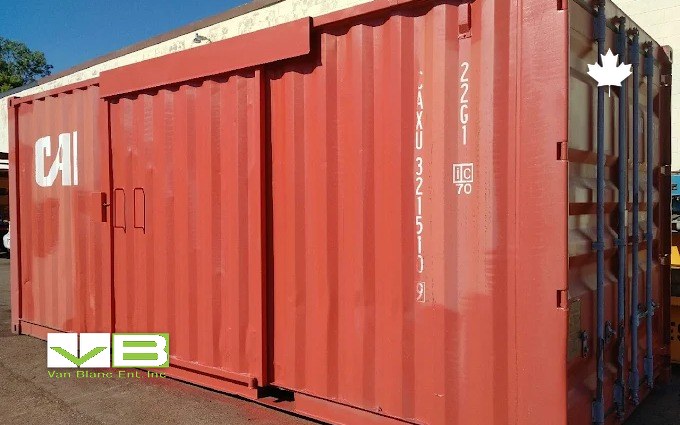
Quick Answer: Downsizing in Ontario means deciding what a smaller home keeps and where everything else honestly lands. Sort by how you live now, not how the house lived ten years ago. Short gaps suit rented self-storage; a permanently kept workshop or an estate’s worth of tools suits steel you own outright.
In This Guide
- The Downsizing Wave Ontario Is Riding
- A Sorting Framework That Survives Contact With the Basement
- The Three Timelines, and Why They Need Different Storage
- What Rented Storage Is For
- The Workshop Problem
- Owning the Box: When the Smaller Life Is Permanent
- What Actually Fits in the Box
- The Furniture Truth Nobody Prints
- The Estate Clock
- The Professionals at Scale
- Downsizing FAQs
Reading Time: 13 minutes
The Downsizing Wave Ontario Is Riding
Downsizing has become one of the province’s great shared projects. The generation that filled Ontario’s four-bedroom houses through the eighties and nineties is trading them for condos, bungalows, and retirement suites, their adult kids are absorbing what the new floor plans cannot, and an entire profession, the senior move manager, has grown up around helping households shrink with dignity. Add the empty nesters leaving early, the couples cashing out of hot markets, and the executors clearing a parent’s home on a probate schedule, and the same question lands on thousands of kitchen tables every month: the house held forty years of accumulation, the next place holds a fraction of it, and every single object now needs a verdict.
We meet this wave from an unusual seat. Van Blanc sells shipping containers from our Brantford yards, which makes us one of the places the overflow eventually calls, and it has taught us to give advice that sounds strange from a storage seller: most downsizing storage should not be bought from us. The bridge between two closings is a rental problem, and we do not rent. Where our product earns its place is the narrower, longer story this page builds toward, the workshop that refuses to die, the estate that needs years rather than weeks, the family land that becomes the new home of the old garage. Serving the whole question first is the only honest way to get there.
Christian LeBlanc, Van Blanc: “The call usually starts with the house sold and the panic already in the voice. My first question is always the same: is this stuff coming back inside within a few months? If yes, I send them to a self-storage place with my blessing, because we sell steel, we do not rent it. The callers I can actually help are the ones who go quiet and then say, honestly, the workshop is never fitting in the condo.”
A Sorting Framework That Survives Contact With the Basement
The professionals who do this weekly converge on a framework worth stealing. Sort against the life being moved into, not the life being left: the question is never whether the bread maker was useful in 2009 but whether it earns counter space in the new kitchen, and the daily-weekly-rarely test answers most objects in seconds. Run four honest streams, keep, gift, sell, and let go, and run them room by room rather than by category, because finishing a room pays morale in a way that finishing “all the books” never does. Start where the sentiment is thinnest: the storage room, the attic, and the boxes unopened since the last move are the oldest and least defended territory, and clearing them builds the muscle the harder rooms need.
Sentiment itself gets a budget rather than a ban. The senior-move profession’s standing advice is to keep the strongest pieces, the ones that carry the memory, and to photograph the rest before it goes, because the photo holds the story at a fraction of the cubic feet. Charities collect furniture and household goods at the door, junk services take what charity cannot, and adult children should be asked once, with a deadline, rather than assumed as the destination for everything unresolved. Households that feel the task outgrowing them can hire the real thing: senior move managers, organized under a professional association with a locator tool, who handle the sorting, the emotion, and the logistics as a trade.
The Three Timelines, and Why They Need Different Storage
Match the Storage to the Clock
- The clean move. Old closing and new closing line up, everything travels once, and the only storage question is what the new place absorbs. The sorting framework is the whole project.
- The gap. Weeks or months between closings, with a household’s contents needing a paid roof in the meantime. This is rental territory by definition, and the honest options are a self-storage unit or a moving-pod service.
- The long tail. A workshop, a collection, an estate, or a family’s worth of kept things that will need housing for years, on property you or your family control. This is the timeline where owning storage beats renting it.
Most downsizing stress comes from treating all three timelines as one problem. The gap wants flexibility and an exit; the long tail wants permanence and an end to monthly invoices. Splitting the pile by timeline, before pricing anything, is the single most clarifying move in the whole project, and it usually shrinks the gap-storage bill dramatically, because the long-tail items were never coming back inside anyway.
What Rented Storage Is For
Rented storage is built for the gap. A self-storage unit rented for a defined bridge, or a moving pod loaded once and delivered to the new address, solves the between-closings problem as designed. The full comparison between renting a unit and owning steel lives in the rent-a-unit-or-own-the-box breakdown, and the pod services get their fair hearing in how pods and containers actually differ.
The honesty that matters is about the calendar, and every self-storage manager knows it: units rented for a three-month bridge have a way of turning three years old, still holding the same load, still invoicing monthly, guarded by nothing but the intention to deal with it soon. The industry’s own economics run on that drift. If you rent for the gap, set a written end date and a calendar reminder, and if the contents are still boxed when the reminder fires, that is the signal the load belongs to the long tail, where the arithmetic changes completely. Households weighing that fork can start with the rent-forever-or-own-once math, which is the fork this whole page keeps arriving at.
The Long Tail Has a Price
When the kept things need a permanent home, one owned 20-foot unit ends the monthly invoice forever, and it is still an asset you can resell when the season of life changes again. Tell us what you are keeping and where it will sit, and we will quote honestly, with a real lead time, not a hopeful one. Fast 1-3 day delivery across Ontario from our Brantford yards. The fastest answer is a call.
Van Blanc Ent. Inc. · Brantford, Ontario · Since 1995 · 4.9 stars across 140+ Google reviews · Cash on delivery
The Workshop Problem
Every downsizing has one room that refuses the framework, and it is almost always the workshop. Forty years of tools do not pass the daily-weekly-rarely test and do not care; the table saw, the welder, the wall of hand tools, and the half-finished projects are not possessions so much as a practice, and asking their owner to sell them is asking them to retire from being themselves. The condo will not take them. The kids’ garages are full. And this, specifically, is the call we get in week two of a downsizing, in a voice trying to sound practical about something that is not practical at all.
The pattern that works, and we have watched it work across hundreds of deliveries, is moving the workshop rather than dissolving it. A container at the family’s rural property, the daughter’s acreage, the son’s back lot, becomes the shop’s next address: tools racked, bench along the wall, the practice intact and visited on weekends. The full version of that build, power, light, bench, and all, is a shop rebuilt inside steel, with the deeper trade-outfitting details in the workshop-and-refuge conversion. It is the happiest category of container we deliver, and the one where the buyer most often phones afterward just to report that the saw is running.
Owning the Box: When the Smaller Life Is Permanent
The ownership argument is arithmetic plus one fact renters forget: a shipping container holds resale value. A used unit bought for the long tail, kept painted and drained, sells on years later to the next farm or contractor with most of its worth intact, which makes the true cost of ownership the spread between bought and sold, spread across years without a single invoice. Compare that against any monthly rate multiplied by the long tail’s real duration and the fork resolves itself for any horizon past a couple of years. The box also sits where you want it, on the property you or your family control, holding an estate-sized load on residential ground without a drive across town to visit your own belongings.
Wind and watertight, the working grade below cargo-worthy, is the downsizing workhorse. Every unit we sell gets walked before money moves, doors cycled, floor checked, seals inspected, which is also the antidote to the marketplace fraud that stalks exactly this demographic. Many people call us saying they can get a bin for $1,000 less on Facebook. Two weeks later some of them call back to say they got scammed. Retirees emptying a family home are that con’s favourite audience, and the defence is a real yard you can stand in.
What Actually Fits in the Box
Downsizers consistently misjudge volume in both directions, so here are the working numbers. A standard 20-foot container holds about 33 cubic metres, which in household terms is the contents of a large garage plus a workshop, or the furniture of a modest three-bedroom home packed tight. A 40-footer doubles that, and the high-cube variant adds a foot of headroom that matters more than it sounds when armoires and shelving ride standing up. The comparison downsizers actually want: one 20-foot unit outholds the large self-storage units most families rent for a house’s worth of goods, sits in your own laneway, and never sends an invoice.
| Unit | Capacity | Household translation |
|---|---|---|
| 20ft standard | ~33 cubic metres | Garage plus workshop, or a modest home’s furniture |
| 40ft standard | ~67 cubic metres | A full family household, tools included |
| 40ft high cube | ~76 cubic metres | The same, with tall pieces standing upright |
Packing order decides how useful the volume stays. Heavy and never-needed goes in first and low, an aisle stays open down the centre if anything will be retrieved before spring, and a taped inventory map inside the door saves every future visit. Households that load with retrieval in mind treat the container like a room they visit; households that load it like a dumpster with a lock spend the next year excavating.
The Furniture Truth Nobody Prints
Now the paragraph most storage marketing omits: solid-wood furniture, upholstery, artwork, and photographs are the hardest things to store well in any unheated space, steel or otherwise, and pretending they are not would sell containers at the cost of heirlooms. Unheated storage swings with the seasons, and wood moves with it; veneers and glue joints tolerate this, finishes usually shrug it off, but the discipline matters: everything off the floor on pallets or dunnage, air paths around the pieces rather than a solid wall of stacked goods, breathable covers instead of plastic shrouds, and the moisture playbook we keep in keeping condensation off stored furniture followed to the letter. Done that way, a container carries a household’s wooden core through Ontario winters respectably.
Some things still should not live in any unheated box, and a seller with thirty years of watching should say which: the piano, the oil painting that matters, the photo albums with no digital twin, and any textile you would grieve. Those belong in the new home, in climate-controlled rented space, or with family. The container takes the garage, the workshop, the seasonal gear, the tools, the overflow furniture of the sturdier sort, and takes them superbly. Matching the object to the environment is the whole craft, and it costs nothing but honesty.
There is a family-land version of this pattern that deserves naming, because it has become one of the most common deliveries on our board. The downsizing couple sells in town; a son or daughter owns acreage an hour out; and the container lands there as shared infrastructure, holding the parents’ kept things, the workshop, and increasingly the grandchildren’s overflow too. The parents visit their belongings on Sunday dinners instead of driving to a storage corridor, the property gains a building it would have wanted anyway, and when the season of life turns again the unit simply changes jobs rather than changing hands. Three generations, one box, no invoices: it is the arrangement the storage industry cannot sell because there is nothing left to bill.
The Estate Clock
The estate version of downsizing runs on a different clock and deserves its own honesty. An executor clearing a family home is balancing probate timelines, siblings in three cities, a market that rewards an empty staged house, and a houseful of contents nobody can lawfully distribute yet. The pattern that has emerged across our deliveries: the house gets cleared fast so it can sell, and the contents move as one load into a container on family ground, where the sorting can then take the year it actually needs instead of the frantic month the listing agent wanted. The operational details live in the estate-clearing storage pattern, and estates heavy in paper, businesses, farms, decades of files, add the records-keeping version of the build.
One boundary stated plainly, because grief makes buyers vulnerable and our trade has its vultures: we sell and deliver the container. We do not clear houses, we do not move belongings, and we do not haul goods, and any container seller offering to do all of it in one friendly package is worth a second look at the fine print. The movers move, the family or the professionals sort, and the steel just waits patiently, which is the only thing steel is supposed to do.
The Professionals at Scale
Behind the household wave stands a working industry, and it is quietly full of container owners. Senior move managers and estate-clearing firms run inventory they must stage somewhere between houses. Home stagers carry warehouses of furniture that cycle in and out weekly. Auctioneers hold consignments awaiting sale dates. For all three, a pair of units in the yard beats leased warehouse bays on cost and beats them badly on security, and multi-unit orders ride the same 1-3 day delivery as a single box. Firms that would rather spread the cost than write one cheque take an equipment loan through their own bank, and the units are theirs from delivery day. We carry no paper and rent nothing, so the model stays clean.
Downsizing is the art of deciding what the next chapter actually needs, and storage is just the place the undecided things wait. Own it when it is permanent. And when the hardest room in the house turns out to be the workshop, know that there is a version of this story where the saw keeps running, twenty minutes up the highway, in a steel room with your name on the lock.
Sold outright. Delivered in 1 to 3 days.
Van Blanc sells new and used shipping containers outright from our 4 Brantford yards, with delivery in 1 to 3 days and payment on delivery. We do not rent, lease or offer rent-to-own. Request a sale quote or call the yard at 519-754-6844.
Downsizing FAQs
What should I get rid of first when downsizing?
Start where sentiment is thinnest: the storage room, attic, and boxes unopened since the last move. They hold the oldest, least-used items and clear fastest. Then work room by room using the daily-weekly-rarely test against the home you are moving into, keeping the strongest sentimental pieces and photographing the rest.
Should I rent storage or buy a container when downsizing?
Match it to the timeline. A short gap between closings is rental territory: a self-storage unit or moving pod with a written end date. Belongings that need housing for years, a workshop, an estate, family overflow on rural property, favour buying, because an owned container ends monthly fees and resells later.
Can furniture be stored in a shipping container?
Sturdy wood furniture stores well in a container with discipline: pieces off the floor on pallets, air space around them, breathable covers, and proper moisture management. Unheated steel swings with the seasons, so prized pianos, significant artwork, irreplaceable photographs, and delicate textiles belong in climate-controlled space or the new home instead.
What is a senior move manager?
A professional who specializes in helping older adults sort, downsize, pack, and relocate, handling both logistics and the emotional weight of shrinking a long-held household. The trade is organized under a professional association with a locator tool, and many Ontario firms serve specific regions. They are worth hiring when the task outgrows the family.
How do executors store the contents of an estate?
The common pattern: clear the house quickly so it can be staged and sold, move contents as one load into a container on family property, and let the lawful sorting take the months it needs. The movers handle the moving; the container supplies secure, invoice-free holding while probate and family decisions run their course.
Sources
- National Association of Senior and Specialty Move Managers. (2025). Find a Move Manager. nasmm.org. The professional association behind the senior move management trade
- Sunrise Senior Living. (2025). 10 Useful Downsizing and Decluttering Tips for Seniors. sunriseseniorliving.com. The sorting and sentimental-item guidance summarized above
- Moves for Seniors. (2025). Decluttering Services for Seniors, Donations, and Home Clean Outs. movesforseniors.com. How the professional downsizing and donation pipeline works
- Senior Moves. (2025). How Move Managers Help You Downsize and Declutter. myseniormoves.com. Planning guidance on sorting for the life being moved into
Reach Van Blanc in Brantford
We have supplied containers across Ontario since 1995, and the downsizing years have made us quiet participants in a lot of family transitions: workshops rehomed, estates given time to breathe, garages that moved to the country. If your long tail needs a home, walk our rows at 90 Morton Avenue East and see the grades side by side.
Van Blanc Ent. Inc., 90 Morton Ave E Unit 1B, Brantford, ON N3R 7J7, 519-754-6844
Not sure which timeline your pile belongs to? Call and describe it. We will size the steel with you on the spot.