
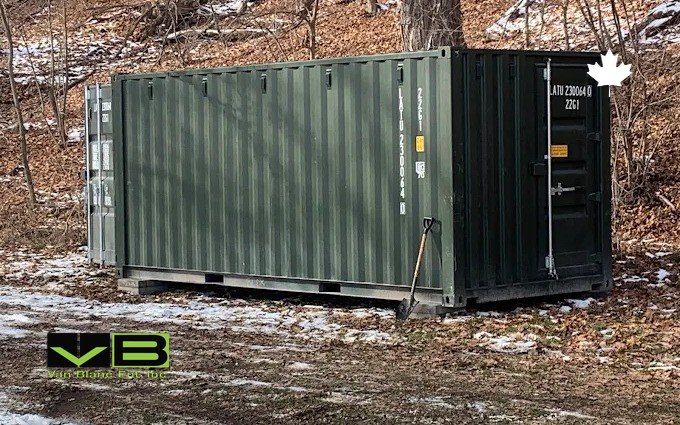
Quick Answer: A car shelter in Ontario means a fabric-covered steel frame that goes up in November and comes down in April. Snow load and anchoring are what actually decide whether it survives February. Fabric shelters, carports, garages, and containers each protect vehicles differently, and honest fit depends on what you park.
In This Guide
- The November Ritual
- What a Fabric Shelter Honestly Buys You
- How Car Shelters Die in February
- The Two-Weekend Tax
- The Shelter Ladder, Rung by Rung
- The Hibernation Problem Is a Different Problem
- Where a Container Honestly Fits, and Where It Does Not
- The Pad, the Frost, and Winter Delivery
- Working Fleets: The Commercial Version of This Question
- Car Shelter FAQs
Reading Time: 14 minutes
The November Ritual
Drive any residential street from Windsor to Ottawa in the second week of November and you can watch the season change in hardware. The patio furniture disappears, the snowblower comes forward, and on driveway after driveway a skeleton of galvanized tubing rises, gets its white or grey polyethylene skin stretched over the bows, and becomes a car shelter until April. Quebec turned this into a full cultural institution decades ago, where the things are simply called Tempos regardless of who made them, and the habit has spread comfortably across Ontario. Gazebo Penguin, Tempo, and a shelf of house brands sell the same essential product: a quick-connect steel frame, a UV-treated fabric cover, door panels that rope shut, and a promise that one household can raise it in an afternoon.
That promise is mostly kept, and the product is mostly honest. A fabric car shelter is the cheapest roof you can put over a vehicle in this province, it requires no foundation, and it comes down in spring, which matters on lots where a permanent structure is unwelcome. It is also, by a wide margin, the shelter most likely to be lying in a twisted heap after the wrong kind of storm. Both of those facts are true at once, and this guide takes them in order. We sell shipping containers in Brantford and have since 1995, so we sit one rung up the ladder this page describes. Nobody here sells fabric shelters, which makes it easier to describe them fairly. The category’s best-known name gets its own brand-level read in our Tempo car shelter review, with the numbers Tempo publishes and the ones it does not.
Paul LeBlanc, Van Blanc: “I have watched thirty Novembers from this yard, and the shelter frames go up the same week the container calls start. It is the same instinct, people want the winter off their equipment. The difference is what happens in February. I have never once had a customer call me to say the wind took their container.”
What a Fabric Shelter Honestly Buys You
A fabric car shelter earns its place on four honest counts. It keeps snow off the vehicle, which means no 6 a.m. brushing and scraping, no frozen wipers, and no ice sheet sliding off the roof onto the highway behind you. It keeps freezing rain off the door seals and lock cylinders. It cuts the daily freeze-thaw cycling that works water into paint chips and seams. And it does all of that for less than almost any alternative, on a gravel or asphalt pad it does not damage, with no permanent footprint. For a daily driver that must come and go twice a day all winter, that list is genuinely hard to beat at the price.
The limits are just as concrete. The cover is fabric, so it stops precipitation and sun, and it stops nothing else. A fabric shelter has no meaningful security: the door panels tie shut with rope or zippers, and anything stored inside beside the car is protected by optimism. The frame is engineered for a managed snow load, meaning the maker assumes somebody knocks the snow down after big storms. The cover itself is a wear item, sun-rotted and brittle somewhere between the third and fifth season on most brands, sooner where it flaps loose and saws against the frame. None of that is a scandal. It is a seasonal tool with a seasonal lifespan, priced accordingly, and the buyers it disappoints are usually the ones who asked it to behave like a building.
How Car Shelters Die in February
Talk to anyone who has owned a fabric shelter for a decade and the failure stories cluster around three killers, all of them concentrated in the deep winter weeks when the shelter is working hardest.
The Three Killers, in Order of Bodies
- Unmanaged snow load. The frame carries a fresh snowfall fine. It carries the third unshoveled snowfall, rain-soaked and refrozen, badly. Bent bows and a collapsed ridge are overwhelmingly a load-management failure, and every manufacturer’s fine print says so: knock the snow down, from inside with a broom against the fabric, after every major storm.
- Wind on lazy anchoring. The kit ships with augers or stakes and instructions nobody enjoys reading. A shelter anchored into frozen gravel with half the specified hardware becomes a kite with a steel frame in the first 90 km/h gust. The wreckage usually lands on the car it was protecting, and occasionally on the neighbour’s.
- Cover fatigue. Ultraviolet light embrittles polyethylene on a schedule. A cover in its fourth season tears where a first-season cover would flex, and a small tear in January becomes a shredded panel by March. Owners who get long service out of these shelters treat the cover as a consumable and budget its replacement.
Notice what all three have in common: they are maintenance failures more than product failures. A fabric shelter is a relationship. You shovel around it, broom it off, tighten the cover, and check the anchors after every blow. Buyers comfortable with that relationship get eight or ten seasons from a good frame and two or three covers. Buyers who wanted to put steel over the car and stop thinking about winter are describing a different product, and the rest of this page is about the rungs where that product lives.
The Two-Weekend Tax
The cost nobody prices at the checkout is time. A fabric car shelter takes a weekend, or a long afternoon with two capable people, to raise in November: frame assembly, cover stretch, door panels, anchoring done properly. It takes most of another one to strike in April, because a cover that spent five months under snow does not fold itself, and a frame does not bundle itself into the garage rafters. Then the whole kit needs a summer home, which on most properties means the same rafters, shed corner, or basement wall that every other seasonal item is fighting for. Multiply by every year of ownership and the two-weekend tax is real money at any honest hourly rate.
Several municipalities also regulate when seasonal shelters may stand, which is why the things vanish from some towns every April with unusual discipline. Permits are managed by your municipality, so check with your local building or planning department before you order. What matters for this guide is the pattern: a fabric shelter is not just cheaper than a building, it is a recurring seasonal chore in a way no permanent option is, and the annual labour belongs in the comparison alongside the sticker.
The Shelter Ladder, Rung by Rung
Vehicle protection in Ontario is a four-rung ladder, and each rung buys a specific upgrade over the one below it.
| Rung | What it adds | What it still lacks |
|---|---|---|
| Fabric shelter | Cheapest roof, seasonal, no foundation | Security, longevity, storm indifference |
| Steel carport | Permanent roof, real snow rating, no teardown | Walls, security, enclosed storage |
| Garage | Full enclosure, heat possible, resale value | Highest cost, longest build, permanent footprint |
| Container | Instant lockable steel, movable, no build timeline | Practical daily in-out for a commuter car |
The second rung has the roofed-steel step up from fabric covered in depth: a bolted steel carport is what a fabric shelter wants to be when it grows up, permanently anchored, snow-rated, and free of the November ritual, at the price of being a permanent structure. The comparison between fabric structures and steel boxes generally gets how fabric garages compare with steel head to head treatment on its own page. And the fourth rung, ours, needs its honest boundaries drawn carefully, because a shipping container is simultaneously the strongest thing on the ladder and the wrong answer for the most common version of the question. We will draw those boundaries two sections down.
The Hibernation Problem Is a Different Problem
Half the people shopping the phrase car shelter are not sheltering a commuter at all. They are putting a summer car, a convertible, a project, or a classic to sleep from November to May, and hibernation is a different engineering problem from daily protection. A hibernating car never needs to leave, so door swing and turnaround convenience stop mattering, and what matters instead is the storage environment plus the preparation ritual the collector world has refined for decades. The rest of the fabric family, the storage tent, the rated shelter and the fabric building, is sorted in what a fabric shelter is actually for.
The consensus list from the classic-car insurers and their garage-side literature runs like this: fill the tank and stabilize the fuel so it survives the layup, put the battery on a tender or pull it entirely, inflate tires toward the maximum sidewall pressure or lift the car onto stands so flat spots cannot set in the cold, leave the parking brake off with chocks doing that job so the pads cannot fuse to the rotors, and strip out anything a rodent could eat or nest in. Do the list and almost any dry, secure space carries a car through winter well. Skip it and the finest heated garage will still hand you a dead battery, varnished fuel, and thumping tires in May. For that buyer we keep hibernating a classic inside a container as its own full walkthrough, and the broader vehicle-in-a-box question, ramps, widths, and all, lives in a full walkthrough of container garages.
Pricing the Steel Rung?
A 20-foot unit swallows a hibernating car or an entire winter’s worth of displaced gear, delivered onto your pad this week. Tell us what you are parking or storing and we will quote the size honestly, with a real lead time, not a hopeful one. Fast 1-3 day delivery across Ontario from our Brantford yards. The fastest answer is a call.
Van Blanc Ent. Inc. · Brantford, Ontario · Since 1995 · 4.9 stars across 140+ Google reviews · Cash on delivery
Where a Container Honestly Fits, and Where It Does Not
Here is the sentence some container sellers will not write: a shipping container is a poor daily-driver garage. The interior is 7 feet 8 inches wide, the cargo doors swing rather than roll, and threading a modern SUV in and out twice a day through winter would exhaust a saint by December. A fabric shelter or a carport is built for a commuter that leaves every morning. What the container does better than anything else on the ladder is everything the fabric rungs cannot do at all.
It is instant lockable enclosure. The same day it lands, a container is a sealed steel room with the lockbox-shrouded padlock setup guarding whatever sleeps inside, built from the same steel ocean decks trust, indifferent to the snow load, the gust, and the ultraviolet that kill fabric on a schedule. For the hibernating summer car, that means a housing that needs no February brooming. For the fabric-shelter owner, the container is often the companion rather than the competitor: the shelter roofs the daily driver, and the container beside it holds the winter tires on rims, the roof box, the shelter’s own frame and cover from May to November, and where the rest of the winter gear lands. One customer pattern we see every year is exactly that pairing, with the interior humidity handled the way we describe in managing winter moisture inside steel: vents open, loads off the floor, and no wet vehicle parked inside to steam the walls.
Grades matter less here than buyers fear. A wind and watertight unit, the working grade below cargo-worthy, does this job perfectly; the premium for new (one-trip) stock buys cosmetics and maximum remaining life, which matters when the box sits in view of the kitchen window and less when it works behind the shop. We walk every unit with you in the yard before you pay, which is the simplest defence there is against the marketplace listing that is suspiciously cheaper. Many people call us saying they can get a bin for $1,000 less on Facebook. Two weeks later some of them call back to say they got scammed. Do not fall for it.
The Pad, the Frost, and Winter Delivery
The site work for the steel rung is modest and worth doing once, properly. A container wants a level, drained base, railway ties or a compacted gravel pad both serve, with a whisker of fall so meltwater runs away from the door sills rather than under them. The delivery truck needs a straight approach and swing room, which is the one conversation to have before ordering rather than after. And winter itself is a fine time to take delivery: frozen ground is hard ground, and delivery on frozen ground often goes smoother than the same drop in April mud. Our drivers place units in every month of the year, and the tilt-deck does not care what the thermometer says.
Power deserves a paragraph, because both rungs eventually want some. Under a fabric shelter, power means a block heater cord snaking to the house, rated for outdoor winter duty and run where nobody trips on it under snow. Inside a container, the usual want is a battery tender for the hibernating car, and the tidy answer is a single exterior-rated cord through the door gasket or a small pass-through, with the tender’s indicator visible from the man door if you have one fitted. Neither rung needs an electrician for those jobs, and anything more ambitious, lights, outlets, a heater circuit, should be installed and certified by a licensed electrician rather than improvised. We rough in cord pass-throughs and conduit paths at the yard when asked; the licensed trade finishes and certifies the live work on site. It is a small detail that separates a clean winter setup from a melted extension cord, and it costs almost nothing to plan before the unit lands.
Compare that once-ever setup against the fabric shelter’s annual cycle and the ladder’s economics come into focus. The shelter is cheaper this year, every year, forever, and it costs two weekends and a cover every few seasons, forever. The container costs more once, then mostly stops costing. Which curve wins depends entirely on your horizon, and an honest seller tells you the crossover exists instead of pretending one rung suits everyone.
Working Fleets: The Commercial Version of This Question
Scale the question up and it changes shape. A landscaping company wintering six trailers, a contractor with two crew trucks and an equipment float, or a rural operator running a vehicle storage yard is not shopping for one fabric shelter. Fleet vehicles winter outdoors as a matter of course; what those operations actually lack is secure, weatherproof volume for everything that must come off the vehicles: plow edges and salt spreaders in summer, mower decks and trimmers in winter, tools and attachments year-round. That is container work, and it is where most of our commercial calls in this category start. A pair of 40-foot units along the yard fence gives a fleet operation locked bays for gear at a fraction of building cost, and multi-unit orders move on the same 1-3 day schedule as a single box.
For a business that would rather spread the cost, the path is an equipment loan or line of credit from its own bank, with the invoice, grade and serial number we supply, and the units are owned from the day they land. We do not rent containers, to businesses or anyone else, so there is no stop-when-done rental to compare against; the choice is cash now or the lender’s payments on a box already yours. The tire wall deserves its own mention for automotive businesses: the tire-wall setup auto shops use turns one 20-footer into the seasonal-swap annex that keeps the service bays clear from October to December.
The November ritual is really a question about horizons. If winter is a season to get through, fabric gets you through it, cheerfully and cheaply, with a broom in your hand after every storm. If winter is something you would rather stop negotiating with, at some point the answer stops being a cover and starts being steel. Most driveways we deliver to have room for both answers, and plenty end up holding both.
Sold outright. Delivered in 1 to 3 days.
Van Blanc sells new and used shipping containers outright from our 4 Brantford yards, with delivery in 1 to 3 days and payment on delivery. We do not rent, lease or offer rent-to-own. Request a sale quote or call the yard at 519-754-6844.
Car Shelter FAQs
Are fabric car shelters worth it in Ontario?
For a daily driver, usually yes, provided you accept the maintenance relationship. A fabric shelter ends daily scraping and shields the vehicle from freeze-thaw cycling for the lowest cost of any option. It requires diligent snow removal after storms, full anchoring per the manual, and a replacement cover every three to five seasons.
Why do car shelters collapse in winter?
Almost always from accumulated snow load or wind on inadequate anchoring, and both are preventable. Frames are engineered for managed loads, meaning the owner brooms snow off after major storms. A shelter that collapses usually carried several storms’ worth of refrozen accumulation, or was anchored with a fraction of the specified hardware.
Can I park my car inside a shipping container?
Physically yes, most cars fit through the 7-foot-8-inch doorway with mirrors folded, and container garages are a real category. Practically, daily in-and-out is tedious, so we recommend containers for hibernating a summer or classic car over winter, and fabric shelters or carports for commuters that leave every morning.
What should I do before storing a car for the winter?
The collector-world consensus: stabilize a full fuel tank, connect a battery tender or remove the battery, inflate tires to maximum sidewall pressure or use stands to prevent flat spots, chock the wheels instead of setting the parking brake, and remove anything rodents could eat or nest in. Preparation matters more than the building.
Where do you store a fabric car shelter in summer?
The folded cover and bundled frame need a dry off-season home from roughly April to November, typically garage rafters or a shed corner. Plenty of our customers dedicate part of a container to exactly this: the shelter kit, winter tires, and seasonal gear all migrate into steel each spring and back out each fall.
Sources
- Gazebo Penguin. (2025). Winter Car Shelters: Vehicle Protection for Snow and Ice. gazebopenguin.com. The manufacturer’s winter shelter line and stated snow-management requirements
- Hagerty. (2024). How To: Classic Car Winterization and Storage. Hagerty Media. The insurer’s layup checklist for fuel, battery, tires, and rodent exclusion
- Beau-frère à louer. (2024). Les 5 meilleurs abris d’auto temporaires pour l’hiver. beau-frerealouer.com. A Quebec comparison of temporary shelter brands and their trade-offs
- International Organization for Standardization. (2020). ISO 668:2020, Series 1 Freight Containers, Classification, Dimensions and Ratings. iso.org. The dimensional standard behind the interior widths quoted above
Reach Van Blanc in Brantford
We have supplied shipping containers across Ontario since 1995 from our Brantford yards, and every winter a share of our deliveries land beside a fabric shelter that is about to get some steel backup. Walk our rows at 90 Morton Avenue East before you decide anything; the grades make sense in person in a way no photo manages.
Van Blanc Ent. Inc., 90 Morton Ave E Unit 1B, Brantford, ON N3R 7J7, 519-754-6844
Wondering whether your winter problem is a cover problem or a steel problem? Describe what you park and what you store over the phone and we will quote the box for it.