
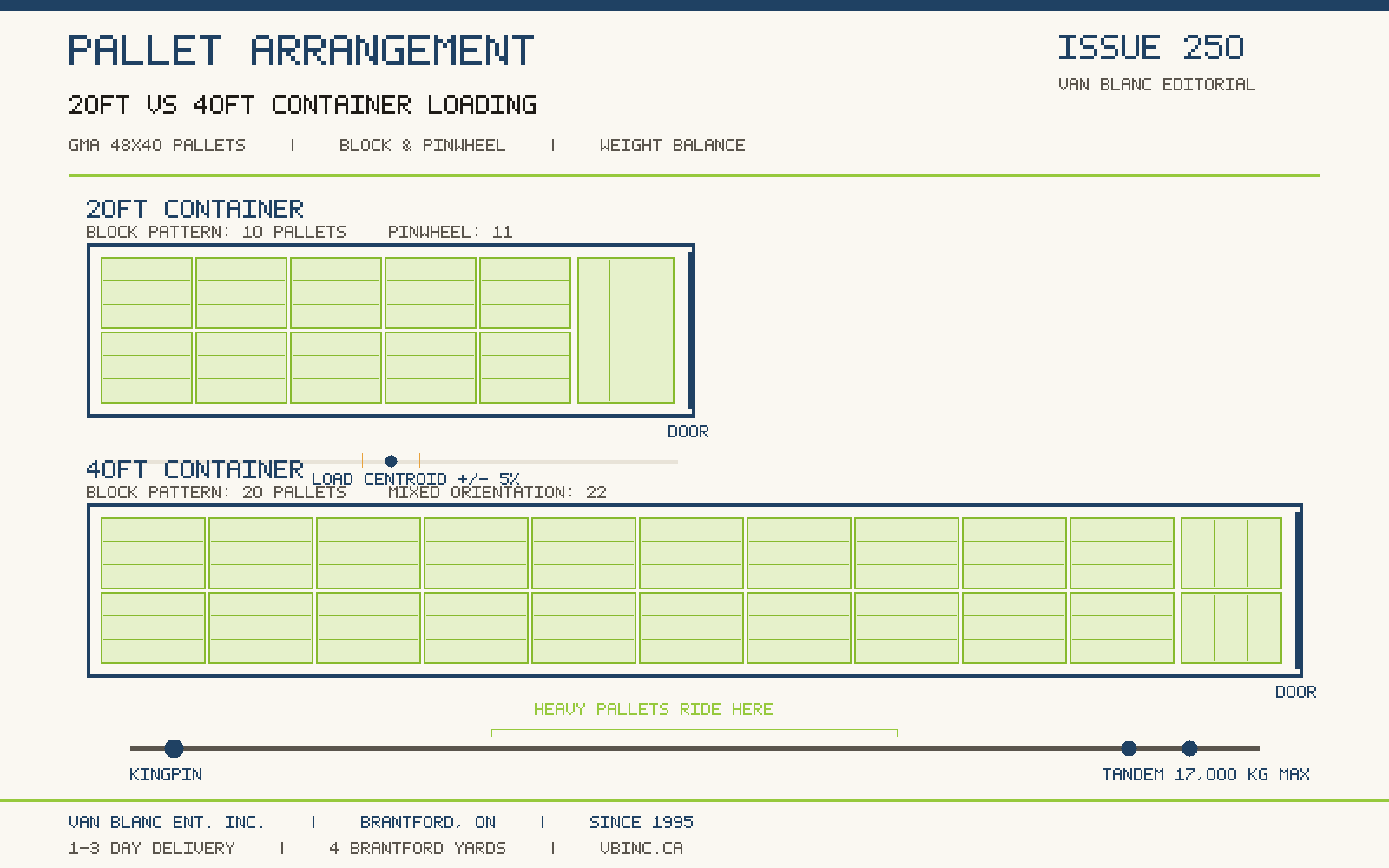
Quick Answer: A standard 20ft container holds 10 to 11 GMA 48×40 pallets in a two-row floor pattern, and a 40ft holds 20 to 22. The right container loading pattern depends on pallet size, cargo weight, and keeping the load balanced over the chassis axles so the truck scales clean. Van Blanc has been Brantford-based since 1995, family-operated, with 1-3 day delivery Ontario-wide.
In This Guide
- How Many Pallets Fit in a 20ft Container?
- How Many Pallets Fit in a 40ft Container?
- What Is the Difference Between Block, Pinwheel, and Chimney Loading?
- How Do You Balance Weight Front-to-Back Inside a Container?
- How Pallet Placement Affects Chassis Axle Loads
- Mixed Pallet Sizes and Awkward Footprints
- Voids, Dunnage, and Why Empty Squares Are Not Free Space
- Double-Stacking Light Cargo Without Crushing the Bottom
- How Buyers in Brantford Plan Their Pattern Before Pickup
- Common Pattern Mistakes We Hear About
- Frequently Asked Questions
Reading time: about 14 minutes.
How Many Pallets Fit in a 20ft Container?
A 20ft standard ISO container has an interior length of 5.90 metres and an interior width of 2.35 metres, with door opening 2.34 metres wide and 2.28 metres tall. That floor gives you roughly 13.87 square metres to work with. Whether you fit 10 pallets or 11 depends almost entirely on what sized pallet you are loading.
The GMA pallet (48 inches by 40 inches, or 1,219mm by 1,016mm) is the North American standard. Two GMA pallets stood side by side across the container width measure 1,219 + 1,219 = 2,438mm, which is wider than the 2,350mm interior. So GMA pallets cannot run with their long axis across the width. They must run lengthwise, two abreast at 1,016mm each (2,032mm total), leaving roughly 318mm of slack across the width for dunnage and shifting tolerance. Down the length, you get five rows of two pallets standing 1,219mm deep each, which fills 6,095mm of length, leaving a hair past the 5,900mm of interior. In practice, ten GMA pallets fit cleanly in a 20ft.
The Euro pallet (1,200mm by 800mm) changes the math. Two Euro pallets stood with their 1,200mm side across the width measure 2,400mm, which still overshoots the 2,350mm interior. Most loaders rotate Euro pallets so the 800mm side runs across the width. Three pallets stood at 800mm each across = 2,400mm, still too wide. So Euro pallets in a 20ft go two abreast at 1,200mm width and a column of singles at 800mm down the length, mixing orientations. That mixed pattern is how Euro shippers get 11 pallets into a 20ft instead of 10.
The 20ft Container Floor Plan, in Numbers
Interior dimensions to know before you draw a pattern: length 5.90m, width 2.35m, door 2.34m wide, door height 2.28m. Volume is 33.2 cubic metres. Max payload around 28,180 kg depending on tare. Tare for a 20ft averages 2,300 kg with one-trip steel running closer to 2,200 kg. ISO 6346:2022 sets the coding and marking that confirms what you are loading. None of these numbers move; your pallet pattern lives inside them.
Paul LeBlanc, who founded Van Blanc in 1995 and has spent thirty years in the container trade, has watched buyers wrestle with this the whole time. “People think a 20ft swallows whatever they bring,” he says. “It swallows ten GMA pallets, eleven if you turn the back pair, and the floor decides the number, not the wishing. We hand a buyer the interior dimensions before they ever rent the forklift.” If you want the bare floor specs to plan against, our breakdown of every container size, inside and out lays out the numbers side by side.
How Many Pallets Fit in a 40ft Container?
A 40ft standard ISO container measures 12.03 metres long inside, with the same 2.35 metre width and 2.39 metre height. High cube adds 30 centimetres of headroom but the floor footprint is identical. The floor is exactly double the 20ft, so the pallet math doubles too. Twenty GMA pallets fit in a straight two-row pattern, with 22 possible if you tighten the spacing and turn the rear pallets crosswise.
For Euro pallets, the 40ft will hold 24 to 25 in a mixed-orientation pattern. The exact count depends on whether the rear two pallets sit lengthwise or crosswise. Loaders working European or Mexican supply chains often hit 25 because Euro pallets nest the rear corners cleanly. North American GMA pallets max at 22 because the 1,219mm depth does not divide evenly into the 12,030mm length without leaving 500mm of leftover.
The 22-pallet GMA arrangement runs ten rows of two pallets lengthwise, with the eleventh row turned crosswise at the rear so two more pallets fit sideways between the doors. That last crosswise pair acts as a natural blocking device against the doors, which is useful for tilt-deck delivery to Ontario job sites where the load may shift slightly between yard pickup and final placement. Turning that rear pair also nudges weight backward, so it pairs with the rules for spreading a heavy load across the chassis axles before the truck hits a scale.
| Container | GMA 48×40 Pallets | Euro 1200×800 Pallets | Floor Utilization |
|---|---|---|---|
| 20ft Standard | 10 (block) / 11 (pinwheel) | 11 (mixed) | 86% to 91% |
| 40ft Standard | 20 (block) / 22 (mixed) | 24 to 25 (mixed) | 86% to 92% |
| 40ft High Cube | 20 / 22 (same floor) | 24 to 25 (same floor) | 86% to 92% |
| 45ft High Cube | 22 to 24 | 27 to 28 | 88% to 93% |
What Is the Difference Between Block, Pinwheel, and Chimney Loading?
Three families of patterns cover almost every container load you will see. Each has a personality, and each has a job it does best. The pattern is a response to what the cargo is and what the truck will do with it after pickup rather than a style choice.
Block loading is the simplest. Every pallet faces the same direction, stacked in clean rows, two abreast. Forklift drivers love it because the entry sequence is the same every pallet: drive in, set down, back out, repeat. That repeatable rhythm is also why it pays to think about how a forklift actually enters and clears the door opening before the first skid moves. The downside is that block patterns sometimes leave dead space along the walls if the pallet dimensions do not divide the interior cleanly. For GMA pallets in a 20ft, block loading is the standard answer.
Pinwheel loading alternates pallet orientation: one row lengthwise, the next row crosswise, alternating to the door. The pinwheel name comes from the visual when you look down on the load from above. It picks up extra capacity in containers where the modular math does not divide evenly. Pinwheel adds one extra pallet to a 20ft (11 instead of 10) and two extra to a 40ft (22 instead of 20). The cost is loader time. Pinwheel takes longer to plan and load because every other pallet rotates 90 degrees during placement.
Chimney stacking (also called centre-pile) faces pallet corners toward the centre of the container. Viewed from above, it looks like a spiral or pinwheel. The structural reason is compression strength. When boxes stack into a chimney, the corners share vertical load down the cardboard column rather than collapsing at the centre. Chimney is for dense cargo (canned goods, hardware fasteners, books) that needs to double-stack without crushing the bottom layer.
Pick the Pattern Before You Pick the Container
The right move is to draw the pallet pattern on paper first, then choose the container size. If your load is 21 GMA pallets, two 20ft containers leave you with one orphan pallet riding mostly empty, while a single 40ft fills cleanly with one row turned crosswise. Drawing the pattern first prevents the costly “we ordered the wrong size” call we hear too often.
How Do You Balance Weight Front-to-Back Inside a Container?
Pallet count is half the math. The other half is where the weight sits inside the container. A 20ft loaded with 10 evenly-weighted pallets balances naturally over the chassis. A 20ft loaded with eight light pallets at the rear and two heavy pallets at the front behaves badly on Ontario roads. The chassis tongue rides nose-heavy, the front axle of the truck takes weight it was not designed for, and tilt-deck delivery becomes risky because the container wants to slide off the deck head-first when the bed lifts.
The math: aim for the load centre of gravity to sit at the middle of the container plus or minus 5 percent of the length. For a 40ft (12.19m), that means the centroid stays within 0.6 metres of the centre. For a 20ft (6.06m), within 0.3 metres. Heavy pallets ride in the middle third of the floor. Light pallets at the doors and the nose.
This becomes critical when the cargo is dense and the truck is doing a long Ontario haul. A 22,000 kg load distributed front-heavy can put 14,000 kg over the chassis front bogie and only 8,000 kg over the rear. Ministry of Transportation scales catch that quickly under HTA Regulation 413/05, which sets a tandem axle limit of 17,000 kg. The fix is in the pallet pattern rather than at the scale.
Why Ontario Hauls Make Pattern Math Non-Optional
Ontario’s MTO weigh stations run frequent inspections on Highway 401, the QEW, and Highway 7. SPIF (Safe, Productive, Infrastructure-Friendly) vehicle rules require axles to auto-load-equalize, but the system only works if the cargo sits where the chassis expects it. A pallet pattern that buries the heaviest skids at one end forces the truck out of compliance before it leaves the yard. Buyers picking up from our four Brantford yards plan the pattern before the forklift starts because we have watched too many trucks turned back at Hamilton scales over front-heavy loads.
How Pallet Placement Affects Chassis Axle Loads
A standard ocean container chassis has two axle groups: the kingpin (front, sitting under the truck’s fifth wheel) and the tandem rear bogie. Weight transfers across both groups based on where the cargo sits inside the box. A pallet placed at the nose of a 40ft transfers most of its weight onto the kingpin and through to the tractor’s drive axles. A pallet placed at the door end transfers weight onto the rear chassis tandem.
The arithmetic works on lever logic. A 1,000 kg pallet sitting 3 metres forward of the chassis centre exerts more leverage on the kingpin than the same pallet sitting 1 metre forward. Multiply that by 22 pallets and small placement choices change axle readings by 1,500 to 3,000 kg. That gap is the difference between a clean scale and an over-axle violation.
Loaders who hit balance consistently follow a simple rule: place the four heaviest pallets first, in the centre eight feet of the container. Light pallets fill the wings. The result is a load that scales cleanly without anyone needing a tape measure or a calculator. The pattern is the math.
Mixed Pallet Sizes and Awkward Footprints
Real-world loads almost never come as 22 identical GMA pallets. Buyers building out a contracting business in Hamilton will mix a half-pallet of fasteners, a 1/3-pallet of conduit, a quarter-pallet of paint, two skids of drywall, and three full GMA pallets of lumber. Each piece has its own footprint, and the pattern has to absorb them all without leaving voids or pinching the heavier items into corners where they cannot be unloaded first.
The approach we recommend is bucket-sorting before loading. Group the pallets by footprint: full GMA, half-GMA, Euro, custom oversized. Set them in the marshalling yard in groups. Build the pattern from largest to smallest, working from the nose toward the doors. Full pallets fill the centre block. Half-pallets fit into the rear pinwheel positions. Loose items strap to dunnage frames in the wings. The container loads in 35 to 50 minutes instead of the 90+ minutes a chaotic mixed load takes.
Awkward footprints (longer than 1.5 metres, wider than 1.2 metres, irregular shape) usually need to ride in their own quadrant rather than mixed with standard pallets. Engine blocks, machine tools, boat trailers, and crated equipment fall into this category. The pattern math still applies, but the units of measurement change. Treat a single oversized item as occupying four pallet positions and recalculate accordingly.
Voids, Dunnage, and Why Empty Squares Are Not Free Space
An empty floor square inside a loaded container is the most expensive square foot on the ship. It pays freight, it pays insurance, and it gives loaded pallets room to shift during transit. The whole point of pattern planning is to reduce the void total to under 10 percent of the floor.
Dunnage is the answer when voids cannot be eliminated. Air bags inflate between pallets to fill horizontal gaps. Lumber blocks bridge vertical gaps between layers. Cardboard sheets between layers prevent rubbing. Plastic strapping holds the cardboard sheets in place. The pattern includes the dunnage; it does not treat it as an afterthought.
What Belongs in the Dunnage Kit
- Inflatable air bags: Two sizes (60cm and 90cm). Fill horizontal voids between pallet rows. Reusable across multiple loads.
- 2×4 lumber blocks: Cut to 1.2 metre and 0.6 metre lengths. Used for vertical bracing and door blocking.
- Edge protectors: Cardboard or plastic L-channels that protect pallet corners from strap damage.
- Polypropylene strapping: 13mm or 16mm width, used with a tensioner and seal crimper. Replaces nylon for most container loads.
- Anti-slip mats: Rubber sheets between pallets and floor when the cargo is prone to walking during transit.
Wasted floor space tends to cluster in the same predictable spots: along the side walls when pallets are 1,000mm wide in a 1,175mm gap, at the door end when the last row does not fit cleanly, and at the corner where the door post creates a 76mm dead zone. Plan for those three spots in every load.
Double-Stacking Light Cargo Without Crushing the Bottom
Pattern math has a vertical dimension as well. Containers stack pallets two layers high when the cargo is light enough to support its own weight without crushing the bottom layer. Standard headroom: a 20ft holds two layers of pallets up to 1.16 metres each (counting pallet plus cargo). A high cube 40ft pushes that ceiling to 1.30 metres per layer. A 53 foot van or domestic container gives about 2.74 to 2.78 metres of ceiling, room for two layers of about 1.35 metres, and its floor counts straight, turned and double-stacked are worked through in the 53-foot pallet count.
The compression rule is simple. If the cargo on the top pallet weighs more than the cargo on the bottom pallet can support without deforming, do not stack. Most consumer goods (clothing, paper, plastic packaging, foam products) double-stack safely. Dense cargo (canned goods, metal hardware, books) only double-stacks with reinforced pallets and rigid load covers between layers.
When you do stack, the chimney pattern earns its name. Corner-supporting boxes form a vertical column down the centre of the load. The compression force travels along that column rather than collapsing into the middle of the lower boxes. Loads that look fine driving out of the yard sometimes show up with the lower layer crushed in the middle if the stacking pattern ignored the chimney rule.
How Buyers in Brantford Plan Their Pattern Before Pickup
Buyers visiting our Brantford yard at 90 Morton Avenue East come with a freight plan more often than not. They have already measured the pallets going in, counted them, sketched the pattern. They show up to walk the container they will load, confirm the door opening matches the planned approach for the forklift, and verify the floor condition will support the planned weight.
That preparation is the difference between a clean load and a chaotic one. The buyer who arrives with a layout plan saves 60 to 90 minutes at loading. The buyer who shows up with a forklift and a vague intention spends that same hour realising the load needs to be repalletized.
Christian LeBlanc, second-generation operator: “We had a contractor pick up a 20ft last spring planning to move 14 pallets of insulation. Ten was the math. He had to leave four pallets on the dock and rent a second truck. We always tell buyers to draw the pattern first, then ask us which container size matches. The conversation takes ten minutes and saves a wasted delivery day.”
Walking the bin before loading also lets buyers see the actual floor condition. A used Cargo Worthy or Wind and Watertight container may have minor dents or surface rust that does not affect structural performance but does affect how a heavy pallet wheel rolls across the floor. Identifying those spots before loading lets the buyer place lighter pallets over the marked areas. We deliver containers across Ontario in 1-3 days from our 4 Brantford yards, and every quote comes with a real lead time. The same applies to load planning: real numbers.
Common Pattern Mistakes We Hear About
After thirty years of hearing how buyers load containers across Ontario, the same three mistakes show up most often. Each one is small in isolation and expensive at scale.
Mistake one: Loading heavy pallets at the door end. Loaders sometimes save the densest pallets for last because they are nearby in the marshalling yard. The result is a rear-heavy load that scales badly and tilts the trailer when the deck lifts. The fix is to bring heavy pallets to the door of the container before loading starts, so they go in first and ride the centre third of the floor.
This matters even more for tilt-deck delivery, where the container slides off the trailer at an angle. A rear-heavy load wants to slide too fast; a front-heavy load wants to dig the nose into the ground. The same logic runs through our broader notes on getting a container loaded and onto the road safely, because the pattern absorbs the geometry of the delivery as much as the geometry of the floor.
Mistake two: Ignoring the door post dead zone. Most standard ISO containers have a 76mm gap behind the door post where pallets cannot fit fully. New loaders try to wedge a pallet into that gap. The pallet sits proud of the doorframe, the door does not close, and the load gets rebuilt. The fix is to recognise the dead zone exists, plan for dunnage there, and accept that 99 percent floor utilization is impossible in a standard container.
Mistake three: No strap plan. Loaders place pallets without a strapping plan and then discover the load shifts when the container moves. E-track rails on the side walls anchor the strap points, but only if the loader knew to ask for an e-track-equipped container during quoting. E-track and other tie-down hardware can be fitted before the box leaves the yard, but it has to be specified before delivery. Putting straps on after loading without anchor points is duct-tape engineering.
The 30-Minute Pre-Load Walkthrough
Before the first pallet goes into the container, spend 30 minutes on a five-step walkthrough: measure the floor with a tape, confirm door opening dimensions, identify the marked dead zones, plan the pattern on a paper grid, and pre-stage the pallets in load order. A 30-minute walkthrough saves 60 to 90 minutes of mid-load adjustment. Every contractor who has tried this swears by it within one season.
Ready to price your container?
Tell us the size and your postal code and we’ll send back an all-in number, container, delivery, and placement, usually within 1-3 days. No pressure, no mystery fees.
Family-run in Brantford since 1995 · 200+ containers in stock · 4.9★ across 140+ Google reviews · every box graded by a person, walk it before it lands.
Frequently Asked Questions
How many GMA pallets actually fit in a 20ft container?
Ten in a clean block pattern, eleven if you pinwheel the rear two pallets. The GMA pallet at 48 inches by 40 inches just barely fits two abreast lengthwise with about 318mm of clearance for dunnage. Most Ontario loaders run the block-10 pattern because it is faster to load and balances weight cleanly across the chassis.
What pallet pattern works best for a 40ft container hauling food-grade cargo?
A block pattern with dunnage air bags between rows is the standard for food-grade goods in a 40ft. Twenty GMA pallets fit cleanly, leaving 500mm at the rear for dunnage and door blocking. Avoid chimney stacking for food because the centre-pile geometry stresses the lower pallets in ways that food cartons are not designed to handle.
Do Euro pallets really fit more in a container than GMA pallets?
Yes, but only marginally. A 20ft holds 11 Euro pallets versus 10 GMA, and a 40ft holds 24 to 25 Euro versus 20 to 22 GMA. The Euro advantage comes from the 800mm short side dividing cleanly into the 2,350mm container width. For most North American supply chains, the GMA standard is more practical because pallet exchange networks support it.
What is the difference between block, pinwheel, and chimney loading patterns?
Block loading puts all pallets in the same orientation in clean rows. Pinwheel alternates orientations, picking up an extra pallet or two in containers where the math does not divide evenly. Chimney stacks pallets with their corners aligned to the centre column, providing compression support for double-stacked dense cargo. Each pattern matches a different cargo profile.
How do I calculate weight balance inside a shipping container?
Aim for the load centroid to sit within 5 percent of the container’s centreline. For a 40ft, that means the centre of gravity stays within 0.6 metres of the midpoint. Heavy pallets ride in the middle third of the floor; light pallets fill the door end and the nose. A balanced pattern scales cleanly and avoids tilt issues during tilt-deck delivery.
Will my pallet pattern affect MTO axle compliance in Ontario?
It will if your cargo is heavy. Ontario regulates tandem axle weight under HTA Regulation 413/05 at 17,000 kg per group. A front-heavy or rear-heavy pallet pattern can push one axle group over the limit even when the total cargo weight is legal. Balanced pattern math is what keeps the truck clean at Hamilton, Burlington, and 401 corridor scales.
Can I double-stack pallets in a 20ft standard container?
Yes for light cargo. A 20ft has 2.39 metres of interior height, which fits two layers of pallets up to 1.16 metres each. Light cargo like clothing, foam, or paper double-stacks safely. Dense cargo like canned goods or hardware needs reinforced pallets and load covers between layers to prevent crushing the bottom row.
How long does it take to load 22 pallets into a 40ft container?
About 75 to 90 minutes with a single forklift driver and a planned pattern. Without a plan, the same 22 pallets can take 2 to 3 hours because the loader rebuilds the pattern mid-load. The 30-minute pre-load walkthrough saves an hour of actual loading time, so the math always works out in favour of planning first.
Do I need e-track inside my container to secure pallets?
E-track installation is optional but recommended for heavy or shifting cargo. The rails anchor strap points along the side walls, allowing ratchet straps to lock pallets in place against rolling or tipping. E-track installation is available as a custom modification done at the yard; ask about it during your quote if your cargo is dense or top-heavy.
What dunnage materials should I have on hand for a typical pallet load?
The standard kit is inflatable air bags (two sizes), 2×4 lumber blocks cut to 1.2m and 0.6m lengths, cardboard edge protectors, polypropylene strapping with a tensioner, and rubber anti-slip mats for floor placement. The kit fits in a single bin and handles 90 percent of mixed pallet loads through Ontario distribution networks.
Sources
- International Organization for Standardization. (2022). ISO 6346:2022, Freight containers, coding, identification and marking. iso.org/standard/82754.html
- Government of Ontario. (2024). Regulation 413/05 under the Highway Traffic Act, Vehicle Weights and Dimensions for Safe, Productive and Infrastructure-Friendly Vehicles. ontario.ca/laws/regulation/050413
- Ministry of Transportation Ontario. (2024). Guide to Vehicle Weight and Dimension Limits in Ontario. Ontario Trucking Association resource library. ctea.ca, 2024 Ontario VWD Guidebook
- Hale Trailer. (2024). What is Pinwheel Pallet Loading? Loading Patterns Comparison. haletrailer.com
- Litco International. (2024). Optimizing Shipping Load Patterns, Pallet Loading Pattern Reference. litco.com
Reach Van Blanc in Brantford
We have been supplying shipping containers across Ontario since 1995. Our warehouse is at 90 Morton Avenue E in Brantford, and we deliver across the province in 1-3 days from our 4 Brantford yards. Every quote comes with a real lead time.
Van Blanc Ent. Inc., 90 Morton Ave E Unit 1B, Brantford, ON N3R 7J7. +1 888-509-6658
Buyers planning a complex pallet load are welcome to walk our yard, measure the container, and confirm the pattern math before delivery day. That walkthrough is part of why buyers from across Ontario say the drive to Brantford is worth it.