
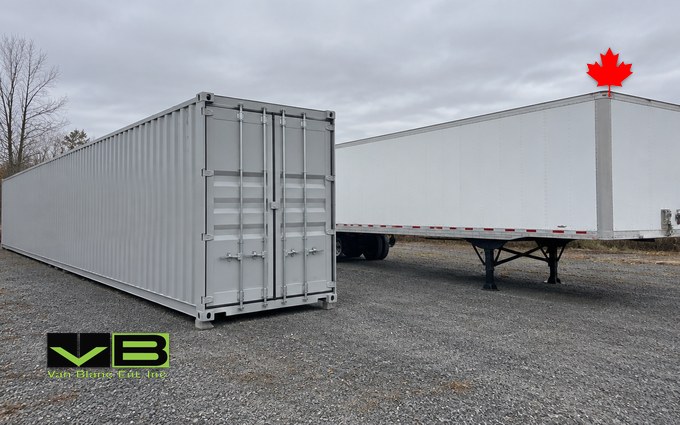
Quick Answer: A 53 foot trailer measures 53 ft by 102 in by 13 ft 6 in outside and about 52 ft 6 in by 100 in by 108 to 110 in inside. It carries 26 GMA pallets straight, 30 turned. A 53 ft domestic container matches that floor and pallet count.
What This 53 Foot Trailer Guide Covers
- 53 foot trailer dimensions at a glance
- Exterior size and Ontario’s legal limits
- 53 ft trailer height, inside and out
- Interior width, door opening and deck height
- Cubic capacity of a 53 foot trailer
- How many pallets fit in a 53 foot trailer?
- Double-stacked pallets and the weight ceiling
- Tare weight, payload and gross limits
- Skids, Euro pallets and 40 ft trailers
- The 53 ft container that matches the trailer
- A 53 for storage: trailer or container
- Dock doors, yard moves and short seasons
- Buying 53 ft containers from Van Blanc
- 53 foot trailer and container FAQs
Reading Time: 15 minutes
53 Foot Trailer Dimensions at a Glance
A 53 foot trailer, the dry van behind most highway tractors in Ontario, is 53 feet long, 102 inches wide and 13 feet 6 inches tall on the outside. Inside, it gives up a little to the walls, the roof bows and the floor: about 52 feet 5 inches to 52 feet 6 inches of length, 98 to 101 inches of width, and 108 to 111 inches of height, depending on who built it and when. A 53 ft domestic container, the steel box that rides the same highways on a chassis and the same railways on a well car, lands within an inch or two of those interior numbers, so a 53 ft domestic container bought outright takes the same pallets in the same pattern. The table puts the trailer and the container side by side in feet and inches and in metres, with the spread across builders shown as a range. The ISO boxes are in the size chart for every container from 10 to 53 feet.
| Measurement | 53 ft dry van trailer | Metric | 53 ft domestic container | Metric |
|---|---|---|---|---|
| Exterior length | 53 ft 0 in | 16.15 m | 53 ft 0 in | 16.15 m |
| Exterior width | 102 in to 102 3/8 in (8 ft 6 in) | 2.59 to 2.60 m | 8 ft 6 in | 2.59 m |
| Exterior height | 13 ft 6 in, ground to roof, on its tractor | 4.11 m | 9 ft 6 in to 9 ft 6 1/2 in, box only, the height of an ISO forty-foot high cube | 2.90 to 2.91 m |
| Interior length | 52 ft 5 in to 52 ft 6 in | 15.98 to 16.00 m | 52 ft 4 in to 52 ft 6 in | 15.95 to 16.00 m |
| Interior width | 98 to 101 in | 2.49 to 2.57 m | 98 to 99 in | 2.49 to 2.52 m |
| Interior height | 108 to 111 1/4 in | 2.74 to 2.83 m | 109 to 109 3/8 in | 2.77 to 2.78 m |
| Rear door opening | About 98 in wide by 108 to 110 in high (swing doors) | 2.49 m by 2.74 to 2.79 m | 98 in wide by 109 in high | 2.49 m by 2.77 m |
| Cubic capacity | 3,800 to 4,000 cu ft | 108 to 113 m³ | 3,884 to 3,948 cu ft | 110 to 112 m³ |
| Floor height | About 4 ft, level with a standard 48 to 52 in loading dock | About 1.2 m (docks 1.22 to 1.32 m) | At ground level, on its bottom rails over a simple pad at four corners | Ground level |
| GMA pallets, one layer | 26 straight, 30 turned | 1,219 by 1,016 mm pallets | 26 straight, 30 turned | Same pallets |
The trailer numbers come from the Wabash and Utility spec sheets and the published guides of two American freight companies and a trailer dealer; the container numbers come from CN’s 53-foot container sheet, the SEA BOX domestic 53 and Van Blanc’s own spec sheet, and our longer write-up on domestic 53s in Canada covers where the boxes come from and what buyers use them for. Every source is dated and linked at the bottom of the page.
Exterior Size and Ontario’s Legal Limits
The 53 foot trailer’s outside dimensions are set by law more than by engineering. In Ontario, the Ministry of Transportation’s weight and dimension guide caps any vehicle at 2.6 metres wide and 4.15 metres high, load included, under the Highway Traffic Act. A 102 3/8 inch van is 2.60 metres wide, right on the line, and a 13 foot 6 inch roof is 4.11 metres, four centimetres under it. The same two numbers bind the tilt-deck trucks that set containers on customers’ lots. Length is where Ontario differs from the American rules most guides quote. A semi-trailer that is not built to Ontario’s SPIF standard (the province’s Safe, Productive, Infrastructure-Friendly vehicle rules) is limited to 14.65 metres, which is a 48-footer. A SPIF semi-trailer can run to 16.2 metres, and 53 feet is 16.15 metres, so a 53 on the 401 or the 403 has to run as part of a SPIF-compliant combination unless it holds an oversize permit. The whole rig, tractor and trailer together, is held to 23 metres overall (about 75 feet), measured bumper to bumper with the load. A rig that long also sets the straight-line room a delivery truck asks for when it drops a long box on a customer’s lot.
Parked in a yard, a 53 ft container sits outside those rules. Off its chassis it is not a vehicle at all, so none of those limits apply to where it stands. On the road it rides a chassis, and the combination has to meet the same 23 metre, 2.6 metre and 4.15 metre rules; where the weight sits over the chassis axles matters as much as how much there is.
53 Ft Trailer Height, Inside and Out
The 53 ft trailer height most people quote, 13 feet 6 inches, is the height of the whole rig from the pavement to the top of the roof with the trailer coupled to a tractor. Utility Trailer lists its 4000D-X composite van at 13 feet 6 inches on a 46 1/2 inch fifth wheel, and Wabash lists its DuraPlate van at the same 13 foot 6 inch figure. In metres, 13 feet 6 inches is 4.11 metres. Ontario’s legal ceiling is 4.15 metres, so a standard 53 has about 4 centimetres of legal headroom above it. Parked on its landing gear, the nose drops or rises with the crank, so the number shifts by a few inches. A van that stays on that gear for years becomes a storage question, and how a parked van ages next to a box on the ground is answered on its own page.
Interior height is the number that matters for loading. A standard swing-door van gives 108 to 110 inches, 2.74 to 2.79 metres, and the newest thin-wall vans go a little higher at the rear: Wabash lists 110 1/4 inches at the front and 111 1/4 inches at the rear, and Utility lists 110 1/2 and 111. A roll-up rear door eats several inches of that at the door header, so check the door type before booking a tall load. The domestic container lands at 109 inches in CN’s sheet and 9 feet 1 3/8 inches (2.78 metres) in SEA BOX’s, so a load planned for a 108 inch van clears the box. For the ISO family, the extra foot a high cube adds over a standard 40 is the comparable headroom story one size down.
Height in Metres, for the Load Planner
Outside, on a tractor: 4.11 m. Ontario’s legal maximum: 4.15 m. Inside a swing-door van: 2.74 to 2.79 m, up to 2.83 m at the rear of a composite van. Inside a domestic 53 ft container: 2.77 to 2.78 m. Two layers of about 1.35 m each, pallet decks included, fill either one to the roof.
Interior Width, Door Opening and Deck Height
The typical interior width of a 53 foot trailer is 98 to 101 inches, depending on the walls. Most vans give 98 to 100, with 100 the figure Anderson Trucking Service and Hale Trailer both call most common. Composite plate vans like the Wabash DuraPlate and Utility’s 4000D-X move the structure into a thin sandwich panel and reach 101 inches wall to wall; Utility measures its 101 inches at the wearband. Any width from 98 inches up takes two 48-inch pallets side by side, turned, with a little room for straps, which a 40 ft high cube’s narrower ISO interior cannot do. The domestic container is 98 inches wide inside in CN’s sheet and 8 feet 3 inches in SEA BOX’s, enough for the turned pair of GMA pallets with two inches to spare.
The rear door opening on a swing-door 53 is about 98 inches wide and 108 to 110 inches high, a little narrower than the interior because the door frame and hinges take room. The container’s door is the same 98 by 109 inches in CN’s numbers, so a forklift that works one works the other, and swing cargo doors against a roll-up door is the same trade-off on a container as on a van.
The floor of a semi trailer sits about 4 feet off the ground, level with a standard loading dock. Blue Giant, the dock-equipment maker, puts the most common dock height at 48 to 52 inches (1.22 to 1.32 metres), and it tells designers to build docks for the truck beds they see most often, which on a shipping dock is the highway van. That height is the trailer’s biggest working advantage: a forklift drives straight off the dock into the van. A container on the ground is the opposite case. Its floor is a few inches up from the pad on its own bottom rails, and a forklift entering a ground-level container door needs a short ramp or no ramp at all, depending on the machine.
Cubic Capacity of a 53 Foot Trailer
A 53 foot trailer holds about 3,800 to 4,000 cubic feet, or 108 to 113 cubic metres, depending on wall thickness and roof height. The arithmetic: 52.5 feet long by 8.33 feet wide by 9 feet high is 3,936 cubic feet, and a thin-wall composite van with a taller rear pushes toward the top of the range. The domestic 53 ft container sits in the same band. CN rates its high-cube 53 at 3,901 cubic feet of usable cube; SEA BOX lists 3,948 cubic feet (111.8 cubic metres); Van Blanc’s spec sheet uses CN’s 3,901 cubic feet, or 110.5 cubic metres. Cube is the number that tells a warehouse manager whether a light, bulky load such as insulation or boxed furniture will run out of room before it runs out of weight. For comparison, the 45 ft high cube, the biggest ISO box, holds about 86 cubic metres, and a 40 ft high cube about 76. A 53 is about 45 percent more box than a 40 high cube, and it has the wider floor.
How Many Pallets Fit in a 53 Foot Trailer?
A 53 foot trailer holds 26 standard 48 by 40 inch GMA pallets loaded straight, 28 pinwheeled, and 30 turned, in a single layer on the floor. It is the same arithmetic behind what fits in every container size. The GMA pallet (named for the Grocery Manufacturers Association) is 48 by 40 inches; CHEP lists that North American standard at 1,219 by 1,016 millimetres. The count comes from dividing the floor. Loaded straight, with the 48 inch side running down the trailer, 630 inches of floor (52 feet 6 inches) divided by 48 gives 13 rows, and a 100 inch interior takes two 40 inch pallets across: 13 rows of 2 is 26. Turned, with the 40 inch side running down the trailer, the same length gives 15 rows, and two 48 inch pallets across take 96 of the 100 inches: 15 rows of 2 is 30. Pinwheeling alternates one straight and one turned pallet in each row and lands at 28, and block, pinwheel and chimney patterns in 20s and 40s work on the same logic with narrower floors. The same counts hold in a 53 ft domestic container: CN rates its 53 at 30 pallets of 48 by 40 or 48 by 42, and RXO gives 26 pallets for a domestic 53.
| Pallet size | Loading pattern | 53 ft trailer, one layer | 53 ft trailer, double-stacked (weight allowing) | 53 ft domestic container, one layer |
|---|---|---|---|---|
| 48 x 40 in GMA (1,219 x 1,016 mm) | Straight | 26 | 52 | 26 |
| 48 x 40 in GMA | Pinwheeled | 28 | 56 | 28 |
| 48 x 40 in GMA | Turned | 30 | 60 | 30 (CN rating) |
| 48 x 42 in (the second size CN rates) | Turned | 28 to 30 | 56 to 60 | 30 (CN rating) |
| 42 x 42 in (paint, beverages) | Square, any way | 30 | 60 | 28 to 30 |
| 36 x 36 in (beverages) | Square | 34 | 68 | About 34 |
| 48 x 45 in (automotive) | As published | 28 | 56 | 26 to 28 |
| 48 x 48 in (drums, barrels) | Square | 26 | 52 | About 26 |
| 1,200 x 800 mm Euro | Three across | Up to 39 on paper (13 rows of 3) | Weight governs | Up to 39 on paper |
The trailer column follows Anderson Trucking Service’s published counts for each pallet size, except the 48 by 42 and Euro rows, which are our arithmetic on a 52 foot 5 to 52 foot 6 inch floor. Double-stack figures are twice the floor, which Hale Trailer confirms for the straight 52, and strapping and blocking a two-high load is what makes them hold on the highway. Container figures other than CN’s two ratings and RXO’s 26 are our arithmetic on a floor 52 feet 4 inches to 52 feet 6 inches long and 98 to 99 inches wide; where a range is shown, the shorter floor gives the lower number. Treat them as a starting point. In a box packed for storage rather than the highway, pallet racking bolted inside a steel box is the other way to use the height.
Christian LeBlanc, second-generation operator, Van Blanc Ent. Inc.: “When somebody has a dry van parked behind the shop and wants the same pallets in something that sits on the ground, the numbers carry straight over. The box is the same length and the pallets go in the same way, two across, 26 straight or 30 turned. The forklift drives in off the ground instead of off a dock.”
Double-Stacked Pallets and the Weight Ceiling
Double-stacking doubles the pallet count on paper, 52 straight and up to 60 turned, but weight decides whether it happens, and a certified scale ticket settles the question before the truck leaves. A 53 foot van legally carries about 42,000 to 45,000 pounds of freight in the United States, and 45,000 pounds spread over 26 pallets is an average of about 1,730 pounds each. Spread over 52 pallets, it is about 865 pounds each; over 60, about 750. So double-stacking is for light, stackable freight such as packaging and boxed consumer goods. Canned food or hardware fills the weight limit long before it fills the floor, and the van leaves the dock with half its height empty. Stackability is the second test. The bottom pallet has to carry the top one for the whole trip without crushing, and a load that shifts at a highway stop is a claim. Carriers hold a double-stacked load in place with load bars and air bags inflated into the gaps between pallets. None of that matters in a stationary box, where the limits are the floor rating and how high a person can safely stack.
The Pallet-Weight Check Before You Book a 53
Divide your freight weight by your pallet count before you promise a customer 30 pallets. Above roughly 1,500 pounds a pallet, a full turned floor already reaches the usual 45,000 pound van payload, and double-stacking is off the table. Below about 750 pounds a pallet, a double-stacked 53 runs out of floor before it runs out of weight.
Tare Weight, Payload and Gross Limits
A 53 foot trailer weighs about 15,000 pounds empty, and the payload a shipper can load is whatever is left under the legal gross once the tractor and trailer are counted. In the United States the federal gross for a tractor and trailer is 80,000 pounds, which leaves the 42,000 to 45,000 pound freight window the carriers quote. Ontario sets its weights axle group by axle group under Regulation 413/05. The MTO guide’s worked example of a SPIF tractor pulling a tandem-axle semi-trailer of up to 16.2 metres allows 40,800 kilograms gross (about 89,900 pounds); its tridem-axle example allows 48,800 kilograms. So a load that scales legally in Ontario can be overweight at the Michigan or New York line, and a cross-border shipper plans to the lower number. For the container, empty and loaded weights for every container size are laid out separately; the 53 figures are in the table below.
| Weight | 53 ft dry van trailer | 53 ft domestic container |
|---|---|---|
| Empty (tare) | About 15,000 lb (6,800 kg), running gear included | 11,070 lb (5,020 kg), SEA BOX and Van Blanc spec |
| Builder’s rating | GVWR 65,000 lb (Utility) to 68,000 lb / 30,845 kg (Wabash) | Gross 67,200 lb / 30,480 kg, payload 56,130 lb / 25,460 kg (SEA BOX) |
| Freight actually carried on the highway | About 42,000 to 45,000 lb (19,050 to 20,410 kg) | About 43,500 lb (19,730 kg), heavier steel for rail double-stacking |
| Legal gross, tractor and trailer | 80,000 lb in the US; 40,800 kg in the MTO’s tandem SPIF example | Same rules on a chassis |
| Floor | Laminated oak, 20,000 lb dynamic rating (Wabash) | 1 1/8 in marine plywood, forklift-tested to 16,000 lb (SEA BOX) |
| Weight limit parked on your lot | Floor and landing gear | Floor only; the box carries its load down to whatever sits under its corner castings |
How much a 53 shipping container weighs empty runs from about 5,000 to 5,500 kilograms, depending on the builder. Parked for storage, the trailer’s legal highway payload stops mattering and the floor rating takes over, and a container floor worn by years of forklifts is the part to inspect before buying either one used.
Skids, Euro Pallets and 40 Ft Trailers
Skid and pallet are used interchangeably on most Canadian shipping docks, and the count in a 53 ft trailer is the same for both. So the answer to how many skids fit on a 53-foot trailer is the pallet answer: 26 straight, 30 turned, and double that if the freight is light and stackable enough.
Euro pallets change the geometry. The 1,200 by 800 millimetre pallet (CHEP lists the 1,200 by 800 size alongside the 48 by 40 North American standard) is narrow enough to go three across: three 800 millimetre sides add up to 2,400 millimetres, or 94 1/2 inches, which fits a 98 to 101 inch interior. With the 1,200 millimetre side running down the floor, 13 rows fit in a 53, which is 39 pallets on paper. Real loads come in lower once overhang, securement gaps and a door-end row are counted, so settle on a load plan drawn before the forklift starts, then promise a number. A 48 by 48 inch pallet goes the other way: it is too wide to turn, and a 53 takes 26.
A 40 foot trailer or a 40 foot container holds about 20 GMA pallets straight. RXO, which books both, quotes 40 foot international containers for 10, 20 and 22 pallet loads, with 20 the usual, and Hale Trailer’s dry-van guide gives 18 to 20. The difference from a 53 is the width. An ISO 40 is about 92 inches wide inside, so turned 48 inch pallets do not fit two across, and pallet-wide ocean containers add some of those missing inches for European shippers. A 48 foot trailer, still common on regional runs, takes 24.
The 53 Ft Container That Matches the Trailer
A 53 ft container is a North American domestic intermodal box: the same length and width as a dry van, built as a steel container that lifts off a chassis and stacks two high on a railcar. It is not an ISO ocean container and carries no CSC plate, the safety approval plate the International Convention for Safe Containers requires on boxes that go to sea. There are no 53 foot ocean containers; the ocean boxes top out at 45 feet, and the ISO family of 20s, 40s and 45s is the one built for ships. Domestic 53s are built to rail and trucking specifications, run between Canadian and American cities by rail intermodal services and trucking fleets, and are retired onto the secondary market when those fleets replace them. RXO counts roughly 336,500 domestic containers on American rails alone.
The container was designed to carry a trailer’s load, so the dimensions match on purpose. Inside, a domestic 53 is 52 feet 4 inches to 52 feet 6 inches long, 98 to 99 inches wide, and about 109 inches high, and its door opens 98 by 109 inches. Put the same 26 or 30 GMA pallets on the floor, and they go in exactly as they would in a van. What changes is what sits under the box: no axles, no tires, no suspension, no landing gear, and a floor at ground level rather than dock height. The steel is heavier, built for rail double-stacking, so RXO puts the container’s highway freight limit a little lower than the van’s. For storage, the extra steel is a plus. Van Blanc’s 53 ft high cube spec sheet lists the full numbers we quote from, including the 110 cubic metre volume.
Where the 53s Come From in Ontario
Domestic 53s reach the secondary market when rail and trucking fleets retire them, which means a thinner, lumpier supply than the ocean boxes that land at every port. Van Blanc typically keeps 2 to 4 of them on the ground across the four Brantford yards, sources specific grades to order in 2 to 4 weeks, and regularly supplies fleet orders of 10 to 20. Ordering a fleet of containers in one purchase works the same way for 53s as for 40s, with the sourcing time stated up front.
A 53 for Storage: Trailer or Container
Plenty of 53s end their working lives as storage. A business with a retired dry van, or a line on one, is weighing it against a container of the same size, and the two differ most in what it takes to own them for years. The table is the short version; the full scorecard of a parked van against a steel box goes line by line through lifespan, security, snow and resale.
| What owning it involves | 53 ft dry van parked for storage | 53 ft domestic container |
|---|---|---|
| Road plate and annual inspection | Only if it goes back on the road; Ontario requires annual inspection of most trailers over 4,500 kg | None; it is not a vehicle |
| Tires, brakes, suspension, landing gear | Stay with it, age in place, and hold it up | None; it sits on its corner castings |
| Floor height | About 4 ft, level with a dock; forklift access off the dock | Ground level; walk in, or a short ramp for the forklift |
| Walls and roof | Built light for fuel economy; thin aluminium or composite | Corrugated steel built for rail stacking |
| Ground under it | Firm, level surface under the wheels and the landing-gear feet | Four corners on a level pad |
| Where it can sit | Anywhere a truck can back it in | Anywhere a delivery truck can set it down |
| How you get one | Buy used, or rent from a trailer leasing company | Van Blanc sells outright; no rent, lease or rent-to-own |
The trailer owner who parks a van for good still owns a vehicle, which means rubber and bearings sitting in one spot through Ontario winters. Laying a level pad under four corners is the container’s version of that upkeep, done once. And if what you actually have is a smaller trailer to put away for the season, wintering the trailer itself is its own question with its own routine.
Dock Doors, Yard Moves and Short Seasons
A parked 53 foot trailer has two working strengths, and a buyer comparing the two should weigh them against the box. Dock height is the bigger one. A warehouse that ships and receives off dock doors can back a van to a door and run pallet jacks straight in. A ground-level container takes the same pallets through its doors with a container ramp from the accessories list or a forklift that works outside, and it never needs a tractor to be backed into place. Mobility is the other. A plated, safetied van can be shunted around a yard by a yard tractor, while a container is set once, by tilt-deck or crane, where it will work, and for storage that stays put that is the whole idea. Short seasons are where rented vans show up: trailer leasing companies rent storage vans by the month, and that monthly bill comes back with every peak. Van Blanc sells containers outright: the box is bought once, carries no plate, tires or annual inspection, and is still on the lot for next year’s peak and the one after. Where the need outlasts a season and the space is off the dock, overflow storage for a 3PL on its own lot works the container case through in full.
Buying 53 Ft Containers From Van Blanc
Van Blanc Ent. Inc. is a family-run container supplier in Brantford, Ontario, founded by Paul LeBlanc in 1995 and run today by Paul and his son Christian, and it sells containers outright. There is no rental, no lease and no rent-to-own. A buyer who wants to spread the cost does it through their own bank or equipment lender, and we supply the invoice, grade and serial number the lender asks for; paying cash or financing through your own lender covers both routes. A 53 earns its length in the jobs a trailer already does: a trucking yard offloading a van’s worth of cargo, a distributor’s peak-season overflow, long equipment that will not fit a 40, and pallet inventory that wants the wider floor. Orders run from a single box to a fleet.
On a typical week we have 2 to 4 domestic 53s on the ground across our four Brantford yards, and a unit in stock delivers in 1 to 3 days. Specific grades are sourced to order in 2 to 4 weeks. Fleet orders of 10 to 20 are regular work, and anything larger is quoted case by case. Grades follow the usual ladder, and one-trip, cargo-worthy, wind-and-watertight and as-is mean the same thing on a 53 as on a 40, with the AAR domestic plate standing in for the CSC re-certification. What moves the number is the grade, the count, whether the unit is on the ground or sourced, and the distance from Brantford; the factors behind every 53 quote are written out in full on their own page.
Pricing a 53 From the Brantford Yards
Tell us how many 53s you need, the grade, the pallets or equipment going in, and the delivery postal code. We will tell you what is on the ground and what needs sourcing, and send one all-in number with a real lead time. The fastest answer is a phone call.
Family-run in Brantford since 1995 · four Brantford yards · 4.9★ across 140+ Google reviews · every box graded by a person, walk it before it lands.
Delivery is where a 53 differs most from a 40. The box rides a specialized long trailer, and it needs more straight approach and more turning room than a 40 foot container does. Before we book a 53, we look at the site on satellite imagery and ask about the approach, the gate width and overhead wires and branches along the drop path. Where the truck cannot reach the final spot, a crane lift from the road is the fallback, quoted in advance. The pad under it is simple: level and firm at the four corners, and ties, blocks or compacted gravel under the corner castings all work for a storage box. Buyers who want to see the steel before they pay are welcome at the yards; walking the box before paying for it is still the best way to judge a used floor and door gaskets. For a single box or a fleet, every size on the lot, from 20s up to 53s, is listed with its interior dimensions.
Frequently Asked Questions
How much room does a 53 foot trailer need?
The trailer itself is 53 feet long and 102 inches wide, and with its tractor the whole rig can run up to the 23 metres (about 75 feet) Ontario allows a tractor and semi-trailer overall. Backing it into a dock or a lot also takes clear space in front of the spot to swing the tractor, so measure the apron, not only the parking space.
How high off the ground is the floor of a semi trailer?
About 4 feet. A highway van’s floor lines up with a loading dock, and Blue Giant puts the most common dock height at 48 to 52 inches (1.22 to 1.32 metres). A domestic container on the ground has its floor only a few inches up, on its bottom rails.
How many skids can fit on a 53-foot trailer?
Twenty-six 48 by 40 inch skids loaded straight, 28 pinwheeled, and 30 turned, in one layer. Double-stacked, that becomes 52 to 60 if the freight is light and stackable enough; at a typical 45,000 pound payload, double-stacking only works when the average skid weighs under about 865 pounds straight, or 750 turned.
How many pallets fit in a 40 ft trailer?
About 20 standard 48 by 40 pallets in a 40 foot container or trailer, loaded straight in two rows; Hale Trailer’s guide gives 18 to 20. The narrower ISO interior, about 92 inches, stops the turned pattern that gets a 53 to 30, and a 48 foot trailer takes 24.
Are there 53 foot ocean containers?
No. Ocean containers are built to ISO standards and top out at 45 feet; the 53 foot container is a North American domestic box for rail and truck, 8 feet 6 inches wide, with no CSC safety approval plate for sea transport. Ocean shipping lines do not accept it, so export loads go in a 40 or 45 foot high cube.
How much does a 53 shipping container weigh empty?
About 5,000 to 5,500 kilograms (11,000 to 12,100 pounds). SEA BOX lists its domestic 53 at 5,020 kilograms, the same figure on Van Blanc’s spec sheet. That is lighter than a 53 foot dry van, which weighs about 15,000 pounds empty because it carries its axles, tires and landing gear.
Does Van Blanc rent 53 foot containers or trailers?
No. Van Blanc sells containers outright only, with no rental, lease or rent-to-own. Storage trailers are rented by trailer leasing companies. A 53 ft domestic container bought from Van Blanc is yours, delivered from the four Brantford yards, and financing, if needed, goes through your own bank.
Sources
- Anderson Trucking Service. (Accessed 2026-09-22). How Many Pallets Fit In a 53-Foot Dry Van Trailer? atsinc.com
- Hale Trailer. (2025, accessed 2026-09-22). How Many Pallets Fit on a 53 Foot Trailer? haletrailer.com
- Hale Trailer. (2025, accessed 2026-09-22). Dry Van Dimensions and Capacity Guide: 53′, 48′ and 40′ Dry Van Trailers. haletrailer.com
- Wabash. (2025, accessed 2026-09-22). Dry Vans with DuraPlate Cell Core Technology, specifications VT-01-5.25. onewabash.com
- Utility Trailer Manufacturing Company. (Accessed 2026-09-22). Dry Van Specifications and 4000D-X Composite Series Dry Vans. utilitytrailer.com specifications; utilitytrailer.com dry vans
- Canadian National Railway. (Accessed 2026-09-22). Intermodal Domestic Equipment: 53-Foot Container. cn.ca
- SEA BOX. (Accessed 2026-09-22). 53 ft x 9 ft 6 1/2 in x 102 in Wide Dry Freight Container, SB5531.9. seabox.com
- RXO. (Accessed 2026-09-22). A Tale of Two Markets: 53 ft Domestic vs. 40 ft International Intermodal Containers. rxo.com
- Ontario Ministry of Transportation. (2024). Guide to Vehicle Weight and Dimension Limits in Ontario, chapters 2 and 5. MTO guide (PDF)
- Government of Ontario. (Updated 2026-09-17). Get a safety or emissions inspection for a commercial vehicle. ontario.ca
- Blue Giant. (Accessed 2026-09-22). Dock Planning and Design: Dock Height. bluegiant.com
- CHEP Canada. (Accessed 2026-09-22). Standard Pallet Size. chep.com
- Van Blanc Ent. Inc. (Accessed 2026-09-22). 53 Ft, 45 Ft and 40 Ft High Cube Container Specifications (volume and tare figures). 53 ft spec sheet; 45 ft spec sheet; 40 ft high cube spec sheet
Trailer to Container, From Brantford
We have been supplying shipping containers across Ontario since 1995. Our office is at 90 Morton Avenue East in Brantford, the four yards are all in Brantford, and we deliver across the province with payment on the day of delivery.
Van Blanc Ent. Inc., 90 Morton Ave E Unit 1B, Brantford, ON N3R 7J7, 519-754-6844.
If you are replacing a trailer with a box, bring the pallet count, the heaviest pallet weight and the delivery postal code to the call, and we will tell you on the spot whether a 53 is on the ground or needs sourcing. Worth the drive for unbeatable quality, family customer service with 30 years of experience.