
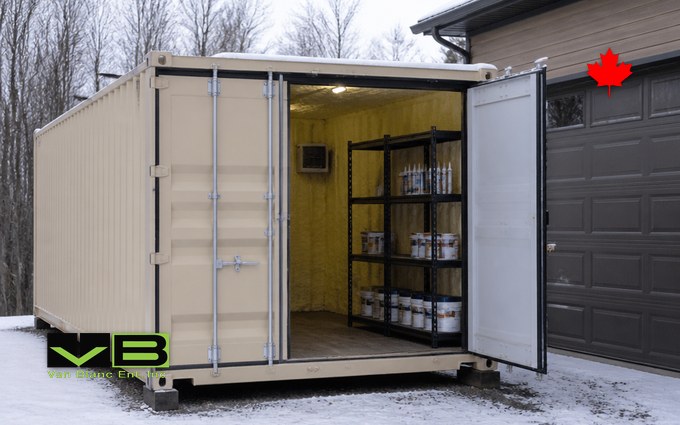
Quick Answer: Climate controlled storage holds a set temperature range, often 10 °C to 25 °C, and sometimes humidity too. Heated storage keeps contents above freezing. Paint, electronics, documents and wine need one or the other through Ontario’s 147 frost days. An insulated container with a heater does it on your property.
Climate and Heat, Item by Item
- What Is Climate Controlled Storage?
- Heated Storage Against Full Climate Control
- Brantford Winter by the Numbers
- Relative Humidity and Mould Timelines
- Climate Needs for Paint, Electronics and Wine
- Heated Storage Units at Self-Storage Sites
- An Insulated Box on Your Own Ground
- Heated Storage Unit Setup: Heater, Humidistat, Wiring
- 20ft or 40ft for Household and Shop Stock
- Asking the Yard About Insulated Units
- Delivery to Toronto, Ottawa and London
- What Moves the Cost on Each Route
- Frequently Asked Questions
Reading Time: 15 minutes
What Is Climate Controlled Storage?
Climate controlled storage is a storage space kept inside a set temperature band all year, and often held to a humidity limit as well. The space can be a unit in a self-storage building, a room in your house or a steel box on your own driveway. What makes it “climate controlled” is the equipment and the setting, not the walls. Van Blanc sells the steel box version, most often a plain 20ft dry box fitted out after delivery, from our 4 Brantford yards. So we look at this question from the container side. Paul and Christian LeBlanc run the business, which dates from 1995.
“When a buyer at our yards asks me for a climate controlled container, my first question is what’s going inside. Paint that can’t freeze and a box of family photos need different setups, even in the same 20ft.”
Christian LeBlanc, second-generation operator, Van Blanc
Self-storage operators publish their own bands. Public Storage Canada’s guide to the topic gives temperature controlled units a range of “usually around 10°C to 25°C”. It then draws a line between that and climate control. A temperature controlled unit holds that range only, while a climate controlled unit also keeps humidity steady. The guide adds that many facilities advertising climate control mean temperature control, with no dedicated humidity equipment. That distinction matters more than the brochure suggests, and the humidity section below shows why.
A box you own can be set up either way. Insulation slows the swing, a heater keeps the floor of the range, and a humidistat or dehumidifier handles moisture. The three kinds of insulated box Van Blanc describes are built in different ways, and the setup inside decides which label fits.
Heated Storage Against Full Climate Control
Heated storage is the simpler promise. A heater keeps the space above freezing, or above a set floor such as 5 °C, and does nothing about summer heat or damp. Full climate control adds a ceiling to the temperature and usually a limit on humidity. Many Ontario buyers of heated storage are protecting against one thing: a January night that freezes a can of paint solid.
For many items, heat is the whole job. Latex paint, caulking, water-based stains, some cleaning products and anything with water in it fails by freezing. For paper, photographs, wood and instruments, freezing is less of the story. Those suffer from damp, from very dry winter air and from fast swings between the two. That second group needs climate control in the full sense, or at least a heater run by humidity instead of temperature.
“It is only liquid water that freezes at 0°C.”
Canadian Conservation Institute, Agent of Deterioration: Incorrect Temperature
| Setup | What it holds | What it leaves alone | Typical contents |
|---|---|---|---|
| Unheated steel box, vented | Weather, theft, pests at the seals | Outdoor temperature swings, condensation | Tools, lumber, tires, garden gear |
| Insulated box, no heat | Slows the daily swing | Long cold spells, humidity | Dry goods, seasonal stock |
| Insulated box with thermostat heater | A floor above freezing | Summer heat, damp | Paint, caulking, water-based liquids |
| Insulated box with humidistat heater | Humidity near 50% RH | A fixed temperature | Documents, books, furniture |
| Self-storage climate unit | About 10 °C to 25 °C, humidity at some sites | Access outside facility hours | Household goods during a move |
The rows are a guide to setups, not a ranking. A tool crib and a paint store want different boxes, and some buyers run one of each. If you have been weighing what insulation actually changes inside a backyard shed, the same physics applies to steel, with a tighter seal.
Brantford Winter by the Numbers
Environment and Climate Change Canada publishes 30-year normals for a station in Brantford, and they set the size of the problem. Over 1981 to 2010, January’s mean daily low was -10.4 °C. The station logged a low at or below freezing on 147 days a year. On 54 days a year the temperature never rose above 0 °C at all.
Those 54 days are the ones that matter for paint and liquids. An unheated space follows the outdoor air with a lag. A week of highs below freezing drains whatever warmth the ground or the sun added. January averaged about 3 days with a low under -20 °C, and the whole year about 5. A heater sized for a mild night has to cover those too. The insulation package on a Van Blanc custom build cuts how hard it works.
Summer runs the other way. July’s mean daily high at the station was 27.2 °C, and it saw about 13 days a year above 30 °C. A dark steel roof in full sun can run hotter than the air around it. So the climate controlled side of the market talks about heat as much as cold. Paint and electronics have upper limits as well as lower ones.
“An example from our daily lives is the rapid distortion of video cassettes, CDs, and DVDs when left in direct sunlight.”
Canadian Conservation Institute, Agent of Deterioration: Incorrect Temperature
Where Ontario Winters Bite Hardest
Brantford sits in a milder band of the province. The same federal normals for the Ottawa CDA station show a January mean low of -14.4 °C. There, 74 days a year stay below freezing all day. A box headed east or north needs a heater sized for a colder floor than a Brantford driveway. Tell us the postal code, and we will tell you which 20ft dry box with its inside measurements or insulated option suits the spot.
Relative Humidity and Mould Timelines
Relative humidity, written RH, is the share of water vapour the air holds against the most it could hold at that temperature. Warm air holds more. So the same air reads a lower RH when you heat it and a higher RH when it cools. That one fact explains most storage damage that is not freezing. It is also why a roaster’s green coffee storeroom is judged on humidity first.
The Canadian Conservation Institute, part of the federal government, publishes the clearest numbers. It gives the practical boundary for damp as 75% RH. Its mould table covers materials rich in protein, starch or sugar, such as leather and parchment. For those, mould starts in about 100 days at 70% RH, 10 days at 80% RH and 2 days at 90% to 100% RH. Those times hold for warm rooms near 25 °C. Cold slows mould down, which is one reason a cold, damp spring is a bigger risk than a frozen January.
“To prevent mould, fix any moisture problems right away and control humidity levels in your home.”
Health Canada, Mould
The same page warns about the opposite problem. Heating winter air without adding moisture can drop indoor humidity a long way. In many parts of Canada, CCI writes, that can mean as low as 5% RH by December when heating to 21 °C. Very dry air cracks wood, loosens veneers and shrinks the tops of guitars and other musical instruments. Wine stored in a container cellar faces the same dry-air risk at the cork. So a heater set high and left alone can harm the very things climate control is meant to protect.
Humidistat Heating, the Museum Method
CCI describes a way out that suits a small insulated box. In humidistatic heating, a humidistat switches the heater, not a thermostat. Heaters come on only when the humidity is above 50% RH. As the air warms, RH falls, and at 50% RH the heat shuts off. The space ends up cooler than a house in winter but holds steady humidity, which is what paper, wood and textiles want. Van Blanc can talk through a humidistat setup for your box before you order. CCI notes one heritage group used it for a storage building, with portable dehumidifiers for summer damp.
For a general museum collection, CCI’s table sets 50% RH and a temperature anywhere between 15 °C and 25 °C. Most household goods tolerate much wider swings than that. Still, it gives a sensible target for heirlooms, and it shows that steady humidity outranks a precise temperature for most organic materials. Condensation is the steel-box version of the same physics, covered in our notes on heating and cooling a container you plan to use.
Climate Needs for Paint, Electronics and Wine
Not everything in a garage needs heat or climate control. Steel tools, lawn furniture, tires, lumber and most sporting gear ride out a winter in a dry, unheated used box with sound seals. The list below covers the items that do need help, with the source’s own wording where a maker publishes one.
Paint, Caulking and Water-Based Products
Benjamin Moore says paint should be stored between 60 and 80 °F, which it gives as 15 to 27 °C. It tells buyers to think about their climate before storing paint in a garage and to make sure it doesn’t freeze. Opened paint, by its count, has a shelf life of two years, a little longer with proper storage. Painting contractors who carry partial cans from job to job are the classic heated storage buyer. An insulated container for a paint room suits them. A thermostat heater set well above freezing covers them, and the insulation keeps the summer peak lower.
Electronics and Batteries
Apple’s battery guidance for its devices names 16 °C to 22 °C as the ideal comfort zone. For long storage it asks for a charge near 50% and a cool, moisture-free place under 32 °C. Other makers publish their own ranges, so check the manual for anything expensive. The pattern is the same across most of them: avoid heat, avoid damp and avoid storing a battery full or flat. A dry, heated box handles the winter half of that, and shade and extra vents cut into the box walls help with the summer half.
Documents, Photographs and Books
Paper and photographs fail through damp and mould far more often than through cold. CCI’s damp boundary of 75% RH is the line to stay under, and the 50% RH target is safer. Keep boxes off the floor on shelving, away from the steel walls, and never in cardboard that has already been wet. Van Blanc can quote shelving along one wall of the box with the order. A humidistat heater or a small dehumidifier set to switch on above 50% suits this group better than a thermostat set to room temperature.
Wine, Instruments and Wood Furniture
Wine wants a steady, cool temperature more than a warm one, plus enough humidity to keep corks from drying. A heater alone is the wrong tool, and a container set up as a wine cellar with its own cooling covers the gear that works. Instruments and solid wood furniture sit between paper and wine. They dislike fast swings and very dry winter air, which is why the humidistat method above suits them. Guitar and piano makers publish their own humidity targets, and those win over any general rule.
Read the label before picking a setting. The tightest limit in the box sets the target. If paint and paper share one container, the paint needs a floor above freezing and the paper needs humidity under 75% RH. A heater on a thermostat with a small dehumidifier covers both. Write each item’s limit on the shelf edge, so whoever checks the box in February knows what the reading should be. Heat and insulation in a backyard shed follow the same labelling habit.
Heated Storage Units at Self-Storage Sites
A self-storage facility rents units inside a building it heats and, at some sites, cools. Heated storage units are the indoor rooms. Drive-up units with a roll-up door to the outside are often unheated. The tenant pays a monthly rate, set by the size of the unit, the climate feature and the location. Access follows the facility’s hours and gate system. A container from Van Blanc is a new steel box you own outright, open whenever you like.
The climate feature varies by operator and by building. Some sites hold temperature only. Others add dehumidifiers or full air conditioning. The guide quoted earlier says most household goods do not require climate controlled storage. It points instead at antiques, documents, photographs, instruments and artwork. Ask a facility what range it holds, whether it controls humidity and how it monitors both. A written answer to those three questions tells you more than the word on the sign. Ask a container seller the same questions, and we answer them in writing with the quote.
Self-storage suits a move, a renovation or a short gap between homes, when the goods are coming back out within months. A business with stock that has to sit warm every winter has a different calculation. It pays rent each month for space it never owns, and its people drive to the facility for every pickup. That buyer is the reason this page exists.
An Insulated Box on Your Own Ground
Owning the storage turns the monthly question into a one-time purchase. A 20ft container sits on your driveway, beside the shop or at the back of the yard. You set the heater, you keep the key and you open it at six in the morning if a job needs the paint. Van Blanc sells containers outright, and payment happens on delivery, once the box is on your ground.
There are two ways to get an insulated box. The first is to buy a standard container and add insulation. Van Blanc frames and installs insulation as an option on any container, as our custom features page lists alongside vents and framing. The second is a box built insulated from the start: a factory-insulated unit or a refrigerated container whose machine no longer runs. Those two are not standing stock lines, so the section on asking the yard covers how to find one.
The base box matters either way. A new box with tight door seals and clean paint has made one loaded voyage, which is why the trade calls it one-trip. It gives insulation a clean, dry shell to bond to. A cargo worthy used box with sound doors and a dry floor works as a base too. If you want to compare every size and grade we stock, side by side, the for-sale page lists them by container number.
“Once a box is lined for heated storage, nobody looks at that steel again. So I check the walls and floor hard before we insulate, because a rust spot or a damp floorboard behind the lining keeps working where you can’t see it.”
Paul LeBlanc, owner, Van Blanc
A Painting Contractor’s Winter Paint Room
Say you run a painting business and carry forty part cans, a few pails of primer and a shelf of caulking between jobs. A 20ft with insulation and a thermostat heater set near 10 °C, plus shelving on one wall, holds all of it. The other wall takes drop cloths, ladders and a sprayer, none of which need the heat but all of which need a lock. The van backs up to the doors, so loading takes minutes.
Heated Storage Unit Setup: Heater, Humidistat, Wiring
The heater is the part that turns an insulated box into a heated storage unit. Electric heaters suit most owners, because they burn nothing inside a closed space and need no venting. A thermostat model keeps a temperature floor. A humidistat-controlled model, or a heater on a separate humidistat switch, follows the CCI method. Pick the control to match the most fragile thing on the shelves. Mini-splits and electric heat for working containers are a bigger step, for boxes people work inside.
Heater Clearance and Fire Safety
One Ontario fire service, the Town of Tecumseh’s, sets out the core advice for space heaters. It says to keep heaters at least one metre away from combustible materials such as paper, bedding, furniture and curtains. It asks for CSA or ULC approved products and says never to plug an electric space heater into an extension cord. It also says to turn off and unplug a space heater when leaving the room or home. A storage box sits empty most of the day, which runs against that last tip. Ask your electrician about a hard-wired heater with its own thermostat, rated for the space, in place of a portable plug-in unit. We can rough in the heater circuit to your spec, and a licensed electrician makes the final connection. Mount it where nothing can be stacked against it, and keep the one-metre zone clear of boxes.
“Fires due to space heaters usually involve them not having adequate safety features; placing them near combustibles; and not properly plugging them in.”
Electrical Safety Authority, Indoor Safety
Never heat a closed container with a fuel-burning heater left running, and never store fuel or propane cylinders inside one. Combustion needs fresh air and venting, and a storage box is sealed by design. Van Blanc builds man doors and vents for occupied boxes, but a storage box stays electric. If a project calls for fuel-fired heat, that is a job for a licensed heating contractor on site.
“I tell anyone planning a heated storage box to keep the heat electric and keep fuel and propane out. A steel container is sealed tight to keep Ontario weather out, and that same seal keeps fumes in.”
Paul LeBlanc, owner, Van Blanc
Power to the Box
A heater needs a proper circuit, not a cord run across the lawn. Van Blanc can rough in electrical to your spec as part of a custom build. A licensed electrician makes the final connection to your supply. ESA says only a Licensed Electrical Contractor can be hired for electrical work in your home, and the contractor files the notification with ESA. Plan the outlet near the heater, a light by the door and, if you want it, a plug for a dehumidifier. Ask the electrician about the circuit size before you buy the heater, so the two match. Send your panel photo with the quote request and we will note it on the build sheet.
Vents still matter in a heated box. Warm air carries moisture, and a sealed space with damp contents can climb in humidity even with heat on. Most containers ship with 2 to 4 vents, and Van Blanc can add more. A cheap digital thermometer and hygrometer on the back wall tells you whether the setup works before the first cold snap. A cargo worthy used box with dry floors takes the same instruments.
Planning a Heated Box for Your Stock?
Tell us what goes inside, the lowest temperature it can take and your postal code. We will suggest a size and grade, say what insulation and electrical rough-in suit it, and send one all-in number with delivery. A call to the yards is the fastest way to get there.
Family-run in Brantford since 1995 · four Brantford yards · 4.9★ across 140+ Google reviews.
20ft or 40ft for Household and Shop Stock
Many heated storage buyers start with a 20ft. Inside, the standard 20ft in our yards runs 19 ft 4 in long, 7 ft 8 in wide and 7 ft 10 in high. That works out to 1,172 cubic feet. It takes 10 standard pallets on the floor. Insulation and an interior liner take a few inches off each wall and the ceiling, so measure the widest shelving unit before you commit.
| Box | Inside volume, standard | Pallets on the floor | Usual heated-storage buyer |
|---|---|---|---|
| 20ft | 1,172 cubic feet | 10 | A household, a painter, a small shop’s overflow |
| 20ft high cube | About 1,300 cubic feet | 10 | Tall shelving or stacked totes |
| 40ft | 2,395 cubic feet | 20 | A contractor’s full winter stock, or two zones |
| 40ft high cube | 2,689 cubic feet | 20 | Retail or event stock on tall racking |
Volumes here are for standard boxes before insulation, and a 40ft takes 20 pallets on the floor. The 40ft dry box with its full measurements is the step up. A 40ft heats more air and needs a larger heater, or two smaller ones at each end. One wall of partition can split a 40ft into a heated end for paint and an unheated end for tools. That layout saves power and keeps the one-metre heater zone easy to respect.
Shelving makes more difference than size for most owners. Steel shelving bolted to the side rails keeps boxes off the floor and away from the cold walls. Leave an aisle wide enough to reach the back without moving everything. Label the shelves by temperature need, with the most sensitive items nearest the heater and the hardiest near the doors. Van Blanc can price racking and a partition wall into the build.
Asking the Yard About Insulated Units
Insulated containers do not sit on our standing stock list. Factory-insulated units and non-running refrigerated boxes come and go, and we make no promise about what is on the ground on a given week. Call 519-754-6844 and ask the yard what insulated units are available, or ask about insulation added to a standard box.
The standard boxes are a different story. The 20ft and 40ft units on our price list are in stock and ready for your order. So a buyer who wants heat this winter can start from a box we hold, with insulation and electrical work quoted on top. Factory panels, foamed boxes and non-running reefers differ in how they hold heat, so read up before you choose a route. Green coffee roasters face the same humidity questions, and roasters holding beans at a steady moisture level show one way a business sets this up.
Delivery to Toronto, Ottawa and London
Van Blanc delivers in 1 to 3 days anywhere in Ontario, Eastern Ontario included. The box comes off a tilt-deck truck onto a level, firm pad like a shed’s. Gravel, patio stones or concrete footings under the corners keep the steel off wet ground and the doors square.
City buyers usually place the box on a driveway or a commercial lot. Drop-offs across Toronto and its tight laneways need the truck’s length and the overhead wires checked first. In the east, boxes headed for Ottawa yards and farm lanes run colder winters, so size the heater for them. Southwest of us, buyers around London and Middlesex County sit closer to our own climate. Send a photo of the spot with the quote request, and we will flag anything tight before the truck leaves.
“A heated storage box bound for Ottawa sees a colder January than one staying near Brantford. I tell those buyers to pass the delivery address to the electrician choosing their heater, so it’s picked for an Ottawa winter.”
Christian LeBlanc, second-generation operator, Van Blanc
Permits are managed by your municipality, so check with your local building or planning department before you order.
What Moves the Cost on Each Route
Self-storage and an owned box price differently, so compare them by what moves each number. A self-storage unit is a monthly rent. Its rate moves with unit size, the climate feature, the city and the season. The total depends on how many months the goods stay.
An owned box is a purchase, plus the work inside it. Size and grade set the base. Insulation, framing, vents and electrical rough-in add to it, and the heater and the electrician’s work are on top. Delivery is priced by distance from our yards. After that, the running cost is the power the heater draws, which climbs with the setting and the size of the box. Our posted container prices cover the boxes themselves, and the extras are quoted per job.
Resale is the part a monthly rent never returns. A container keeps a market value after the paint has been used up or the stock has moved on. If you sell the property, the box can go with it or go to a new owner. Before any deposit to any seller, read the warning signs behind fake container listings. A real seller shows you the actual box, in person or on a video call.
Frequently Asked Questions
Is climate control worth it for storage?
It depends on what is going in and for how long. Steel tools, tires and lumber ride out an Ontario winter without it. Paint, liquids, electronics, documents, photographs, instruments and wood furniture are the items climate control protects. For long storage of those, steady humidity under 75% RH and a floor above freezing are worth paying for. That holds in a rented unit or a box you own.
What is the difference between climate controlled and temperature controlled storage?
A temperature controlled space holds a temperature range only. A climate controlled space also keeps humidity steady, with dehumidifiers or air conditioning. Many self-storage sites use the terms loosely, so ask what range the unit holds and whether humidity is controlled. In an owned container, a humidistat-switched heater or a small dehumidifier adds the humidity half.
Is climate-controlled storage really necessary?
For most household goods it is not, according to the self-storage guide cited on this page. It is necessary for items with a maker’s limit, such as paint that must not freeze, and for paper and wood stored for months. A short summer move can skip it. A business holding stock through an Ontario winter usually cannot.
How much do storage units cost per month in Ontario?
Monthly rates depend on the unit size, the climate feature, the city and the season, and climate units cost more than standard ones. Ask each facility for a written rate. An owned container is a one-time purchase instead, priced by size, grade, insulation, electrical work and delivery distance, plus the heater’s power. Call 519-754-6844 for an all-in number.
What temperature should a heated storage unit be?
Set it by the most sensitive item inside. Benjamin Moore asks for paint between 15 and 27 °C and never frozen. Apple asks for long-stored devices under 32 °C. For paper and wood, CCI’s humidistat method holds 50% RH instead of a fixed temperature. Many owners run a floor near 10 °C, which keeps liquids safe without heating the box to room temperature.
Can a shipping container be climate controlled?
Yes. An insulated container with a heater, a humidistat or dehumidifier and vents can hold a steady range on your property. Van Blanc frames and installs insulation on any container we sell, and roughs in electrical to your spec for a licensed electrician to connect. For insulated units built from the factory, call the yard to ask what is available.
Will a heated container get condensation inside?
It can if the contents are damp and the air has nowhere to go. Heat lowers relative humidity, which helps, but moisture still collects on any cold surface. Insulation keeps the walls warmer, vents let damp air out, and a hygrometer on the back wall tells you whether humidity stays under 75% RH. Dry everything before it goes in.
Sources
- Environment and Climate Change Canada. Canadian Climate Normals 1981-2010, Brantford MOE station, climate ID 6140954. ECCC climate normals for Brantford MOE, checked November 2026.
- Canadian Conservation Institute. Agent of Deterioration: Incorrect Relative Humidity. CCI incorrect relative humidity guidance, checked November 2026.
- Public Storage Canada. What is Climate-Controlled Storage? Public Storage Canada climate-controlled storage guide, checked November 2026.
- Benjamin Moore. 6 Tips for Storing Leftover Paint and Shelf Life. Benjamin Moore leftover paint storage tips, checked November 2026.
- Apple. Batteries: Maximizing Performance. Apple battery performance and storage guidance, checked November 2026.
- Town of Tecumseh Fire Services. Heating Safety. Tecumseh Fire Services heating safety tips, checked November 2026.
- Electrical Safety Authority. Hire a Licensed Electrical Contractor. ESA guidance on hiring a licensed electrical contractor, checked November 2026.
- Canadian Conservation Institute. Agent of Deterioration: Incorrect Temperature. CCI incorrect temperature guidance, checked November 2026.
- Health Canada. Mould. Health Canada advice on humidity, moisture and mould, checked November 2026.
- Electrical Safety Authority. Indoor Safety. ESA portable space heater guidance, checked November 2026.
Heated Box Questions? Call the Yards
We have been supplying shipping containers across Ontario since 1995. Our public yard is at 90 Morton Avenue East, one of our 4 Brantford yards.
Van Blanc Ent. Inc., 90 Morton Ave E Unit 1B, Brantford, ON N3R 7J7, 519-754-6844.
Bring a list of what needs to stay warm, or read it to us over the phone, and we will walk you through the standard boxes and the insulation work that suits them. Worth the drive for unbeatable quality, family customer service with 30 years of experience.