
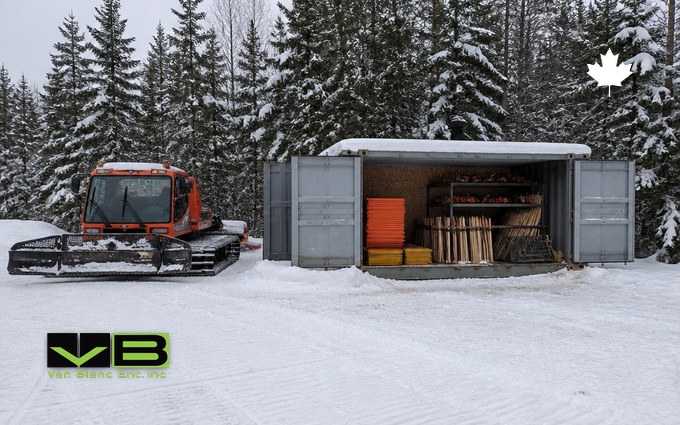
Quick Answer: A snowmobile club is a volunteer-run, non-profit group that signs and grooms its section of the OFSC’s 30,000 kilometres of trails. Groomers and wide drags are too wide for a container door. The signs, stakes, saws and parts fit, and a 20ft or 40ft at the groomer base holds them.
What This Trail Club Guide Covers
- How a snowmobile club runs Ontario trails
- Three tiers: club, district, federation
- How are snowmobile trails groomed?
- Night shifts, cold snow and setting time
- Signs, stakes and the spring takedown
- Club volunteers by the hours
- Trail groomer size against a container door
- What fits through 7 feet 8 inches
- The groomer base box: 20ft or 40ft
- Racks, hooks and a lockbox
- Setting the box at a trailhead
- Trail club picks a container grade
- One club, two boxes, one season
- Snowmobile club storage FAQs
Reading Time: 16 minutes
How a Snowmobile Club Runs Ontario Trails
A snowmobile club is a non-profit group of local riders that builds, signs and grooms one stretch of Ontario’s provincial trail network. In March 2023 the Ontario Federation of Snowmobile Clubs counted 182 community clubs. Together they provide 30,000 kilometres of what the federation officially calls OFSC Prescribed Snowmobile Trails. A club’s volunteers ask landowners for the use of their land, cut and sign the corridor, and run the groomer at night. The federation says over 60% of its trail kilometres cross private property. It credits about 18,000 private landowners and 6,000 volunteers for the whole network. A club also owns a surprising amount of gear, and much of it has to live somewhere dry for half the year. That is where a graded used box from our rows comes into a club’s planning.
Van Blanc is a family-run container seller in Brantford, in business since 1995. Paul LeBlanc started the company, and his son Christian works the rows with him across our 4 Brantford yards. This guide starts on the trail, with how Ontario clubs are organised and how a groomer actually works the snow. Then it moves to the shed door: what a club stores, what a Van Blanc box can and cannot take, and where it sits. The door and floor figures come from our standard 40ft listing.
| Organized snowmobiling in Ontario | Figure | Where it comes from |
|---|---|---|
| Community member clubs | 182 | OFSC, March 2023 |
| OFSC Prescribed Snowmobile Trails | 30,000 kilometres | OFSC, March 2023 |
| Club volunteers | 6,000 | OFSC, October 2024 |
| Private landowners granting trail use | 18,000 | OFSC, October 2024 |
| Industrial trail groomers | approximately 300 | OFSC, October 2024 |
| Districts listed on the OFSC district finder | 15 | OFSC district finder |
| Year the founding clubs formed the OFSC | 1967 | OFSC, October 2024 |
Three Tiers: Club, District, Federation
Ontario snowmobiling runs in three tiers, and the OFSC’s own October 2024 explainer lays them out. Tier 1 is the community club. Its volunteers still lead every operating job in their area: landowner permission, trail development, signage installation and grooming. Each club is its own non-profit under local volunteer leadership. A trail permit for a sled does not make its owner a club member. A rider who wants to help has to join a club.
Tier 2 is the district. The district finder lists District 4 for Orangeville, Collingwood and the Barrie end of Simcoe County. District 7 covers Muskoka and North Simcoe, the lake country around Huntsville and its cottage roads. District 11 covers North Bay, Mattawa and Burk’s Falls, the Near North Trail Association. District 12, the Sudbury Trail Plan, takes in Sudbury, Espanola and Manitoulin. Districts are volunteer-led non-profits too, drawn roughly along tourism or government boundaries, and each has at least one staff person for the paperwork. Some take an operating role in trail maintenance and grooming for their clubs.
Tier 3 is the federation, formed by founding clubs in 1967. It does not occupy land or maintain trails. It is the sole authorized agent for the Ministry of Transportation of Ontario on the Ontario Snowmobile Trail Permit. Prescribed Trail signs are set out under Ontario Regulation 185/01 of the Motorized Snow Vehicles Act. That makes it a legislated sign. Provincial programs, insurance and advocacy run from a small professional staff in its office in Barrie.
How Are Snowmobile Trails Groomed?
Snowmobile trails are groomed by a tracked machine towing a drag that cuts, mixes and packs the snow into a firm, level surface. The Upper Canada Snowmobile Region, OFSC District 1, describes a purpose-built groomer with low ground pressure. Its cab is enclosed and heated, with lights and GPS. Behind it, the drag carries cutting knives or blades to break up hard or icy snow. Paddles or teeth rework the crystals, and a compactor pan levels and presses the surface. The work runs in stages. Early-season passes build a base, later passes cut out ruts and moguls, then the operator shapes corners, crown and drainage. The last stage is setting, when the packed trail is left to firm up in cold air.
Temperature drives all of it. The same District 1 page puts ideal grooming temperatures between -3°C and -30°C, when the crystals bond best. Frozen ground matters at the groomer base too, and a gravel pad laid before freeze-up gives a storage box a level, drained base. Grooming too early, too warm or on too thin a base can expose the ground and pull up vegetation. That is why a club’s season starts with waiting for the right snow.
Purpose-Built Machines and Tractor Conversions
The OFSC’s provincial fleet has two kinds of large equipment. Tractor conversions are farm tractors moved from wheels onto a track system. They pack a solid base on flat ground but are heavy, larger and less nimble. Purpose-built trail groomers weigh less, turn more easily in twisty or steep country, and tow somewhat less drag. In March 2023 the federation counted an active fleet of 280 groomers, and its October 2024 explainer describes approximately 300. Some clubs also run smaller drags behind utility sleds for early packing of wet areas and for tight local trails and portages. A sled and a small drag are the one grooming outfit that can share a forty-foot box with the club’s signs.
The Mattawa and Area Snowmobile Club in District 11 shows both kinds in one shed. Its website lists a 2012 Case IH Maxxum 125 with an 8-way blade and a 9 foot adjustable drag. For the 2021 season the club added a PistenBully groomer and kept the tractor, nicknamed Big Red. The OFSC lists what decides the mix. Traffic, terrain and trail width count, along with bridge strength and width, snow load, run length against fuel capacity, and the operators available. A purpose-built groomer and the full-size drags behind either kind are wider than the cargo door on Van Blanc’s 20ft listing, as the measurements below show.
Ski Slopes, Snowcats and Slang
The OFSC notes that trail groomers are close relatives of ski-hill machines but neither as big nor as wide, and are built for longer runs. To groom a ski slope means the same flattening and preparing of snow, on a hill instead of a trail. In ski slang the machine has other names too: snowcat in North America, piste basher in Britain.
Night Shifts, Cold Snow and Setting Time
Most grooming happens overnight, and District 1 gives the reason. Colder, steadier temperatures and little traffic let the packed trail set before the first sleds arrive. Its shifts last eight to twelve hours. A freshly groomed trail ridden before it sets loses much of the work. A Northern Ontario Travel visit with the Bonfield Snowmobile Club, just outside North Bay on Lake Nipissing, gives one club’s numbers. Bonfield’s trail system of 150 kilometres is groomed twice a week, with the groomer moving for a total of 30 hours. Average speed is 8 to 12 kilometres per hour. New operators finish an OFSC online course, then ride with a veteran for at least a year before grooming alone, a Bonfield club policy. The club tries to keep two people in the groomer at all times.
Across the province the totals get large. The OFSC’s by-the-numbers release, using 2018-2019 figures, counted trail permits for about 105,000 sleds. Grooming logged about 74,000 hours that season on an estimated 1.2 million litres of fuel. About 77% of permit revenue went to pre-season trail operations, including the groomer fleet, and the remaining 23% went to in-season grooming. Trail signs come out of that same permit money, so a used container that keeps them dry between seasons protects what the club already spent.
A British Columbia club’s tip sheet for riders says grooming is a club’s largest expense. Riders save the club money when they keep right, hold a steady throttle and wait for the operator’s signal before passing a groomer.
Grooming in Five Numbers
- Temperature: -3°C to -30°C is the ideal window on the District 1 page.
- Shift: eight to twelve hours, often overnight.
- Speed: 8 to 12 kilometres per hour on Bonfield’s trails.
- Province: about 74,000 grooming hours in 2018-2019.
- Fuel: an estimated 1.2 million litres the same season.
Signs, Stakes and the Spring Takedown
Grooming gets the attention, but signage is the other half of a club’s job. The stakes are orangey-red posts with reflective ends that mark the corridor across fields and ice. In storage, arms that hold posts and stakes off the floor keep them straight. Craig Nicholson writes as the Intrepid Snowmobiler, and he lists what volunteers put up. There are regulatory, cautionary, destination, directional and informational signs, plus map boards, field and lake stakes, and posts. Information signs are black or blue print on white, and cautionary signs are red or yellow. One sign tells riders the legislated speed limit on OFSC trails, 50 km/h.
Signs come and go every year. Nicholson describes a three-step cycle: installation in the fall, removal in the spring and installation again the next fall. A big meltdown can knock signs and stakes over and send volunteers out to reset them. Freeze and thaw move the ground under a storage box too, and how frost lifts and drops a container’s corners explains the effect on steel. An OFSC trail cannot change from RED to YELLOW or GREEN on the Interactive Trail Guide until it is signed to the federation’s sign guidelines. His educated guess is upwards of a couple of hundred thousand signs across Ontario, paid for from trail permit revenue.
In his words, the signs that come down at season’s end “have to be transported and stored.” That line is the storage problem in one sentence. A club that pulls its signs in April has to keep them somewhere until October, along with bundles of stakes and the posts. A locked steel box at the groomer base keeps the whole sign inventory in one place, sorted by trail and dry. Signs filed flat on brackets that clamp to the corrugated walls stay readable from the door.
Club Volunteers by the Hours
Club work is mostly hours. In the Bonfield profile a typical volunteer gives 30 to 40 hours a year. Office volunteers and groomer and maintenance operators put in upwards of 200 hours each. The same piece lists what an OFSC member club has to keep up. Directors attend club and district meetings. Bridges are maintained, signage is kept visible and equipment stays in working order. Ice crossings are checked for thickness, the shop is kept organized and a grooming schedule is followed. The club also clears downed trees, brushes back growth, replaces culverts, installs trail markers and files bi-weekly reports with the OFSC. Keeping that shop organized is easier with container shelving set up for parts and bins.
Read that list as a shopping list and the storage needs show up. Chainsaws and brush cutters for the clearing. Culvert pieces, bridge hardware and lumber offcuts. Ice augers and thickness gear. Drag knives and spare parts for the groomer. Sign stock, stakes and posts. A club shop works better with a second room for everything that does not need heat. Farther north, District 14, the Timiskaming Abitibi Trail Association, runs from New Liskeard and Kirkland Lake to Timmins and the Porcupine country.
Christian LeBlanc, Van Blanc Ent. Inc.: “When a club calls about a box, I ask three things. How long are your longest posts, does a sled have to go in with the signs, and which way should the doors face once the snow is piled up? Those three answers pick the size and where it sits.”
Trail Groomer Size Against a Container Door
A trail groomer does not fit through a shipping container door, and the numbers settle it quickly. Van Blanc’s live 20ft product page gives the cargo door opening on a standard 20ft as 7 ft 8 in wide by 7 ft 6 in tall. In metric that is 2.340 m by 2.292 m. Prinoth’s Husky, a purpose-built trail groomer, lists track working widths from 8’2″ (2.5 m) upward. Its blade with the wings closed is 8’10” (2,695 mm). Both are wider than the door before the cab or the drag are counted. Drags miss too. Mattawa’s 9 foot drag is wider than 7 ft 8 in, and so is any drag of 96 inches or more. The forty’s spec and weight tables give the same 2.340 m door width.
Smaller gear clears. SnowGroomers.net sells its Snow Groomer Pro drag in 48, 72, 96 and 120 inch widths. The two narrow sizes pass a 92-inch door, and the two wide ones do not. A utility sled clears easily. Utility sleds come with different track types, and Ski-Doo sells the Skandic SE with a 20 in or 24 in track. It lists the 2027 Skandic SE at 1,089 mm wide, 1,513 mm tall and 3,222 mm long. Every figure here comes from a maker’s spec sheet or the door figures on our 20ft page, set side by side. None of it comes from a test load, so measure your own machine before you plan around it. If height is the issue, the 40ft High Cube door opening is 8 ft 6 in (2.597 m) tall.
| Item | Maker or club figure | Standard door, 7 ft 8 in wide and 7 ft 6 in high |
|---|---|---|
| Prinoth Husky trail groomer, track working width | 8’2″ (2.5 m) and up | Too wide |
| Prinoth Husky blade, wings closed | 8’10” (2,695 mm) | Too wide |
| Tractor conversion drag, Mattawa club | 9 foot adjustable drag | Too wide |
| Snow Groomer Pro drag, wide sizes | 96 and 120 inch | Too wide |
| Snow Groomer Pro drag, narrow sizes | 48 and 72 inch | Clears the width |
| Ski-Doo Skandic SE utility sled, 2027 | 1,089 mm wide, 1,513 mm tall, 3,222 mm long | Clears both |
The open side container Van Blanc sells changes the loading face but keeps the box’s height. Our open side page lists the 40ft High Cube open side as factory-built and one-trip grade, stocked like our other new containers. Its side opening is about 11.93 m by 2.58 m. That long wall suits racks of signs loaded from the side, or a sled rolled in sideways. The groomer itself still needs the club’s own building.
What Fits Through 7 Feet 8 Inches
Once the groomer and the big drag are out of the picture, nearly everything else a club owns goes through the door. Signs stack flat on shelves by trail number. Stakes bundle and stand in bins or lie on arms. Posts and lumber go on a rack along one wall. Saws, brush cutters and hand tools hang on a pegboard or sit on a bench. Spare drag knives, teeth and hardware go in labelled bins. A utility sled and a narrow drag can share a 40ft with all of it, held in place by straps hooked to wall-mounted E-track. In the off-season the same box holds the summer brushing kit. In winter it holds the sign stock waiting for a meltdown repair.
A Club Box Load List
- Signage: regulatory, cautionary, directional and destination signs, map boards and sign hardware.
- Markers: field and lake stakes, posts and the driver to set them.
- Clearing gear: chainsaws, brush cutters, axes, chaps and helmets.
- Groomer spares: drag knives, teeth, pins and filters in bins.
- Ice and trail kit: augers, thickness gauges, first aid kits and trail-closed barriers.
- Machines: a utility sled and a narrow drag, in a 40ft.
The Groomer Base Box: 20ft or 40ft
A groomer base is where the machine is fuelled, fixed and parked, and it is the natural spot for a twenty-foot steel room for signs and saws. As a rule of thumb, a 20ft usually suits a club whose box holds signs, stakes, saws and parts. A 40ft suits one that also wants a utility sled and a narrow drag inside. Van Blanc’s 20ft page gives inside measurements of 19 ft 4 in long, 7 ft 8 in wide and 7 ft 10 in tall. That is 1,172 cubic feet. The 40ft runs 39 ft 6 in inside and holds 2,395 cubic feet. On paper a 3,222 mm Skandic leaves about 2.7 m of floor in a 20ft. In a 40ft the sled, the drag and a wall of clamp-on shelving share the length.
| Box | Inside length | Inside width and height | Volume | Door opening | Usual club load |
|---|---|---|---|---|---|
| 20ft standard | 19 ft 4 in | 7 ft 8 in wide, 7 ft 10 in high | 1,172 cubic feet | 7 ft 8 in across, 7 ft 6 in up | Signs, stakes, saws, parts |
| 40ft standard | 39 ft 6 in | 7 ft 8 in wide, 7 ft 10 in high | 2,395 cubic feet | 7 ft 8 in across, 7 ft 6 in up | All of that plus a utility sled and a narrow drag |
| 40ft High Cube | Same floor as the 40ft | One foot taller | More height for racking | 8 ft 6 in tall | Tall sign racks and stacked bins |
Most clubs can plan on one box at the groomer base. A club with a long system may add a second at the far trailhead. Then volunteers are not hauling signs across the whole territory twice a year. Both boxes can go on one Van Blanc quote. Every size and grade we stock, on one page, makes it easy to compare a pair of twenties with one forty before you call.
Racks, Hooks and a Lockbox
A bare box becomes a club store with a few fittings. Shelving goes along one long wall for signs filed by trail and type. Hooks and cleats on the other wall carry saws, chaps and coiled rope. Ask about fittings when you price the box, and the list of custom features shows what is available. Tie a sled or drag down so it cannot roll into the shelves.
Security matters at a remote trailhead, because a box full of saws is worth breaking into. A lockbox welded around the padlock hasp keeps bolt cutters off the lock. A man door lets one volunteer grab a sign without swinging both cargo doors through a snowbank. Where a man door goes in the wall walks through the choices. A roll-up door is another option, and our roll-up door container listing covers that build.
Setting the Box at a Trailhead
Placement decides how well the box works in February. The box should sit on firm, level ground that drains, with the doors facing the lane the club plows. Snow from the groomer yard and the roof piles up fast, and a door that opens into a drift is a door nobody uses. A spot beside the groomer shed keeps the parts a short walk from the machine. A compacted gravel pad keeps the corners level and the floor dry, and our site prep guide for pads and blocks covers the base.
Access is the next question. A trailhead on a concession road or a bush lane needs a truck path in. Delivery down rural lanes and gravel roads sets out the clearances and the spring half-load season. Van Blanc delivers on a tilt-deck truck that slides the box onto the pad, so the approach needs room to line up. Remote hunting camps face the same road test, and the bush-road camp guide covers it from the hunter’s side. For a trailhead nobody watches, a solar camera rig for an off-grid box runs without hydro.
Fuel Stays Out of the Box
Saw gas and groomer diesel do not belong in a closed steel box. TSSA’s advice is that it is safer to use gasoline up than to store it. Where it must be stored, TSSA says to keep it at room temperature in a detached shed or garage. That building should be at least 15 metres (50 feet) from a heat or ignition source, such as direct sunlight or a pilot light. TSSA also warns that gasoline vapours are heavier than air and travel along the floor. A sealed container in the sun is not that building. Keep fuel cans and drums out of it, and follow TSSA’s guidance wherever they do go.
Trail Club Picks a Container Grade
Container grade is the club’s choice, and each grade has a plain description. New boxes, which the industry calls one-trip because they made a single loaded ocean voyage, have factory paint and clean floors. Van Blanc lists them with boxes fresh off their first voyage, and minor handling marks are possible. Cargo Worthy boxes are used, described on Van Blanc’s product pages as used 8 to 15 years, with surface rust and a valid CSC re-certification. Wind and Water Tight boxes are used 12+ years, with heavier rust and a sealed roof and floor. As-Is units are donor or scrap stock, sold with their defects written down. Those ages describe how old the box is, not how long it will last on a pad.
A club spends permit money and fundraising money, so the board will want one clear number. A Van Blanc quote gives the box, the delivery and the placement as one all-in figure. Be wary of the listing that undercuts every Ontario yard. People call us about a Facebook bin priced far below ours, and two weeks later some call back, scammed. How the Marketplace container scam works shows the pattern before a club treasurer wires anything.
Pricing the Club’s Trail Box
Tell us how many signs and stakes come off the trail in spring and the length of your longest posts. Add whether a sled goes inside and the postal code of the groomer base. Van Blanc will come back with twenty or forty, the grade, the fittings and one all-in number with a real lead time.
Family-run in Brantford since 1995 · 4.9★ across 140+ Google reviews · see your unit by its container number first.
One Club, Two Boxes, One Season
A club box earns its keep across the whole year. In October volunteers pull the sign stock and stakes out and load them onto trailers for the fall install. Through the winter the box holds groomer spares, saws for downed trees and replacement signs for the ones storms and vandals take. In April the signs come back in, dried and sorted by trail onto the shelving set up for them. Through summer and fall the brushing crews draw saws and brush cutters from it. Culvert and bridge hardware waits there for work days.
Van Blanc delivers to clubs across the snowbelt. North Bay and the Near North clubs sit up Highway 11, and Sudbury, Espanola and the Manitoulin trails sit up Highway 69. Haliburton County’s trail clubs are closer in. Stocked boxes deliver in 1-3 days across most of Ontario. North Bay, Sudbury and cottage-country runs are premium freight quoted per route, usually 5-10 days, and every quote comes with a real lead time, not a hopeful one. Buyers who want to see the steel first can walk the rows Monday to Thursday 9:30 to 5 or Friday 9:30 to 4. You can pick the exact unit by its container number.
Before the Board Votes
- Count the signs, stakes and posts that come off the trail each spring, and measure the longest post.
- Decide whether a utility sled or a narrow drag goes inside. That decides twenty or forty.
- Pick the spot beside the groomer shed, with the doors facing the plowed lane.
- Check the truck path in, gates and overhead wires included.
- List the fittings: shelving, hooks, lockbox, man door.
- Call with the counts and the postal code, and take the all-in number to the board.
Frequently Asked Questions
What does a snowmobile club do?
A snowmobile club is a volunteer-led non-profit that delivers its local section of OFSC trail. Its volunteers get landowner permission, build and sign the trail, and groom it, and the OFSC counted 182 such clubs in 2023. Members also clear downed trees, replace culverts, check ice crossings and keep the club’s equipment in working order.
How are snowmobile trails groomed in Ontario?
A tracked groomer or tractor conversion tows a drag with cutting blades, mixing teeth and a compactor pan. Operators build a base early in the season, then cut moguls, shape the trail and leave it to set, usually overnight. OFSC District 1 puts ideal grooming temperatures between -3°C and -30°C.
Will a trail groomer fit in a shipping container?
No. A standard container door opening is 7 ft 8 in wide by 7 ft 6 in tall on Van Blanc’s 20ft and 40ft pages. Prinoth lists the Husky groomer’s narrowest track working width at 8’2″ (2.5 m), and a 9 foot drag is also wider than the door. A utility sled and a 48 or 72 inch drag do clear it.
What trail groomer can a snowmobile pull?
A utility snowmobile pulls a tow-behind drag rather than a full groomer. The OFSC notes some clubs run smaller drags behind utility sleds for early packing of wet areas and tight local trails. SnowGroomers.net sells its Snow Groomer Pro drag in 48, 72, 96 and 120 inch widths, so check the sled maker’s towing guidance before you choose.
Which snowmobile pulls a grooming drag?
Clubs use utility sleds for this work. Ski-Doo’s 2027 Skandic SE, for example, comes with a 20 in or 24 in track and measures 1,089 mm wide and 3,222 mm long. That size goes through a standard container door, so a sled and a narrow drag can share a 40ft.
Which brands build snowcat trail groomers?
Prinoth and PistenBully both build purpose-built trail groomers, and the Mattawa club runs a PistenBully beside a Case IH tractor conversion. The OFSC fleet also includes farm tractors converted to track systems, which the federation calls a cost-effective option in flatland areas. The choice turns on traffic, terrain, bridge widths and fuel range.
Should a snowmobile club buy a 20ft or a 40ft?
As a rule of thumb, a 20ft suits signs, stakes, saws and groomer parts. A 40ft suits a club that also stores a utility sled and a narrow drag inside. The 20ft is 19 ft 4 in long inside and the 40ft is 39 ft 6 in. A club with a long trail system may add a second box at a far trailhead.
Sources
- Ontario Federation of Snowmobile Clubs. (2024). OFSC, Behind the Scenes: How is the OFSC Organized?; also The Power of Appreciation (2023), Grooming Equipment 101 (2023), By The Numbers (2021), Landowner Appreciation (2023) and Find Your District. Checked October 2026.
- Upper Canada Snowmobile Region, OFSC District 1. UCSR Snowmobile Trail Grooming. Checked October 2026.
- Northern Ontario Travel. (2024, 2025). Why Volunteer With Your Local Snowmobile Club and A Rider’s Guide to Ontario Snowmobile Trail Signs. Checked October 2026.
- Craig Nicholson, Intrepid Snowmobiler. Intrepid Snowmobiler, Signs On Snowmobile Trails. Checked October 2026.
- Prinoth. Prinoth Husky technical data; BRP. Ski-Doo Skandic 2027 specifications. Checked October 2026.
- Mattawa and Area Snowmobile Club. Mattawa club trail maintenance page; SnowGroomers.net. SnowGroomers.net trail grooming guide; TSSA. TSSA gasoline transportation and storage; Powder Mountain Snowmobile Club, 10 Ways to love your Snowmobile Trail Groomer; Ski Cat Company, What Is a Snow Groomer Called. Checked October 2026.
Pricing a Box for the Club Shed
We have been supplying shipping containers across Ontario since 1995. Our office is at 90 Morton Avenue East in Brantford, and all four of our yards are in Brantford.
Van Blanc Ent. Inc., 90 Morton Ave E Unit 1B, Brantford, ON N3R 7J7, 519-754-6844.
If the signs are coming off the trail in spring and there is nowhere to put them, call with the counts, the groomer base and your postal code. You will know before you hang up which twenty or forty fits and when a truck can reach the trailhead. Worth the drive for unbeatable quality, family customer service with 30 years of experience.