
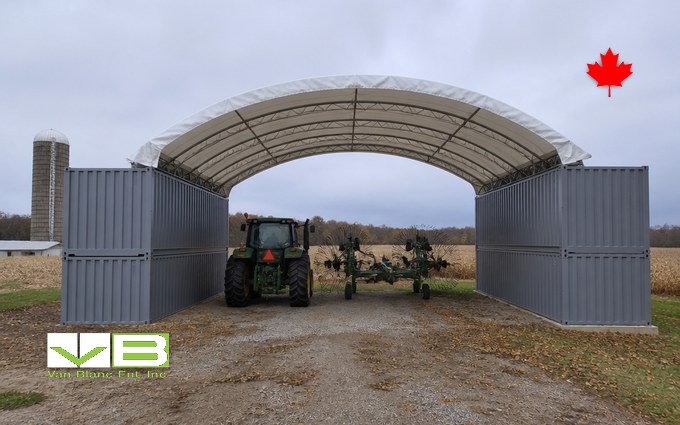
Quick Answer: A machine shed keeps tractors, combines and implements out of the weather. Pole barns, quonsets and fabric buildings supply wide spans. Smaller machines fit 40ft high cubes (door 7 ft 8 in by 8 ft 6 in) or 53ft boxes (door 8 ft 2 in by 9 ft 1 in).
Machine Shed Planning, Section by Section
- What Is a Machine Shed?
- Machine Shed Size Starts With a Tape
- Which Machines Earn Indoor Storage
- Machine Shed Options, Span by Span
- Machines Against Container Doors
- The 40ft High Cube for Tools and Small Iron
- 53ft Boxes for Cab Tractors and Long Loads
- A Tractor Bay Under a Container Roof
- Getting Machines Ready for a Steel Box
- Where the Box Sits in the Yard
- Ordering Steel for Farm Equipment Storage
- Frequently Asked Questions
Reading Time: 20 minutes
What Is a Machine Shed?
A machine shed is a farm building with wide doors and a clear floor. It holds tractors, combines and implements out of the weather between jobs. Ontario farmers also call it a drive shed, an implement shed or an equipment shed, and builders file the family under machinery storage. Statistics Canada counted 48,346 farms in Ontario in its 2021 Census of Agriculture, with 9,051,011 acres in crops. The grain from those acres goes into the bins, augers and dryer of an on-farm system. The machine shed holds what does the harvesting.
Van Blanc is a shipping container yard in Brantford, and the family has sold steel boxes to Ontario farms since 1995. A container takes on part of a machine shed’s work: the compact tractor, the skid steer, the parts room and the tools that need a lock. A combine stands taller than any container door, so it parks under a clear span: a farm building, or a roof engineered between two boxes. This page sizes both.
Machine Shed Size Starts With a Tape
Machine shed size comes from the machines, so planning starts with a tape measure. Measure each machine at its widest point in transport, counting mirrors, duals and folded wings. Measure height to the highest thing on it: the cab roof, the roll bar, the amber warning light or the GPS receiver. Note the length with the implement hitched, if that is how the pair will park. The equipment that works only a few weeks a year still takes floor space, and the off-season storage plan for seasonal gear sorts that list.
Builders then add room to move. yourbarndom.ca, a Canadian barn kit supplier, advises at least one metre of clearance above your tallest machine. Its machine shed guide says eave heights of 16 to 18 feet (4.9 to 5.5 m) are becoming standard for large farm gear. Smaller utility buildings might get by with 12 to 14 feet (3.7 to 4.3 m). Typical machine shed doors, it says, run from 16 feet wide by 16 feet tall up past 24 feet wide for the widest planters and air drills.
Ontario’s Ministry of Transportation gives a second yardstick. Its farm guide calls equipment over-dimensional when it is wider than 2.6 m (8 ft 6 in) or higher than 4.15 m (13 ft 6 in). A length past 23 m (75 ft) counts too. Lighting rules step up past 2.6 m wide, again past 3.8 m (12 ft 6 in) and again past 4.8 m (15 ft 9 in). Any machine in those width bands is wider than the end doors on the 53, our widest end-door box. Our factory open side 40ft High Cube opens about 11.93 m by 2.58 m along one long wall, with 2.34 m of depth inside. A wide implement shallower than that can go in sideways; anything else needs a clear span.
Christian LeBlanc, second-generation operator, Van Blanc Ent. Inc.: “Measure the tractor, then measure the lane. A 53 needs a long, straight run for the truck to back in, so if your lane bends past the barn, send us the address. We’ll check the yard on a satellite picture before we book the day.”
Write the list in three columns: machines that must go inside, machines that should, and machines that can wait outside. Parts, feed and hay make a fourth column, and the grain and feed side of on-farm storage sorts that one. The next section ranks the machines with numbers from extension research.
Which Machines Earn Indoor Storage
Virginia Cooperative Extension worked out what indoor storage saves on each class of machine, as a share of its purchase price every year. The figures add three things: higher trade-in value, fewer repairs and less downtime. In the same publication, machinery stored inside had 7.6 percent downtime, while unhoused equipment was down 14.3 percent of the time it should have been working.
| Machine | Greater trade-in value | Fewer repairs | Less downtime | Total saving per year |
|---|---|---|---|---|
| Combine | 2.0% | 3.5% | 1.2% | 6.7% |
| Planter | 1.2% | 2.5% | 1.2% | 4.9% |
| Tractor | 1.6% | 1.5% | 1.2% | 4.3% |
| Tillage | 0.5% | 0.5% | 0.6% | 1.6% |
The combine comes first and tillage comes last. The Virginia publication says tillage equipment kept inside is worth only about 5 percent more after five years. It names tillage implements as the last to be placed inside. Its keep-inside list runs to tractors, combines, planters, drills, forage choppers, trucks and pickups. That ranking is the order to fill a machine shed, or a row of steel boxes picked length by length.
Penn State Extension summarizes what major farm equipment manufacturers and farm suppliers recommend, and it lands in the same place. Combines and balers may deteriorate rapidly if stored outdoors for a few seasons, while tillage equipment rarely sees a benefit from being stored indoors. Machinery with a high share of electrical components, exceptional resale value or extreme sensitivity to sunlight and moisture takes precedence. Penn State also advises against storing machinery in the same building as hay, especially a building with a farm workshop in it. Small squares can go in a separate steel box set aside for hay and feed.
Whether a machine shed is worth building is arithmetic the extension figures make possible. Multiply each machine’s value by its percentage, add the column, and set the yearly total against what the building costs you to own. Remuda Building, an Alberta post-frame builder, says an unheated cold storage building captures most of the protection benefit. It adds that a heated shop brings the comfort to service machines through winter. Many farms, it says, build one structure with a wall between a cold bay and a heated bay. A steel box can play either part: bare for cold storage, or spray-foamed in our Brantford shop for a parts room you heat. The heated workshop comparison covers the service bay side.
Machine Shed Options, Span by Span
Four kinds of building make up the machine shed options here, and each has its own longer guide on this site. The table puts the span each maker or builder publishes in one place, beside the container doors, so the comparison runs on the same measure. Height limits are listed the way each source states them.
| Option | Published width or door | Height note | Source |
|---|---|---|---|
| Clear-span machine shed, any frame | Clear spans from 40 ft (12 m); 60 to 100 ft common | Eaves 16 to 18 ft for large gear | yourbarndom.ca |
| Steel arch, round (Q) | 16 ft (4.87 m) to 125 ft (38.10 m) | Height half the width or less | Future Buildings |
| Steel arch, straight wall (S) | 10 ft (3.04 m) to 75 ft (22.86 m) | Straight sidewalls under the arch | Future Buildings |
| Fabric on trusses | 24 ft to 210 ft (about 7.3 m to 64 m), any length | Set by model | Britespan |
| Roof between two containers | 20 ft to 60 ft span, any length | Box line 9 ft 6 in on high cubes | Future Buildings; Van Blanc |
| 40ft high cube container | Door 7 ft 8 in (2.340 m) wide | Door 8 ft 6 in (2.597 m) high | Van Blanc |
| 53ft domestic container | Door 8 ft 2 in (2.489 m) wide | Door 9 ft 1 in (2.769 m) high | Van Blanc; CN |
Post-Frame Pole Barns
A pole barn sets treated posts below frost depth and spans engineered trusses between them. yourbarndom.ca’s sample medium machine shed, with no frame type named, runs a 60 ft (18 m) clear span with at least one 20 ft by 16 ft overhead door. Our post-frame guide, frost to trusses covers the posts, the snow load and the build calendar in full.
Steel Arch Kits
A steel arch, or quonset, is a row of corrugated arch panels bolted together with no frame inside. Future Buildings, a Markham arch seller, builds its round Q style up to 125 ft wide. The curve costs headroom near the walls, so tall cabs park down the middle. Its S style stands the arch on straight walls, which the seller says lets larger equipment park against them. How quonset model letters read on a quote covers the profiles, and our look at the Markham arch seller reads that one company closely.
Fabric on Galvanized Trusses
A fabric building stretches a membrane over a row of steel trusses. Britespan lists free-span buildings from 24 ft to 210 ft wide in any length. Two of our reviews cover the category from the container side: Britespan’s trusses and warranty terms and Cover-Tech’s dome and gothic frames.
Rigid-Frame Steel
A rigid-frame steel building is the fourth option: straight walls, a pitched roof and a steel frame engineered for the site. The rigid-frame steel guide times it from first quote to finished doors.
Machines Against Container Doors
A shipping container’s door opening is the hard limit for any machine, and it is smaller than the inside of the box. Van Blanc’s 40ft high cube is 8 ft 10 in (2.692 m) tall inside. Its door opening is smaller: 7 ft 8 in wide by 8 ft 6 in high. The 53ft domestic box opens 8 ft 2 in wide by 9 ft 1 in high. That matches the 98 by 109 inch door CN lists for its 53-foot high-cube container. The floor sits above the pad on the bottom rails, so wheeled machines go in over a short ramp. The table sets real machines from their makers’ sheets against the high cube’s door and the 53-footer’s taller door.
| Machine (maker’s figure) | Width | Height | 40ft high cube door | 53ft door |
|---|---|---|---|---|
| Kubota L3901 compact, roll bar up | 55.1 in | 97.1 in (to top of ROPS) | Fits | Fits |
| Kubota M7060 utility, roll bar up | 1,860 mm (73 in) | 2,470 mm (97.2 in) | Fits, 127 mm under the header | Fits |
| Kubota M7060 utility, cab | 1,860 mm (73 in) | 2,565 mm (101 in) | 32 mm to spare: treat as no | Fits, 204 mm under the header |
| Bobcat S650 skid steer | 1,880 mm bucket | 2,065 mm cab | Fits | Fits |
| New Holland CR8.90 combine, transport | 10.83 ft | 13 ft | No | No |
| Any implement MTO calls over-dimensional | Over 2.6 m (8 ft 6 in) | Any | No | No |
Three rules come out of that table. A combine, and any implement over 2.6 m wide that cannot go in sideways, parks under a clear-span farm building or a roof between two boxes. A compact tractor, a utility tractor with the roll bar up and a skid steer go through either door. On Kubota’s figures, the cab M7060 is a 53 job. Ten millimetres is no margin for a warning light, an aerial or a softer tire. Cab heights change with tire size and options, so measure your own machine before you trust a spec sheet, ours included. A cab tractor too tall for the high cube’s door can also park under a steel canopy bolted across two boxes, covered further down.
Length is the easy part. The Kubota M7060 is 3,505 mm (138 in) long, and the L3901 runs up to 119.1 in with its three-point hitch. A high cube’s floor takes a tractor and its attachments in a line. A smaller machine can suit a smaller box, and the size page from 10ft to 53ft lists every length we sell.
The 40ft High Cube for Tools and Small Iron
A 40ft high cube is an ISO steel container 40 ft long, 8 ft wide and 9 ft 6 in tall outside. That is one foot taller than a standard 40. Inside it gives 39 ft 6 in (12.040 m) of length and 7 ft 8 in (2.337 m) of width. The box holds 2,689 cubic feet (76.1 m³). On a farm that is a lockable machine room on a gravel pad. Van Blanc typically holds 15 to 30 of them across our 4 Brantford yards.
- The compact tractor, with its loader bucket lowered and the mower deck behind it.
- A skid steer and its pallet forks, bucket and grapple.
- Belts, filters, sickle sections, planter parts and the welder.
- Hand tools, power tools and the fencing gear, behind a padlock under a welded lockbox.
As a rule of thumb, one high cube holds a working farm’s parts and tools, and a second takes the compact tractor with its attachments. Each grade does something well. A wind and watertight box sheds weather, its gaskets seal and rodents stay out, with dents and faded paint on show. A cargo worthy box adds a structural inspection to the same promise. Used high cubes, graded and numbered before sale come in both grades. Our product page lists cargo worthy high cubes as used 8 to 15 years and wind and watertight ones as used 12+ years. Those figures are the age of the box. A new one-trip box arrives with factory paint and holds its resale value. It suits a unit that faces the road or gets insulated, and new high cubes from the same yards sit beside the used rows.
53ft Boxes for Cab Tractors and Long Loads
A 53ft container is a North American domestic box built for rail and road, not an ISO ocean container. It follows Association of American Railroads domestic intermodal standards and carries no CSC plate. A CSC plate governs ocean shipping, and a farm yard has no use for one. Outside it is 53 ft long, 8 ft 6 in wide and 9 ft 6 in tall. Inside it gives 52 ft 4 in (15.951 m) of length, 8 ft 2 in of width and 9 ft 1 in of height. That is 3,901 cubic feet (110.5 m³). The 53-footer with the 9 ft 1 in door has its full spec table and grades on its own page.
A 53 earns its place on a farm two ways. Its door clears the cab M7060 that the high cube’s header stops. Its floor also runs nearly 13 ft longer than a high cube’s, so machines park nose to tail with room for long, narrow gear behind them. Any load narrower than 8 ft 2 in and lower than 9 ft 1 in in transport position, with room to spare, goes through the door. The floor then takes up to 52 ft 4 in of it.
Van Blanc typically keeps 2 to 4 53ft units in standing inventory and supplies fleet orders of 10 to 20. Grades read a little differently on a domestic box: a cargo worthy 53 has been used 5 to 12 years in rail and road service. The truck needs about a 110-foot straight approach and a 40-foot turning radius. A high cube needs about a 90-foot approach and a 35-foot turning radius. How a tilt-deck slides a box onto a farm pad walks through the drop itself.
A Tractor Bay Under a Container Roof
A container roof kit spans a steel or fabric roof between two parallel containers, so the pair become walls and the gap becomes a covered bay. Van Blanc does not sell or install the kits; we supply the two base containers. Future Buildings, for one, sells container covers in widths from 20 to 60 ft and any length. The kits fix to the boxes with mounting plates and are custom-engineered for local snow, wind and seismic loads. Mounting points and snow loads for container canopies have their own guide, with the kit sellers named.
The containers set the clear height at the sides of the bay. Two high cubes stand 9 ft 6 in (2.895 m) tall, so the bay clears 2.895 m at its edges before the arch rises. On the Kubota sheet, the cab M7060 at 2,565 mm passes under that line. The New Holland combine, listed at 13 ft in transport, does not clear that edge line. The arch rises toward the centre, so ask the kit maker for the clear height where a combine would park. The width between the boxes is whatever span the kit maker engineers for your site.
The pair under the roof should match: two high cubes, set level, with sound corner castings, at the spacing the kit drawing gives. The roof and its engineering belong to the kit maker and your engineer. The boxes, and the two lockable rooms they make on either side of the bay, come from Van Blanc. Joining two 40-footers against putting up a building runs the same choice for a closed shop.
Tractor list in hand? Size the steel
Send us the machine list with widths and heights, and the postal code of the yard. We will tell you which go in a high cube and which need the 53. We will also say whether a roof between two boxes fits the rest, with one all-in number and a real lead time.
Family-run in Brantford since 1995 · 4.9★ across 140+ Google reviews · 4 Brantford yards.
Getting Machines Ready for a Steel Box
Machines going into a container need the same fall routine as machines going into any shed. The one difference: a steel box is closed, so moisture stays where it is left. Penn State Extension’s list, and a Canadian safety rule, cover most of the work.
- Wash the machine, then let it dry in the open. Penn State warns against parking wet machinery in enclosed spaces with high humidity, because it may encourage corrosion. Inside the box, tubs, silica or a small dehumidifier for the closed box handle what moisture is left.
- Blow out chaff, grain and residue. Penn State names grain residue, dried hay and chaff, and cab insulation as food and nesting material for rodents.
- Lower the loader. The Canadian Centre for Occupational Health and Safety says to lower the loader to the ground, stop the engine and lock the brakes before leaving the operator’s platform.
- Check tire pressure before parking. Penn State says each ten-degree Fahrenheit drop in temperature can lower tire pressure by about one PSI.
- Deal with batteries. If a machine has a parasitic draw, Penn State suggests disconnecting the battery and storing it in a warm location.
- Take cordless tool packs to the house. Toronto Fire Services tells residents to store lithium-ion batteries at room temperature, away from anything that can catch fire.
Air movement does the rest. A closed steel box holding a damp machine can sweat, so the vents belong on the order. Still vents, turbines and an exhaust fan, compared for a closed box, sets out the options. Rocky Mountain Equipment also suggests parking on concrete or on wood planks or blocks, away from moisture and cold ground. It suggests easing belt tension for the winter too.
Where the Box Sits in the Yard
Place the container where a machine can come out without a three-point turn around it. That usually means the door end facing the lane or the yard, square to the way the tractor leaves. Agree on which end faces the lane before the truck arrives, because a box is hard to turn once the truck has gone.
The pad matters more for a box that takes machine weight. Level gravel, compacted and drained, keeps the floor flat and the doors square. A compacted gravel base sized for the box covers the depth, the stone and the drainage. Keep the pad clear of the spot where snow comes off the barn roof and of the low corner where meltwater sits. If the box goes beside the machine shed, leave room for the shed’s doors to swing or slide. Leave space for a loader to work between the two as well.
Ordering Steel for Farm Equipment Storage
The machine list sets the order. High cubes take the parts, tools and compact machines, and a 53 takes a cab tractor or long gear. Tell us the machine list and the yard, and the quote covers the boxes, delivery and placement as one all-in number. Every size and grade we stock, listed side by side, is the page to compare before you call. Van Blanc sells every box outright.
Delivery runs 1 to 3 days from our 4 Brantford yards, and every quote comes with a real lead time, not a hopeful one. These are road distances from east Brantford to four city halls, measured with OSRM routing on October 2, 2026.
| Destination | Main roads | Road distance |
|---|---|---|
| Woodstock and the Oxford County concessions | Highway 403 | 47.4 km |
| Kitchener and the Waterloo Region farm belt | Highway 24, Highway 8 | 49.1 km |
| Guelph and the Wellington County side roads | Highway 24, Wellington Road 124 | 50.3 km |
| Windsor and the Essex County fields | Highway 403, Highway 401 | 272.5 km |
Pick the box by its container number, in person or on a video call, before it ships. Our own tilt-deck trucks carry it to the pad. A listing that undercuts every Ontario yard by a wide margin is the scam pattern. The deposit-first listings to walk away from are set out on their own page. Van Blanc holds 4.9 stars across 140+ Google reviews, and you can walk the rows before you buy.
Frequently Asked Questions
Can a tractor be left outside all winter?
Yes, a tractor can stay outside. Tractor Mike says tractors are designed to be fine either in or out, though paint fades in the sun and he keeps his own inside. The extension numbers favour the roof: Virginia Cooperative Extension puts the yearly saving from indoor storage at 4.3 percent of a tractor’s purchase price. On the Kubota figures, a compact tractor or a utility tractor with its roll bar up fits through a 40ft high cube door.
What is the best way to store tractor implements?
Clean them first. Tractor Mike greases plow bottoms so they turn soil cleanly, and pulls a brush hog’s PTO shaft into the garage when the cutter winters outside. Virginia Cooperative Extension ranks tillage implements last for indoor space. Penn State puts balers and machines with many electrical components ahead of them, so those get the roof first.
Is it okay to leave a tractor’s loader bucket up?
No. The Canadian Centre for Occupational Health and Safety says to lower the loader to the ground, stop the engine and lock the brakes before leaving the operator’s platform. It also says not to travel with the bucket raised. The same rule applies inside a container or a shed: the bucket goes down to the floor every time the seat is empty.
Where should power tools be stored over winter?
Somewhere dry and locked, in their cases, with the batteries taken out. SmartShelters suggests storing power tools in their cases and using silica gel or a rust inhibitor in drawers. Toronto Fire Services tells residents to store lithium-ion batteries at room temperature, away from anything that can catch fire. The packs spend the winter in the house; the tools stay in the box.
Will a combine fit in a shipping container?
No. RitchieSpecs lists a New Holland CR8.90 at 13 ft high and 10.83 ft wide in transport. The tallest container door Van Blanc sells is 9 ft 1 in, on the 53ft box. A combine needs a clear span: a machine shed, or a roof kit between two containers with the height the kit maker confirms. Containers beside it hold the spare parts, belts and tools the combine needs at harvest.
What else is a machine shed called?
In Ontario the same building is called a drive shed, an implement shed, an equipment shed or a machinery storage building. A curved steel one is often just called a quonset. Builders sell it as post-frame, steel arch, fabric or rigid-frame steel. Whatever the name, the building is a roof and a wide door over the machinery.
Sources
- Grisso, R. and Pitman, R. (2009). Five Strategies for Extending Machinery Life, publication 442-451. Virginia Cooperative Extension. Virginia Cooperative Extension machinery life publication, checked October 2026.
- Curtis, Z. (2024). Preparing and Storing Farm Equipment for Winter. Penn State Extension. Penn State Extension winter equipment storage, checked October 2026.
- Ontario Ministry of Transportation. (2024). Farm Guide: Farm Equipment on Ontario’s Highways. MTO farm equipment guide; Statistics Canada. (2022). Canada’s 2021 Census of Agriculture. Statistics Canada, The Daily, 2021 Census of Agriculture, checked October 2026.
- Canadian Centre for Occupational Health and Safety. Tractors: Front End Loaders. CCOHS front end loader safety; City of Toronto. Lithium-ion Batteries. Toronto Fire Services lithium-ion battery safety, checked October 2026.
- Machine and container specifications: Kubota, M6060, M7060 Specifications and L3901 Detailed Specifications, Winter 2017. Kubota M7060 specification sheet; Kubota L3901 specification sheet; Bobcat S650 skid-steer loader specifications; RitchieSpecs New Holland CR8.90 combine; CN 53-foot domestic container sheet, checked October 2026.
- Building makers and builders: yourbarndom.ca machine sheds for heavy equipment; Future Buildings quonset building styles; Future Buildings container covers; Britespan fabric building range; Remuda Building machine shed savings, checked October 2026.
- Storage practice: Ask Tractor Mike on storing equipment inside; Rocky Mountain Equipment winter storage tips; SmartShelters on storing farm tools, checked October 2026.
Farm Steel From Four Brantford Yards
We have been supplying shipping containers across Ontario since 1995. Our office is at 90 Morton Avenue East in Brantford, and all four yards are in Brantford.
Van Blanc Ent. Inc., 90 Morton Ave E Unit 1B, Brantford, ON N3R 7J7, 519-754-6844.
If the harvest is in and the small machines need a roof before the snow, call with the machine list and your postal code. We will tell you on the spot which high cubes and 53s are on the ground and when one can land on your pad. Worth the drive for unbeatable quality, family customer service with 30 years of experience.