
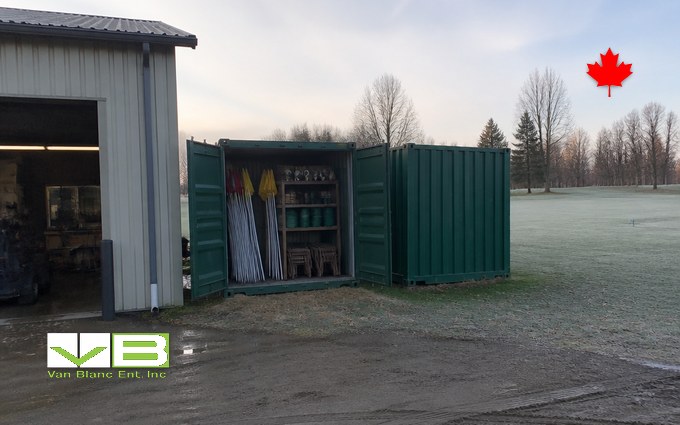
Quick Answer: Golf course maintenance is the care of a course’s turf, irrigation, equipment and furniture, run by the superintendent’s crew. Ontario’s fall close adds snow mould sprays, green covers and an irrigation blow-out capped at 50 psi. Tee markers, benches and electric carts can winter in containers beside the maintenance shop.
Contents, From Last Round to Spring
- What does golf course maintenance involve?
- The superintendent and the crew
- Ontario’s fall closing calendar
- Course furniture comes inside
- Snow mould and the last fungicide
- Green covers, ice and the 45-day mark
- Irrigation blow-out before freeze-up
- Mowers and reels in the winter shop
- Golf course storage beside the shop
- Box sizes, inside and out
- Golf cart storage in a 40ft
- Chemicals keep their own building
- Which grade sits where
- Late-fall delivery to a course
- Before you call: the course count
- Golf course maintenance FAQs
Reading Time: 18 minutes
What Does Golf Course Maintenance Involve?
Golf course maintenance is the daily and seasonal work that keeps a course playable. Through the summer it means mowing and rolling greens, cutting cups, raking bunkers, feeding the turf and running the irrigation. It also means keeping a shop full of mowers, sprayers, aerators and carts in working order. An Ontario course adds a second job that warm-climate guides tend to skip. Once play winds down, the same crew puts the course to bed for ice, snow mould and frozen ground. Then it spends the winter indoors on the machines.
Seasonal clubs all make this swap twice a year, from a curling club drying its stones for summer to a course bringing in tee markers. The stakes run higher on a course. A green lost to ice in February can mean sod, seed or a temporary green in May.
Van Blanc is a family business in Brantford that has sold shipping containers across Ontario since 1995, run by Paul LeBlanc and his son Christian. The turf advice below comes from the Guelph Turfgrass Institute, the USGA and the other sources listed at the end. The storage advice is ours.
| Window | On the course | In the shop and yard |
|---|---|---|
| Ontario handicap season, April 15 to October 31 | Mowing, cups, bunkers, fertilizing, watering, insect and disease control | Daily mower and cart upkeep; tee markers, ball washers and benches out on the holes |
| Late fall to freeze-up | Higher mowing heights, fall nitrogen and potash, the snow mould fungicide, covers on the greens that need them | Irrigation blow-out; course furniture into the shop or a box beside it, fitted out before delivery |
| Freeze-up to snowmelt | Ice watch on the greens; in trials, ice-encased annual bluegrass was dead after 45 days | Reel grinding, engine service, refinishing tee markers, ball washers and benches |
| Snowmelt | Covers off; damaged turf sodded, seeded or replaced by a temporary green | Irrigation refilled and pressurized; furniture back out on the course |
The Superintendent and the Crew
A golf course’s maintenance department answers to the superintendent. The Ontario Golf Superintendents’ Association, formed in 1924, counts the rest of that team among its members: assistant superintendents, technicians and equipment managers. Below them works a seasonal crew. Job Bank’s Ontario profile files golf course workers under NOC 85121, landscaping and grounds maintenance labourers. Its duty list runs from cutting, raking and aerating to spraying for insects and disease as directed. Grounds crews outside golf keep the same calendar, wintering the mower fleet in a box that summers the plows.
The work is outdoor and physical. Job Bank describes it as exposed to weather and extreme temperatures, usually 35 to 40 hours a week, with manual handling, bending and repetitive motion. Winter thins the team. USGA agronomists note that most courses reduce staff significantly over the winter, so the fall jobs below land on a smaller crew. The OGSA also keeps a Best Management Practices committee and acts as liaison on integrated pest management and water.
At a member club, a Van Blanc storage box is one capital line a board can vote on. At a municipal course, it goes through purchasing like any other equipment, on the RFQ route a public works yard already follows.
Ontario’s Fall Closing Calendar
Ontario’s fall close follows the weather more than the calendar. Golf Ontario’s handicap season runs April 15 to October 31, and rounds played outside it are not posted for handicap. A course may stay open past that date in a mild fall, but the turf work keys off frost and snow. The closing jobs run roughly in this order.
- Raise the mowing height on the greens late in the season. A USGA summary of the research calls it one of the best things a superintendent can do for winter.
- Feed nitrogen and potash in the fall, which GreenMaster’s winterkill review lists for building winter hardiness.
- Get any storage box onto the compound before the lanes go soft. After freeze-up works too, because frozen ground carries a loaded tilt-deck better than a soft October lane.
- Bring in the tee markers, ball washers and benches for their winter refinishing.
- Blow out the irrigation before the ground freezes.
- Make the last snow mould application close to permanent snow cover.
- Cover the greens that need it.
- Move the mowers and reels into winter service.
Course Furniture Comes Inside
Course furniture is everything the crew sets out on the holes for play and pulls back in for winter. USGA agronomists name tee markers, ball washers and benches as pieces a winter crew can make or refinish for the next season. Every hole also has a flagstick and a cup. Add the bunker rakes, signs, divot boxes and bins, and an 18-hole course brings in a stack measured in pallets. The inside measurements of every container size show how a 48 by 40 inch pallet sits in each one.
The shop is where that stack causes trouble, because winter is shop season. USGA agronomists describe servicing and detailing equipment as an immense effort each winter. Every bench leaning on a wall is floor a mechanic can’t use. Moving the furniture to a box beside the building gives the bays back to the machines. The painters then bring pieces in a few at a time.
Paul LeBlanc, owner, Van Blanc Ent. Inc.: “When a superintendent calls about storage, I ask them to picture the shop in January. The mowers are in pieces, the reels are on the grinder, and the tee markers wait along the wall for paint. Whatever is leaning on that wall tells me the size of the box.”
For scale, a Van Blanc 20ft takes 11 standard pallets on its floor. A course’s tee markers, ball washers and benches usually fit in a standard 20ft with 1,172 cubic feet behind its doors. Flags and signs go on shelving above.
Snow Mould and the Last Fungicide
Snow mould is the winter turf disease Ontario superintendents spray against in late fall. Guelph researchers study two kinds on putting greens: grey snow mould, caused by Typhula incarnata, and pink snow mould, caused by Microdochium nivale. USGA agronomists point out that snow mould doesn’t always need snow to develop.
Timing is the hard part. In a 2000-2001 trial on a creeping bentgrass green at the Guelph Turfgrass Institute, Cook and Hsiang tested a granular fungicide at set dates. Most treatments made within three weeks before permanent snow cover gave significant suppression. The 6 November treatment, five weeks before snow cover, showed reduced efficacy, and rain and melt in the gap may explain it. A 15 December application also fell short.
The same report records a concern that Fusarium patch in mid to late fall raises pink snow mould through the winter. So the last spray date comes from the forecast. A damp November is also when an unvented steel box starts to sweat on the inside. Any storage box gets its vents before the furniture goes in. Once the spray is down, the crew’s attention turns to the greens that need covers.
Green Covers, Ice and the 45-Day Mark
Ice cover is the winter risk with a clock on it. In 2014, Golf Canada reported ice encasing greens on many Ontario courses for more than three months. It called that twice what most Poa grasses can withstand. Superintendents at Toronto and Etobicoke clubs reported half or more of the grass damaged or dead on affected greens. One club opened temporary greens, and another prepared to sod every green. A Van Blanc steel box takes the same winter with far less fuss, given roof vents, oiled door seals and a yearly roof check.
The 45-day figure comes from research. GreenMaster’s review of Canadian winterkill, posted by GCSAA, cites Olds College trials in which ice-encased annual bluegrass plants were all dead after 45 days. Creeping bentgrass withstood 90 days. The review advises trying to remove ice before the 45-day mark, with dark topdressing that absorbs heat and honeycombs the ice. It adds that 8°C for 48 hours is enough to deharden annual bluegrass.
Permeable or Impermeable Covers
Green covers come in two families. USGA agronomists say northern greens with a lot of Poa annua are often covered for long periods with impermeable material. The aim is to prevent injury from ice and cold. Permeable covers sit on GreenMaster’s list of ways to prevent desiccation, the drying that can only happen without snow cover. Around Quebec City, where snow is predictable, the review describes impermeable covers alone. Around Montreal, the system is a permeable cover, then straw, then an impermeable one.
Rolled covers wait out the summer best off the floor, on brackets and shelves fixed to a container’s side walls. Covers carry their own winter risk, because oxygen can run out underneath. In one Quebec study the review cites, greens with recurring damage went anoxic by day 90. Greens that wintered well kept enough oxygen to day 130.
Irrigation Blow-Out Before Freeze-Up
An irrigation blow-out drains the pipes and pushes the remaining water out of every sprinkler with compressed air, before the ground freezes. USGA agronomists explain why: water left in the system freezes, expands and can break pipes and sprinklers. Timing is the judgment call. Shut the system down too early and warm, dry weather can return to stress the grass. Wait too long and a sudden cold snap does the damage.
The blow-out also frees a shelf of spares for the winter: sprinkler heads, swing joints, valves, wire and the quick coupler keys. Spring repairs go faster with those parts sorted by size in a Van Blanc box, on wire-deck shelving that keeps small parts in their bins. Toro’s winterization guide for golf systems sets out the procedure itself. Its limits are specific.
- Air volume clears the pipe. Toro says the volume of cubic feet per minute matters most, more than the pressure.
- Golf systems typically need a compressor in the range of 375 to 900 CFM.
- Do not exceed 50 psi of air pressure in any system; Toro warns that more can cause severe equipment damage and personal injury. It has crews set the regulator to 40 psi, adjusting in 2 psi increments as needed.
- Activate each sprinkler only once. A dry sprinkler fired again can spike the pressure, and Toro warns of equipment damage and personal injury.
- Work from the highest elevation to the lowest, closing each drain once it shows only air.
- Run the air through a length of 2-inch galvanized pipe first, because heat at the connection can damage PVC piping.
Mowers and Reels in the Winter Shop
Winter shop work is where an equipment manager sets up the next season. A course short of bays can add a 40ft fitted out as a heated workshop. Toro’s operator’s manual for its Reelmaster 3100-D mower lists the storage steps for that machine.
- Thoroughly clean the traction unit, the cutting units and the engine.
- Inflate all tires to 14 to 18 psi and check the fasteners.
- Clean and grease the battery terminals, and slowly recharge the battery every 60 days for 24 hours.
- Change the oil and filter, then drain all fuel from the tank, lines, fuel filter and water separator.
- Seal the air cleaner inlet and the exhaust outlet with weatherproof tape, and check the antifreeze for the coldest temperature expected.
Paint for the tee markers and benches is a shop supply that hates frost. Van Blanc’s insulated container page puts paint among the loads that have to stay between roughly five and thirty degrees all year. An insulated container slows how fast the inside follows the outside, which a small heater can finish.
Other machines follow their own manuals with the same pattern: clean, charge, drain and seal. Courses that log maintenance in software record each machine’s winter service as a work order. Fuelled machines stay in the shop under the course’s own fuel rules. A closed steel box is no place for gasoline or a full tank. The engines need the floor space, which is the case for moving everything else out.
Golf Course Storage Beside the Shop
Golf course storage, in practice, means the space beside the maintenance building where things wait for spring. A shipping container is an ISO-sized freight box of corrugated steel, with locking cargo doors at one end and a marine plywood floor. Set it on a crushed-stone pad a foot wider than the box all round. A Van Blanc container there turns the stack along the shop wall into rows the crew can reach in March. Sorted by job, a full 18-hole operation can split into up to four boxes.
| Box | What goes in | How it works |
|---|---|---|
| 20ft, course furniture | Tee markers, ball washers, benches, flagsticks, bunker rakes, signs, bins | Heavy pieces on the floor, flags and signs on wall shelving, painting stock nearest the doors |
| 20ft, parts and covers | Irrigation spares through the winter; rolled green covers through the summer | Shelving down both walls with an aisle up the middle; full in both seasons |
| 40ft, electric carts | A single file of carts, with furniture or shelving along the other wall | Carts roll in over a ramp and come out in reverse order in spring |
| 40ft, overflow | A second cart row, tournament stakes, ropes and tee signs, event gear | The box that grows with the club |
Clubs buying two or more at once can stage them on one delivery plan, with the aisle and snow-lane spacing between the boxes worked out before the first truck. Nine-hole layouts and smaller courses start with the furniture box and add from there. Lining the boxes up door to door along the compound keeps one lane clear for the carts and the plow.
Box Sizes, Inside and Out
Our 20ft and 40ft dry boxes match on width, height and door size. Only the length changes, which is why the 40-footer with 39 ft 5 in of floor is the cart box. Our product pages give the box figures below. The pad sizes come from our gravel pad guide, and the approach lengths from our tilt-deck delivery walkthrough, which asks for a longer straight run than the product pages list.
| Measurement | 20ft dry | 40ft dry |
|---|---|---|
| Inside length | 19 ft 4 in (5.898 m) | 39 ft 5 in (12.029 m) |
| Inside width | 7 ft 8 in (2.352 m) | 7 ft 8 in (2.350 m) |
| Inside height | 7 ft 10 in (2.385 m) | 7 ft 10 in (2.385 m) |
| Door opening, width x height | 7 ft 8 in x 7 ft 5 in (2.343 m x 2.280 m) | 7 ft 8 in x 7 ft 5 in (2.340 m x 2.280 m) |
| Volume | 1,172 cu ft (33.2 m³) | 2,390 cu ft (67.7 m³) |
| Standard pallets on the floor | 11 | 20 to 21 |
| Gravel pad, about | 22 ft x 10 ft | 42 ft x 10 ft |
| Straight approach, per our tilt-deck delivery walkthrough | 80 ft | 120 ft |
What is standing on our lots this week is listed by size and grade across our 4 Brantford yards. A 40ft holds roughly double the 20ft’s volume on a 320 square foot footprint, and a high cube adds a foot of height.
Golf Cart Storage in a 40ft
Golf carts need more floor than anything else on the list, and a Van Blanc 40ft fits them by length. E-Z-GO lists its Freedom RXV ELiTE lithium fleet car at 93 in (236 cm) long and 46.5 in (118 cm) wide. With the roof it stands 70.5 in (179 cm) tall. Its curb weight is 638 lb (290 kg). Measure your own model, then hold it against the box.
The 40ft floor is 170 mm (6.7 in) off the ground, so carts roll in over a ramp. The container ramp on Van Blanc’s accessories list measures 1542 L x 2000 W x 145 mm and carries a 6.5 ton rating. The field guide to locks, vents, ramps and other add-ons covers the rest of the kit.
| Check | The cart | The box | Result |
|---|---|---|---|
| Height | 70.5 in (179 cm) with roof | Door opening 7 ft 5 in (2.280 m) | Clears with about 18 in to spare |
| Width | 46.5 in (118 cm) | Inside width 7 ft 8 in (2.350 m) | Two abreast need 93 in, so carts go single file |
| Length, 40ft | 93 in (236 cm) | Inside length 39 ft 5 in, or 473 in | Five carts use 465 in on paper; plan on four with walking room |
| Length, 20ft | 93 in (236 cm) | Inside length 19 ft 4 in, or 232 in | Two carts use 186 in |
A single file of carts leaves about 1.17 m (46 in) of floor along the other wall, enough for benches or a run of shelving. Gas carts carry fuel, so this layout is for electric fleets only. A course with more furniture than that strip holds puts it in a separate 20-footer beside the cart box.
Battery Care Before the Doors Close
Trojan Battery, which makes flooded lead-acid batteries for golf carts, gives plain storage rules. The first is to avoid locations where freezing temperatures are expected, because freezing does irreparable damage to a battery’s plates and case. Trojan adds that a high state of charge also prevents freezing. Completely charge the battery before storing it, and keep it cool and dry, protected from the elements. Give it a boost charge when it shows a 70% charge or less. Trojan puts the electrolyte’s freezing point at -69°C (-92°F) in a fully charged battery, and about -9°C (16°F) at a 40% state of charge.
Trojan also says to charge only in well-ventilated areas, with sparks and flames kept away. So the carts come out to the cart barn or the shop for their boost, and the charger never lives in the box. An unheated steel box gets as cold as the Ontario winter outside it. A club with flooded batteries can order the cart box insulated, with a small heater. Our insulated container page lists batteries among the loads it keeps between roughly five and thirty degrees. Without that, the batteries stay at full charge and get checked through the winter, as Trojan advises. Lithium carts such as the ELiTE follow the storage steps in their own manual. Either way, a hidden-shackle puck lock on the cart box doors keeps the fleet locked in until April.
Chemicals Keep Their Own Building
Fungicides, insecticides and fertilizer stay out of the furniture and cart boxes. Ontario requires a golf course that uses unlisted pesticides to hold accreditation from a ministry-approved IPM body by the second anniversary of first use. The province also requires an annual report, prepared before January 31 and kept at the head office for five years. USGA agronomists add that winter is when superintendents plan the next year’s plant protectant program, so the products are on hand when needed. Where that product waits between sprays is a building question of its own. Storing pesticides and fungicides in a dedicated building covers it in detail.
Which Grade Sits Where
Van Blanc sells four grades, and on a golf property the choice follows the sightlines. A box behind the maintenance shop is seen by the crew. A box by the first tee, the pro shop or the clubhouse lot is seen by every member and guest. Each grade has a place.
- New (one-trip): one voyage from the factory, with clean paint and tight doors. Our custom features page names one-trip as the base for anything customers see, so it suits a new box set where members walk past it.
- Cargo worthy: used 8 to 15 years and carrying a current CSC re-certification. Expect surface rust outside; the doors close on a full seal. It is the working grade for a compound box, and our graded used containers for working yards walk through the inspection.
- Wind and watertight: used 12+ years. Its roof and floor are sealed, and its panels show more rust than a cargo worthy box. It suits long-term static storage at the back of the compound, such as covers and spares.
- As-is: donor stock with every defect written down before purchase, sold as a shell for heavy cutting or for its scrap value.
Those ages count how old the box is today. Paint is one of the modifications quoted with the box. A cargo worthy unit can go out in a colour that sits quietly against the trees.
Pricing Boxes for the Maintenance Compound
Count the tee markers, benches and ball washers, add the number of electric carts, and pick the spot beside the shop. Give us those counts, the spot and your postal code. We will tell you which 20ft and 40ft units fit, in which grade, with one all-in number and a real lead time.
Family-run in Brantford since 1995 · 4.9★ across 140+ Google reviews · see your unit by its container number first.
Late-Fall Delivery to a Course
Late-fall delivery to a golf course comes down to ground and geometry. Van Blanc delivers on a tilt-deck truck that weighs over 45,000 lb loaded, and our tilt-deck delivery walkthrough sets the site needs. A 20ft wants a straight approach of 80 ft and a 40ft wants 120 ft, on a path 12 ft wide. Overhead clearance is 14 ft (16 to 18 ft preferred), and the slope should be under 5 percent. On a course, the place for a box is the maintenance compound’s gravel or asphalt, well clear of the turf.
Build the pad first. Our gravel guide calls for 4 to 8 inches of compacted 3/4-inch crushed stone, levelled to within roughly an inch end to end. A level pad keeps the cargo doors swinging true through a January thaw. A box set before the October rains also saves the lane from ruts.
A stocked Van Blanc box reaches clubs in and around Guelph or public and resort courses near Niagara Falls in 1-3 days. Every quote comes with a real lead time, not a hopeful one. Before the truck is booked, our team asks for photos of the approach, the wires overhead and the spot itself.
The same window covers courses on the Barrie side of Lake Simcoe, where a delivery before the snow keeps the compound simple. East of Toronto, a lakeshore club in Ajax gets the same tilt-deck and the same placement. Whichever course it is, the driver sets the box once, level, with its doors facing the compound lane.
Before You Call: The Course Count
A storage quote for a course goes fastest with numbers in hand. These are the ones that make the call quick.
- Count the course furniture by type: tee markers, ball washers, benches, flagsticks, rakes, signs and bins.
- Count the electric carts, and measure one cart’s length, width and roof height against the 7 ft 5 in door opening.
- Decide who will see the box and which grade you want, using the grade notes above.
- Pick the spot on the compound, then check the pad size, the straight approach and any overhead wires.
- Plan the doors and air. Most containers ship with 2 to 4 vents, and our yard-built doors, vents and shelving include roll-up doors in 6, 7, 8 and 10 ft widths.
- Keep fuel and chemicals out of the boxes, and keep cart charging where the air moves.
- Call with the counts and your postal code, or send them with a photo of the compound.
Frequently Asked Questions
How much does golf course maintenance cost?
Budgets vary with the number of holes, the rounds played and the climate, and Van Blanc does not print dollar figures. The main lines in a maintenance budget are usually labour, equipment, plant protectants and fertilizer, water and energy. USGA agronomists note that most courses cut staff significantly in winter. A storage container is a one-time purchase, quoted by size, grade and delivery distance.
Is golf course maintenance hard work?
It is physical, outdoor work. Job Bank’s Ontario profile for golf course workers, NOC 85121, lists manual handling, standing, repetitive motion and bending. The work is exposed to weather, extreme temperatures and noise. The usual schedule is 35 to 40 hours a week through the season, and most courses run a much smaller crew in winter.
What jobs are on a golf course maintenance crew?
The superintendent leads the department. Assistant superintendents, technicians and equipment managers fill the senior roles, all listed among the Ontario Golf Superintendents’ Association’s members. The seasonal crew falls under NOC 85121, landscaping and grounds maintenance labourers. Van Blanc does not print pay figures, and Job Bank publishes the wage data for the crew role.
When do golf courses in Ontario close for the season?
The date depends on the course and the weather. Golf Ontario’s handicap season runs April 15 to October 31, and rounds outside it are not posted for handicap. A course may stay open later in a mild fall. The turf work follows snow cover. In Guelph research, snow mould treatments made within three weeks before permanent snow cover suppressed the disease, while one made five weeks ahead lost efficacy.
Do you need to winterize a golf cart?
Yes, and the battery is the main job. For flooded lead-acid batteries, Trojan says to avoid storage where freezing temperatures are expected, charge completely before storage and boost at 70% or less. It also says to charge only in well-ventilated areas. A fully charged battery’s electrolyte freezes at -69°C, while one at 40% freezes near -9°C. Lithium carts follow their own manual.
How many golf carts fit in a 40ft shipping container?
Plan on four, in a single file with room to walk. A fleet cart such as the E-Z-GO Freedom RXV ELiTE is 93 inches long and 46.5 inches wide. A 40ft is 39 ft 5 in long inside, so five fit nose to tail on paper. Two abreast will not fit its 7 ft 8 in width. A ramp bridges the 170 mm sill.
What size container does a golf course need for winter storage?
A Van Blanc 20ft usually suits a course’s furniture: tee markers, ball washers, benches, flags and signs. A 40ft takes a single file of electric carts with furniture along the other wall. A full 18-hole operation can split its storage across up to four boxes, by job. Smaller courses start with one 20ft and add as the club grows.
Can a container be delivered to a golf course in November?
Yes. Our tilt-deck delivery walkthrough asks for a straight approach of 80 ft for a 20ft or 120 ft for a 40ft. It also needs 14 ft of overhead clearance and firm ground. Set the box on the maintenance compound’s gravel or asphalt, clear of the turf. Frozen ground carries the truck well, so a delivery after freeze-up works too.
Sources
- United States Golf Association, Green Section Record. USGA, Getting the Golf Course Ready for Winter (November 3, 2023); USGA, What Do You Do All Winter? (November 1, 2024), checked October 2026.
- Cook, S. and Hsiang, T. Guelph Turfgrass Institute 2002 Annual Research Report. University of Guelph, Effects of Rainfall After Final Fungicide Application on Snow Mould Control, 2000-2001, checked October 2026.
- GreenMaster, January/February 2010, hosted by GCSAA. GCSAA, Winterkill: The Wrath That Is a Canadian Winter, checked October 2026.
- Golf Canada. Golf Canada, The Harsh Hand of Winter (April 28, 2014), checked October 2026.
- The Toro Company. Toro, Irrigation System Winterization and Pressurization Procedures; Toro, Reelmaster 3100-D Operator’s Manual, checked October 2026.
- Government of Ontario. Government of Ontario, Pesticides and Golf Courses (updated June 30, 2026), checked October 2026.
- Government of Canada, Job Bank. Job Bank, Golf Course Worker in Ontario (updated August 7, 2026), checked October 2026.
- Golf Ontario. Golf Ontario, Handicap; Ontario Golf Superintendents’ Association. OGSA, About Us, checked October 2026.
- E-Z-GO. E-Z-GO, Freedom RXV Fleet Golf Cart specifications; Trojan Battery. Trojan Battery, Battery Maintenance, checked October 2026.
Course Storage From Four Brantford Yards
We have been supplying shipping containers across Ontario since 1995. Our office is at 90 Morton Avenue East in Brantford, and all four of our yards are in Brantford.
Van Blanc Ent. Inc., 90 Morton Ave E Unit 1B, Brantford, ON N3R 7J7, 519-754-6844.
If the furniture is coming in and the shop is already full, call with the counts, the spot beside the shop and your postal code. Before you hang up, you will know which 20ft and 40ft units fit that count and the date a truck can reach the compound. Worth the drive for unbeatable quality, family customer service with 30 years of experience.