
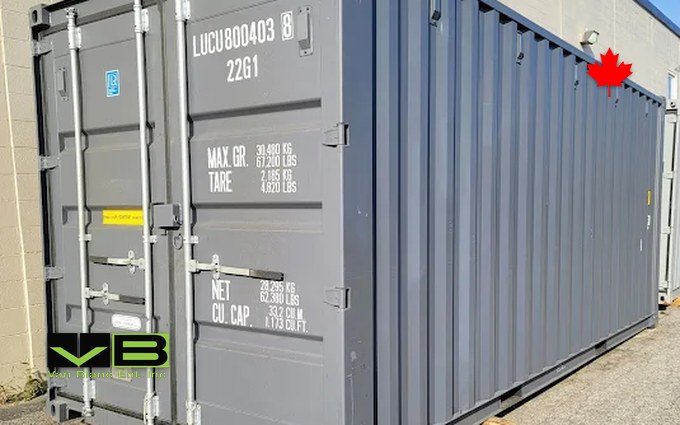
Quick Answer: A gravel pad, four to six inches deep and a foot wider than the shed, is the right base for most Ontario sheds: it drains and floats level through frost. Skids and blocks suit small sheds, a slab a workshop, piers a room. Containers sit on the same gravel pad.
In This Guide
- Where We Stand
- The Door That Will Not Open in March
- Float on Top, or Go Below the Frost
- The Five Bases, Compared
- The Gravel Pad, Step by Step
- Skids, Deck Blocks and Patio Stones
- The Slab: When It Is Worth Pouring
- Piers and Piles: For a Room, Not a Shed
- Drainage Is the Variable Nobody Prices
- What a Container Sits On
- Who Should Build Which
- Shed Foundation FAQs
Reading Time: 14 minutes
Where We Stand
This guide is written by a shipping container yard in Brantford, Ontario, which sets steel boxes on gravel, blocks and piers across the province and has written the container version of every base on this page, from the gravel pad under a box to helical piers against a slab. We sell no sheds, no gravel and no concrete, so the shed sections here are written to help a shed buyer put the right base under the right building, and the container section at the end says where a steel box is simpler. Depth, stone and levelness figures come from the Ontario shed builders’ own site-prep pages, read on September 15, 2026; the frost figures are the province’s.
The Door That Will Not Open in March
Every bad shed base in Ontario announces itself the same way: a door that swung freely in October will not close in January and will not open in March. The shed has not moved, exactly. One corner of it has, because the ground under that corner froze, expanded and lifted it, and the ground under the opposite corner did not. Water expands by about nine percent when it freezes, and wet soil freezing from the top down pushes whatever sits on it upward with a force no shed can resist. The ground in southern Ontario freezes to about 1.2 metres in a normal winter, and to 1.8 metres or more around Sudbury, North Bay and Thunder Bay. A house deals with that by putting its footings below the frost, where the ground never freezes. A shed cannot afford to, so it does the opposite: it floats on top and lets the whole building rise and fall together. Every base on this page is a way of making that rise and fall uniform, and the ones that fail are the ones that let one corner move more than another. Frost heave under a container is the same physics with a heavier, stiffer building on top.
Float on Top, or Go Below the Frost
Two philosophies, and the shed you are buying decides between them. A floating base sits on or just below the surface, drains freely so there is little water under the shed to freeze, and is built wide and uniform so the frost lifts it evenly and drops it back level in April. A gravel pad, skids on gravel, deck blocks, patio stones and a floating slab are all floating bases, and they are right for anything that is a shed: a building whose doors and walls can tolerate a quarter-inch of seasonal movement and whose floor is its own. A frost footing goes below the frost line, on concrete piers or helical piles or a full foundation wall, and it is right for a building that cannot move: a room with plumbing, a structure tied to the house, a slab that carries a lift or a machine that has to stay true. The mistake in both directions is common. A gravel pad under a 12×24 workshop with a 240-volt panel and a lathe is a floor that walks; piers under an 8×10 resin shed are money spent to solve a problem the shed never had. The site-prep guide for a steel box sorts the same decision for a container, which floats better than any shed because it is rigid end to end.
The Five Bases, Compared
| Base | Floats or footed | Right for | Frost behaviour | Drainage | Weak point |
|---|---|---|---|---|---|
| Gravel pad, 4 to 6 in compacted crushed stone in a timber frame | Floats | Any kit, prefab or Amish shed to about 12×24; every resin shed; a container | Lifts and settles evenly if the pad is uniform and drained | The best: water runs through and away | Built too small or too thin; built on topsoil instead of subsoil |
| Wood skids on gravel or blocks | Floats | Prefab sheds delivered on skids; sheds that may move | Even if the gravel under the skids is uniform | Good on gravel, poor on soil | Skids on bare ground rot from below in a decade |
| Deck blocks or patio stones | Floats | Small sheds to about 8×10; resin sheds with a plastic floor | Each block heaves on its own; fine on sand or gravel, poor on clay | Only as good as what is under the blocks | Differential heave on clay; the March door |
| Floating concrete slab, 4 in on 4 in gravel, thickened edge | Floats | Workshops, riders, ATVs, anything heavy or oily; mice-proof floor | Lifts as one piece if the gravel under it drains; cracks if it does not | Needs the gravel layer and a fall away from the slab | Costs close to the shed; the shed above it must be bolted down |
| Concrete piers, sonotubes or helical piles below frost | Footed | A room, a studio with plumbing, a building tied to the house, a container home | Does not move | Irrelevant to the footing; still matters to the floor | Cost and a contractor; wrong money for a storage shed |
The row that sells the most sheds in Ontario is the first one, and the row that causes the most calls in March is the third. Railroad ties against blocks against gravel is the container version of the same three-way choice, and the conclusion is the same: blocks are fine on ground that drains and a gamble on clay.
The Gravel Pad, Step by Step
The Ontario shed builders agree on the pad because it is the one base that drains, floats and can be built by the owner in a weekend. North Country Sheds asks for four to six inches of 5/8-inch crushed stone, extending one foot past the shed in every direction, so a 10×10 shed gets a 12×12 pad, levelled with a string or laser level, with an optional pressure-treated timber border and weed fabric under the stone to stop grass and weeds. Sheds Unlimited and the Amish builders say the same in slightly different numbers. The sequence that works: mark the pad a foot bigger than the shed each way; strip the sod and the topsoil down to the firmer subsoil, four to six inches, more if the topsoil is deep; build a frame of 4×4 or 6×6 pressure-treated timber, corners screwed or pinned, and level it with the laser, shimming the low side with stone rather than digging the high side into a hole that collects water; lay weed fabric; fill with 3/4-inch clear crushed stone or 5/8 crusher run, in two lifts, compacting each with a plate compactor or, for a small pad, a hand tamper and patience; screed it level to the top of the frame; and let the delivery crew set the shed. Levelling and shimming covers the last quarter-inch for a container, and the technique is identical for a shed on skids.
Two choices inside that sequence matter more than the rest. Clear stone against crusher run: 3/4-inch clear has no fines, drains fastest and does not compact into a hard surface, which is right under a shed that sits on skids; crusher run has fines, compacts into a firm crust, and is right under a slab or under a container’s corner blocks. And frame or no frame: a pad without a timber border spreads at the edges under the plate compactor and again every spring, and a shed on a spreading pad is a shed that slowly sinks at the corners. Build the frame. The stone under a container needs the same thinking, and what the delivery truck does to the ground is why the pad should be finished before the truck arrives and not after.
Skids, Deck Blocks and Patio Stones
A prefab shed usually arrives on two or three pressure-treated 4×4 or 6×6 skids, and the delivery crew’s job is to land those skids on something level that drains. On a gravel pad that is the whole story. On deck blocks, the concrete pyramid blocks with a slot for the skid, the shed is fine as long as each block sits on compacted stone rather than on lawn, because a block on lawn sits on topsoil, topsoil holds water, and each block then heaves by its own amount. Patio stones under a resin shed are the same idea in a flat shape: right for an 8×10 Keter or Lifetime on sand or gravel, wrong on clay, and the makers’ own base guidance says the surface has to be flat and level to a small tolerance or the panels will not snap together and the doors will not meet. The wood shed delivery guide covers what the Ontario prefab builders deliver on and what they ask you to have ready; the Keter base rules reads the resin makers’ base rules line by line.
Skids on bare ground is the base that is not a base. It is how most sheds in the province actually sit, and it is why so many of them have a rotten sill, a floor that slopes toward the door and a family of something living underneath. Ground contact rots pressure-treated wood in a decade; a shed on gravel outlives the same shed on lawn by twenty years. Why a container floor is replaced is the steel-box version of the same moisture-from-below story.
The Slab: When It Is Worth Pouring
A floating concrete slab is the floor everybody wants and the base most sheds do not need. What it gives is real: a floor that takes a riding mower, an ATV, a compressor or an engine on a stand without a soft spot; a floor that oil and salt do not ruin; a floor mice cannot chew through; and a building that can be bolted down. What it costs is the reason the Reddit threads ask whether anyone regrets it, and the Ontario builders answer plainly: North Country says a six-inch pad can cost nearly what the shed costs. The honest version for a shed is a four-inch slab over four inches of compacted gravel, with the edges thickened to eight or ten inches to stiffen the perimeter, reinforced with mesh or fibre, poured a few inches larger than the shed so the walls sit inside the edge, and sloped so water runs away from the door. Two inches is not a slab; it is a crust that cracks under the first rider. And concrete poured on bare dirt, with no gravel and no compaction, is the slab that cracks in a year, because the dirt holds water, the water freezes, and the slab lifts unevenly. The container pool page is the one place on this site where a full engineered slab is the right answer, and it explains why.
The rule for deciding: pour the slab if the shed is a workshop, a garage in all but name, or a building with a heavy machine in it, and if it is going to stay where it is for the life of the house. Build the gravel pad for everything else, and put the money saved into the shed. A 12×16 workshop with a rider, a bench and a compressor is the borderline case; it can live on a good pad with a plywood floor over skids, and it lives better on a slab. Where the concrete-pad decision goes for a steel box, and what drives its cost, arrives on this site in early October.
Piers and Piles: For a Room, Not a Shed
Concrete piers in sonotubes, or helical piles screwed to refusal, go below the frost line and do not move, which makes them the base for a building that cannot: a studio or office with plumbing in the wall, a bunkie someone sleeps in, a structure connected to the house, a container home. They are the wrong money for a storage shed, because a shed’s floor system spans between them on beams and has to be built anyway, and because a shed tolerates the movement the piers are there to prevent. The one shed case for piers is a slope: a lot that drops three feet across the footprint, where a level pad would need a retaining wall, is cheaper on six piers and a beam floor than on a pad. The sonotube pier page and helical piers against a pad work through both systems under a container, where the load is concentrated at four corners and the pier count is small.
Drainage Is the Variable Nobody Prices
Every base above works on ground that drains and fails on ground that does not, and drainage is the line item missing from every shed foundation guide. Frost needs water to heave; dry gravel does not lift. A pad on a high, sandy corner of the yard will sit level for thirty years with no more than a rake in the spring. The same pad in the low corner where the downspout discharges and the neighbour’s grade runs toward it is a pad that heaves every winter and holds a puddle every spring. Before any base, fix the water first: extend the downspouts, grade the pad area so it is the high point of its surroundings by a few inches, and if the yard is clay, dig the pad deeper and fill it with more stone so there is somewhere for the water to go. A French drain along the uphill side of a pad in clay is cheap insurance. Delivery on a sloped site covers what a grade does to the truck; what it does to the base is the same problem a week earlier.
Whether a given shed, slab or pad can go where you want it is your municipality’s call, so check with your local building department before you dig; the questions on this page are about what the ground will do to the building, and the ground does not read the rules.
What a Container Sits On
A shipping container is the easiest building on this page to put a base under, because the box was designed to be set down on four points and to stay square while it is. All of its weight and all of its cargo bear on the four corner castings, so the base is four bearing points plus, for a 40-foot, a pair of points at the middle to stop the long floor from bowing under a heavy load. The standard base is the same gravel pad the shed builders ask for, four to six inches of compacted crusher run, a foot past the box each way, and the box is set on it directly or on a concrete block, a patio stone or a section of railroad tie under each corner to lift the steel off the stone and keep air moving underneath. That is the whole job for a storage box, and it is a morning’s work. The gravel pad for a container is the how-to, ties against blocks against gravel compares the corner supports, and how the tilt-deck sets the box explains why the pad needs a straight run behind it.
Where the container beats the shed is frost. A shed is a wood frame, and when one corner lifts an inch the frame racks, the door binds and the roof line opens. A container is a welded steel box with corrugated walls that behaves as one rigid piece: when a corner lifts, the whole box tilts by a fraction of a degree, nothing racks, the doors still swing, and in April it settles back or is shimmed level in twenty minutes with a jack and a plate. The levelling and shimming page is that twenty minutes, and the frost heave page explains why a box on a drained pad rarely needs it. The container also skips the slab argument entirely for storage, because its floor is already 1 1/8-inch marine plywood on steel cross-members, rated for a forklift, which is a better floor than any shed slab and arrives with the building; a pad is enough under a rider, an ATV or a full workshop, and the container workshop build on a pad is built on one.
Where it does not skip anything is the dwelling. A container home, an office with plumbing or a bunkie someone sleeps in wants the same footed base as any room, piers or piles below frost, because the services and the finishes inside cannot take seasonal movement even if the steel can; the sea can dwelling guide starts there. And a container needs what a shed needs and a little more of it: level, drained and a foot bigger than the footprint, because a box that is set on a sloped pad will have its doors out of square from the first day, and the truck that sets it weighs more than the truck that delivers a shed. Rural and cottage delivery access covers the last hundred metres.
Christian LeBlanc, Van Blanc: “Half the site-prep calls I get are people asking whether they need a slab for a storage container. They don’t. Six inches of packed gravel a foot bigger than the box, a block under each corner, and it’ll sit level for twenty years if the water runs away from it. The slab calls that make sense are the workshop with a lift and the house, and those are different conversations.”
For the buyer whose shed base turned into a container pad somewhere on this page, the box is the one line we can speak to from the yard. A storage container sits on a pad from the used rows or the one-trip rows at 90 Morton Avenue East, picked by number before any money moves: the 20-foot dry container on four blocks on four blocks is the storage answer, the 40-foot high cube on six on six is the workshop answer, and every unit lands anywhere in the delivery map for Ontario in one to three days with payment on delivery, on the pad you built the week before. Everything is sold outright; Van Blanc keeps no rental fleet.
Who Should Build Which
Build the gravel pad, framed and a foot oversize, under any storage shed from 8×10 to 12×20, under every resin shed, and under every container that is not a dwelling. Set deck blocks or patio stones only on ground that drains, only under a shed of 8×10 or less, and only on compacted stone rather than on lawn. Pour the floating slab, four inches over four of gravel with a thickened edge, under a workshop, a machine or anything that has to be bolted down, and accept that the base will cost a large fraction of the building. Go below frost, on piers or piles, only for a room: plumbing, sleeping, a connection to the house, or a container that is becoming a home. And before all of it, move the water away from the spot. The sea can against storage shed comparison is the wider read for anyone still deciding which building goes on the pad, and the hub for every building against a container is the widest.
Pad built, box next? Price the container once
Tell us the size, the grade and your postal code, and whether the pad is in, and we will send an all-in number for the unit delivered and set on your blocks, usually the same day. If your project is really a shed on a gravel pad, we will say so. Or walk the Brantford yard’s gravel and see how the units sit on the ground here.
The two pages that finish this one are the container anchoring guide, which takes the pad through anchoring and access, and landing a box on frozen ground, for the buyer whose pad will not be built until spring.
Shed Foundation FAQs
What is the best type of foundation for a shed?
For most sheds in Ontario, a compacted gravel pad: four to six inches of crushed stone in a pressure-treated timber frame, extending a foot past the shed on every side, levelled with a laser. It drains, so there is little water under the shed to freeze, and it floats, so the frost lifts the whole shed evenly and drops it back level. A slab is better under a workshop; piers are better under a room.
What is the cheapest foundation for a shed?
Deck blocks or patio stones on compacted stone, for a shed of 8×10 or less on ground that drains. Cheaper still is skids on bare ground, which is the base that rots the sill and heaves one corner, so it is not a saving. A gravel pad costs a little more than blocks and is the cheapest base that will still be level in ten years; the stone and the timber frame are the whole bill.
How deep should a shed foundation be?
A floating base is shallow by design: strip the sod and topsoil, four to six inches, down to firm subsoil, and fill with compacted crushed stone to a few inches above grade. It does not need to reach the frost line, which is about 1.2 metres in southern Ontario and 1.8 metres or more in the north; only a footed base for a room or a house goes that deep. Depth under a shed is about drainage, not frost.
What is the best foundation for a 10×12 shed?
A 12×14 gravel pad, four to six inches of compacted crushed stone in a timber frame, levelled, with landscape fabric underneath. A 10×12 is big enough that deck blocks on clay will heave unevenly and small enough that a slab is more base than the shed needs, unless the 10×12 is a workshop with a riding mower or a machine in it, in which case a four-inch floating slab over gravel is the better floor.
Is a 2 inch concrete slab enough for a shed?
No. Two inches is a crust that cracks under the first riding mower and breaks up at the edges within a few winters. A shed slab is four inches of concrete over four inches of compacted gravel, with the perimeter thickened to eight or ten inches and mesh or fibre reinforcement, sloped so water runs away from the door. Anything thinner is worse than a gravel pad and costs more.
Can I pour concrete directly on dirt for a shed?
You can, and it is the slab that cracks in the first year. Dirt holds water, the water freezes, and the slab lifts unevenly and breaks. Strip the topsoil, compact four inches of crushed stone, and pour on that; the stone drains the water away from the underside of the slab so the whole thing floats as one piece. The gravel layer is the difference between a slab and a broken slab.
Does a shipping container need a foundation?
Not a poured one, for storage. A container carries all its weight on four corner castings, so it needs four level, drained bearing points: a compacted gravel pad a foot larger than the box with a concrete block, patio stone or railroad tie under each corner, plus two at the middle for a 40-foot. It stays square through frost because the box is rigid, and it is shimmed level in minutes if a corner moves. A container home or office wants piers below frost like any room.
Sources
- North Country Sheds. (2026). Preparing a Shed Base: Site Preparation. northcountrysheds.com
- SW Backyard. (2026). Should I Choose Concrete Slab, Patio Stones or Wood Base? swbackyard.ca
- Sheds Unlimited. (2026). Building a Gravel Shed Pad: Step-By-Step Guide. shedsunlimited.net
- Keter. (2026). Do Sheds Need a Base? The Shed Foundation Dilemma. keter.com
- Fencescape. (2026). Your Guide to Frost Depth in Ontario. fencescape.ca
- Van Blanc Ent. Inc. (2026). Shipping Container Foundation and Site Prep: Frost Heave, Anchoring and Access. vbinc.ca
Reach Van Blanc in Brantford
We have been supplying shipping containers across Ontario since 1995. Our yard is at 90 Morton Avenue East in Brantford, and we deliver right across the province with payment on the day of delivery. No deposit, no upfront wires, no chase-the-paperwork.
Van Blanc Ent. Inc., 90 Morton Ave E Unit 1B, Brantford, ON N3R 7J7, 519-754-6844 (cell) or 1-888-509-6658 (toll-free).
If the shed base you were planning turned into a container pad somewhere in this page, call with the size, your postal code and whether the pad is in, and we will tell you on the spot what is in stock and when it can be set. Worth the drive for unbeatable quality, family customer service with 30 years of experience.