
Quick Answer: A small warehouse for rent in Ontario is priced as net rent per square foot plus additional rent for taxes, maintenance and insurance, on a three-to-five-year term, plus utilities, a deposit and often a guarantee. The smallest bays run about a thousand square feet. Below that, buy a steel box.
In This Guide
- How an Ontario industrial lease is actually priced
- Additional rent: the TMI line and what it hides
- Term, escalations, deposits and the personal guarantee
- What the smallest units look like
- The 2026 market: availability, subleases and inducements
- Who rents small warehouse space, and what they actually store
- The yard-of-your-own alternative, honestly
- The math on one page
- The small-warehouse checklist
- Warehouse rental FAQs
Reading Time: 12 minutes
How an Ontario industrial lease is actually priced
An industrial lease in Ontario is quoted the way nobody outside the trade expects: as net rent, a number per square foot per year, that is not the rent. We sell steel boxes from a yard in Brantford and do not lease anything, so this page is the tenant’s briefing written by the other side of the fence. The tenant pays that number divided by twelve each month, plus additional rent, which is the landlord’s property taxes, building maintenance and insurance passed through per square foot, plus utilities, usually separately metered, plus HST on all of it. A listing that reads as one figure is the net figure; the cheque is the net figure plus the additional rent plus the hydro plus the tax, and on a small bay the additional rent can be a fifth to a third again on top of the net. That structure is why two units that look the same on a portal cost different money, and why the first question to ask a leasing agent is not the rate but what the rate includes. It is also the first thing a business owner should understand before deciding whether a warehouse is the answer at all, because the container against warehouse storage is a comparison that only works once the warehouse side is priced correctly. The numbers here are left as structure rather than dollars, because rates move by the quarter and by the block.
Additional rent: the TMI line and what it hides
Additional rent is the line tenants underestimate, and the leasing trade calls it TMI: taxes, maintenance and insurance. It is quoted as an estimate per square foot per year at signing, billed monthly, and reconciled at year end against what the landlord actually spent, so a tenant who budgeted the estimate gets a catch-up invoice the following spring if the property taxes rose or the roof was repaired. Maintenance in a multi-tenant plaza means the common areas, the parking lot, the snow, the landscaping and the management fee, and in a small bay the tenant’s share is proportional to floor area, so the smallest unit pays the same rate as the largest. The Q2 2026 GTA West market read puts additional rent as a separate weighted figure by submarket, with Mississauga the highest, which tells a small tenant two things: the line is real money, and it varies enough by municipality that the same net rent in two towns is not the same cheque. What TMI does not cover is the inside of the unit: the tenant’s own insurance, the hydro, the gas, the alarm, the racking, and the repairs to anything the tenant touches. Insuring a container on your own lot is the equivalent line on the other side of the comparison, and it is one line rather than four.
Term, escalations, deposits and the personal guarantee
A small industrial lease in Ontario is not a month-to-month arrangement. The GTA West read shows mid-market deals at 48 to 121 months and large-format commitments at 84 to 180, and a small bay in a plaza typically signs for three to five years with a renewal option, annual escalations written in, a deposit of first and last, and, for a young company, a personal guarantee from the owner, which means the lease survives the business if the business does not. The inducements the market offers in 2026 are worth reading carefully: the same read found six months of free rent on a 121-month term in Halton Hills and a seven-month fixturing period in Caledon, with the Oakville small-bay flex units asking the region’s top rates, and those inducements are real value but are paid for by the length of the commitment. A tenant who needs space for two seasons is signing for five years to get it, and the exit is a sublease or an assignment that needs the landlord’s consent and clears, in the current market, materially below the direct rate. A box bought outright has no term at all, and how long a container actually lasts is the only calendar on the other side of that comparison.
Read the lease as a cheque, not a rate
Net rent plus additional rent plus hydro plus HST, times twelve, times the term, plus the deposit, plus the fit-out, plus the guarantee. Then divide by the square feet you will actually fill, not the square feet you are paying for. A thousand-foot bay holding three hundred feet of pallets is priced at the thousand.
What the smallest units look like
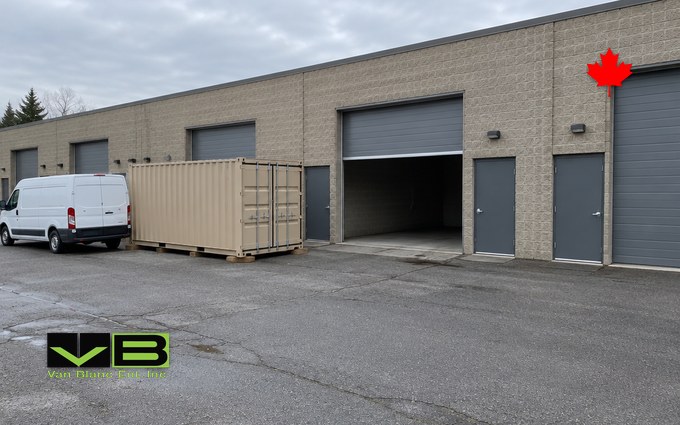
The smallest industrial bay a tenant can lease in most Ontario plazas is around a thousand square feet, and fifteen hundred to twenty-five hundred is the common floor, because landlords do not demise smaller than the plumbing and the doors allow. A small bay is a rectangle with a drive-in door at grade, sometimes a dock, a man door, a small washroom, a mezzanine or an office box in one corner, a clear height of sixteen to twenty-two feet in the older plazas that hold most of the small units, three-phase power in some and single-phase in more than tenants expect, and a shared yard where the truck backs in. Zoning is municipal and a warehouse use in an industrial zone is straightforward, while a retail counter or a wash bay in the same unit is a conversation with the city. The bay is heated to keep the sprinklers from freezing, which is not the same as heated for a person, and the tenant fits out the rest: racking, lighting, the alarm, the second washroom. For the tenant whose stock is three pallets and a van’s worth of tools, the smallest bay is three times the room and four times the cheque, and the stock room built in a box is what that tenant usually ends up with instead.
| Line | Small warehouse bay | A box on your own lot |
|---|---|---|
| Quoted as | Net rent per square foot per year | One number, delivered |
| Added on | Additional rent (TMI), hydro, HST, deposit, fit-out | The pad, a lock, HST once |
| Term | Three to five years small; 48 to 180 months in the wider market | None; it is yours |
| Exit | Sublease or assignment with consent | Sell it or move it; the resale routes |
| Smallest size | About a thousand square feet | 80 square feet in a ten; 160 in a twenty |
| Guarantee | Often personal, for a new company | None |
| What it needs from you | A business that fills a thousand feet for five years | A lot, a pad and a truck’s way in |
The 2026 market: availability, subleases and inducements
The small tenant is shopping into a market that loosened after the 2022 peak and is tightening again. The Q2 2026 GTA West read has overall availability at 5.3 percent, lease availability at 4.0 percent, and a sublease pool of about one percent of inventory, the largest shadow supply in the region, concentrated in Bolton and Caledon at 1.6 percent and Brampton at 1.4 percent. Two things follow for a small tenant. First, the sublease market is where the value is, because sublease space clears materially below direct-lease benchmarks, and a tenant who can live with someone else’s remaining term and someone else’s fit-out gets the best rate in the market. Second, small-bay product under 25,000 square feet commands a premium in every submarket, because the demand for small units is deep and the supply is old, so the thousand-foot tenant is competing for the scarcest product with the least bargaining power. Landlords are responding with free rent and fixturing periods rather than lower headline rates, which flatters the effective rent on a long term and does nothing for a short one. The Mississauga overflow pattern is what the tenants who already have a bay do when it fills: a box in the yard rather than a second unit at the small-bay premium.
Christian LeBlanc, Van Blanc Ent. Inc.: “The call I get is from the owner with a thousand-foot unit, three hundred feet of stock and a lease with three years left. I cannot fix the lease. What I can do is put a box behind the shop so the next lease is smaller, or so there is no next lease.”
Who rents small warehouse space, and what they actually store
The small-bay tenant is rarely a warehouse business. It is the online seller who outgrew the spare room and holds forty pallets of inventory and a packing table; the contractor whose vans need a base, a parts wall and a place the trailer sleeps; the landscaper with mowers in winter and pallets of salt; the caterer with racks of rentals; the moving company with client goods; the retailer whose back room stopped being big enough. Each of them rents a thousand feet to use three hundred well and seven hundred as an aisle, and each of them is paying net rent, additional rent and hydro on the aisle. The honest sort is by what the space has to do beyond hold things: a business that needs a counter, a washroom, staff at a bench all day, a dock for a fifty-three-foot trailer or three-phase power needs a unit, and the lease is the price of those. A business that needs dry, locked, dense storage it visits daily needs a room, and a room is bought once. The HVAC and plumbing contractor’s parts store and the landscaper’s winter vault for mowers are two of those rooms built out by trade, and the trade setups hub has the rest.
The yard-of-your-own alternative, honestly
The alternative to the smallest bay is a yard the business already controls, the driveway of a home-based operation, the corner of a commercial lot the business owns or already leases for its counter, or the farm, with a steel box on it. A 20-foot container is 160 square feet, a 40-foot high cube is 320, and two or three of them racked properly hold more pallets than the thousand-foot bay’s usable floor, because a box is all floor and no aisle until the tenant chooses to leave one. It is bought outright, delivered in one to three days from our Brantford yards, sits on four blocks and a stone pad, locks behind cam doors and a shrouded padlock, and sells or moves when the business changes. What it is not is a unit: there is no washroom, no counter, no dock, no three-phase, no heat unless it is lined and wired, and a box on a lot the business rents for its storefront needs the landlord’s yes and the municipality’s, which is one conversation rather than a lease. The container against warehouse leasing is that comparison scored line by line, and the grade that suits a storage yard is wind-and-watertight for most of it. What moves the number is size, grade and distance, and the drivers behind a yard-box quote are the same list on every call. We sell outright, never rent; a business spreading the cost does it through its own bank with the invoice and the serial number we supply, and the box is an asset on the balance sheet rather than a line on the lease.
Bay or box?
Tell us what you store, how many pallets it is, whether staff work in it all day, and where a box could sit that you already control. We will tell you twenty or forty, the grade, the racking and one honest all-in number with a real lead time.
Family-run in Brantford since 1995 · 200+ containers in stock · 4.9★ across 140+ Google reviews · every box graded by a person, walk it before it lands.
The math on one page
Here is the arithmetic without the dollars, because the structure is what decides it. The bay costs net rent times square feet, plus additional rent times the same square feet, plus hydro and tax, every month for the term, plus the deposit and the fit-out up front, plus whatever the guarantee costs if the business stumbles; divide the total by the months and by the square feet actually used and the true rate per useful foot is often double the headline. The box costs one number up front plus the pad and the lock, and then nothing monthly; divide by the months the business will use it, which for a bought box is as many as the business lasts, and the rate per useful foot falls every month it stays. The crossover is early, usually inside the first year of a small lease, and the box keeps a resale value the lease never has. The cases where the bay still wins are real and short: staff at a bench all day, a customer counter, a dock, three-phase, a use the yard cannot take, or a business with no yard at all. The self-storage locker against a box is the same sum at the small end, where the monthly meter is a locker rather than a lease, and buying the box cash or through the bank is the last line on the yard side.
Where the bay-or-box calls come from
The lease calls come from the plazas: online sellers and contractors in the Mississauga small-bay belt, trades around the Brampton industrial parks, shops along the Hamilton industrial corridor, and the home-based businesses across Cambridge and Kitchener whose garage stopped being enough. Worth the drive for unbeatable quality, family customer service with 30 years of experience.
The small-warehouse checklist
Before signing a lease, or instead of one
- Turn the listing into a cheque: net rent plus additional rent plus hydro plus HST, times the term, plus deposit, fit-out and guarantee.
- Measure the stock, not the unit. Count pallets and shelf-feet, and divide the cheque by the feet you will actually fill.
- List what the space must do beyond hold things: counter, staff, washroom, dock, three-phase. Each one is a reason for a unit.
- Check the sublease market first; it clears below direct rates and the term is shorter.
- Find the yard you already control and measure it for a box and a truck.
- Walk both: the bay with the agent, and the rows at our Brantford yard with the pallet count, before either deposit.
A business that runs that list ends up in the right place, and the right place is a unit more often than a container yard likes to admit and a box more often than a leasing agent does. The tenant who signs for five years to store three hundred feet of stock is the one this page was written for, and the container against every building and lease it competes with is the wider table when the choice is broader than bay or box.
Frequently Asked Questions
How is warehouse rent calculated in Ontario?
As net rent per square foot per year, divided by twelve for the monthly cheque, plus additional rent for the landlord’s taxes, maintenance and insurance at a second per-square-foot rate, plus separately metered utilities and HST. The additional rent is estimated at signing and reconciled at year end, so the first year’s budget is a guess the landlord corrects the following spring.
What is the smallest warehouse space I can rent?
About a thousand square feet in most Ontario plazas, with fifteen hundred to twenty-five hundred the common floor, on a three-to-five-year term with a deposit and often a personal guarantee. Below that size the market is self-storage lockers, which are not a business premises, or a container on a lot you control, which holds 160 to 320 square feet per box and is bought rather than leased.
What is TMI on a warehouse lease?
Taxes, maintenance and insurance: the landlord’s property tax, common-area upkeep, snow, landscaping, management fee and building insurance, passed through per square foot as additional rent. It does not include the tenant’s own insurance, hydro, gas, alarm, racking or repairs inside the unit, and it varies enough by municipality that the same net rent in two towns is not the same cheque.
Can I use a shipping container instead of renting a warehouse?
For dry, locked, dense storage a business visits daily, yes: one to three boxes on a lot the business controls hold more pallets than a small bay’s usable floor, are bought once, and move or sell when the business changes. For staff at a bench all day, a customer counter, a dock or three-phase power, no; those are what a unit is for. We sell containers outright and do not rent them, and the leasing comparison scores both honestly.
Is subleasing warehouse space cheaper?
Usually. The Q2 2026 GTA West market read puts the sublease pool at about one percent of inventory, the largest shadow supply in the region, and notes that sublease space clears materially below direct-lease benchmarks. The trade-offs are someone else’s remaining term, someone else’s fit-out, and the head landlord’s consent.
What is the personal guarantee on a commercial lease?
A clause that makes the business owner personally liable for the rent if the company cannot pay, common on small bays leased to young corporations. It means the lease outlives the business, which is the single biggest difference between a five-year unit and a box bought outright, where the risk ends at the purchase.
Sources
- Brelih, G. (2026). Q2 2026 Insight, Toronto West Markets. goranbrelih.com
- Kain Logistics. (2026). Industrial Warehouse Space for Rent in Ontario: Guide. kainlogistics.com
- CBRE Canada. (2026). Canada Industrial Figures Q2 2026. cbre.ca
- Cresa. (2026). Q1 2026 GTA Industrial Market Report. cresa.com
- LoopNet Canada. (2026). Ontario Industrial Space for Lease. loopnet.ca
Reach Van Blanc in Brantford
We have been supplying shipping containers across Ontario since 1995. Our yard is at 90 Morton Avenue East in Brantford, and we deliver right across the province with payment on the day of delivery. No deposit, no upfront wires, no chase-the-paperwork.
Van Blanc Ent. Inc., 90 Morton Ave E Unit 1B, Brantford, ON N3R 7J7, 519-754-6844 (cell) or 1-888-509-6658 (toll-free).
If the lease is on the desk and the stock would fit in a box, call with the pallet count and your postal code, and we will tell you on the spot which boxes are on the ground and when one can land. Worth the drive for unbeatable quality, family customer service with 30 years of experience.