
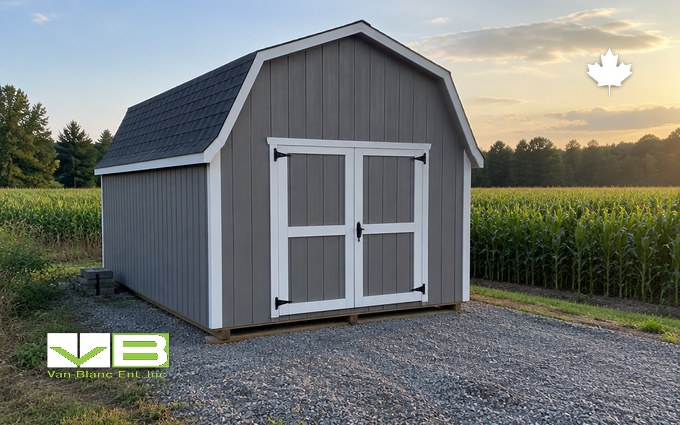
Quick Answer: Amish sheds are stick-built sheds made by Amish and Mennonite shops, true 2 by 4 framing on 16-inch centres, a three-quarter-inch plywood floor on treated skids, hemlock board-and-batten siding and a steel roof. They arrive assembled on a trailer and sit on patio stones or six inches of crushed gravel.
In This Guide
- What “Amish-built” means in Ontario
- Who builds them, and where
- The construction, line by line
- Styles, sizes and the joined-shed trick
- Delivery: the trailer, the crane and the gate
- The base the builders actually ask for
- Amish shed kits versus delivered buildings
- What an Amish shed is genuinely good at
- When it is the wrong building
- The steel alternative, honestly
- The Amish shed buyer’s checklist
- Amish shed FAQs
Reading Time: 13 minutes
What “Amish-built” means in Ontario
An Amish shed is a wood-frame outbuilding built in a shop by an Amish or Old Order Mennonite crew and delivered finished, and in Ontario the phrase describes a building method more than a religion. The method is the one a carpenter would use for a small house: dimensional lumber framing on regular centres, a sheathed and plywood-decked floor on skids, real siding and a real roof, assembled by hand in a shop and moved to the site as one piece. What the label promises is that the building was not stamped out of thin panels in a factory, and what it does not promise is any particular spec, because every shop sets its own. The buyer’s job is to read the spec sheet the way this guide reads them below. We are a shipping container yard in Brantford and we sell a competing building; the Amish shed gets a fair hearing here because it earns one, and the steel box appears near the end for the buyer whose list has outgrown wood, which is also where the wood shed guide’s species and base chapters already send them.
Who builds them, and where
Ontario has its own Amish and Old Order Mennonite country, and the shed shops follow it. The Old Order Amish settlements sit in the farm belt around Milverton, Aylmer, Norwich and Chesley; the Old Order Mennonite country runs north of Waterloo through St. Jacobs, Elmira and up toward Listowel. The shops sell two ways: direct, from a lot beside the shop, and through dealers who display the buildings on a highway lot and take the order. Wagler Mini Barns builds in Aylmer, Mennonite-built since 1974, with seven styles and dealers across southwestern Ontario and the GTA. Amish 1 sells Amish-built hemlock buildings from a Niagara lot in Fonthill. Amish Sheds Inc. sells hemlock board-and-batten buildings across Canada with a Niagara display area. Valley Sheds shows Mennonite-built sheds on a lot in Carleton Place, Kim’s Custom Amish Sheds serves Grey and Bruce counties, and Custom Amish Sheds and Rob’s Amish Built Sheds sell the same format under their own names. What the buyer sees on a dealer lot is a finished building; the price and the spec depend on which shop built it, which is why the delivery area and the shop’s location are the first two questions to ask. The city pages for the Milverton farm belt and Aylmer and the tobacco country south of it describe the same townships from our side of the driveway. The largest dealer brand those shops build for is reviewed on its own in the Old Hickory Buildings write-up. Where those shops sit against the box stores, the steel kits and the fabric spans is charted in the Ontario storage buildings guide.
The construction, line by line
The construction is the reason to buy an Amish shed, so it deserves the whole spec sheet. The floor is the part the buyer never sees and the part that decides the building’s life: treated skids, often 4 by 4 or, at Amish Sheds Inc., 7-inch treated hemlock, with 2 by 4 joists on 16-inch centres and a three-quarter-inch plywood deck. The walls are true-dimensional 2 by 4 lumber, 2 by 6 in the larger buildings, framed on 16-inch centres and sheathed. The siding is where the Ontario shops differ from the American catalogue: the Ontario builders lean on 1-inch hemlock board-and-batten, a species used on barns for centuries that resists carpenter bees and insects, where the American shops sell engineered LP SmartSide panels. The roof is steel on most Ontario builds, in a choice of colours, over sheathing; asphalt shingles are the alternative. Doors are built, hung and lockable; windows slide and carry screens. The lumber is the difference the buyer can measure in the lot with a tape, and the cost drivers for a built shed against a box start with exactly that measurement.
| Element | What Ontario Amish and Mennonite shops build | What a bargain kit ships | What to check on the lot |
|---|---|---|---|
| Skids and joists | Treated skids, 2 by 4 joists at 16 inches | 2 by 3 or metal runners, wider spacing | Crawl under the edge; count the joists |
| Floor deck | 3/4-inch plywood | OSB, often thinner | Jump on it in the middle |
| Wall framing | True 2 by 4 or 2 by 6 at 16 inches | 2 by 3 at 24 inches, or panels | Open the door and look at a stud |
| Siding | 1-inch hemlock board-and-batten; some LP SmartSide | Thin panel siding | Knock on it; hemlock sounds like a barn |
| Roof | Steel over sheathing, or shingles | Thin steel or roll roofing | Ask for the sheathing thickness under the steel |
| Doors and windows | Built doors, lockable; sliding windows with screens | Panel doors with a hasp | Swing the door twice; a good one closes on the second swing |
| Anchoring | Self-supporting; the Ontario shops say no anchoring is needed | Anchoring required by the warranty | Ask what the warranty requires; the resin warranties tie coverage to anchoring |
Styles, sizes and the joined-shed trick
The Ontario shops sell the same handful of roof styles under slightly different names: the barn or Dutch barn with its gambrel roof and loft, the A-frame or gable, the saltbox, the slant or lean-to, and the cottage with a porch. Sizes run from a 6 by 8 garden shed to buildings 11 or 12 feet wide and up to 30 feet long, the width being set by the trailer that has to carry the finished building down a public road. The joined-shed trick gets around the road: Amish 1, for one, joins two 11 by 30 buildings on site into a 22 by 30 footprint, which is a garage-sized building delivered in two halves. Playhouses, bunkies, pool houses, workshops and even bus shelters and fishing huts are the same frame with different openings, which is why the bunkie guide’s kit-and-prefab chapter and the she-shed piece both run into the same shops. A buyer choosing style should choose loft or no loft first, because the gambrel roof is the one that turns a shed into two floors of storage and it is the reason the barn style outsells the rest on farm lots.
Delivery: the trailer, the crane and the gate
An Amish shed arrives finished on a trailer, and the trailer is the constraint that decides whether the building you liked on the lot can reach the spot you have for it. The path from the road to the pad has to be wide enough for a building up to 12 feet across and tall enough under wires and branches for a gambrel roof, with ground the truck will not sink into. Where the path fails, the Ontario shops offer a crane: Amish Sheds Inc. lists crane delivery for properties without truck access, which is the same answer a container delivery uses when the driveway is the problem. The shops also pause building over winter and resume in spring, so a shed ordered in November is a spring delivery, and a shed on the lot in August is the one that lands in September. Ask two questions before paying: what the widest point of the loaded trailer is, and who is responsible if the building does not fit through the gate.
Paul LeBlanc, Van Blanc Ent. Inc.: “The Mennonite shops build a better shed than most of the catalogue, and I tell people that. The buyers I see afterward are the ones whose list changed: the quad, the trailer, the business stock. That is a different building, and it should be.”
The base the builders actually ask for
The Ontario builders are relaxed about the base in a way the resin catalogue is not. Amish Sheds Inc. states that its buildings are self-supporting and need no anchoring, and that they install on a few patio stones or on a six-inch bed of three-quarter-inch crushed gravel, with no concrete pad required. That is possible because the building has a real skid floor that spreads the load and a frame that holds itself square. It is not a licence to skip the base. A skid shed on a gravel bed that is not level racks over its first winter, the door stops meeting the jamb, and the plywood deck takes water at the low corner; the base should be level, drained, and slightly bigger than the building so the skids never sit in a puddle. The compacted-stone pad we spec for a container is the same pad, and the frost-line notes in the site-prep hub explain why a pad on Ontario clay wants to be proud of the grade around it.
Patio stones or gravel
Patio stones under the skids are the quick base and they work on sand and gravel soils. On clay they walk. A six-inch bed of crushed stone in a lumber frame, compacted and levelled, is a weekend’s work and the only base worth doing on a Brant, Oxford or Waterloo County lot that holds water in April.
Amish shed kits versus delivered buildings
“Amish shed kits” is a small search with a real question behind it: can the building come in pieces and go together on site? Some shops sell panelized or pre-cut kits, mostly for sites the trailer cannot reach or for buyers who want to save the delivery, and the American catalogue is full of them. A kit built to the same spec, real lumber on 16-inch centres and a plywood deck, is the same building at the end of the weekend, and it fits through any gate one panel at a time. What it costs is the weekend, the second pair of hands, and the risk that the floor goes down out of square and everything above it follows. The delivered building is the format the Ontario shops are known for, and for most buyers it is the right one; the kit is the answer for the fenced backyard in Guelph or Burlington with a four-foot gate. The container garage write-up makes the same kit-or-delivered call one size up.
What an Amish shed is genuinely good at
An Amish shed is good at being a small wooden building that lasts, and that is not faint praise. Real framing holds shelves, hooks and a workbench anywhere a screw goes, which a resin wall never will. The floor takes a riding mower, a snowblower and a stack of tires without a thought. The gambrel loft holds a season of what the garage no longer can. Hemlock board-and-batten weathers to a grey that suits a farm lane, or takes stain and paint if the house wants it to match. And the building looks like it belongs beside a house, a barn or a cottage, which is the thing a steel box never does without cladding. For a farm lane in Oxford County, a cottage lot on the lake, or a suburban yard where the shed is in view of the kitchen window, it is the right building, and the container yard writing this says so.
The Norwich hobby farm
A 12 by 24 barn-style Amish shed with a loft, on a compacted-stone pad at the end of the lane, holding the mower, the garden tools, the fencing supplies and a winter of loft storage above. Delivered on a trailer in September, stained to match the barn, and still square ten years later because the pad was done first. Nothing on this page argues with that purchase, and the Norwich farm lanes are where we see it most.
When it is the wrong building
An Amish shed is the wrong building the day the contents acquire theft value, the day the width stops mattering and the length starts, and the day the building has to move. A built door with a hasp and a padlock is a door a cordless grinder opens in a minute, and a wood wall is a wall a reciprocating saw opens in five; a quad, a trailer of tools, a business’s inventory or a season of copper wants steel. A shed that is 12 feet wide and 30 feet long is a big shed; a contractor’s store or a workshop that needs 40 feet of length in one run is a different building. And a wood shed on skids is technically movable and practically not: it takes the same trailer and the same crane to move it as to deliver it, where a container rides a tilt-deck to the next property in an afternoon. The theft-prevention rundown for a steel box is the honest comparison on the first point, and the twenty-year durability math is the honest one on the rest.
List outgrown the shed?
If what goes inside has wheels, a serial number or a resale value, tell us what it is and where the box would sit. We will tell you the size and the grade, and one honest all-in number with a real lead time.
Family-run in Brantford since 1995 · 200+ containers in stock · 4.9★ across 140+ Google reviews · every box graded by a person, walk it before it lands.
The steel alternative, honestly
The steel alternative is a used shipping container, and the honest comparison is short because the two buildings are good at different things. A container is Corten steel with doors that crossed an ocean, it locks behind a welded shroud over the padlock, it arrives on a tilt-deck in one to three days from our four Brantford yards, and it sits on the same crushed-stone pad the Amish shed does with no anchoring clause in any warranty. It is 8 feet wide, which is narrower than a 12-foot shed, and 20 or 40 feet long, which is longer than any shed the trailer can carry; the twenty-footer that replaces a 10 by 16 shed and the forty-foot high cube with a workshop’s headroom are the two the shed buyer compares. It does not look like a barn. Board-and-batten cladding over the steel is the answer when it has to, and it is a real cost that the Amish shed builds in for free.
The grade decision is the one an Amish shed buyer never faces. A wind-and-watertight used box, the most common grade, is a sealed, lockable room with surface rust that a farm lane never minds; a cargo-worthy unit is structurally certified; a one-trip shell is the new steel for a box that will be lined, clad or looked at every day, and the grade ladder read from a shed buyer’s side puts the four in one table. What moves the number is size, grade, any cut-ins and the distance from Brantford, and what moves the quote on a used box is the same list on every quote we write. We sell outright, never rent, and a buyer who wants to spread the cost does it through their own bank. The rows on the ground in Brantford can be walked with Paul or Christian first, and the shed lot in Fonthill or Aylmer can be walked the same week, which is how a buyer with a real list decides.
Worth the drive, both ways
The shed shops are worth the drive to Aylmer, Milverton or Fonthill, and the buyer who walks a lot of finished buildings learns more in an hour than in a week of catalogues. The same is true of a container row. Buyers from Stratford and Perth County, the Mennonite country around Elmira and the Listowel farm lanes drive to the yard on Morton Avenue East for the same reason they drive to a shed lot: to see the thing before paying for it. Worth the drive for unbeatable quality, family customer service with 30 years of experience.
The Amish shed buyer’s checklist
Before you order
- Ask which shop built it and where. The dealer’s lot is not the builder’s shop, and the spec belongs to the builder.
- Read the spec as numbers: joist spacing, deck thickness, stud size and spacing, siding thickness, roof sheathing. A shop that will not give the numbers has given the answer.
- Measure the path from the road to the pad, wide and high, and ask the widest point of the loaded trailer.
- Build the base first: a level, drained bed of compacted crushed stone bigger than the skids, on clay especially.
- Decide loft or no loft before style. The gambrel is the storage roof.
- Write down what goes inside and what it is worth. If the answer includes wheels or a serial number, read the last two sections again before ordering the shed.
An Amish shed chosen that way is a building a family keeps for a generation. It is also a building we happily send people to buy, and the wider comparison of every building a yard can hold is where the buyer whose list is still moving should read next.
Frequently Asked Questions
Are Amish sheds worth the money?
For a wood shed, yes, when the spec matches the label: true 2 by 4 framing on 16-inch centres, a three-quarter-inch plywood floor on treated skids, hemlock or engineered siding and a steel roof. The building holds shelves and a mower and lasts decades on a level base. Read the numbers on the spec sheet rather than the word Amish on the sign.
Where are Amish sheds built in Ontario?
In the Amish and Old Order Mennonite farm belt: Wagler Mini Barns builds in Aylmer, other shops sit around Milverton, Norwich and Chesley and in the Mennonite country north of Waterloo, and dealers display the finished buildings on lots in Fonthill, Carleton Place, Grey and Bruce counties and across the GTA. Ask the dealer which shop built the building on the lot.
What base does an Amish shed need?
The Ontario builders install on patio stones or on a six-inch bed of three-quarter-inch crushed gravel, and say the buildings are self-supporting and need no anchoring or concrete pad. The base still has to be level and drained, slightly larger than the skids, and compacted; on clay soils a framed stone pad beats patio stones, which walk over a winter.
How is an Amish shed delivered?
Finished, on a trailer, with the width of the building set by what the trailer can carry down a road, usually up to about 12 feet. The path from the road to the pad has to be wide and high enough and the ground firm; where it is not, some shops crane the building over. Larger footprints are delivered as two halves joined on site. Shops pause building over winter.
Are Amish shed kits as good as delivered sheds?
A kit built to the same spec is the same building once assembled, and it fits through a narrow gate one panel at a time. It costs a weekend and a second pair of hands, and the floor has to go down level and square or the walls follow it. The delivered building is the format the Ontario shops are known for; the kit suits the fenced suburban yard.
When is a shipping container better than an Amish shed?
When the contents have theft value or the job needs 20 to 40 feet of length in one run, or when the building may have to move. A used container locks behind steel, rides a tilt-deck to the next property, and sits on the same gravel pad. It is 8 feet wide and looks like a container unless clad, which is the honest trade against a 12-foot-wide hemlock building that looks like it belongs.
Sources
- Amish 1. (2026). Custom Quality Amish Built Sheds, Fonthill, Ontario. amish1.ca
- Amish Sheds Inc. (2026). Amish Sheds: hemlock board-and-batten buildings delivered assembled. amishsheds.ca
- Wagler Mini Barns. (2026). Mennonite, quality built sheds and mini barns, Aylmer, Ontario. waglerminibarns.com
- Valley Sheds Inc. (2026). Custom Quality Sheds, Carleton Place. valleysheds.ca
- Kim’s Custom Amish Sheds. (2026). Custom Amish sheds and bunkies, Grey and Bruce County. kimscustomamishsheds.com
- North Country Sheds. (2026). Why Amish Sheds? northcountrysheds.com
Reach Van Blanc in Brantford
We have been supplying shipping containers across Ontario since 1995. Our yard is at 90 Morton Avenue East in Brantford, and we deliver right across the province with payment on the day of delivery. No deposit, no upfront wires, no chase-the-paperwork.
Van Blanc Ent. Inc., 90 Morton Ave E Unit 1B, Brantford, ON N3R 7J7, 519-754-6844 (cell) or 1-888-509-6658 (toll-free).
If the shed lot answered the question, we are glad. If the list has wheels and a serial number on it, call with what goes inside and your postal code, and we will tell you on the spot which boxes are on the ground and when one can land. Worth the drive for unbeatable quality, family customer service with 30 years of experience.