
Quick Answer: A grain bin is engineered crop storage: a corrugated steel cylinder with aeration moving air through the mass, holding corn near 15 percent moisture and cooler than 10 degrees. Containers never replace bins for bulk grain, but they own the farm’s other storage: seed, parts, chemicals under lock, and tools.
In This Guide
- A Bin Is a System, Not a Can
- The Physics of the Pile
- The Storage Calendar
- Reading the Cables
- The Rules Written in Hard Lessons
- Bags, Piles, and the Temporary Tier
- Why a Container Never Holds Bulk Grain
- The Farm Storage Steel Honestly Owns
- The Smallholder’s Version
- The Bin Yard’s Supporting Cast
- Buying the Yard in the Right Order
- Grain Storage FAQs
Reading Time: 12 minutes
A Bin Is a System, Not a Can
From the road, a grain bin reads as the simplest structure in agriculture, a corrugated galvanized cylinder with a cone hat, and that impression is exactly wrong in the way this site enjoys correcting. The working bin is a machine with a building around it: a perforated floor or ducting creating an air plenum beneath the grain, a fan sized to push air up through hundreds of tonnes of resistance, roof vents letting that air escape with the moisture it collected, temperature cables hanging through the mass reporting what the pile is doing in its depths, and unload equipment, hopper cones, sweep augers, engineered to move a material that flows like liquid until the moment it decides not to. The cylinder is just the pressure vessel for a slow, season-long process of keeping a living commodity asleep. Farmers know all this in their bones; this guide exists for the acreage owners, new growers, and curious neighbours who search the term, and for the honest question of where the rest of a farm’s storage, the part that is not grain, actually belongs.
Christian, Van Blanc: “Every fall I deliver boxes into bin yards, and it is always for the same list: seed, parts, tools, oil, the stuff that was living in the drive shed until the drive shed filled. Nobody has ever asked me to put grain in a container twice. The ones who ask once get the honest answer, and then we talk about what the box is actually for.”
The Physics of the Pile
Stored grain is not inert; it respires, it holds moisture, and it hosts every mould and insect that would love a warm damp winter home, so the whole discipline of storage is keeping the pile cold and dry enough that biology stays on pause. The Ontario guidance puts numbers on the pause button: grain held below ten degrees, ideally down in the two-to-five range, with corn going into storage around fifteen percent moisture for a six-month stay and drier still for longer, soybeans a couple of points below that. Aeration is the tool that gets the pile there and holds it, ambient air pushed through when its humidity is low enough to dry rather than dampen, and the operator’s skill is really weather-reading: running fans in the cool dry windows the season offers and keeping them off when the air would deposit more water than it removes. The failure mode is quiet and expensive, a warm wet pocket somewhere mid-pile that moulds, crusts, and spreads, which is why the cables and the weekly checks are not fussiness but the whole game.
The Storage Calendar
The bin’s year runs on a rhythm every grain region shares. Harvest fills it with grain that is usually warmer and wetter than storage wants, so the fall’s work is the cooldown, fans riding the cold dry fronts of October and November until the mass sits at winter temperature. Winter is the quiet season with a checklist: climb, look, smell, pull the temperature readings, because a problem caught in January is a discount and one caught in April is a loss. Spring reverses the vigilance as the sun warms the south wall and the headspace; condensation and crusting want to start where warm air meets cold grain, and the operator manages the warming the way fall managed the cooling. And through all of it, the marketing calendar runs alongside, since the entire economic argument for on-farm storage is the freedom to sell when the price is right rather than when the combine is running, a freedom the bins only deliver if the grain in them stays sound.
The calendar’s most underrated entry is the empty season. The weeks between the last load out and the first load in are when the system gets its physical, floors swept to bare steel, old grain and fines removed from every corner an insect could winter in, fans run to prove they still spin, cables checked, and the empty cylinder inspected for the rust, seam gaps, and door-seal failures that a full bin hides. The operations that skip the empty-season hour pay for it in the fall, because every storage problem is cheaper to find in a bin holding nothing.
Reading the Cables
The monitoring side of grain storage has quietly become one of agriculture’s better technology stories, because the problem suits sensors perfectly: a huge opaque mass whose trouble starts small, deep, and warm. The classic instrument is the temperature cable, hung from the roof through the grain, reporting a vertical profile of the pile at each drop; a hot spot announces itself as one sensor drifting up while its neighbours hold, days or weeks before any smell reaches the hatch. The newer layers stack onto that foundation: moisture cables reading the water the temperature only implies, carbon-dioxide sensors in the headspace catching the breath of mould before the heat shows, and controllers that run the fans automatically when the outside air crosses into a drying window, which turns the operator’s weather-watching into a setpoint. The remote dashboards matter more than they sound like they should, since the difference between checking a phone at breakfast and climbing six bins in a January wind is the difference between monitoring that happens daily and monitoring that happens when convenient. None of it replaces the climb and the smell test entirely, the veterans keep both, but the instrumented yard catches its problems at the discount stage, and over a storage season that is the technology paying for itself.
The Rules Written in Hard Lessons
Grain storage carries one hazard that outweighs every other on this page, and it deserves plain language. Flowing grain behaves like quicksand with a motor behind it: a person standing on a pile while an auger unloads below can be waist-deep in seconds and fully buried in less than a minute, and the grain’s grip makes self-rescue impossible long before it covers a person. The rules the farm-safety bodies repeat every season are absolute rather than advisory. Nobody enters a bin while loading or unloading equipment is running, ever. Augers get locked out, physically prevented from starting, before anyone steps inside. Entry happens with a written procedure, a lifeline, and a person outside who does nothing but watch. Crusted grain gets broken from outside the bin, never by walking on it, because a crust can bridge over a void and a bridge holds until it does not. None of this is dramatic; it is the sober operating culture of an industry that learned these rules at terrible cost and now teaches them to every new pair of boots in the yard.
Outfitting a Bin Yard?
We supply the steel around the grain: sealed, lockable containers for seed, parts, tools, and the supplies a bin yard runs on, delivered into the yard on our own trucks. Real lead time, not a hopeful one. Fast 1-3 day delivery across Ontario from our Brantford yards, cash on delivery.
Van Blanc Ent. Inc. · Brantford, Ontario · Since 1995 · 4.9 stars across 140+ Google reviews · Cash on delivery
Bags, Piles, and the Temporary Tier
Big harvests outrun bin space in the good years, and the industry keeps an honest temporary tier for exactly that overflow. The grain bag is its modern face: a long polyethylene tube laid in the field by a bagger, sealing grain in an oxygen-limited environment that holds quality surprisingly well through a winter, provided the grain went in dry, the site drains, and the wildlife is kept from finding the puncture that undoes the seal. The covered outdoor pile is the tier’s industrial end, an elevator’s move more than a farm’s, engineered with aeration under tarps and a tolerance for shrink that a farm ledger rarely enjoys. What makes the tier honest is its own self-description: temporary, one season, first grain to market in the spring. The trouble starts when temporary quietly becomes permanent, a bag going into a second summer or a pile waiting on a better price, because the temporary tier’s physics were only ever rated for the months it promised. Used as designed, bags in particular have earned their place in Ontario yards, and they are the answer we give the callers who were about to ask a container to do this job.
Why a Container Never Holds Bulk Grain
Because we sell containers into farm country weekly, we owe the question a straight answer: a shipping container is the wrong vessel for bulk grain, completely and permanently, and the reasons are the bin’s features read in reverse. The box has no plenum and no aeration path, so a pile inside it cannot be cooled or conditioned, and grain that cannot be aerated is grain on a countdown. The sealed steel that makes the container magnificent for equipment turns condensation into rain inside a grain load, wetting the top of the pile with the moisture the grain itself breathes out. The geometry refuses to unload, no cone, no sweep, just a floor-level door that a loose pile would bury from inside. And the floor structure was engineered for palletized freight, not for a dense flowing material pressing outward on corrugated walls that, as with burial, were never asked to carry distributed lateral loads. A farmer improvising harvest overflow into a box loses quality by Christmas; the honest overflow answers are grain bags, a neighbour’s empty bin, or commercial elevator space, and every agronomist in the province will say the same.
The Farm Storage Steel Honestly Owns
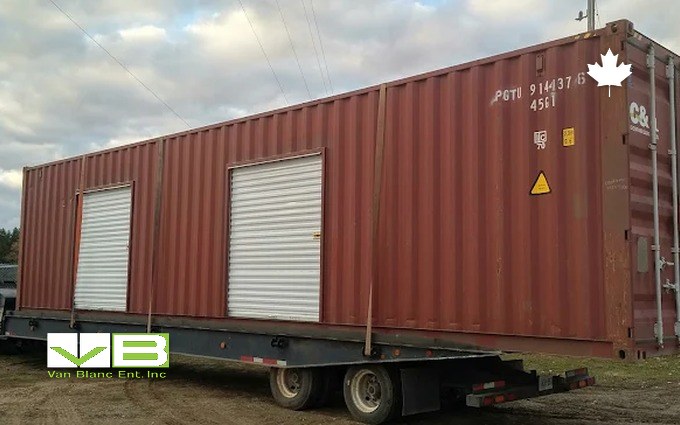
Rule the grain out and the container’s real farm résumé appears, and it is long. Seed is the headline tenant: proboxes and bagged seed wintering in a sealed, rodent-proof room instead of a drive shed with a mouse economy, which is the difference between spring germination and spring surprises. Parts are the second, because a bin yard and its machinery run on belts, bearings, auger flighting, fan motors, and filters, and a shelved forty-footer beside the yard turns breakdown day from a town trip into a ten-minute walk. Crop-protection products belong behind a real lock in a ventilated space, and a container with the vents and security hardware from the modification bench’s catalogue does that job to the standard the product labels ask. Then the long tail: oil and filters, shop tools, sweep equipment, tarps, the electric cords and heaters of winter, all the working inventory that otherwise migrates into the post-frame shed the machinery actually needed. The pattern is the one the whole farm already runs on: the bin stores the crop, and the box stores everything that keeps the crop storable. What a crop-protection store needs beyond the vents and the lock, from the curbed floor to the warning sign, is set out in the vent, curb and sign figures for a pesticide store.
Many people call us saying they can get a bin for $1,000 less on Facebook. Two weeks later some of them call back to say they got scammed. Farm country gets targeted hard in the fall, when the pressure is real and the daylight is short, and the defence never changes: inspect in person, pay on delivery, and buy from a yard you can drive to in January.
The Smallholder’s Version
Not every grain question comes from a thousand-acre operation, and the smallholder’s version deserves its own honest answer because it is the one our own customers ask most. The hobby farm buying feed grain by the tote or the bag, for the horses, the laying flock, the pigs of a freezer project, is not storing a commodity; it is storing feed, in quantities where the bulk-bin physics never enter the picture, and its enemies are humbler: mice, raccoons, damp, and the slow staling of feed bought too far ahead. At that scale the answers invert cheerfully. Sealed metal cans and heavy totes beat any structure’s ambient conditions; feed bought on a rhythm beats feed stockpiled; and a container earns its keep as the room around the cans, rodent-proof in a way no wooden feed shed ever managed, dry through the spring melt, and lockable against the feed’s second-order thieves, the ones with hands. The one physics rule that survives the scale change is moisture: feed grain wants the same dryness the elevators demand, so the cans stay off the floor on pallets, the lids seal, and the year’s humid weeks get the same respect the big yards give them. Everything else about the smallholder’s version is easier, which is a pleasant thing to be able to tell a caller.
The Bin Yard’s Supporting Cast
A working bin yard is a small industrial site, and its supporting cast decides how smoothly the season runs. Power leads the list, since fans, dryers, and unload motors make the yard one of the farm’s hungriest circuits, and the electricians who serve grain country size and certify that service as a specialty. The dryer, where the operation runs one, is its own discipline with its own fuel supply and its own respect. Handling equipment, augers, conveyors, the grain cart’s staging routes, wants a yard layout planned for the truck turning circle rather than hoped around it. And the human infrastructure matters as much: lighting for the 2 a.m. fan check, a heated corner for the monitor screens and the coffee, and storage close enough that the tool the job needs is never a field away. It is the same lesson every working property on this site teaches, that the headline structure only performs as well as the unglamorous logistics around it, and the yards that run calmest planned the supporting cast on the same drawing as the bins.
Site drainage belongs on that same drawing, and it is the quiet difference between a yard and a mire. Bins concentrate enormous roof area into a small footprint, trucks arrive heaviest in the wettest weeks of fall, and a yard graded casually turns its own traffic into ruts that freeze into January’s washboard. The good yards are built like the loads they carry, packed granular bases crowned to shed water, with the container pad, the dryer, and the approach lanes all draining to the same plan, and the payoff arrives every harvest in the plainest currency farming has: trucks that keep moving.
Buying the Yard in the Right Order
| Need | The honest vessel | Why |
|---|---|---|
| Bulk grain | Engineered bin with aeration | The crop must breathe, cool, and unload |
| Harvest overflow | Grain bags or elevator space | Temporary volume without faking a bin |
| Seed, parts, tools, inputs | Sealed lockable container | Dry, rodent-proof, secure, movable |
| Machinery | Post-frame or steel building | Span and height the equipment demands |
The order of operations follows the money the crop earns: bins and their systems first, because they protect the revenue itself; the machinery roof second, because iron ages fastest in the weather; and the container tier third, arriving cheap and instant to absorb everything the first two categories displaced. Permits are managed by your municipality, so check with your local building or planning department before you order, and the bin dealers and millwrights who put up grain systems handle their own engineering as a matter of course. The box needs none of that ceremony, a pad of packed gravel at the yard’s edge and a delivery truck, which is exactly why it slots in last and works from the first morning.
The grain bin earns its place at the centre of the yard by doing a job no other structure can fake: keeping a living crop asleep through an Ontario winter. Respect the physics, run the fans on the right days, follow the entry rules to the letter, and give everything that is not grain a home built for what it actually is. The bins hold the harvest. The steel around them holds the operation.
Grain Storage FAQs
What moisture and temperature should stored grain hold?
Ontario guidance runs corn near 15 percent moisture for storage up to six months and drier for longer holds, soybeans a couple of points lower, with the whole mass kept below 10 degrees and ideally in the two-to-five range. Aeration fans hit those targets by running in the season’s cool, dry weather windows.
Can you store grain in a shipping container?
No, and we sell containers for a living. A box has no aeration path, so the pile cannot be cooled or conditioned; sealed steel turns the grain’s own moisture into interior rain; and the geometry cannot unload a flowing material. Honest overflow answers are grain bags, borrowed bin space, or the elevator.
What are the cardinal grain bin safety rules?
Never enter a bin while loading or unloading equipment runs; lock out augers before any entry; enter only with a written procedure, a lifeline, and a watcher outside; and break crusts from outside, never by walking the pile. Flowing grain buries a person in under a minute, so the rules are absolute.
Why do farms store grain instead of selling at harvest?
Marketing freedom: on-farm storage lets the crop sell when prices favour the seller rather than when the combine forces the sale, and it keeps harvest moving when elevator lines stretch. The freedom only pays if the grain stays sound, which is why the aeration and monitoring disciplines are the storage economics.
What farm storage does a container handle best?
Everything around the grain: bagged and boxed seed in rodent-proof dry, the parts inventory that keeps fans and augers alive, crop-protection products ventilated behind a real lock, and the tool-and-supply tail of the whole yard. It arrives on a gravel pad in days and works from the first morning.
Sources
- Government of Ontario. (2026). Grain Aeration. ontario.ca. The province’s aeration, moisture, and temperature guidance
- Ontario Grain Farmer. (2024). Managing Stored Grain. ontariograinfarmer.ca. Storage temperature targets and monitoring practice in Ontario
- Ontario Grain Farmer. (2019). Maintaining What’s in the Bin. ontariograinfarmer.ca. The season-long checking and conditioning routine
- Iowa State University Extension. (2025). Grain Safety Shorts: Aeration. crops.extension.iastate.edu. Aeration practice and the safety culture around stored grain
Reach Van Blanc in Brantford
We have trucked steel into Ontario farm country since 1995, and the bin yards taught us our place in them: everything but the grain. If this season’s yard needs its parts room, seed room, or locked input storage, the rows at 90 Morton Avenue East are an easy detour off the 403.
Van Blanc Ent. Inc., 90 Morton Ave E Unit 1B, Brantford, ON N3R 7J7, 519-754-6844
Planning fall storage? Call with the list of what needs a home.