
We sell containers. We do not rent.
Van Blanc sells shipping containers outright. We do not rent, we do not lease, and we do not offer rent-to-own. Renting comes up on this page because buyers compare it against owning, and that comparison is worth reading, but purchase is the only arrangement we offer. Stocked units deliver from our Brantford yards in 1 to 3 days. Request a sale quote or call the yard at 519-754-6844.
Quick Answer: Van Blanc sells 20ft and 40ft storage containers across Burlington, from Aldershot to Kilbride, delivered from our 4 Brantford yards. Every quote states a real lead time, not a hopeful one. Sea cans for inward renovations, downsizing seasons, festival kit, and the escarpment properties above the brow.
On This Page
- A City That Finished Building
- What Arrives When You Rent
- Growing Inward: The Renovation Economy
- The Downsizing Decade
- Above the Brow: Kilbride and the Rural Fringe
- Festival Season on the Waterfront
- The Storage Math of a Finished City
- The Commercial Layer, Briefly
- Sizes Against Burlington Duties
- One of Our Shortest QEW Runs
- Four Grades, Stated Before the Truck Rolls
- What Sets a Burlington Number
- Burlington FAQs
Reading Time: 13 minutes
A City That Finished Building
Burlington did something almost no Ontario city has managed: it ran out of room on purpose. Pinched between the lake and the protected escarpment, with the greenbelt holding the line above Dundas Street, the city essentially completed its outward growth years ago. What is left is one of the province’s most settled, most finished cities, which sounds like the end of a story and is actually the beginning of a storage one.
How it got here is worth one paragraph, because the constraint is the character. Burlington grew up as orchard and market-garden country between the lake and the rock, boomed with the QEW generation, and then watched its own boundaries harden: the escarpment won protection, the greenbelt drew its line, and the city chose to stay a city rather than sprawl into its own farmland. The result is scarcity by design, and scarcity by design is a storage market.
A city that cannot build outward grows inward. Houses get renovated instead of replaced, basements become suites, garages become gyms, and every one of those projects displaces a household’s contents into a space that does not exist, because the city is finished. An owned storage container is the space that arrives in a day and stays as long as the house needs it: a full-size steel sea can from our 4 Brantford yards, on the driveway, under your lock, bought once. In a built-out city, it is the only square footage anyone can still add in a day, and it sells on when the house finally has room again.
Paul LeBlanc, Owner: “Burlington was one of the first GTA-edge cities where I noticed the calls change. Nobody is building a bigger garage; there is nowhere to put one. They renovate what they have, and the container is the pressure valve. It shows up, the house exhales into it for a season, and then it becomes the shed. Thirty years in containers and that pattern only gets stronger there.”
What Arrives When You Rent a Storage Container in Burlington
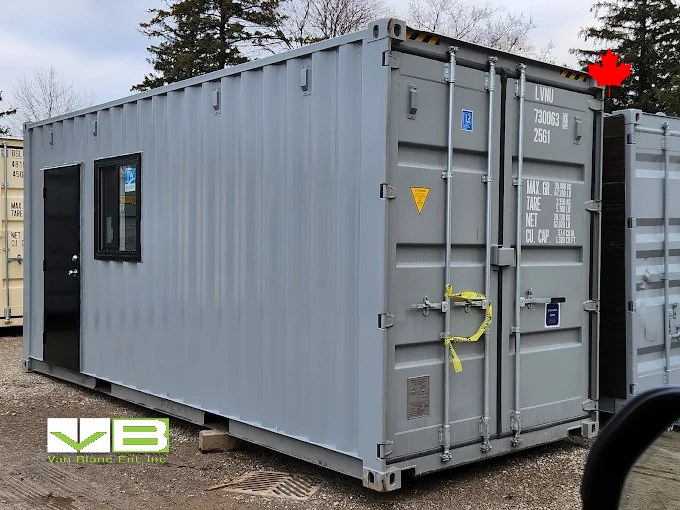
What people search as a storage container rental is a full-size steel shipping container, 8 feet wide, placed on your Burlington property as private, lockable, weathertight storage. Van Blanc sells it and delivers it down the 403 from Brantford on a tilt-deck; we do not rent, so the box is yours from the day it lands. Sea can, c-can, storage bin: one box, your padlock.
Units ship wind and watertight or better on every Burlington order: sealed doors, sound roof, rodent-proof. The 20ft covers renovations and seasonal duties at roughly 33 cubic metres; the 40ft and high cube take whole households and commercial stock at 67 to 76. How renting from a fleet operator compares with owning one of ours is set out on the page where renting meets owning, and multi-site businesses run the same box as portable storage stationed on their own ground. Contents insurance rides your own policy, the lockbox upgrade earns its keep wherever tools sleep, and unit condition is documented before drop-off so you know exactly what you bought.
Growing Inward: The Renovation Economy
Burlington’s renovation market is what happens when a prosperous city’s entire housing stock passes thirty at the same time. The ranches and side-splits of Aldershot and Shoreacres, the 80s crescents of Headon Forest and Millcroft, and the lakeshore streets that predate everything are all being reworked simultaneously: kitchens, additions, basement suites, and the once-a-generation full gut. Every project runs the same logistics: the house’s contents need somewhere to wait, and the trades need the rooms empty.
The container earns its driveway space twice per project, holding the furniture within reach and staging the materials dry beside the work. Owning the box absorbs the schedule slips renovations are built from, and the box goes to the back of the lot the week the final inspection passes. On the tighter lakeshore streets, placement runs beside the house more often than at the curb, and the two photos we ask for with every quote settle it before anything is booked.
The addition wave adds a second rhythm. When a finished city wants more house, it builds up or back, and an addition project displaces more than furniture: it displaces a garage, because the garage becomes the staging ground for the build. The container takes the garage’s whole job for the duration, cars excepted, and hands it back when the addition closes in, then keeps the seasonal gear the new garage was never going to hold. Contractors working Burlington’s addition market increasingly write the container into their own site plan, one per project, because a clear garage and a dry material cache shorten every build they touch.
Use Case: The Shoreacres Side-Split, Round Two
A family renovating a side-split for the second time in twenty years took a 20ft in May: main-floor furniture in the front half, new flooring and cabinetry staged in the back. The job grew a powder room mid-project, the box simply stayed the extra five weeks, and the driveway hosted the whole operation without a single locker trip. Their neighbour ordered the same unit class for September before our truck had left the street.
The Downsizing Decade
Finished cities age gracefully but they do age, and Burlington is deep in its downsizing decade: long-tenured households trading big lots for condos, estates being settled with care, and forty years of accumulation meeting a moving date. The container has become the humane tool for that transition. It lands at the family home, absorbs the sort-later volume, and gives everyone a season to make good decisions instead of a weekend to make rushed ones.
The rhythm we see weekly: the house sells, the essentials move to the new address, and the container holds the rest, the workshop, the seasonal life, the boxes of history, while the family works through it at human speed. Some of it goes to the kids, some to donation, and the box sells on or goes with the workshop when the sorting is truly done. Owning it means nobody is racing a locker invoice through their parents’ basement; the downsizing timelines get the room they need.
The condo end of the same move deserves the caveat: a tower on Lakeshore or beside a GO station has no ground to lend a container, and our comparison of a locker facility or a small portable box against a container covers that case. Where the container wins the downsizing story is at the house being emptied, which is where the volume actually is; the box works the departure end of the move, and the arrival end mostly needs a good elevator booking.
Above the Brow: Kilbride and the Rural Fringe
North of Dundas the city changes costume entirely: Kilbride, Lowville, and the escarpment concessions run rural lives inside city limits, with hobby farms, horse properties, and the long laneways that come with them. Storage up here works on farm logic, equipment between seasons, feed and supplies kept dry, a 40ft on gravel beside the barn that is already full, and it is the corner of Burlington where buying wins by the widest margin, because the duty never ends.
Delivery on the brow is real planning: laneway grades, soft spring shoulders, and tree canopies that own the route. Photos settle most of it in advance, and the answer on a marginal lane is occasionally a placement at the road or a smaller unit, said before the truck rolls rather than discovered after.
The equestrian layer deserves its own sentence, because Burlington’s brow country keeps more horses than most people guess. Barns fill with hay and bedding on their own schedule, tack and show equipment want clean, dry, rodent-sealed space year-round, and a 20ft beside the barn has become the standard answer at farms that show through the season. It is quiet, it is lockable, and unlike the barn it never has a mouse problem.
Price a Burlington Container
Tell us the size, the grade, and your postal code, and an all-in number comes back, usually the same day. Faster: call the yard, describe the driveway or the laneway, and we will confirm placement and the delivery day in one conversation.
Family-run from Brantford since 1995 · 4.9 stars across 140+ Google reviews · Real lead times, stated in the quote
Placement Notes Between the Lake and the Ridge
Three Burlington patterns repeat: mature-canopy streets in the south where the approach photo decides everything, tight lakeshore lots where the box lives beside the house rather than in front of it, and brow properties where laneway grade and spring softness set the calendar. All three resolve from two photos and a call before booking, which is exactly when placement questions should be resolved.
Festival Season on the Waterfront
Burlington’s waterfront runs one of the busier civic calendars on the lake: the Sound of Music Festival filling Spencer Smith Park in June, Canada Day, ribfests, and a winter lights season that takes real infrastructure. Behind every one of those weekends is an organization caching staging, fencing, signage, and vendor kit between events, and steel is how the smart ones do it: a 20ft or 40ft owned and parked near the site, at a fraction of year-round hall storage.
The hospitality strip that feeds off that calendar runs the retail version, patio seasons and holiday services staged in a box behind the restaurant, paid for once and used every season. The pattern compounds: a sea can that caches festival fencing in June often holds a Brant Street shop’s holiday stock in November, the same box doing a second job for the same owner in a different season.
The Storage Math of a Finished City
Scarcity shows up in Burlington’s numbers before it shows up in anyone’s driveway. Commercial and industrial space in a built-out city rents at a premium and rarely sits vacant, self-storage facilities run full because they cannot expand either, and the waiting lists tell the same story the greenbelt map does: the square footage that exists is all there is going to be. Every business bulge and household transition competes for the same fixed supply of walls.
An owned sea can sidesteps the whole competition by adding space in the one place the city still has it: your own property. It costs one cheque instead of a lease, occupies ground you already control, and holds its value when the season ends. In a city where permanent square footage is spoken for, a box you own is the only rational product left, and the math of owning against leasing is why enough of Burlington figured that out years ago.
Use Case: The Festival Vendor’s Shoulder Season
A food vendor working the waterfront circuit runs a 20ft from May to October behind their commissary: booth, canopies, signage, and the service kit that only exists during festival season. November through April the box sits in the same corner holding the canopies, and the bill is zero because there is no bill. Three summers in, the vendor has never once paid winter rent on summer equipment, and the container kiosk is the next step they are pricing.
The Commercial Layer, Briefly
Burlington’s industrial parks along the QEW corridor run the classic overflow duty, and we keep the full walkthrough in the Burlington commercial warehouse guide. The lakefront’s boating layer, clubs, marinas, and the households that serve them, has its own dedicated page at the Burlington marine storage service. Both duties run on the same yard stock and per-order quote as everything on this page; the short version is that commercial Burlington orders multi-unit and boating Burlington orders by the haul-out calendar.
Sizes Against Burlington Duties
| Size | External dimensions | Capacity | Typical Burlington duty |
|---|---|---|---|
| 20ft dry | 6.06m x 2.44m x 2.59m | ~33 m³ | Renovations, downsizing seasons, festival kit |
| 40ft dry | 12.19m x 2.44m x 2.59m | ~67 m³ | Whole households, escarpment equipment |
| 40ft high cube | 12.19m x 2.44m x 2.90m | ~76 m³ | Palletized commercial overflow |
| 20ft reefer | 6.06m x 2.44m x 2.59m | ~28 m³ | Hospitality and event cold storage |
One of Our Shortest QEW Runs
Burlington sits barely 50 kilometres from the Brantford yards, straight down the 403 to the QEW split, which makes it one of the shortest freight legs on our whole map. Deliveries live comfortably inside the standard 1-3 day window, often at the early end, the quote states the actual day, and the driver calls ahead. Burlington drops batch constantly with Hamilton, Oakville, and Waterdown runs, so even the freight-sharing trick barely matters here: the truck is practically in the neighbourhood already.
Placement needs are the standard pair: firm ground and roughly 60 feet of straight approach for a 20ft. The mature-tree streets of south Burlington occasionally add a canopy question, which the approach photo answers before booking.

Four Grades, Stated Before the Truck Rolls
Condition runs the same four-step ladder here as everywhere, and every caller hears all four: one-trip, essentially new off one crossing, the pick for visible placements; cargo worthy, still shipping-certified under honest wear; wind and watertight, the storage workhorse, sealed and dry on lapsed papers; and as-is, cheap steel with structural questions. Orders ship WWT minimum, cargo worthy when stock allows, and the grade is stated in the quote where it belongs.
What Sets a Burlington Number
Size, grade, one of the shortest freight legs we run, and yard stock that week. One all-in figure comes back with the delivery day inside it, and the invoice matches the quote. Burlington’s crunch weeks follow the boating calendar and the fall market; a week’s head start in either buys the pick of the rows. Fastest path is the phone at 519-754-6844; in writing, size, grade, and postal code through the contact page brings the number the same business day, most days. If the cash needs spreading, your own bank’s equipment loan does it against a box you own from day one.
A finished city still has unfinished seasons. The box arrives for exactly those, and is still there for the next one: that has been the whole idea since 1995.
Burlington Storage Container FAQs
How quickly can a container land in Burlington?
Burlington is one of our shortest runs, barely 50 kilometres down the 403, so deliveries sit at the early end of the standard 1-3 day window. The quote states the actual day, and the driver calls an hour out.
Can a container fit on a mature south-Burlington street?
Usually, with the canopy being the real question: old trees own some approaches. Two photos with the quote, the driveway and the approach, settle placement before booking, and the answer is occasionally beside the house rather than at the curb.
Is a container useful for downsizing a long-held home?
It is the humane way to do it: the box absorbs the sort-later volume at the house and gives the family a season to decide well instead of a weekend to decide fast. Because the box is owned, the sorting takes the time it needs, and the container sells on or goes with the workshop afterward.
Do you deliver above the escarpment to Kilbride and Lowville?
Regularly. Laneway grade, spring softness, and tree cover are the real variables, which photos answer in advance. Where a lane is marginal the options are a road placement or a smaller unit, said before the truck rolls.
What decides a Burlington container’s price?
Size, grade, a short freight leg, and yard stock that week, quoted fresh as one all-in figure with the delivery day stated; every container is sold outright. Posted rates age badly, so the number arrives with your postal code, usually the same business day.
Can I buy a Burlington container outright?
That is the only way we sell them: outright, with no rental, lease, or rent-to-own. If the cash needs spreading, an equipment loan through your own bank or financer does it against a box you already own, and the yard runs that math with you.
Does a container work for horse farms and tack storage?
Very well: dry, lockable, and sealed against the rodents every barn fights. Hay-adjacent farms use a 20ft for tack, show equipment, and feed-room overflow, keeping the barn for the horses. Laneway photos with the quote settle delivery before booking.
Sources
- City of Burlington. (2026). Official plan, growth framework, and community profile. City of Burlington site
- Niagara Escarpment Commission. (2025). The Niagara Escarpment Plan. the Niagara Escarpment Commission
- Halton Region. (2025). Growth and demographic data. Halton Region data
- International Organization for Standardization. (2022). ISO 6346:2022, Freight containers, Coding, identification and marking. ISO 6346:2022 reference
Reach Van Blanc in Brantford
We have been supplying shipping containers across Ontario since 1995. Our warehouse is at 90 Morton Avenue E in Brantford, and we deliver right across the province with all-in quotes and real lead times.
Van Blanc Ent. Inc., 90 Morton Ave E Unit 1B, Brantford, ON N3R 7J7, +1 888-509-6658
Renovation, downsizing season, or a laneway above the brow: the box can be on Burlington ground within days, with the day stated plainly. Call the yard and we will put a number on it.