
Last updated: June 20, 2026
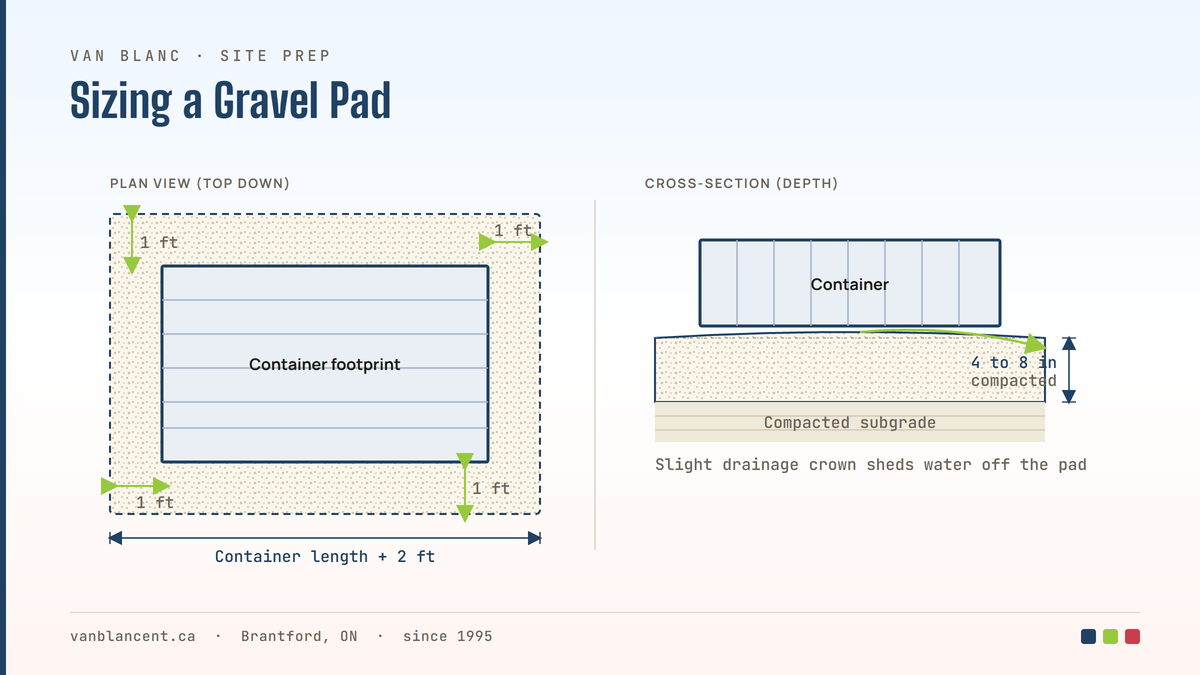
Quick answer. Build the gravel pad about one foot larger than the container on every side: a 20ft (6.06m) box wants a pad near 22ft by 10ft, a 40ft (12.19m) box near 42ft by 10ft. Use 4 to 8 inches of compacted 3/4-inch (19mm) angular crushed stone, crowned slightly for drainage, and level it to within roughly an inch end to end so the doors stay plumb.
In This Guide
- What size gravel pad do you need for a shipping container?
- How level does the ground need to be?
- Which gravel should you use, and which should you avoid?
- How deep should the pad be, and how do you compact it?
- Why does the pad need a drainage crown?
- Will the ground hold the truck that delivers the container?
- How much access does the delivery truck need?
- Frequently asked questions
Reading Time: 8 minutes
What size gravel pad do you need for a shipping container?
A gravel pad for a shipping container should be about one foot larger than the container on every side, built from 4 to 8 inches of compacted angular crushed stone. A 20ft box wants a pad near 22ft by 10ft, and a 40ft box near 42ft by 10ft. The extra apron lets the corner castings land on firm stone. The shed builders ask for exactly the same pad, and shed foundations in Ontario, base by base puts the gravel pad beside skids, blocks, a slab and piers for a building that is not a container.
A gravel pad for a shipping container should extend about one foot past the container footprint on all four sides, and one to two feet is better where you have the room. A standard 20ft container measures 19’10” by 8’0″ (6.06m by 2.44m) at the base, so a pad in the range of 22ft by 10ft covers it with margin. A 40ft container is 40’0″ by 8’0″ (12.19m by 2.44m), so plan for roughly 42ft by 10ft. The extra apron is not waste. It gives the corner castings firm stone to land on even if placement is an inch or two off, and it keeps the splash zone around the base on gravel instead of mud.
Match the pad to the box you are buying. If you are still deciding on a size, the range of containers we stock at the Brantford yard lays out the footprints side by side so you can size the gravel once and not redo it. A high-cube 40ft (9’6″ tall) has the same footprint as a standard 40ft, so the pad size does not change, only the overhead clearance does. If you are putting two containers side by side, leave at least a couple of feet of gravel between them so water sheds off both walls cleanly and a person can still walk the gap to inspect or paint.
The pad-size rule in one line
Container footprint plus one foot of gravel on every side is the working minimum. For a 20ft (6.06m) container that is about 22ft by 10ft of pad; for a 40ft (12.19m) container, about 42ft by 10ft. Containers carry their entire load on four corner castings roughly six inches square, so the pad does not need to be a parking lot. It needs to be firm and continuous under those four corners and the rails between them.
How level does the ground need to be?
How level does the ground need to be for a shipping container? Level enough that the box does not twist. There is no published code number, but the practical target the trade works to is within about one inch across the full length and across the width. A shipping container is a rigid steel frame, and the doors only swing true when all four corners sit in the same plane. Drop one corner an inch or two and the frame racks slightly: the door leaves stop meeting, the locking bars bind, and a gasket that sealed in the yard now lets in light. The cleaner the doors start out, the more a level pad protects them, which is part of why buyers who want the tightest factory seal look at a fresh one-trip unit that has only made a single loaded voyage and then set it on a pad worth the effort.
This is why level matters more than pretty. You can place a container on a slope, but the pad under it has to bring the four corner points back into plane. Out past about an inch of difference corner to corner, you start fighting the doors. Small corrections are normal and easy: a steel shim or a pressure-treated block under a low corner, raised in fractions of an inch until the door gasket lines up all the way across the opening. Build the pad close, and you only ever need a shim, not a rebuild.
Christian LeBlanc, second-generation operator: “Nine times out of ten, the call about a door that will not latch is a level problem, not a door problem. I grew up around these boxes, traveling to Asia with my dad since I was 15, and the pattern never changes. Get the four corners in one plane on a firm pad and the doors behave for twenty years. Skip it and you are shimming a loaded box every spring.”
Check level before the truck leaves, not after
The cheapest time to correct an out-of-plumb door is while the driver is still on site and the container is fresh on the gravel. Open and close both doors before you sign off. If a leaf binds or the gasket gaps at one corner, that corner is low, and a shim under the casting fixes it in minutes. Catch it a month later and you are jacking a loaded box yourself.
Which gravel should you use, and which should you avoid?
For a shipping container pad, use angular crushed stone, not rounded river rock. Crushed stone has broken faces that lock together under compaction and stay put; round pea gravel and river rock roll under load and never knit into a solid base. Gravel is not the only base buyers ask about, and how it stacks up against railroad ties or timber blocks is its own decision; the standard choice here is 3/4-inch (19mm) clear or crushed stone. In Ontario the equivalent road-base spec is Granular A under OPSS.PROV 1010, a crushed sand-and-stone blend with a minimum of 50% crushed particles and all of it passing the 26.5mm sieve. That is the same material that goes under driveways and roads across the province, and it is exactly what you want under steel.
A layer of geotextile fabric under the stone is cheap insurance. It separates the gravel from the native soil so the stone does not slowly sink and disappear into clay over a few wet seasons. On the heavy clay common around Brantford and across southwestern Ontario, the fabric is the difference between a pad that lasts and one that needs topping up every couple of years. The same pad suits a sea can delivered to a Hamilton lot, from an Ancaster driveway to a bayfront yard.
Here is how the common base materials compare for a stationary container that has to stay level through Ontario freeze-thaw:
| Base material | Stays level under load | Drainage | Frost behaviour | Best for |
|---|---|---|---|---|
| 3/4-inch angular crushed stone (Granular A) | Excellent, faces interlock | Excellent, water percolates through | Resists heave when compacted with fabric | The standard container pad |
| Pea gravel or river rock | Poor, rounded stone rolls under load | Good | Shifts with movement | Not recommended under containers |
| Bare soil or grass | Poor on clay, corners sink | Poor, holds water against the floor | Heaves badly | Short-term placement only |
| Concrete slab or footings | Excellent | Sheds water but can pool at edges | Stable below frost line | Permanent occupied conversions |
Paul LeBlanc, owner: “People want to use the round stone because it looks nice in the yard. It rolls. I have watched a container settle into pea gravel within a season because nothing locks it together. Crushed three-quarter, compacted, with fabric underneath. That is the bin that is still sitting level where we put it twenty years on. I have got 19 years in containers and four decades in trade behind me, and the base is the one thing people skimp on and regret.”
How deep should the pad be, and how do you compact it?
Pad depth for a shipping container runs 4 to 8 inches of compacted crushed stone on firm subsoil, and up to about 12 inches on soft or clay-heavy ground where the base needs to spread the load further. The number that matters is not the loose depth, it is the compacted depth. Loose gravel ruts under a delivery truck and lets the corners settle unevenly later.
Lay the stone in lifts of roughly 4 inches and compact each lift before adding the next. A plate compactor with several passes per lift gives you a base dense enough that a heel barely marks it. The goal is simple to state and worth the rented compactor: a surface that holds a 45,000 lb truck without rutting and holds four loaded corner castings without settling. Loose stone fails both tests.
Farm and acreage sites
On a working farm in Brant, Norfolk, or Oxford County, a hard-packed laneway or an existing compacted yard often already meets the firmness test, and a thinner gravel topping levels it off. The container becomes a feed store, an equipment shelter, or a secure tool cage that sits where you drop it for decades. Most farm buyers set a used wind and watertight box on that kind of pad, because a dry floor and a door that seals are the whole job. The pad spends an afternoon to build and saves you a sinking corner every spring thaw.
Why does the pad need a drainage crown?
A gravel pad needs a drainage crown so water sheds away from the steel floor instead of pooling under it. Build a slight crown or slope into the pad, about 1 to 2 percent, so rain runs off the apron and away from the container. A container floor is marine plywood on steel cross-members, and the cross-members are the part that rusts when they sit in standing water. Gravel drains, which is most of why gravel beats a bare dirt pad. Adding the crown finishes the job: rain hits the roof, runs off the walls onto the gravel apron, and sheds away rather than collecting under the steel.

This is also why the pad extends past the footprint. The one-foot apron is the splash and drainage zone. Water coming off the container walls lands on stone and percolates down, not into a muddy trench right against the base rails. Keep the surrounding grade falling away from the pad, not toward it, and the floor stays dry through Ontario winters.
Why Ontario ground argues for a real pad
Southern Ontario sits on a lot of clay, and clay holds water and heaves with frost. A bare soil placement that looks fine in July can be a soft, shifting mess by April. A compacted crushed-stone pad with fabric underneath drains the meltwater, resists frost movement better than bare ground, and keeps the box level through the freeze-thaw cycle. It is the single best afternoon of prep you can do before delivery, and it is the reason buyers from across the province still drive to our Brantford yard to see the bins before they buy.
Will the ground hold the truck that delivers the container?
Ground bearing is where the pad earns its keep on delivery day. A loaded tilt-deck rig with a container on the deck can weigh well over 45,000 lb, and most of that rides on the rear axle group while the box slides off. The ground does not get tested by the container. It gets tested by the truck, and firm dry stone passes that test while soft, wet, or grassy ground can swallow a wheel before the container ever lands.
Once the container is down, the load story changes. The box funnels its entire weight through four corner castings, each roughly six inches square. At maximum gross a 40ft container puts on the order of 210 lb per square foot through its footprint, concentrated at those four points. A compacted gravel pad spreads that and keeps the corners from punching in. On a Van Blanc delivery, the container lands at ground level straight off the tilt deck, so when access allows there is no crane and no extra lift cost. The pad and the approach are what make that clean drop possible.
Ready to price your container?
Tell us the size, your grade, and your postal code, and we will send back an honest, all-in number, usually the same day, with a real lead time, not a hopeful one. The fastest answer is a call: describe your site over the phone and our crew will tell you on the spot whether your pad and access will work for a tilt-deck drop.
Van Blanc Ent. Inc. / Family-run in Brantford since 1995 / 4.9 stars across 140+ Google reviews / Fast 1-3 day delivery to every region across Ontario
How much access does the delivery truck need?
A perfect pad does nothing if the truck cannot reach it. A tilt-deck delivery needs a roughly straight pull-out behind the drop point so the container can slide off the deck onto the ground, and the room it takes is more than people expect: plan on about 75 to 100 feet of straight clearance for a 20ft container and 120 to 130 feet for a 40ft. The rig needs about 12 feet of width down the approach, and during the tilt-off the raised deck needs roughly 14 to 16 feet of overhead clearance, a bit more for a high-cube. Watch for low branches, hydro lines, eaves, and sign posts along the whole path, not just over the pad.
When site access cannot give the truck that straight run, a HIAB crane lift becomes the way in, setting the box over a fence or into a tight yard. That is real work we do across Ontario, and it is worth a quick conversation before you build the pad so the pad ends up where the truck or the crane can actually reach. For the full picture on grading, frost, and anchoring beyond the pad itself, our deeper walkthrough on getting your site ready for a container, from frost heave to ground conditions covers what happens under and around the gravel.
Frequently Asked Questions
What size gravel pad do I need for a 20ft shipping container?
Plan a pad about one foot larger than the container on every side. A 20ft container is 19’10” by 8’0″ (6.06m by 2.44m), so a pad near 22ft by 10ft works well. Use 4 to 8 inches of compacted 3/4-inch crushed stone. The extra apron gives the corner castings firm stone and keeps drainage off the base.
How level does the ground need to be for a shipping container?
Aim for within about one inch across the full length and width. A container is a rigid frame, so one low corner twists the box and the doors stop sealing. There is no code number, but the trade works to roughly an inch corner to corner, then fine-tunes with steel shims or blocks under a low corner until the door gasket lines up.
Can I use pea gravel or river rock instead of crushed stone?
No. Round pea gravel and river rock roll under load and never lock together, so the corners settle and the box goes out of level. Use angular 3/4-inch (19mm) crushed stone, Granular A in Ontario terms. Its broken faces interlock under compaction and stay put for decades. Round stone is the most common pad mistake we see.
Do I need a concrete slab, or is gravel enough?
For most storage and yard uses, a compacted crushed-stone pad is plenty and drains better than concrete. Gravel sheds water away from the steel floor, costs less, and goes in faster. Concrete or footings make sense for permanent occupied conversions or very soft ground. For a straightforward container drop, a proper gravel pad is the right call. What the concrete alternative actually costs to build, driver by driver, is in the concrete pad cost drivers guide.
How deep should the gravel pad be?
Run 4 to 8 inches of compacted crushed stone on firm subsoil, and up to about 12 inches on soft or clay-heavy ground. Lay it in roughly 4-inch lifts and compact each lift with a plate compactor. A geotextile fabric layer underneath stops the stone migrating into the soil over Ontario’s wet seasons.
Sources
- International Organization for Standardization. (2013). ISO 1496-1:2013, Series 1 freight containers: specification and testing. iso.org
- Government of Ontario / Ministry of Transportation. (2025, updated). OPSS.PROV 1010, Material Specification for Aggregates: Base, Subbase, Select Subgrade, and Backfill. roadauthority.com
- International Maritime Organization. (1972, amended). International Convention for Safe Containers (CSC). imo.org
- Eveon Containers. (2024). Building the Perfect Foundation for a Shipping Container. eveoncontainers.com
- Steed and Evans Limited. (2024). Definitions of Commonly Used Construction Materials (Granular A). steedandevans.ca
Reach Van Blanc in Brantford
We have been supplying shipping containers across Ontario since 1995. Our warehouse is at 90 Morton Avenue E in Brantford, and we deliver right across the province. Tell us about your site and we will tell you straight whether your pad and access are ready for a tilt-deck drop or whether a crane lift is the smarter way in.
Van Blanc Ent. Inc. 90 Morton Ave E Unit 1B, Brantford, ON N3R 7J7. 519-754-6844
Building a pad this week? Call the Brantford yard before you order the stone, and we will help you size it to the exact box you are buying.
Related Reading
- Frost heave and anchoring beyond the pad
- Delivering onto dirt or a lawn
- Clearance the tilt deck needs
- Ties versus blocks versus stone
The pad is an afternoon of work that decides the next twenty years. Get it firm, get it level, crown it for drainage, and the container lands clean and the doors swing true the day it arrives and every day after. When you are ready, call the yard and we will size it with you.