
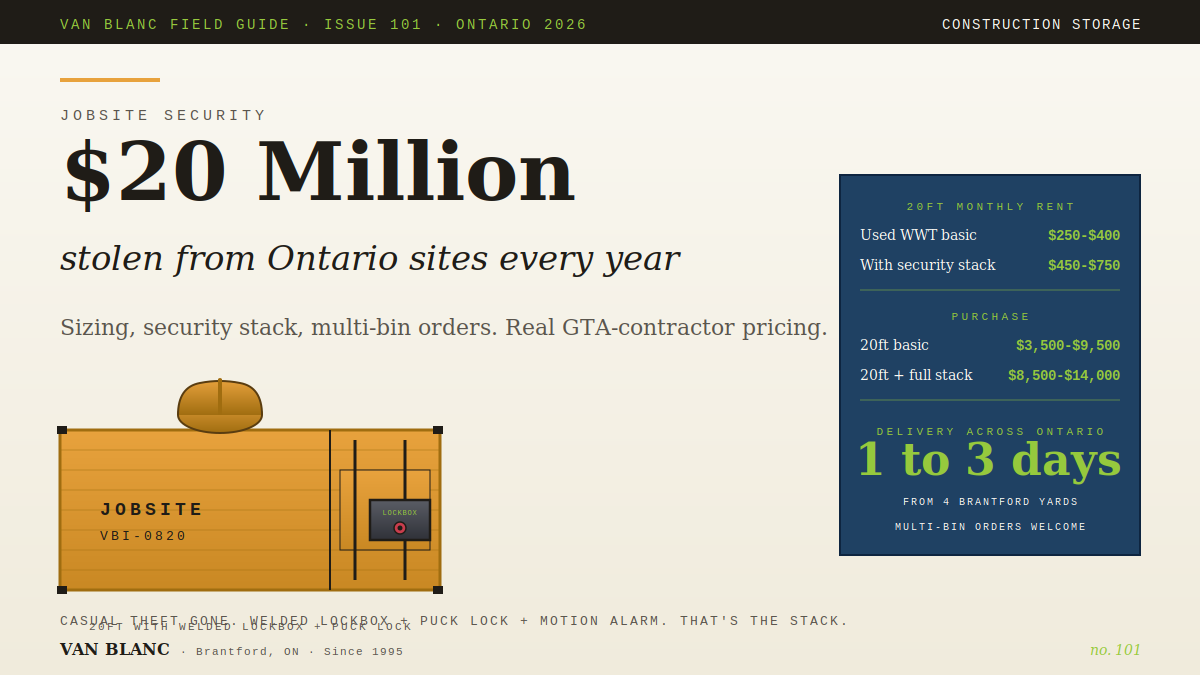
Quick Answer: Ontario construction sites lose millions of dollars in tools and equipment to theft every year, according to Insurance Bureau of Canada and OPP data. A 20-foot shipping container with welded lockbox, puck lock, and motion alarm prevents the majority of unattended-site theft on a unit you own outright. 40-foot containers add space for crew offices, larger equipment, and material kitting. Real lead times and COD-honest pricing, quoted to your specific address: call us at 519-754-6844. 30+ years operating, 4.9 stars on 140+ Google reviews. 1-3 day delivery Ontario-wide from our Brantford yards.
In This Guide
Reading time: about 12 minutes.
How Bad Is Construction Site Theft in Ontario?
Construction site theft in Ontario costs contractors tens of millions of dollars a year, concentrated in overnight and weekend windows when sites sit unattended. A 20-foot steel shipping container with a welded lockbox and a hardened puck lock is the single most effective deterrent, which is why most Ontario jobsites have switched from trailers and tool cribs to containers.
Christian LeBlanc, who runs deliveries to GTA sites most weeks, puts it plainly: “The trailer guys we delivered to ten years ago are container guys now. The week they get hit once, they call us the next morning.” His father Paul founded Van Blanc in 1995 and has watched the jobsite theft pattern repeat for almost two decades in the container trade.
Ontario Provincial Police track tens of millions of dollars in stolen construction equipment across the province every year. That figure is heavy equipment only (excavators, skid steers, generators). Add in stolen tools, materials, and unmonitored small items and the real total is higher. The pattern is consistent across Brampton, Mississauga, Hamilton, the entire 401 corridor, and even rural sites that look like nobody would bother.
Most thefts happen in two windows: overnight (10 PM to 5 AM) and weekend (Friday evening to Monday morning). The vulnerability is the same in both cases. Unattended construction sites have tools, materials, and equipment sitting in trailers, tool cribs, or worse, in the open on pallets. Thieves arrive with bolt cutters, cargo vans, and 20 minutes of work to clear out enough to retire for the night.
Documented Ontario case: thieves cut the perimeter gate lock, drove onto the site, cut the storage trailer lock, and removed power tools plus rented GPS surveying equipment. The total estimated loss ran well into five figures. The contractor’s insurance deductible alone was a significant out-of-pocket hit. The week of project delay from waiting for replacement tools cost even more.
What gets stolen, in approximate order
- Power tools. Cordless drills, impact drivers, saws, grinders. Easy to fence on Kijiji or Facebook Marketplace.
- Copper wire and pipe. A high scrap value per kilogram makes copper a target on electrical and plumbing job sites.
- Generators. Job-site portable generators are highly valued and easily resold.
- Surveying and GPS equipment. Rentals especially; resale market exists.
- Skid steers and small excavators. Take an hour to remove with a flatbed, easily resold privately.
- Job-site fuel. Diesel and gasoline storage tanks; growing target since 2022 fuel prices climbed.
Why Is a Shipping Container Better Than a Tool Crib or Trailer?
A shipping container beats a tool crib or a jobsite trailer because the entire enclosure is welded steel, not plywood or cuttable vinyl, and its factory cargo doors carry four locking points before you add a single upgrade. The comparison below shows how each common storage option stacks up on security, weather resistance, and how often it gets hit.
| Storage type | Security rating | Weather resistance | Setup time | Theft frequency |
|---|---|---|---|---|
| Open pallets, plastic bins | None | Poor (tarps deteriorate) | None | Very high |
| Wooden tool crib, plywood | Low (easily breached with hand tools) | Moderate | 1-2 days to build | High |
| Job-site trailer (factory) | Moderate (vinyl siding cuttable, locks bypassable) | Good when new, declines | 1-2 hours to set up | Moderate |
| 20ft shipping container (basic) | Good (steel walls, cargo door locks) | Excellent | 1-2 hours delivery | Low |
| 20ft shipping container + welded lockbox + puck lock | Very good (multi-layer security) | Excellent | Same delivery | Very low |
| 20ft container + lockbox + alarm + lighting | Excellent (full security stack) | Excellent | Same delivery | Almost zero |
The shipping container is not a magic bullet but it is meaningfully harder to breach than the alternatives most jobsites use. The cargo doors require either bolt cutters that can defeat a hardened lock (rare on a casual thief) or a cutting torch (loud and visible). With the security stack layered properly, container-stored tools are protected at a level approximating commercial-bank security in a jobsite context.
Brantford-yard observation
Christian on the GTA jobsite pattern: “We deliver 20-foot containers to Brampton, Mississauga, and the GTA construction sites almost every week. The contractors who started with us 10 years ago using trailers have all moved to containers. The shift happened in the 2015-2020 window when theft got worse. The container plus lockbox plus alarm is now the GTA standard. Sites that still use trailers usually do it because the trailer is a hand-me-down from another project; new procurement is almost always containers.”
What Size Construction Storage Container Do I Need?
The right construction storage container size comes down to crew size and what you are storing. A 20-foot container is the Ontario jobsite workhorse for a typical 3-to-8-worker crew, a 40-foot suits multi-trade sites or a storage-plus-office split, and a 10-foot fits a single-trade sub or a gate-house station. The table maps each size to its interior space, crew fit, and best use.
| Container size | Interior storage | Crew fit | Typical use | Best for |
|---|---|---|---|---|
| 10ft container | ~75 sq ft, ~600 cu ft | n/a (storage only) | Small site tool storage, gate-house storage | Single-trade subs, security stations |
| 20ft container, basic | ~150 sq ft, ~1,170 cu ft | n/a (storage only) | General contractor tools, materials kitting | Most jobsites, the workhorse size |
| 20ft container, half office split | ~75 sq ft storage + ~75 sq ft office for 2-3 workers | 2-3 workers | Foreman office plus secure tool storage | Small to mid jobsites |
| 40ft container, basic | ~300 sq ft, ~2,400 cu ft | n/a (storage only) | Large equipment, multiple trades, kitting station | Large jobsites, multi-trade general contractors |
| 40ft container, half office split | ~150 sq ft storage + ~150 sq ft office for 4-6 workers | 4-6 workers | Site office plus secure equipment storage | Mid-to-large projects |
| 40HC container | ~330 sq ft, ~2,689 cu ft, 9.5ft ceiling | n/a (storage only) or 4-6 office | Equipment with overhead clearance needs | Premium jobsite storage |
The 20-foot single-purpose storage container is by far the most common Ontario construction site size. It fits a small crew’s worth of tools, materials kitting space, generator storage, and a small workbench for prep work. The 40-foot half-and-half split (storage on one end, office on the other) is the next-most-common configuration for sites with foreman space needs.
How Do You Secure a Construction Site Container?
You secure a construction site container by layering hardware on top of the factory cargo-door locks. Van Blanc recommends the six-layer framework below for unattended jobsite storage, and you add layers based on what is inside the box and the site’s theft risk profile. The first two layers do most of the work; the rest add deterrence and evidence.
- Factory cargo door cam locks. Built into every shipping container. Two locking bars per door, four locking points total. Baseline security. Defeated only with bolt cutters or cutting tools.
- Welded lockbox. Steel cover welded over the cargo door cam lock assembly. Protects the cam lock from being attacked directly. A modest one-time cost to install. Eliminates 80 percent of casual theft attempts.
- Heavy-duty puck lock. Hardened steel puck lock through the lockbox. Resists bolt cutters and most prying. Inexpensive per lock. Use two: one on each cargo door pair.
- Crossbar or horizontal bar lock. Steel bar across both cargo doors with a single lock point in the middle. Adds visible deterrent and physical strength. A small added cost to install.
- Motion-activated alarm and lighting. 12V or 110V alarm with siren plus floodlight triggered by motion within 6-10 metres of the container. A reasonable mid-range investment to install. Wakes up neighbours; sends thieves running.
- Camera with cellular alert. GPS-enabled trail camera or cellular-connected security camera with motion-triggered notifications. The hardware is a one-time cost plus an ongoing monthly cellular service fee. Provides recorded evidence and remote awareness.
The full security stack is a worthwhile investment to install on a single container. For a 20-foot container holding thousands of dollars of tools inside, this is insurance you cannot get from a policy alone. We weld the lockbox, fit the bars, and rough in the alarm wiring at the yard as part of our on-site conversion and security buildout work before the box ever leaves Brantford, and our deeper breakdown of each locking layer walks through the technical detail.
The single security upgrade with the best ROI
Welded lockbox plus heavy-duty puck lock. Combined, they cost a fraction of the full stack. Eliminates the majority of casual jobsite theft because the bolt cutter attack vector is removed and the cam lock is no longer exposed. Skipping this step and relying on the factory cam lock alone is the most common Ontario mistake.
Should a Contractor Rent or Buy a Storage Container?
Van Blanc does not rent; we sell containers outright. The decision turns on project duration, expected reuse and capital, and a box you own keeps its resale value when the job ends. An equipment loan through your own lender covers the cash-flow gap, with the invoice, grade and serial number from us. The lists below answer the usual short-project questions from the owning side, and our rent-versus-own breakdown for Ontario sites carries the full break-even math.
Short projects, answered from the owning side
- Single project under 18 months: the box sells on when the job wraps, or ask us about buyback
- No follow-on projects: a graded container keeps resale value after the last pour
- Cash flow tight: an equipment loan through your own bank spreads the purchase
- Delivery and placement come in one all-in quote, paid on delivery
- Several containers for a short window: buy the set, then sell on or keep them for the next site
Buy makes sense when
- Multi-year project (over 2 years)
- Multiple sites needed sequentially (rotate the same container)
- End-use plan exists (sell, keep for next project, repurpose)
- Capital available; depreciation can be expensed over 5-10 years
- Customer values long-term cost certainty over monthly cash flow
Break-even math for a typical 20ft container
Owning a 20ft container pays back against monthly rental at approximately month 33 (about 2.75 years), accounting for delivery on both ends, and from then on the box costs nothing while a rental keeps billing. Before that point the owner still holds a container with resale value, which a rental never leaves behind. The math is more favorable for general contractors who can rotate a single container across multiple project sites over its 25-year lifespan.
What Drives the Price of a Construction Storage Container?
The price of a construction storage container is driven by five things: the size, the grade (a Wind & Water Tight used unit versus a near-new one-trip), the security buildout, the delivery distance from our Brantford yards, and the season. We publish relative tiers rather than dollar figures because real numbers move with the steel market and your address, and a posted price that is wrong helps nobody. The table ranks the common configurations against a basic used 20-foot baseline.
| Configuration | Relative size | Relative price (basic used = baseline) | Best fit |
|---|---|---|---|
| 10ft used container, basic | ~75 sq ft | Lowest, the entry point | Tight sites; also short-term rental hosts |
| 20ft used (WWT grade), basic | ~150 sq ft | Baseline reference for this list | The most common jobsite size |
| 20ft one-trip, basic | ~150 sq ft | Higher than WWT used (near-new grade) | When appearance and longevity matter |
| 20ft + lockbox + puck lock | ~150 sq ft | Used baseline plus a small security add-on | The standard jobsite spec |
| 20ft + full security stack | ~150 sq ft | Used baseline plus the largest security add-on | High-value tool storage |
| 20ft half-office split | ~75 storage + ~75 office | Above basic 20ft (interior buildout) | Foreman space that moves on to the next project |
| 40ft used, basic | ~300 sq ft | Higher than 20ft (double the footprint) | Multi-trade jobsites |
| 40ft one-trip, basic | ~300 sq ft | Highest among basic units (size plus grade) | Long-term multi-site use |
| 40ft half-office split | ~150 storage + ~150 office | Above basic 40ft (interior buildout) | Site office and storage, reused job to job |
| 40HC, basic | ~330 sq ft, 9.5ft ceiling | Slight premium over standard 40ft | Tall equipment storage |
Most Van Blanc construction site customers choose a 20-foot container with appropriate security, bought outright. The 40-foot office-and-storage hybrid sits at a higher tier and serves larger contractor crews. What moves your actual number is the size, the grade (WWT used versus one-trip), the security buildout, the delivery distance from our Brantford yards, and the season, so every quote is priced to your specific address. If you are weighing grades for the first time, our plain-language walkthrough of inspecting a box before you pay explains what separates a CW unit from a WWT one and why it matters on a jobsite.
How Does Delivery Work on an Active Jobsite?
Delivery to an active jobsite works by tilt-deck drop or HIAB crane placement of the container you buy, and active sites present specific access challenges that a quick site walk solves before the truck arrives. The points below cover the approach room, overhead clearance, pad prep, and timing that keep a delivery from getting cancelled at the gate.
- Tilt-deck delivery requires 60-80 feet of straight approach. Many active jobsites have limited maneuvering room. Pre-confirm tilt-deck access before booking. Some sites require HIAB crane delivery as alternative.
- Overhead obstructions. 14 feet of vertical clearance during tilt-deck unloading. Power lines, scaffolding, and partially-built structures often interfere. Site walk before delivery prevents same-day cancellation.
- Pad preparation. Container needs a stable base. Compacted gravel, concrete pad, or concrete blocks support the load. Active sites with shifting grade may need pad work first.
- Truck arrival timing. Most contractors prefer first-of-day delivery (7-9 AM) so crews can use the container by mid-morning. Late-day delivery delays first use to next morning.
- Multiple-bin orders. Large projects requiring 10-30 containers benefit from staged delivery over 2-3 days. Our guide to how a container reaches your site across Ontario covers the logistics in detail.
Van Blanc’s standard delivery window across Ontario is 1-3 days from order to on-site. Same-day is not promised; 1-3 days is the floor.
How Do Multi-Bin Orders Work for Large Projects?
A multi-bin order is a single project that needs 10 to 30 containers staged across different build phases, common on skyscraper builds, hospital construction, and large industrial sites. Van Blanc has supplied multi-bin orders for projects in the GTA, Hamilton, Niagara, and London corridors. Standard practices for multi-bin work:
- Staggered delivery. Containers arrive in waves of 4-8 per day to avoid jamming up site logistics.
- Pre-modified packages. Standard modifications (lockbox, puck lock pre-installed, paint color matching site standards) handled at the yard before delivery.
- Volume pricing. Multi-unit orders are quoted as one package, containers, delivery and placement together.
- Phase-by-phase planning. As project phases complete and storage needs shrink, the units the contractor owns move on to the next site in waves.
- End-of-project disposition. Either the contractor keeps the units for ongoing use, sells them on, or asks us about buyback.
Christian LeBlanc, second-generation operator: “Large GTA jobsites are where we see the multi-bin orders. A 30-story condo build in Mississauga or a hospital expansion in Hamilton might need 15 to 20 containers across two years. We coordinate delivery in waves, handle the security buildouts, and arrange end-of-project disposition. The contractors who work with us on these large projects usually become repeat customers because the logistics consistency matters more than the per-unit price.”
What Do GTA Contractors Actually Buy?
GTA contractors overwhelmingly buy a 20-foot container with a lockbox and puck lock as their standard jobsite spec. Van Blanc has supplied container storage to Ontario construction sites since 1995, and the buying patterns Christian sees on Brantford yard visits and GTA deliveries break out roughly as follows. If appearance and a 25-year service life matter on a unit that stays visible from the road, contractors step up to a factory-paint one-trip box for sale in Ontario instead of a used grade.
- 55 percent: 20ft one-trip or WWT used, with lockbox and puck lock. The standard jobsite spec.
- 20 percent: 40ft used or one-trip, basic. Larger projects, multi-trade general contractors.
- 10 percent: 20ft with half-office split. Smaller projects needing foreman space plus storage.
- 10 percent: 40ft with half-office split or full office. Mid-to-large projects with formal office needs.
- 5 percent: Multi-container packages (5+ units). Large GTA construction.
Worth the drive to Brantford
Contractors planning multi-bin orders regularly visit the Brantford yards at 90 Morton Avenue East to walk our inventory before committing. You can compare WWT used containers to one-trip premium grade, see what installed lockboxes and security upgrades look like on real bins, and plan multi-unit logistics with us in person. With 200 plus containers in stock you pick the bin and we deliver across Ontario in 1-3 days. Most Ontario container suppliers do not let you choose the specific unit. We do.
Go Deeper: Detailed Topic Guides
For more depth on specific aspects of this topic, see our spoke articles:
More from this cluster
Deeper reads we’ve added since the original guide:
Sold outright. Delivered in 1 to 3 days.
Van Blanc sells new and used shipping containers outright from our 4 Brantford yards, with delivery in 1 to 3 days and payment on delivery. We do not rent, lease or offer rent-to-own. Request a sale quote or call the yard at 519-754-6844.
Frequently asked questions
What size shipping container do I need for a construction site?
20-foot is the workhorse Ontario jobsite size, fitting tools, materials kitting, and a small workbench for a typical crew (3-8 workers). 40-foot suits larger projects with multiple trades or office space needs. 10-foot suits single-trade subs or security stations. Most general contractors land on 20-foot for jobsites.
How much does it cost to rent a construction storage container in Ontario?
Van Blanc does not rent containers; we sell them outright. Rental elsewhere bills monthly by size, configuration and contract length. A purchase from us is one all-in number for the container, delivery and placement: a basic 20-foot used unit is the entry point, a 20-foot with the full security stack costs more, a basic 40-foot is higher again, and a 40-foot half-office is the top of the range, with ESA inspection extra if the unit is an office. Owning pays back against monthly rental in about 33 months. Call us for a sale quote priced to your site.
Are construction site shipping containers theft-resistant?
Significantly more than alternatives. The steel walls are not easily breached without cutting tools. With a welded lockbox over the cargo door cam lock plus a hardened puck lock, casual theft is eliminated. Adding motion-activated alarm and lighting makes overnight theft very rare. The full security stack is an affordable one-time investment relative to the value of the tools it protects.
How much construction equipment is stolen in Ontario each year?
Tens of millions of dollars per year in heavy equipment alone, according to Ontario Provincial Police data. Add stolen tools, materials, and small items and the real total is meaningfully higher. Construction theft is concentrated in the GTA, Hamilton, and 401 corridor but rural sites are also targeted.
Should I rent or buy a construction storage container?
Buying pays for projects over 2 years or multi-site use, and a box bought for a shorter project sells on after it. Break-even on a 20ft container, comparing monthly rental against the one-time purchase price, is approximately 33 months. For general contractors with sequential projects, ownership wins almost every time once a single container has rotated through 2-3 sites.
Can a construction storage container also serve as an office?
Yes, either as a dedicated office (40ft basic or 40HC with full interior buildout) or a half-and-half split (20ft or 40ft with storage on one end and office on the other). Occupied office use requires ESA Special Purpose Equipment certification (SPE-1000-13). Our write-up on getting a container office wired and inspected covers the certification process.
How fast can I get a container delivered to my Ontario construction site?
1 to 3 days standard delivery from our Brantford yards to any Southern Ontario, GTA, Niagara, or Hamilton-area construction site. Ottawa, Kingston and eastern Ontario also run 1 to 3 days. Northern Ontario is quoted per address. Every quote comes with a real lead time, not a hopeful one, and we confirm tilt-deck or crane access for your specific site when we book the drop.
Can I get multiple containers delivered to a large jobsite?
Yes. Van Blanc supplies multi-bin orders (5-30 containers) for large GTA, Hamilton, Niagara, and London projects. Standard practice: staggered delivery in waves of 4-8 per day, pre-modified at our yard with security packages installed, volume pricing on multi-unit orders. Contact our yard for multi-bin quoting.
What is the best lock for a construction site shipping container?
A welded lockbox (steel cover over the cam lock assembly) combined with a hardened puck lock through the lockbox. This two-layer approach defeats bolt cutters and prevents direct attack on the factory cam lock. Add a horizontal bar lock for visible deterrent and motion-activated alarm and lighting for overnight protection.
Are used shipping containers acceptable for construction site storage?
Yes. Wind & Water Tight (WWT) grade used containers are the cost-effective standard for construction storage. Cosmetic patina is acceptable on a jobsite; structural integrity is what matters. Our checklist for checking a used unit over before you pay covers grade selection for non-occupied storage.
Do construction site containers need to be anchored?
Recommended for sites in tornado corridors or near Great Lakes shorelines. For typical urban jobsites with surrounding buildings as windbreak, anchoring is often skipped without consequence. Our notes on tying a box down against wind cover helical anchor and twist lock options.
Sources
- Ontario Provincial Police. (2024). Construction Equipment Theft Statistics, Annual Report Ontario. opp.ca
- Insurance Bureau of Canada. (2024). Construction Site Theft Trends and Prevention Strategies for Canadian Contractors. ibc.ca
- International Organization for Standardization. (2013). ISO 1161:2016 Series 1 freight containers: Corner and intermediate fittings. iso.org
- Fast Fence Inc. (2024). 10 Ways to Prevent Construction Site Theft in Ontario. fastfence.ca
- Northbridge Insurance. (2024). Tips to Prevent Construction Equipment Theft. northbridgeinsurance.ca
Reach Van Blanc in Brantford
We have been supplying shipping containers across Ontario since 1995. Our warehouse is at 90 Morton Avenue East in Brantford, and we deliver across Ontario in 1 to 3 days from our four Brantford yards. No surprise fees, no chase-the-paperwork. Every quote comes with a real lead time, not a hopeful one.
Van Blanc Ent. Inc. 90 Morton Ave E Unit 1B, Brantford, ON N3R 7J7. +1 888-509-6658
Walk our yard before you commit. We can show you 20ft and 40ft containers with installed lockbox and puck lock setups, walk through what a multi-bin GTA construction order looks like, and quote your project with realistic delivery timing built in. With 200 plus containers in stock you pick the bin and we deliver. Most Ontario container suppliers do not let you choose. We do.
Related Reading
Ready to price your container?
Tell us the size and your postal code and we’ll send back an honest, all-in number, container, delivery, and placement, usually within 1-3 days. No pressure, no mystery fees.
Family-run in Brantford since 1995 · 200+ containers in stock · 4.9★ across 140+ Google reviews · every box graded by a person, walk it before it lands.