
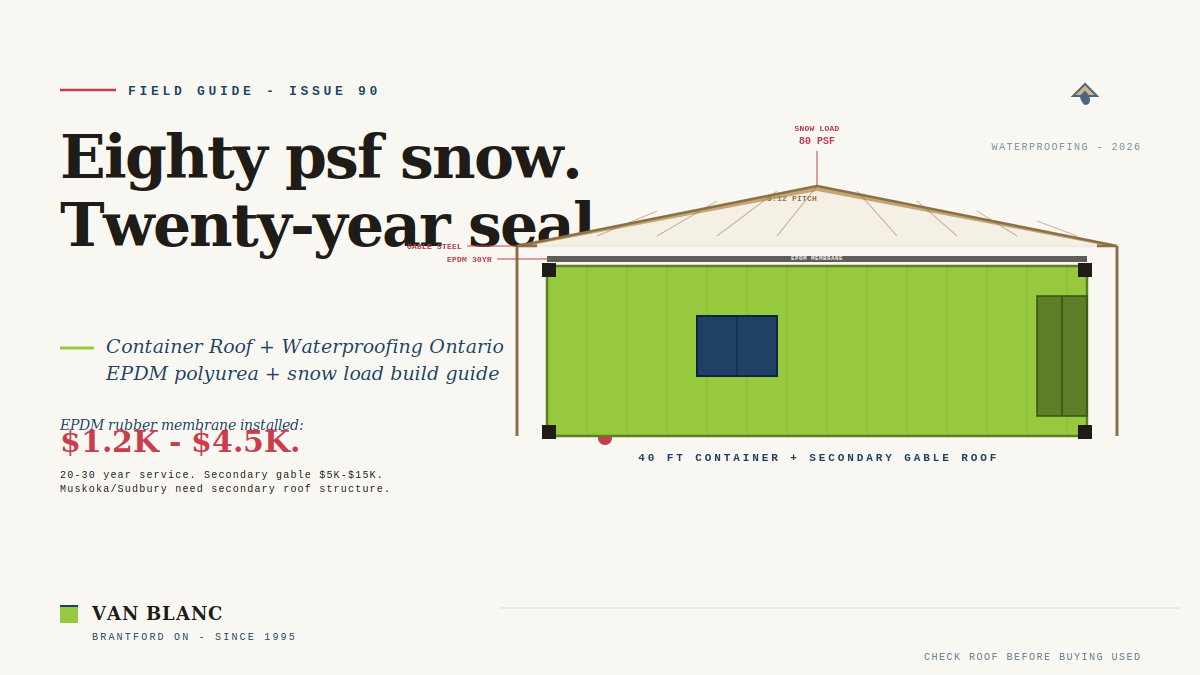
Quick answer. A shipping container roof waterproofing system in Ontario runs across several tiers. DIY elastomeric coatings sit at the budget end, professional EPDM rubber membrane and polyurea spray coating occupy the durable middle, and a full secondary roof structure (gable or arch) sized for Canadian snow load is the top tier. What you pay scales with container length (20 ft versus 40 ft), the coating grade you choose, and whether the site needs a snow-rated secondary roof.
Standard container roofs are 14-gauge corrugated steel with factory paint, designed to be watertight but not pitched for snow shedding. Ontario snow loads concentrate on the flat roof surface, creating ponding, ice damming, and structural deflection risk. For 40+ psf ground snow loads (most of Ontario), proper roof reinforcement or a secondary roof structure is recommended. A full cost breakdown, Canadian snow load specifications, waterproofing options from EPDM through polyurea, and the trade-off between flat roof maintenance and secondary roof structures all sit below.
For full expected container lifespan and how roof maintenance extends it by decades, see our shipping container lifespan Ontario guide. Pick up the phone and we will quote your real cost in 5 minutes. Ask for Christian or Paul, 519-754-6844. Family-run Ontario shipping container supplier since 1995. 4.9 stars across 140+ Google reviews, 1-3 day delivery.
Where should you start with container roof waterproofing in Ontario?
Container roof waterproofing in Ontario means sealing the flat steel roof against rain, snow melt, and freeze-thaw so the box stays dry for decades. The common systems are DIY elastomeric or liquid rubber coatings, professional EPDM membrane, polyurea spray, closed-cell spray foam, and a snow-rated secondary roof. Snow load decides how far up that ladder you go.
If you searched for “container roof,” “shipping container waterproofing,” “container roof leak,” “container roof snow load Canada,” “container roof coating Ontario,” or any variation, the question underneath is the same: how do I waterproof and protect my shipping container roof against Ontario weather, and when do I need a full secondary roof structure? In this guide we walk through what drives the price of roof waterproofing, why container roofs need attention in Ontario, the waterproofing options tier by tier, how much snow load a container roof can handle, two real Ontario projects, a maintenance schedule, how to stop rain noise, the most common mistakes, and what Van Blanc provides. Each section stands on its own, so skip to whatever you came for.
What drives the price of container roof waterproofing in Ontario?
| Roof treatment | Install path | Typical service life | Relative cost tier |
|---|---|---|---|
| Elastomeric coating (DIY) | Brush or roller, owner-applied | 5 to 8 years | Budget |
| Liquid Rubber / RV roof coating (DIY) | Brush or roller, owner-applied | 8 to 12 years | Budget to mid |
| Professional EPDM membrane (installed) | Roofing contractor, adhered or mechanically fastened | 20 to 30 years | Mid to premium |
| Polyurea spray coating (premium) | Certified spray applicator | 15 to 25 years | Premium |
| Closed-cell spray foam roof (insulated + waterproof) | Spray foam contractor | 20 to 30 years | Premium |
| Secondary gable roof structure (snow load rated) | Structural build over the container | 30 to 50 years | Highest |
| Secondary steel arch quonset cover | Structural build over the container | 30 to 50 years | Highest |
For most Ontario container applications, the elastomeric or EPDM membrane options protect the roof envelope adequately. Closed-cell spray foam roofs add insulation along with waterproofing for residential and commercial conversions where climate envelope matters. Secondary gable or arch roof structures are recommended for Ontario locations with heavy snow loads or for any container that will be unattended through winter.
Why do container roofs need attention in Ontario?
Standard shipping container roofs are designed for the deck stack environment of ocean shipping, not for sitting stationary in Ontario weather for 20+ years. The factory roof is functional but has several known weaknesses in Canadian climate:
- Convex shape with shallow pitch. Container roofs are slightly convex but essentially flat. Water and snow accumulate rather than sheding immediately. Ponding water accelerates rust and paint degradation.
- 14-gauge corrugated steel. Adequate for the original use case but not for snow concentration over years of stationary deployment.
- Factory paint degradation. 6 to 12 years of ocean shipping leaves factory paint significantly degraded. Used containers in Ontario aftermarket often have roof paint that needs refresh within 2 to 5 years.
- Rain noise. Steel container roofs amplify rain noise to unusable levels for occupied applications like residential, commercial, or studio use. Acoustic isolation requires either secondary roof structure or interior acoustic treatment.
- Snow concentration. Ontario snow loads of 40 to 80 psf can deflect the container ceiling inward, damaging interior finishes and structural integrity. Heavy snow loads exceed the roof’s design rating.
- Ice damming. Freeze-thaw cycles at the roof edge create ice dams that force water back under any seal failure, accelerating rust and structural damage.
- Condensation on cold steel. Interior side of roof condenses moisture during temperature swings. Without insulation, this drips onto stored goods or interior finishes.
“The roof is the first thing I check when a customer rolls a used container into the yard. Most leaks I have seen in twenty years of growing up around this trade start as one pinhole nobody caught. Catch it on day one and a coating fixes it. Catch it after two winters and you are chasing rust through the whole panel.”
Christian LeBlanc, second-generation operator, Van Blanc Ent. Inc., Brantford
Pro tip from our delivery yard. Ontario buyers inspecting used containers should test the roof with a flashlight from inside on a sunny day. Pinhole rust failures in the roof transmit light visibly. Any pinpoint of light from outside means a future leak that will accelerate during winter freeze-thaw cycles. Reject the container or budget for immediate roof remediation. A pre-purchase roof inspection prevents unexpected remediation costs on used CW and WWT grade containers.
What are the container roof waterproofing options, tier by tier?
Elastomeric coating (DIY budget tier)
Latex or acrylic-based liquid coating applied with brush or roller. Forms a flexible membrane over the existing steel. Two to four coats over 24 to 48 hours. One gallon covers roughly 50 to 80 sq ft, so a 20 ft roof is a modest, owner-applied job. Service life 5 to 8 years. Best for budget refresh of older container roofs.
Liquid Rubber / RV roof coatings (DIY mid-tier)
Higher-grade liquid rubber coatings designed for RV roofs and trailer applications. Better elasticity and UV resistance than basic elastomeric. Same DIY brush or roller application, so a 20 ft roof stays an owner-applied job. Service life 8 to 12 years. The standard DIY tier for Ontario container owners doing their own waterproofing.
EPDM rubber membrane (professional installation)
Single-ply ethylene propylene diene terpolymer rubber membrane, the industry standard for low-slope commercial roofing. Installed by a professional roofing contractor over the container roof using fully adhered, mechanically attached, or ballasted methods. Priced per square foot installed, so a 40 ft roof costs proportionally more than a 20 ft roof. Service life 20 to 30 years. The Ontario commercial standard.
Polyurea spray coating (premium professional)
Fast-curing polymer spray coating with exceptional adhesion, elasticity, and chemical resistance. Professional spray application creates a seamless membrane in minutes. Priced per square foot installed, it carries a premium over the DIY tiers because it needs certified equipment and an applicator. Service life 15 to 25 years. Premium choice for high-value commercial and residential container conversions.
Closed-cell spray foam roof (insulated + waterproof)
Spray foam applied to the container roof at 2 to 4 inches thickness. Provides R-12 to R-24 insulation plus an integrated waterproof barrier. Priced per square foot installed, it sits at the premium end because a single system delivers both insulation and waterproofing. Service life 20 to 30 years with periodic topcoat refresh. The standard for residential and commercial container conversions requiring both waterproofing and insulation.
Secondary roof structure (gable or arch cover)
Full secondary roof built over the container. Gable-style with 3:12 or steeper pitch for Canadian snow shedding. Galvanized steel construction rated to 50 to 60 psf snow load. It is the highest cost tier and scales with the length covered, so a 40 ft cover costs more than a 20 ft cover. The right choice for Ontario locations with heavy snow exposure (north of Bracebridge, lake-effect snow belts, exposed rural sites) or for containers needing decades of unattended service life.
How much snow load can a container roof handle in Ontario?
A standard shipping container roof handles roughly 60 to 80 psf of concentrated snow before it starts to deflect, which is why Ontario snow load decides whether a coating is enough or a secondary roof is required. The National Building Code of Canada (NBCC) sets snow load requirements that affect container roof design across Ontario:
| Ontario region | Ground snow load (psf) | Recommended container roof treatment |
|---|---|---|
| Southern Ontario (Toronto, Hamilton, Niagara, GTA) | 30 to 45 psf | Coating or membrane adequate |
| Kitchener-Waterloo, London, Brantford | 40 to 50 psf | Membrane + winter snow removal protocol |
| Ottawa Valley, Eastern Ontario | 50 to 65 psf | Membrane + periodic snow clearing |
| Muskoka, Algonquin region | 60 to 80 psf | Secondary roof structure recommended |
| Sudbury, Timmins, North Bay | 70 to 90 psf | Secondary gable roof structure |
| Northern Ontario (Thunder Bay, Kenora) | 80 to 100+ psf | Engineered gable structure with reinforced supports |
| Lake-effect snow zones (Owen Sound, Tobermory, Goderich) | Add 25 to 50 percent to regional baseline | Secondary roof structure recommended |
Standard container roofs deflect under approximately 60 to 80 psf of concentrated snow load. Ontario locations with regular snow loads exceeding this threshold should plan for either active snow removal (manual or mechanical snow clearing after major storms) or a secondary roof structure. Active removal is acceptable for attended commercial sites with maintenance crews. Secondary roof structure is the right choice for residential, agricultural, and unattended commercial deployments.
What do real Ontario container roof projects look like?
Real Ontario container roof projects fall into two patterns we see at the yard again and again: a high-snow cottage build that needs a full secondary roof, and a working fleet that needs durable membrane to stop recurring leaks. Here is one of each.
The Muskoka cottage country off-grid container cabin
Visited the yard last spring. A Toronto homeowner was converting a One-Trip 40 ft container into an off-grid Muskoka cottage near Bracebridge, a 75+ psf snow load region. They specified a full secondary gable roof structure rated to 80 psf snow load, with metal standing seam panels in dark green. The build included engineered structural supports and proper drainage, and the roof structure also accommodates a 6 kW solar array mounted on the south-facing slope. Owner credits the secondary roof for surviving three consecutive Muskoka winters with zero snow load issues plus the added benefit of rain noise elimination inside the container.
The Brantford commercial storage operator
Worked with a Brantford commercial storage operator owning a fleet of 12 used Cargo Worthy containers used for tool and inventory storage at customer industrial sites. Recurring problem: 4 to 6 roof leaks per year across the fleet, each one driving emergency tarp repairs and inventory replacement. Solution: applied professional EPDM membrane to all 12 containers over a 6 month rotation. Zero roof leak incidents in the subsequent 22 months. The emergency tarp runs and the inventory write-offs stopped, the fleet stayed in service through the winters, and the membrane keeps protecting those roofs across its 20+ year service life.
What is the container roof maintenance schedule in Ontario?
A container roof maintenance schedule in Ontario is a short, repeatable routine: inspect twice a year, clear debris and standing water, rake heavy snow, touch up rust, refresh seam sealant, and recoat on a multi-year cycle. The table below sets the frequency for each task.
| Maintenance task | Frequency | Who does it / effort |
|---|---|---|
| Visual roof inspection (rust spots, seam failure) | 2x per year (spring + fall) | DIY walk-around, or professional for hard-to-reach roofs |
| Debris and leaf removal | Quarterly | DIY, minutes per visit |
| Standing water and ice removal | As needed after storms | DIY with a squeegee or roof rake |
| Heavy snow clearing (40+ psf zones) | 2-5x per winter | DIY roof rake from ground, or hired service |
| Rust spot treatment | Annual | DIY wire-brush and touch-up paint |
| Sealant refresh on seams | Every 3-5 years | DIY caulk gun, half a day |
| Coating recoat (elastomeric/liquid rubber) | Every 5-10 years | DIY brush or roller, one to two days |
| Full membrane replacement (EPDM/polyurea) | Every 20-30 years | Professional roofing contractor |
Properly maintained container roofs deliver 25 to 40 years of waterproofing service in Ontario climate. Neglected roofs fail within 8 to 15 years through rust penetration, seam separation, and structural damage. The maintenance investment is small relative to the alternative cost of full roof rebuild or container replacement.
How do you stop rain noise on a container roof?
Steel container roofs amplify rain and hail noise to levels that interfere with normal interior use. For storage containers, the noise is irrelevant. For occupied containers (offices, homes, restaurants, studios, retail), the noise becomes a significant comfort and operational problem.
Rain noise reduction options:
- Closed-cell spray foam roof interior. 2 to 4 inches of spray foam on the underside of the roof reduces rain noise 30 to 50 percent while adding insulation. Priced per square foot installed.
- Rubber roof membrane exterior. EPDM or polyurea membrane on the exterior surface dampens initial impact noise 40 to 60 percent. Pairs with interior treatment for cumulative effect.
- Secondary roof structure. Full gable or arch cover with air gap creates two impact surfaces with damping between them. Reduces rain noise 70 to 90 percent. Best result but highest cost.
- Acoustic ceiling treatment. Suspended acoustic ceiling panels inside the container with mineral wool fill above. Reduces transmitted noise 30 to 50 percent. Pairs with other methods for serious applications.
For container music studios and recording spaces, our container music studio Ontario guide covers the complete acoustic envelope including rain noise specifically.
What are the most common container roof mistakes in Ontario?
After 30 years supplying containers to Ontario buyers across every grade and use case, the predictable roof mistakes are clear. Avoiding these protects the container envelope and the long-term operating budget.
- Skipping the pre-purchase roof inspection. Used CW and WWT containers can have pinhole rust failures invisible from a quick walk-around inspection. Climb the container roof or inspect with flashlight from inside on a sunny day. Pinhole failures become major leaks within 2 to 5 years.
- Ignoring standing water. Container roofs accumulate water in low spots and along seams. Standing water accelerates rust, paint degradation, and seam failure. Maintain proper drainage paths or apply coating that fills low spots.
- Buying a used roof-damaged container. Containers with prior roof damage (dented from improper handling, prior leak repairs visible) signal accelerated remediation. Reject or factor full roof replacement cost into purchase price.
- Wrong waterproofing for the climate. Standard residential roof coatings rated for warm climates fail under Ontario freeze-thaw cycles. Always specify products rated for Canadian climate or commercial roofing applications.
- No secondary roof in heavy snow zones. Containers in Muskoka, Sudbury, Thunder Bay, and similar 70+ psf snow load regions need secondary roof structures or active snow removal protocols. Skipping this creates structural damage within 2 to 5 Canadian winters.
- Forgetting condensation control. Interior side of the roof condenses moisture during Ontario temperature swings. Closed-cell spray foam interior or vapor barrier + insulation prevents this. Skipping creates dripping problems for stored goods or interior finishes.
- DIY professional-grade applications. EPDM membrane and polyurea spray coating require professional equipment and certification for proper installation. DIY attempts at these systems typically fail within 2 to 4 years vs 20 to 30 year professional installation life.
For broader container body rust prevention beyond just roof, see our container rust prevention Ontario guide.
What does Van Blanc provide for Ontario container roof projects?
We supply containers with pre-purchase roof inspection at our Brantford yard and connect customers with vetted Ontario roofing trade partners for waterproofing installation. For roof-equipped builds we recommend:
- One-trip containers for premium applications requiring the longest possible roof service life. Clean factory paint and no prior roof damage give the best baseline once delivered, which is why most roof-critical builds start with a freshly arrived box off its single loaded voyage. See how the one-trip and cargo-worthy grades actually differ before you choose.
- Cargo Worthy containers from our in-stock Brantford inventory you can walk before you buy, for value-minded builds with roof remediation planned from day one. Used-grade roofs typically need elastomeric coating or EPDM membrane within the first few years, so plan the container and the roof work together.
- Delivery to your site from our four Brantford yards. 1 to 3 days from confirmation to most Ontario addresses.
- Vetted Ontario contractor referrals for EPDM membrane installation, polyurea spray coating, closed-cell spray foam roofs, and secondary roof structure builds. The venting, insulation, and interior side of a roofed conversion is part of our yard conversion program, and we work with established commercial roofing contractors for the exterior membrane and structural work.
For broader use-case context where roof considerations matter, see our insulated shipping containers guide for complete climate envelope specifications, our container HVAC Ontario guide for the integration between roof, insulation, and HVAC, and our what to know about container modifications for the full conversion options. For grade selection across container categories, see our our guide to new or used container selection.
“Roof customers come to us in two categories. The first group is buying a new container and wants to do the roof right from day one. EPDM or polyurea coating, maybe a secondary structure for cottage country deployment. The honest math wins. A good membrane lasts 25 years on a one-trip, and the per-year cost is tiny next to the price of a roof that fails. The second group is dealing with an aging used container roof that has been leaking for two seasons. We can usually save the container with proper coating treatment, and sometimes the better call is replacement. The pre-purchase inspection prevents both scenarios.”
Paul LeBlanc, founder, Van Blanc Ent. Inc., Brantford
Go Deeper: Detailed Topic Guides
For more depth on specific aspects of this topic, see our spoke articles:
More from this cluster
Deeper reads we’ve added since the original guide:
Frequently asked questions
What drives the price of container roof waterproofing in Ontario?
The price scales with the tier you choose. DIY elastomeric and Liquid Rubber coatings sit at the budget end, professional EPDM membrane and polyurea spray coating occupy the durable middle, closed-cell spray foam adds insulation on top of waterproofing, and a secondary gable or arch roof structure is the highest tier. Within any tier, a 40 ft roof needs more material than a 20 ft roof. The drivers are container length, coating grade, site access, and whether the location needs a snow-rated secondary roof. Tell us the size and your postal code and we will send back an honest, all-in number.
What is the best waterproofing for a shipping container roof?
EPDM rubber membrane for commercial-grade durability, priced per square foot installed with a 20 to 30 year life. Polyurea spray for premium seamless application. Closed-cell spray foam for combined waterproofing plus insulation. DIY elastomeric or Liquid Rubber for budget refresh on older containers. Match the system to the application requirements.
Do shipping containers leak in Ontario weather?
New One-Trip containers are watertight when delivered. Used CW and WWT containers may have rust pinhole failures or seam separation creating leaks. Ontario freeze-thaw cycles accelerate any existing weakness. Pre-purchase inspection plus proactive waterproofing prevents leaks; ignoring guarantees future failure.
Can a shipping container handle Ontario snow load?
Standard container roofs deflect under 60 to 80 psf concentrated snow load. Ontario snow loads range from 30 psf (southern GTA) to 100+ psf (Thunder Bay, lake effect zones). Light snow regions tolerate flat roof with snow removal. Heavy snow regions (60+ psf) need secondary roof structure or active snow clearing.
Do I need a secondary roof structure for my Ontario container?
Yes for Muskoka, Algonquin, Sudbury, Thunder Bay, and lake-effect snow zones (70+ psf). Optional for southern Ontario (30-45 psf) where membrane plus snow removal works. Required for unattended residential, agricultural, or commercial applications where active snow clearing is not practical.
How do I prevent rain noise on a container roof?
Closed-cell spray foam interior reduces rain noise 30-50 percent. Exterior rubber membrane (EPDM, polyurea) reduces 40-60 percent. Secondary gable or arch roof structure reduces 70-90 percent. Acoustic ceiling treatment inside adds 30-50 percent. Combine methods for cumulative effect on occupied containers.
What is the lifespan of a properly waterproofed container roof?
EPDM rubber membrane 20-30 years. Polyurea spray coating 15-25 years. Closed-cell spray foam 20-30 years. Elastomeric DIY coatings 5-8 years. Liquid Rubber DIY 8-12 years. Secondary roof structures 30-50 years. Properly maintained container roofs deliver 25-40 years total service life.
Can I apply EPDM membrane myself?
Not recommended. EPDM membrane installation requires specific surface preparation, primers, seam sealing, and adhesive techniques. DIY EPDM installations typically fail within 2-4 years vs 20-30 years for professional installation. Hire an established commercial roofing contractor.
How do I inspect a container roof for damage?
Visual inspection from outside for dents, rust, ponding water, and seam separation. Interior inspection with flashlight on sunny day – pinhole rust failures show as pinpoints of light. Roof walking inspection for soft spots indicating corrosion underneath. Test door seal integrity to confirm watertight container envelope.
What causes condensation on the inside of a container roof?
Cold steel roof contacts warmer humid interior air, condensing moisture on the cold surface. Worst in Ontario fall and spring with temperature swings between exterior cold and interior warmth. Prevention: closed-cell spray foam insulation interior creates thermal break, eliminating the cold-steel surface that condenses moisture.
Do I need to remove snow from a container roof?
Yes for Ontario zones with 60+ psf snow loads (Eastern Ontario, Muskoka, Northern Ontario, lake-effect zones). Remove after major storms (>15 cm accumulation) or when accumulated depth approaches 30-40 cm. Use long-handled roof rake from ground – climbing icy container roofs is dangerous.
Coating or a secondary roof, how do you choose?
A coating or membrane is the lighter, faster option and protects the existing steel roof for 5 to 30 years depending on the system. A secondary gable or arch roof is the heavier build that adds 20 to 50 years to total roof life, eliminates rain noise, and carries extreme snow loads in places like Muskoka and Northern Ontario. Choose the coating when snow load is moderate and the container is attended. Choose the secondary roof for heavy-snow, unattended, or occupied builds. The right call depends on your climate zone and how the container will be used.
Come pick your container at our Brantford yard
If you are buying a shipping container in Ontario, pre-purchase roof inspection prevents future surprises. We hold 200+ containers in stock at our Brantford yard. For roof-critical applications we recommend One-Trip High Cube units with verified clean roof condition. You walk the row, inspect the roof from above and below, and confirm container condition before paying. Delivery to most Ontario addresses in 1 to 3 days from confirmation.
Call Van Blanc, Brantford, Ontario, 519-754-6844
Van Blanc Ent. Inc. has supplied containers with roof condition guarantees for Ontario commercial and residential buyers since 1995. 4.9-star rating across 140+ Google reviews. Brantford yards with 200+ containers in stock, and you pick your unit before you pay.
Ready to price your container?
Tell us the size and your postal code and we’ll send back an honest, all-in number, container, delivery, and placement, usually within 1-3 days. No pressure, no mystery fees.
Family-run in Brantford since 1995 · 200+ containers in stock · 4.9★ across 140+ Google reviews · every box graded by a person, walk it before it lands.
Sources & References
Authoritative external sources cited or referenced in this guide: