
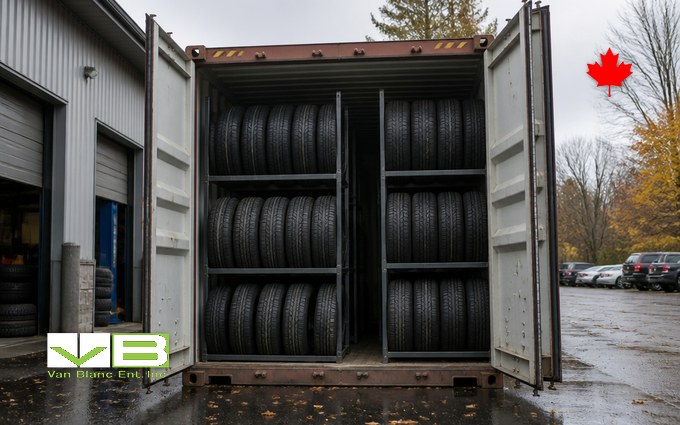
Quick Answer: A tire hotel is a shop’s seasonal tire storage service. You leave the off-season set at the changeover, and the shop inspects, labels and racks it until your next appointment. Tire makers want tires cool, dry and dark. A racked 40ft high cube from Van Blanc holds the shop’s hotel.
What This Tire Hotel Guide Covers
- How a Tire Hotel Works
- Tire Hotel or the Basement: A Driver’s Choice
- Winter Tire Storage at Home, Per Tire Makers
- Garage Tire Storage Ideas
- Stored Tire Age: The 6 and 10 Year Marks
- The Fall Changeover Rush in Ontario
- Seasonal Tire Storage Inside a Shop
- Where Do Shops Keep Hundreds of Sets?
- 40ft High Cube as the Shop’s Tire Hotel
- Keeping Stored Tires Cool in a Steel Box
- New or Used: The Grades We Sell
- Delivery Before the Spring Swap
- FAQs
Reading Time: 16 minutes
How a Tire Hotel Works
A tire hotel is the trade’s name for seasonal tire storage sold by a tire shop or a dealership. The driver leaves the off-season set at the changeover, pays a fee for the season, and finds the set waiting at the next swap. Van Blanc Ent. Inc. has sold shipping containers from 4 Brantford yards since 1995, and a shop can rack one to hold exactly this service. Our earlier piece on racking a 20ft beside the service bays covers that build. This guide starts with the driver, then follows the tires into the shop.
Demand for the service rides on winter tire use, and Ontario runs high. The Tire and Rubber Association of Canada (TRAC) found 74 per cent of Ontario drivers on winter tires in its 2024 survey. The national figure was 78 per cent. Most of them swap back in spring, which leaves a set off the car for half the year. Among Ontario drivers who skip winter tires, 10 per cent told TRAC they have no place to store an off-season set. That is the same space squeeze that sends drivers shopping for a car shelter for an Ontario winter. A tire hotel answers that problem for a fee, and it gives the shop a reason to see the car twice a year.
“If you want to make sure that the storing of your tires is in professional hands we would recommend to let them be stored at your tire dealer.”
Continental Canada, Storing tires
Tire Hotel Steps, Drop-Off to Pickup
Kal Tire publishes its storage process step by step, and a dealership service manager walked Canadian Auto Dealer through the recall side. Put together, a set moves like this, whether it sleeps in a warehouse or in a container fitted out for a trade. The left column is the step, and the right column is what the shop does.
| Step | What happens to the set |
|---|---|
| Drop-off | The off-season set comes off the car at the changeover appointment. |
| Inspection | A technician checks each tire for wear or damage and calls the owner about anything found. |
| Prep and label | The set is prepared and labelled so it comes back to the right car. |
| Storage | Kal Tire racks sets on site the same day, or at a central site within one week, for up to 9 months. |
| Recall | Pickering Toyota orders sets back from its storage partner two days in advance. |
| Install | The set is inspected again, then mounted at the next changeover. |
Small shops run a shorter version of the same loop, with the sets racked in a 40ft high cube parked out back. Paul LeBlanc founded Van Blanc in Brantford in 1995. The box comes later in this guide, after the tires themselves.
Tire Hotel or the Basement: A Driver’s Choice
Tire hotel storage trades a seasonal fee for space and a sore back. Autotrader’s 2022 owner guide lists the trade-offs plainly. The fee comes back every season. The driver has to return to the same shop to get the set mounted, which pinches when that shop is booked solid. And the driver should ask where the tires actually sleep, since conditions vary from shop to shop. That return visit is the point for the shop, and it’s why shops treat storage as a way to fill the spring book. Autotrader also notes the weight. Today’s 18 to 22 inch tires and rims are much heavier than the 13 to 16 inch sizes common a few decades ago.
“If you’re a driver weighing a tire hotel, ask to see where your set will sit. A shop running its hotel out of a container should be glad to open the doors and show you dry racks off the floor.”
Christian LeBlanc, second-generation operator, Van Blanc
Kal Tire’s storage page answers some of those worries for its own service. It stores tires bought elsewhere at the same charge, and it says its storage sites are insured against damage, loss and theft. It also recommends an appointment for spring and fall pickups. That last point is the catch every tire hotel shares, because the changeover weeks fill up fast.
Van Blanc sells the box and leaves the storage service to shops, so this part is the driver’s call. Home storage costs nothing but room. A driver with a dry basement and a strong back will do fine following the makers’ rules below. A driver in a condo, or one whose garage swings hot and cold, is the tire hotel’s natural customer. Rural drivers with a barn or a steel garage built from a container sit somewhere in between.
Winter Tire Storage at Home, Per Tire Makers
Winter tire storage at home follows the same rules Michelin and Continental publish for every tire. Michelin Canada says tires should always be stored in a cool, dry, clean, indoor environment. Its guide warns that tires left outdoors and unused for a month or more grow dry, and surface cracks can appear. Continental Canada goes further: tires should never sit in the open air, even under a protective covering, in cold weather or warm. Under that rule, a shed or a prefab garage kit at least keeps tires out of the open air.
“The worst place to store tires is outdoors … which exposes the tire to the extremes of temperature and humidity, as well as to damaging UV rays from the sun.”
Brad Fraser, Customer Engineering Support, Michelin North America, quoted by Autotrader
The prep is the same for both makers. Before the set comes off, Michelin suggests noting where each tire sat on the car, so the next mounting can rotate them. Then the routine runs in this order.
- Inspect each tire for damage or uneven wear.
- Wash the tires (and the wheels, if mounted) with water, or detergent and a tire brush as Continental suggests.
- Pick out stones caught in the tread grooves.
- Dry everything well; Michelin’s reason is to limit corrosion on the wheels.
- Skip tire dressing; Continental says gloss products can hinder rather than help.
- Bag each tire in an airtight plastic bag with the air pressed out, a step Continental credits with slowing oil loss from the rubber.
Whitewalls and raised white letters get one more step. Both makers say to store white sides facing white sides. Continental explains that oils from standard black rubber can stain the white areas. Hanging sets on wall-mounted e-track rails and hooks keeps that sorting easy.
Stand, Stack or Hang: Mounted vs Unmounted
Mounted and unmounted tires are stored differently, and the makers agree on the split. The table sets the two guides side by side.
| Tire | Michelin Canada | Continental Canada |
|---|---|---|
| Mounted on rims | Hang them or stack them; never store them standing upright | Stacking is preferable; hanging from racks or hooks also works |
| Not on rims | Stand them up; never stack or hang them | Standing is best; never hang unmounted tires |
| Floor | Keep them off bare concrete, which can draw moisture | Not stated; avoid humidity swings |
Continental’s US page simplifies the rule to standing tires vertically where possible, on clean wood rather than the ground. Its Canadian page adds a practical limit: if you must stack, keep the pile low so it cannot tip. A carport roof keeps rain off but leaves tires in the open air, and the carport against garage comparison sets out what each one shelters.
Ozone, Sun and Solvents
Ozone is the chemical Continental names first. Electric motors with contact brushes give it off, and the Canadian guide lists generators, compressors, furnaces, switches, sump pumps and central vacuums. Keep tires out of any room that holds one. Sunlight and heat age rubber too, so the spot should stay dark. Solvents, fuels and lubricants belong somewhere else entirely. In a storage container the same rule means the compressor stays in the shop and any wiring follows a licensed electrician’s plan.
Garage Tire Storage Ideas
Garage tire storage works when the garage behaves more like a basement. Continental notes that most garages, sheds and attics run through a range of temperatures, precipitation and humidity. It calls a basement or other climate-controlled space ideal. A garage can still do the job with a few habits drawn from the makers’ guides.
- Hang mounted sets on wall hooks, or stack them on a pallet, so they never touch the slab.
- Stand unmounted tires on a wood shelf, in their bags.
- Keep the rack on the wall farthest from the furnace, the compressor and the overhead door motor.
- Store fuel cans and solvents on another wall, or outside the garage.
- Cover the rack against sunlight from a window.
Continental lumps attics in with garages and sheds for those swings, so the attic is no better. A homeowner short on garage room can add a Van Blanc 20ft beside it. The classic car storage guide covers the same moisture habits for a vehicle kept in one.
Stored Tire Age: The 6 and 10 Year Marks
Stored tires keep ageing even in good storage, because rubber oxidizes whether or not it rolls. Michelin Canada says tires can be stored for several years without meaningful degradation under ideal conditions. Tires stored badly, outdoors or near heat, can crack in as little as one season. Michelin adds two marks worth writing on the garage wall. Tires older than 6 years should be inspected by a professional before use. Tires older than 10 years should be replaced.
“Tires older than 6 years should be professionally inspected before use, and those over 10 years should be replaced.”
Michelin Canada, How do I store my tires?
The build date is stamped on the sidewall as the last four digits of the DOT code. Under Transport Canada’s tire regulations, the first two digits give the week of manufacture. The last two give the year. A tire hotel’s inspection at drop-off is the natural time to read it. Michelin also allows short-term outdoor storage of a few weeks, raised off the ground under an opaque, waterproof cover with vent holes. Anything longer belongs indoors. For a shop, that points to a closed Van Blanc box with vents set high and low on the walls. A pile under a tarp does not meet the makers’ rules.
The Fall Changeover Rush in Ontario
The fall changeover rush starts when the thermometer drops. TRAC’s 2024 report says winter tires outperform all-season and summer tires at 7°C or lower, where the other compounds start to harden. Tirecraft tells drivers to switch once temperatures consistently dip below 7°C, which usually means November through March. Ontario adds a financial nudge. TRAC notes that since January 1, 2016, Ontario legislation has required insurers to reduce premiums for drivers with four winter tires installed. It tells drivers to ask their own insurer how to qualify.
“At temperatures of 7°C or lower, winter tires outperform all-season and conventional summer tires, where these tires start to harden and lose traction.”
Tire and Rubber Association of Canada, Winter Tire Report 2024
TRAC also reminds drivers that tires lose about 1 psi for every 5°C drop. It advises a pressure check at least once a month in the cold. For the shop, the effect is a wave of cars in a few weeks. Kal Tire recommends booking ahead for exactly that reason in both spring and fall. A small garage can be ready for that wave with a 20ft sized for a smaller storage book.
November is when the summer sets come off and the tire hotel fills. Each changeover car leaves four tires behind, often on rims, and every one needs a tag and a rack slot before the next car pulls in. The winter sets stored since spring come out, and their summer partners go into the same racks. That is the week a shop finds out whether its storage space was big enough, which is why boxes ordered now still matter. A Van Blanc container ordered this week lands in 1 to 3 days, inside the rush. The case for buying a container in the cold months instead of summer has its own guide.
Seasonal Tire Storage Inside a Shop
Seasonal tire storage inside a shop is a small warehouse with a deadline twice a year. A smooth hotel and a lost set differ in three habits. Each set gets one label and a check at the door, and the recall runs ahead of the appointment. Van Blanc sells the box, and the shop owns the system that runs inside it. Other trades’ container layouts show how a parts room or a tool room borrows the same habits.
Tagging Each Set
Tagging is where tire hotels win or lose. Kal Tire says its sets are clearly labelled for identification before they move to storage. Canadian Auto Dealer’s 2024 feature describes the software end of the trade. One Mississauga storage software firm prints a unique QR code for each customer’s wheels, so the set is scanned at every move like a parcel. A paper tag tied to the booking system works the same way for a two-bay garage. Our auto-shop guide already covers the tag and rack layout for a single 20ft.
“The tires are prepped and clearly labeled for identification before being transferred to our storage facility.”
Kal Tire, Tire storage at Kal’s Tire Lodge
Cleaning and Inspection at Drop-Off
The drop-off check protects the shop as much as the driver. Kal Tire’s technicians visually inspect every set and call the owner about wear, damage or a coming replacement. Reading the DOT date at the same time catches sets near Michelin’s 6 and 10 year marks. A rinse and dry before racking follows the makers’ advice, and it keeps brake dust off the rack. Wet sets racked in a cold box will sweat, so drying matters more in November than in May. Choosing passive or powered vents decides how fast the box clears that moisture.
Calling Sets Back Before the Swap
Recall is the step customers notice. The Pickering Toyota service manager told Canadian Auto Dealer his shop orders stored sets back two days in advance. The sets are scanned out of a warehouse and delivered to the dealership. A shop with its own box on the lot shortens that to a walk across the yard. A forklift-friendly door layout helps if sets travel on pallets.
Customer tires in storage are customer property, and Kal Tire’s storage terms deal with that in writing. A shop starting its own hotel should ask its insurer how stored customer sets are covered, and write the storage period into the ticket. Kal Tire stores for one season at a time, up to 9 months, which gives a sensible template.
Where Do Shops Keep Hundreds of Sets?
A shop has three places to keep customer sets, and each has a trade-off. The first is inside the building, on a mezzanine or in a back room, which takes floor space from the service bays. The second is a third-party warehouse. Canadian Auto Dealer describes dealerships that send sets out on a pickup route, with tires scanned in and out. That keeps the floor clear, but every set travels twice a season and the shop waits on a truck.
The third is a steel container on the lot. It sits beside the bays, it locks, and the tech walks the set over in a minute. A man door cut into the side wall saves swinging the cargo doors for every set. Van Blanc sells that option outright, delivered in 1 to 3 days. Shops ordering for a dealership lot in Mississauga, a service bay in London or a tire store in Kitchener get the same delivery window.
40ft High Cube as the Shop’s Tire Hotel
A 40ft high cube is a 40ft shipping container built one foot taller than the standard box. Inside it runs 39 ft 6 in long and 8 ft 10 in high, per Van Blanc’s product page. CN Intermodal rates its usable cube at 2,689 cu ft (76.1 m³), against 2,395 cu ft (67.8 m³) for the standard 40ft dry box. That extra height is why it suits a tire hotel. The table puts the high cube beside the two boxes a shop usually compares it with.
| Measurement | 20ft standard | 40ft standard | 40ft high cube |
|---|---|---|---|
| Inside length | 19 ft 4 in (5.898 m) | 39 ft 6 in | 39 ft 6 in |
| Inside width | 7 ft 8 in | 92 in | 92 in |
| Inside height | 7 ft 10 in | 94 in | 106 in |
| Door opening (width by height) | 2,340 by 2,292 mm | 2,340 by 2,292 mm | 2,340 by 2,597 mm |
| Usable volume | 1,172 cu ft (33.2 m³) | 2,395 cu ft (67.8 m³) | 2,689 cu ft (76.1 m³) |
| 48 by 40 inch pallets on the floor | 10 | 20 | 20 |
The 20ft figures are from the 20 foot box a small garage often starts with. The 40ft figures are CN’s, and the door openings are Hapag-Lloyd’s fleet specs. Van Blanc carries the 20ft and the 40ft in both standard and high cube height.
“I’ve been buying containers for 19 years, and when a busy shop wants a tire hotel I point them to the high cube. That extra foot lets three levels of winter sets slide out without the top row scraping the roof.”
Paul LeBlanc, owner, Van Blanc
Why the Extra Foot Matters for Racks
The extra foot decides how comfortably the racks fit. Take a common winter size, a 225/65R17. Using the standard sidewall formula, that tire stands about 28.5 inches tall on its tread. Three levels of upright tires use roughly 86 inches before beams and floor clearance. CN lists 94 inches of inside height for a standard 40, which leaves about 8 inches for beams and the gap under the bottom level. The high cube’s 106 inches leaves about 20, so the top set slides out without scraping the roof.
That arithmetic is a rule of thumb, since tire sizes vary across a shop’s book. Mounted sets lying flat stack differently, and our auto-shop guide covers that layout. The taller door also helps: at 2,597 mm high, it gives a tech pushing a loaded dolly more room overhead. The full high cube against standard comparison covers the other uses of the extra foot.
Double Doors and Open Sides
Door layout matters when a hotel runs at full speed. Van Blanc’s price list includes the 40ft new high cube with double doors, and with two, three or four side doors. Every unit on that list is in stock and ready for your order. A box with doors at both ends lets one tech load spring sets at one end while another pulls fall sets at the other. An open side box with doors down its length puts every rack bay one step from the lot. Both suit a shop where the hotel sits along a laneway.
How Many Boxes a Shop Orders
Box count follows the size of the storage book. Our auto-shop guide estimates 80 to 100 passenger sets in a racked 20ft, and roughly double that in a 40ft. Treat those as planning figures, since truck and SUV rubber takes more room. The table is a rule of thumb built on those figures.
| Shop | Typical first order | When to add a box |
|---|---|---|
| Two-bay independent garage | One 20ft | When the book outgrows the 20ft’s racks |
| Busy independent or tire shop | One 40ft high cube | When the spring book fills it before May |
| Dealership service department | Two 40ft high cubes | Add a third or fourth as the storage list grows |
Planning delivery for a two-box order starts with the shop’s lot and where each box will sit.
Size the Hotel on One Call
Tell us how many sets you stored last season, where the box will sit and how your techs move tires. The fastest answer is a call. We’ll tell you twenty or forty, standard or high cube, which doors, and one all-in number with a real lead time.
Family-run in Brantford since 1995 · 4.9★ across 140+ Google reviews
Keeping Stored Tires Cool in a Steel Box
Stored tires in a container get the makers’ indoor conditions only if the box is set up for them. A closed steel box keeps out sun, rain and open air, which covers part of Continental’s list. Heat and humidity swings are the part a shop has to manage. Autotrader’s guide tells drivers to ask whether a shop keeps tires in a steel container or a climate-controlled building. A well-set box answers that question at the counter.
- Place the box on the shaded side of the building where the lot allows.
- Add vents high and low so summer heat has a way out.
- Insulate the walls and roof if the box sits in full sun; insulation added at our yards goes in before delivery.
- Keep compressors, generators and fuel out of the box.
- Rack every set off the floor, and dry wet sets before they go in.
“A tire hotel holds winter sets right through July, when steel bakes in the afternoon sun. I’d tuck that box where the shop building shades it, with vents up near the roof and down by the floor to let the heat out.”
Christian LeBlanc, second-generation operator, Van Blanc
Lighting and any heat are the shop electrician’s work, and Van Blanc preps the box to take them. The vents, insulation and doors we fit before a box leaves are listed on our custom features page. A container insulated from the start is another route for a shop in full sun.
New or Used: The Grades We Sell
Van Blanc sells four grades, and the choice is the buyer’s. New, which the trade calls one-trip because the box made a single loaded voyage, carries factory paint and the longest service life. Cargo worthy (CW) and wind and watertight (WWT) are the two used grades, and both close tight and keep tires dry. They show their years in rust spots, dents and faded paint. As-is units are donor stock for builds. The cargo worthy and wind and watertight boxes on our used page come in 20ft, 40ft and 40ft high cube.
“On a box headed for a tire hotel, the floor gets my hardest look. Steel racks loaded with mounted winter sets stand on those boards all year, so a sound, dry floor matters more to me than fresh paint.”
Paul LeBlanc, owner, Van Blanc
A shop whose hotel faces the street may want a new one-trip container with its factory finish, since customers see it on every visit. Size, grade, doors and delivery distance are what move the number, and the price list for each size and grade is public. To compare them all at once, see every box we stock, laid out by size and grade. Payment can be on delivery, by draft cheque, cash, wire transfer or credit card by authorization form.
Delivery Before the Spring Swap
Delivery takes 1 to 3 days anywhere in Ontario, shipped from Van Blanc’s 4 Brantford yards. The box arrives on a tilt-deck truck that slides it onto the spot. The shop needs a clear run for the truck and a level, firm base. How a tilt-deck sets the box down shows the room the truck wants. Set the doors toward the service bays, and leave the side doors clear of parked cars if you chose an open side. A box placed before the spring swap is racked and labelled before the first summer set comes off. A box landing in January has its own checklist, covered in delivering onto frozen ground at the drop spot.
“At a tire shop I set the doors facing the service bays. A tech carrying a mounted set in November shouldn’t have to walk around the container to reach the rack.”
Christian LeBlanc, second-generation operator, Van Blanc
Frequently Asked Questions
What is the right way to store tires?
Clean and dry them, then keep them in a cool, dry, dark indoor spot away from sunlight, heat, ozone sources and solvents, per Michelin and Continental. Stand unmounted tires upright. Stack or hang tires mounted on rims. Keep them off bare concrete, and have them checked before they go back on.
How long are tires good for if stored indoors?
Michelin Canada says tires can be stored for several years under ideal conditions, though rubber still ages. It advises a professional inspection for tires older than 6 years and replacement past 10 years. Check the DOT date on the sidewall at every changeover.
What is the 3 tire rule?
People use the phrase for different things. The one with engineering behind it is the 3% rule. A replacement tire’s overall diameter should stay within 3% of the factory size, so the speedometer and safety systems read correctly. Ask your tire shop to check the math before you change sizes.
Does Canadian Tire do tire storage?
Canadian Tire’s website sells tire storage racks and covers for home use. Its auto service page did not list tire storage as a service when we checked in November 2026, so ask your local store directly. Ask any shop where the tires are kept, how long they’re held and how they’re labelled.
Can tires be stored in a shipping container?
Yes, if the box meets the makers’ conditions. Keep it shaded, vented and free of motors and fuel, and rack the tires off the floor. Insulation helps in full sun. A shop can run its whole tire hotel this way, and Van Blanc delivers the box in 1 to 3 days.
What size container does a tire hotel need?
As a rule of thumb, a small garage starts with one 20ft and a busy shop with a 40ft high cube. The high cube’s extra foot gives the racks headroom. A dealership might plan on two or more. Call Van Blanc with last season’s set count and we’ll size it.
How long can tires sit unused outside?
Michelin Canada allows a few weeks outdoors, raised off the ground under an opaque, waterproof cover with vent holes. Past a month or more, it warns that surfaces dry out and crack. Continental Canada says tires should never be stored in the open air at all.
Sources
- Tire and Rubber Association of Canada. TRAC Winter Tire Report 2024. Checked November 2026.
- Tire makers’ storage guides: Michelin Canada, Storing tires; Continental Canada, Storing tires; Continental Tire, Seven Tips For Storing Tires. Checked November 2026.
- Kal Tire. Kal Tire, Tire storage at Kal’s Tire Lodge. Checked November 2026.
- Canadian Auto Dealer. Perry Lefko, Boost service retention with tire storage (October 1, 2024). Checked November 2026.
- Owner, shop and regulation guides: Autotrader, Where and How Should You Store Your Winter Tires?; Tirecraft, Storing Winter Tires; Performance Plus Tire, What Is the 3 Tire Rule?; Canadian Tire, Auto Service; Transport Canada, Motor Vehicle Tire Safety Regulations (SOR/2013-198), section 6, tire identification number. Checked November 2026.
- Container specifications: CN Intermodal, 40-foot container sheet; Hapag-Lloyd, Container Specification. Checked November 2026.
Walk the Boxes in Brantford
We have been supplying shipping containers across Ontario since 1995. The public yard at 90 Morton Avenue East is one of our 4 Brantford yards, and it’s the one to visit.
Van Blanc Ent. Inc., 90 Morton Ave E Unit 1B, Brantford, ON N3R 7J7, 519-754-6844.
Drop in Monday to Thursday from 9:30 to 5, or Friday from 9:30 to 4. Bring a tape measure and one of your bigger truck tires, and stand it inside a forty and a high cube before you choose. Worth the drive for unbeatable quality, family customer service with 30 years of experience.