
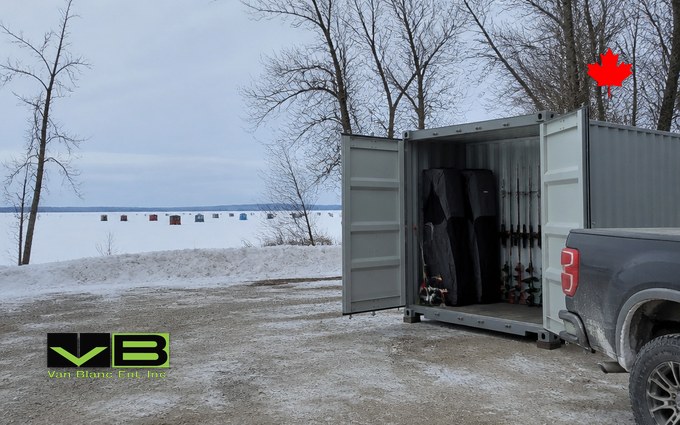
Quick Answer: An ice fishing hut is a heated shelter set over holes in lake ice, from a fabric hub to a hard-sided skid house. Ontario says snowmobiles need at least 20 cm of clear blue ice, and the Canadian Red Cross says no ice is 100 percent safe. Removal dates vary.
Inside This Ice Hut Guide
- Ice Fishing Hut Basics
- Hub, Flip-Over and Skid House
- What Is an Ice Fishing Hut Called?
- Ice Thickness, Three Charts
- Reading Lake Ice Before the Hut
- Ice Hut Registration in Ontario
- Removal Dates by Fisheries Zone
- Heaters and Carbon Monoxide
- Ice Shack Prices, What Moves Them
- Choosing a Shelter for Your Crew
- Hut Operators on Simcoe and Nipissing
- Shore Base: The Operator’s 40ft
- Family Ice Shack Kit in a 20ft
- Will a Hard Hut Clear the Doors?
- Grades for a Hut-Gear Box
- Placing the Box at the Landing
- Simcoe, Nipissing and Sudbury Deliveries
- Ice Hut FAQs
Reading Time: 16 minutes
Ice Fishing Hut Basics
An ice fishing hut is a small shelter an angler sets on frozen lake ice, over holes drilled through it, to fish out of the wind. Ontario calls it an ice hut. Anglers on Lake Simcoe say hut, shack or shanty, and the overnight ones get called bungalows. The shelter can be a fabric hub that pops open in a minute or a flip-over sled with a canopy. It can also be a hard-sided house on skids, with a heater and bunks. Past a size line, the province treats every build the same way. It gets a registration number, and it comes off the lake by a fixed date.
Van Blanc sells shipping containers from 4 Brantford yards, and we have since 1995. A container has one job in this sport, and it sits on land. It is the shore base where hut gear lives between trips, or where ice huts spend the nine months off the lake. A container never goes on the ice. This guide covers the hut first, the ice under it second, the rules third, and the steel box on shore last, new or graded used from our rows.
Christian LeBlanc, second-generation operator, Van Blanc Ent. Inc.: “A container belongs on the shore, never on the lake. For a hut operator that means one 40 at the landing, on gravel, where our truck can reach it. The sleds, heaters and spare floor panels come out of it when the ice is ready and go back in on removal weekend.”
Hub, Flip-Over and Skid House
Ice fishing huts sort into four families, and each one trades weight against warmth. North American Outdoorsman’s 2026 shelter test timed the setup on a pop-up hub at under 90 seconds, and its packed carry bag weighed about 35 pounds. A flip-over is a plastic sled tub with a canopy that swings over the angler. The tested Nanook XT weighed about 120 pounds as tub and shelter together, with 67 inches of headroom. Hard-sided skid houses are built of aluminum, fibreglass or wood and get towed out behind a truck or a sled. Lake operators run the fourth family: permanent wooden huts with floors, stoves and pre-drilled holes. Lake Simcoe, east of the Barrie waterfront, has operators running fleets of them.
| Hut type | How it moves | Figures from its source | Registration in Zones 9 to 12 and 14 to 20 |
|---|---|---|---|
| Pop-up hub (fabric) | Carried or pulled in a bag | Quickfish 3i: under 90 seconds to set up, about 35 pounds packed | Only if it covers 7 square metres or more erected |
| Large thermal hub (fabric) | Sled or snowmobile | Clam X-600: 96 by 120 inches of floor, about 7.4 square metres | Yes: over 7 square metres |
| Flip-over sled | Towed sled tub | Nanook XT: about 120 pounds, 67 inches of headroom | Only if it covers 7 square metres or more erected |
| Hard-sided skid house | Towed on skids | Ambush: welded aluminum frame, no wood | Yes: any hut not made of fabric |
| Operator’s wooden hut | Hauled out and left for the season | Lucky’s Sons: huts for 2-8 adults, wooden floors | Yes: any hut not made of fabric |
Every hut in the table travels with gear that needs a dry home on shore, such as a family’s 20ft in the driveway. The registration column comes from Ontario’s own wording, covered further down. The square metre figure for the X-600 is the tested floor converted to metric. Ontario counts the area a tent covers when erected, so measure a hub set up, not packed.
What Is an Ice Fishing Hut Called?
An ice fishing hut goes by half a dozen names, and the name usually tells you which family it belongs to. Ontario’s regulations say ice hut. Hut operators on Lake Simcoe say hut for the heated day units and bungalow or sleeper hut for the overnight ones. The North American Outdoorsman test says shanty and shelter. Makers of the towed hard-sided kind say skid house or ice shack. Fabric pop-ups get called hubs, after the frame that snaps open.
The names matter for one practical reason: the rules do not care what you call it. A fabric hub over 7 square metres and a plywood shack get the same registration duty in the zones that have one. A plywood shack built on a cottage lot in Innisfil is still a hut once it sits on the ice.
Ice Thickness, Three Charts
Ice thickness guidance in Ontario comes from three bodies, and their numbers do not match. The Lifesaving Society’s chart lists 10 cm of new clear hard ice for ice fishing and walking. A 2014 Canadian Red Cross tip sheet lists 15 cm for skating, walking or skiing in small groups. The Red Cross ice safety blog says to skate only on ice 20+ cm thick. Ontario’s ice fishing page lists 20 cm of clear blue ice for snowmobiles, where the Red Cross lists 25 cm. Where they disagree, the larger number is the cautious reading. The charts read the same on Simcoe as on the lakes around Sudbury.
| Load on the ice | Lifesaving Society (new clear hard ice) | Canadian Red Cross | Government of Ontario |
|---|---|---|---|
| Stay off | 3″ (7 cm) or less | Unless you are absolutely sure it is thick enough | Honeycombed ice |
| Walking, ice fishing | 4″ (10 cm) | 15 cm for walking in small groups (2014 tip sheet); skate only on 20+ cm (blog) | Not listed |
| Larger groups | Not listed | 20 cm | Not listed |
| One snowmobile or ATV | 5″ (12 cm) | 25 cm | 20 cm (8 inches), snowmobiles |
| Car or small pick-up | 8-12″ (20-30 cm) | Not listed | 30 cm (12 inches) or more, light vehicles |
| Medium truck | 12-15″ (30-38 cm) | Not listed | Not listed |
| White or opaque ice | Chart covers clear hard ice only | Grey ice is unsafe | Double the thickness |
None of the three charts lists an ice hut by itself. A hard-sided hut adds its own weight, and the truck or sled towing it adds more. That rig leaves from shore, where a 40ft on gravel at the landing holds the rest of the kit. Ontario’s page gives the practical step: check ice conditions with local ice hut operators or other anglers before you go out. The Red Cross tip sheet adds two more. Check with local authorities first, and measure thickness every few metres, because the ice changes across one bay.
What the Safety Bodies Say About Safe Ice
The Canadian Red Cross opens its ice safety advice with one line. “There is no such thing as 100 percent safe ice.” The Red Cross snowmobile tip sheet says no ice formed over open water can be considered 100% safe. The Lifesaving Society’s chart opens with “No ice is without some risk.” The thickness numbers are minimums for clear, hard ice, measured in several places. They are never a promise that a given patch will hold.
Reading Lake Ice Before the Hut
Lake ice is read by colour, by place and by recent weather, on the North Bay side of Nipissing as much as on Simcoe. Ontario’s ice fishing page says clear blue ice is the strongest and white or opaque ice is much weaker. The Red Cross adds that grey ice shows water inside it and is unsafe to stand on. The Lifesaving Society’s instructor notes say almost three quarters of ice-related incidents occur on lakes (73%), which is where every hut in this guide sits.
Ontario lists the weak spots: ice over flowing water, springs, pressure cracks, old ice holes and river mouths. Near-shore ice is often thicker than ice farther out, early in the season especially. Heavy snow slows freezing. The Red Cross adds refrozen ice and rising mist, which can mean open water. Ontario says to check thickness with a spud bar or auger as you move out.
The province also says the removal date for huts is a safety measure, set so huts are off before thawing starts. That date is covered below, and so is the gear that has to leave the lake with the hut. A 20ft parked on shore or in the driveway can hold it. A Van Blanc box is never part of the ice load.
Ice Hut Registration in Ontario
Ice hut registration in Ontario applies in Fisheries Management Zones 9 to 12 and 14 to 20. Ontario’s Ministry of Natural Resources sets it out in the Fishing Regulations Summary, effective January 1, 2026. A hut in those zones must be registered if it is made of anything other than fabric. A fabric tent needs a number when it covers 7 square metres (75.4 square feet) or more erected. Zones 1 to 8 and 13 have no registration and no removal date. Van Blanc delivers shore boxes to lake country across Ontario, from Huntsville and the Muskoka lakes north to Nipissing.
Ontario’s ice fishing page says registration is free and needs no Outdoors Card. You can register online through the Fish and Wildlife Licensing Service or in person at a participating ServiceOntario location. You register once, and one number covers every hut you own. The number goes on the outside of the hut, at least 6.3 centimetres high. Once registered, the summary says, a hut can be used anywhere in Ontario.
The angler inside needs a valid fishing licence, sport or conservation. In most waters an ice angler may fish 2 lines. You must stay within 60 metres (197 ft) of every line or tip-up, with a clear view of them.
Two extra layers apply to some lakes. Ontario says commercial or tourist operations on Lake Nipissing need a special licence. Huts in provincial parks and conservation reserves may need separate approval. The operator section further down covers a hut fleet’s gear list and the box on shore for it. Containers delivered to North Bay and the Nipissing shore are one of the routes.
Removal Dates by Fisheries Zone
Ice hut removal dates in Ontario fall in three groups, and the summary words them as “removed before” each date. The ontario.ca ice fishing page gives the same deadlines as remove by March 1, March 15 and March 31. Lake Simcoe sits in Zone 16, and Lake Nipissing sits in Zone 11.
| Fisheries Management Zones | Huts removed before | Example lake |
|---|---|---|
| 17 and 20 | March 2 | Not covered here |
| 14, 16, 18, 19 and 12 (below the Timiskaming Dam) | March 16 | Lake Simcoe (Zone 16) |
| 9, 10, 11, 15 and 12 (above the Timiskaming Dam) | April 1 | Lake Nipissing (Zone 11) |
| 1 to 8 and 13 | Ice break-up (no set date) | Not covered here |
The summary adds one rule for every zone. Under the Public Lands Act, leaving an ice hut out after ice break up is an offence, whether or not a date applies. Ontario’s page adds that the removal date does not end ice fishing on that water. Simcoe huts come off before March 16, so Barrie buyers on the Simcoe shore clear their huts about two weeks ahead of Nipissing. The removal weekend is when the shore base earns its keep, because every hut, heater and sled needs a dry place the same day. For a family, that place is often the driveway, and summer storage for the hut and its kit has its own page.
Heaters and Carbon Monoxide
Heaters make the hut comfortable, and carbon monoxide is the hazard that comes with them. BayToday quoted the North Bay Fire Department’s fire prevention captain on hut heaters. A fuel-burning heater at an ice hut can emit deadly levels of CO, the captain said, if it is not designed for indoor use, malfunctions or is not properly ventilated. Use heaters built for indoor use, run them to the maker’s instructions, ventilate, and keep snow off flues and vents.
The same advice says a CO alarm is the only way you will be alerted to the gas. Test it every visit and carry spare batteries. Replace the alarm every 5 to 7 years, as its instructions say. Early symptoms include headache, dizziness, nausea and fatigue, and anyone feeling them should get outside to fresh air. North American Outdoorsman’s test adds: crack a window or vent, even on the coldest days.
The hut is where the heat belongs. A Van Blanc shore box stays unheated, unless it is built as an insulated container from the start. The fuel that feeds those heaters needs its own plan off the ice. Propane cylinders and gas cans stay out of a closed steel box. A container with vents cut into the side walls moves damp air out, but it is a store for hardware, never for fuel.
Ice Shack Prices, What Moves Them
Ice shack prices climb with weight, insulation and how much of the hut is built rather than sewn. A single-angler pop-up hub is the entry point. Thermal fabric, more floor and taller walls push a hub up, and a flip-over adds the moulded sled tub. Hard-sided skid houses climb again with frame material, insulated panels, bunks, holes and options. An operator’s wooden hut is built rather than bought off a shelf, so its price is lumber, labour and the heater inside it.
A day in someone else’s hut is the other way in. Lake Simcoe operators such as Lucky’s Sons take bookings for heated day huts and overnight bungalows, with transport from shore and minnows supplied. A few booked days on the ice show an angler which hut type suits the crew before buying one.
Then comes the shore cost that every owner meets. A hut, a sled and a heater need a dry, locked home between trips and all summer. Every box we stock, sorted by size and grade, is on one page. Van Blanc prices the box, delivery and placement as one all-in number, usually the same day.
Choosing a Shelter for Your Crew
The best ice fishing shelter is the one sized to the crew and the way it travels. North American Outdoorsman’s test says there is no single best shanty for every angler. Its checklist: count the regular users, weigh portability against insulation, and check heater compatibility and ventilation. It also says a rated six-person shelter fits six people, but not six fishing comfortably, so plan for one fewer.
- One angler who moves often: a pop-up hub that sets up in minutes and carries by hand.
- Two anglers who want to stand: a flip-over with tall headroom, towed behind a sled.
- A family or a group of four to six: a large thermal hub, with registration once it crosses 7 square metres.
- Long weekends on one lake: a hard-sided skid house with a heater and bunks.
Each step up the list adds gear that has to travel and be stored, in a garage or a used steel box at the cottage. A hub folds into a bag. A skid house, its heater, auger, sled and spare parts fill the back of a garage, and that is where the shore base comes in.
Hut Operators on Simcoe and Nipissing
Ice hut operators on Lake Simcoe and Lake Nipissing run fleets of heated huts for anglers who book by the day or the night. Lucky’s Sons places its huts about a kilometre out on Lake Simcoe, at the mouth of Cooks Bay. They seat 2-8 adults, with wooden floors over pre-drilled holes. Staff drive anglers out, show them the stove and check on them through the day. On Nipissing, Ontario requires a special licence for commercial or tourist operations, on top of hut registration.
Spare huts, sleds, heaters, augers, floor panels, minnow buckets and signage all need a locked room on shore, along with the tools to fix them. OSRM puts Keswick, on the south shore, 172 km from east Brantford, and containers trucked to Barrie and Kempenfelt Bay run 179 km.
Van Blanc is a container seller, so the help here is the box, not the hut. Van Blanc does not build, sell or place huts. The next three sections cover how an operator’s 40ft and a family’s 20ft fit the job, and what goes through the doors.
Shore Base: The Operator’s 40ft
A 40ft container is the shore base that suits a hut operator. Van Blanc’s 40ft page lists the standard 40ft at 39 ft 6 in (12.040 m) inside, with 2,395 cubic feet of room. It is 7 ft 8 in wide and 7 ft 10 in tall inside. It covers a 320 square foot footprint on the ground. One box at the landing holds the season’s loose gear in a single locked room, beside the lot where staff park.
One Operator’s Landing Box
A Simcoe operator with a fleet of wooden huts on the ice keeps a forty-foot steel unit on gravel at the landing. Shelving runs down one wall for heaters, augers and spare stove parts. The back half holds sleds, spare floor panels and the signage. The cargo doors face the parking lot, so a sled backs straight in after the last anglers come off the ice. Fuel and propane stay outside under the operator’s own fuel rules.
How many boxes an operator needs is a sizing call, not a measured fact. As a rule of thumb, one 40ft per landing the operation launches from keeps the gear where the staff start each morning. A second box at a second landing beats hauling gear between them. Loaner rods, tip-ups and buckets for customers fit on shelving along the walls.
The 40ft page carries the full specification, weights and pallet count. Boxes delivered around Greater Sudbury follow the same plan on northern lakes.
Family Ice Shack Kit in a 20ft
A 20ft container suits a family with its own ice shack. The 20ft product page’s measurements list 19 ft 4 in (5.898 m) inside, with 1,172 cubic feet of room. Inside width and height match the 40ft. As a rough guide, that holds a flip-over sled or two, a packed hub, the auger and the heater. Rods, tip-ups and a gear sled fit along the walls.
The box sits in the driveway or behind the garage, never on the ice. A family that fishes one lake can keep the 20ft at the cottage instead, so the kit is next to the ice. A roll-up door makes daily trips easier, and the roll-up door against the standard cargo doors covers what each one does in winter. A box holding augers and electronics needs a good lock, such as a lock whose shackle bolt cutters cannot reach.
| Buyer | Usual box | Inside length | Inside volume | Where it sits |
|---|---|---|---|---|
| Family with one shack and a sled | 20ft standard dry | 19 ft 4 in (5.898 m) | 1,172 cu ft (33.2 m³) | Driveway, garage side or cottage lot |
| Hut operator or lake association | 40ft standard dry | 39 ft 6 in (12.040 m) | 2,395 cu ft (67.8 m³) | Gravel at the landing or the home yard |
The sizes in the table are guidance, not a rule. A family with two skid houses’ worth of gear may want the 40, and a small operator may start with a 20. Van Blanc sizes the box to the gear list, read out on the phone or sent through the quote page with your postal code.
Will a Hard Hut Clear the Doors?
A hard-sided ice hut goes into a container only if it clears the door opening in width and height, skids and roof vents included. Van Blanc’s 20ft page lists the door opening at 7 ft 8 in (2.340 m) wide and 7 ft 6 in (2.292 m) high. The 40ft page gives the same 2.340 m by 2.292 m. A hut built 8 feet wide does not fit through a 7 ft 8 in opening.
Measure the hut at its widest point and its highest, then compare. Flip-over tubs, packed hubs and sleds go in with room to spare. A hut too big for the doors stays outside, with everything around it in the Van Blanc box. That split is covered in more depth on the ice hut off-season page, so this guide leaves it there.
Grades for a Hut-Gear Box
Container grades describe the box’s age and condition. Three of them are sold for storage, and As-Is is sold for builds. Van Blanc’s grade notes on the product pages give the ages. The grade is the buyer’s choice, and each one has a job it does well.
- New (one-trip): one loaded voyage from the factory, clean paint, tight doors and a current CSC plate. Factory-new containers from one voyage hold their value longest.
- Cargo worthy (CW): used 8 to 15 years, with valid re-certification, surface rust and doors that seal fully.
- Wind and watertight (WWT): used 12+ years, sealed against weather, with heavier surface rust and a CSC plate that may be expired.
- As-Is: donor and project stock with its defects written down, sold for cutting and builds.
A hut-gear box is dry storage, so the deciding points are the doors, the floor and the seals. Walk numbered used boxes with their flaws listed before you choose, or ask for photos of a specific unit. Tired rubber is a fixable item, and a new gasket set restores the seal on an older box.
Price a Shore Box for Your Huts
Tell us how many huts, sleds and heaters the box has to hold, where it will sit and your postal code. We will tell you which size fits and send one all-in number with a real lead time, usually the same day.
Family-run in Brantford since 1995 · 4 Brantford yards · 4.9★ across 140+ Google reviews.
Placing the Box at the Landing
A shore box at a hut landing needs firm, level ground the truck can reach in winter. The box stays on land, set back from the shoreline on a pad that drains. A crowned pad of packed gravel keeps meltwater from pooling at the doors each spring. Point the cargo doors at the lane the sleds use, because a placed container is hard to turn.
The delivery truck sets the box down by sliding it off a tilting deck. The tilt-deck drop onto the pad, step by step, explains how it works, and the truck needs the straight run a delivery truck needs behind the spot. A landing lot is easier to reach while it is dry and empty. Book the box for fall, so it is in place before the first hut goes out.
A well-placed box lasts many winters at a landing. How many winters a steel box lasts depends on the pad, the drainage and basic upkeep. A shore base can get all three right on day one.
Simcoe, Nipissing and Sudbury Deliveries
From 4 Brantford yards, Van Blanc delivers across Ontario in 1-3 days. Every quote comes with a real lead time, not a hopeful one. The hut lakes in this guide sit on three routes. The Simcoe run goes up Highway 400 to Barrie and the south shore. The Nipissing run carries on to steel for North Bay operators and anglers. The Sudbury run serves the lakes around the city.
Lake country delivery is easiest on a dry, firm lane. Tell us the landing or the address, how close the truck can get, and which way the doors should face. Christian or Paul will say on the call what the site needs, and Van Blanc puts the delivery day on the quote.
Frequently Asked Questions
How thick does ice need to be for an ice fishing hut?
No chart lists a hut on its own, and no ice is guaranteed safe. The Lifesaving Society lists 10 cm of new clear hard ice for ice fishing on foot. The Red Cross lists 15 cm for walking in small groups, and Ontario lists 20 cm of clear blue ice for snowmobiles. Ontario says to check with local hut operators first.
Do I need to register my ice hut in Ontario?
Yes, in Fisheries Management Zones 9 to 12 and 14 to 20, for any hut not made of fabric. A fabric tent needs a number if it covers 7 square metres or more erected. Registration is free, needs no Outdoors Card, and one number covers every hut you own. Display it outside, at least 6.3 centimetres high.
When do ice huts have to be off the ice in Ontario?
The 2026 summary says before March 2 in Zones 17 and 20. Zones 14, 16, 18, 19 and part of 12 have until before March 16. Zones 9, 10, 11, 15 and the rest of 12 have until before April 1. In every zone, leaving a hut out after break-up is an offence under the Public Lands Act.
How much does an ice fishing hut cost?
The price climbs with the build. A pop-up hub is the entry point, with thermal hubs and flip-over sleds next. Hard-sided skid houses with insulation and bunks sit at the top. Booking a heated day hut from a lake operator is the way to try one first. The gear still needs a dry home on shore.
What is the best ice fishing shelter?
The one sized to your crew and your travel. A hub suits one angler who moves often, a flip-over suits two who want to stand, and a large thermal hub suits a family. North American Outdoorsman’s test advises planning for one fewer person than a shelter’s rated capacity.
Where can I find ice fishing shelters in Canada?
Portable hubs and flip-overs sell through outdoor and sporting goods stores and the makers’ own dealer networks. Hard-sided skid houses come from builders and their dealers, and Ontario lake operators on Simcoe and Nipissing book heated huts by the day. Van Blanc sells the container that holds the gear on shore.
Can a shipping container go on the ice as an ice hut?
No. A container stays on land, at home or at the landing, and holds the hut gear between trips. Van Blanc delivers 20ft and 40ft boxes from 4 Brantford yards to driveways, cottage lots and shore bases across Ontario, set on firm, drained ground.
Sources
- Government of Ontario. Ice fishing: registration, removal dates and ice safety tips. Ontario.ca, checked October 2026.
- Ontario Ministry of Natural Resources. (2026). Ontario Fishing Regulations Summary: General fishing regulations, ice hut registration, effective January 1, 2026, checked October 2026.
- Ontario Ministry of Natural Resources. (2026). Ontario Fishing Regulations Summary: Fisheries Management Zone 16 and Zone 11, checked October 2026.
- Canadian Red Cross. Ice Safety: Know when it’s safe to play, checked October 2026.
- Canadian Red Cross. Health and Safety Tips: Safety On and Around the Ice and Snowmobiling on Ice tip sheet, checked October 2026.
- Lifesaving Society. Recommended Minimum Ice Thickness for New Clear Hard Ice and Check The Ice! learning activity, checked October 2026.
- BayToday. (2021, January 10). Going camping or ice fishing? Take along a carbon monoxide alarm, advises fire department, checked October 2026.
- Ammerman, J. (2026, March 26). Tested and Reviewed: The 6 Best Ice Fishing Shelters. North American Outdoorsman, checked October 2026.
- Ambush Ice Fishing. Skid Houses product range, checked October 2026.
- Lucky’s Sons. Lucky’s Sons Ice Fishing Huts, Lake Simcoe, checked October 2026.
- Project OSRM. OSRM routing engine: Brantford to Keswick and Barrie drive distances, checked October 2026.
See a Hut-Gear Box Before Freeze-Up
We have been supplying shipping containers across Ontario since 1995. Our public yard is at 90 Morton Avenue East, one of our 4 Brantford yards.
Van Blanc Ent. Inc., 90 Morton Ave E Unit 1B, Brantford, ON N3R 7J7, 519-754-6844.
Bring the hut’s widest and tallest measurements and a list of the gear. The yard is open Monday to Thursday from 9:30 to 5, and Friday from 9:30 to 4, and we can open a 20ft and a 40ft side by side so you can see what fits. Worth the drive for unbeatable quality, family customer service with 30 years of experience.