
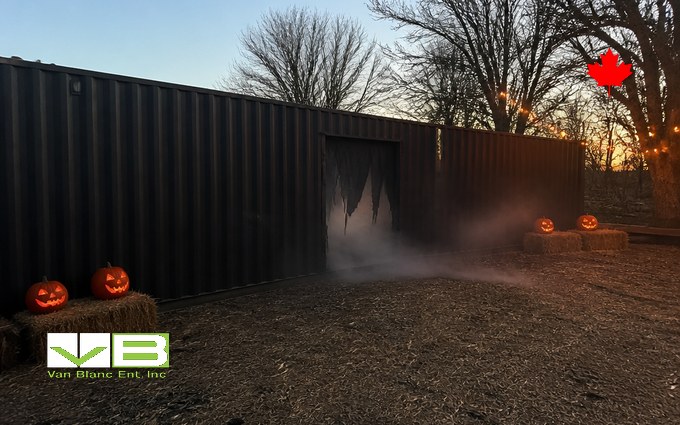
Quick Answer: Good haunted house ideas start with a theme, a backstory and a path that sets the pace. Then add darkness, sound, fog and live scares. For a haunted attraction, 40ft containers from Van Blanc become modular rooms and corridors, and plain boxes store all the props through the long off-season.
What This Haunt Build Guide Covers
- Haunted House Ideas Operators Actually Build
- What Makes a Haunted Attraction Work?
- Haunted House Themes That Last
- Backstory Plots for a Walk-Through
- Haunted House Characters for Scare Actors
- Pacing Fear in the Just-Right Zone
- Haunted House Lighting, Sound and Fog
- Props Worth Building First
- Haunted Attractions Near Toronto and Niagara
- Container Haunts From 40ft Boxes
- 40ft Inside Dimensions for Scene Planning
- Cut-Outs, Man Doors and Lead Times
- Off-Season Prop Storage in a Plain Box
- Grades for Show Boxes and Prop Boxes
- Delivery to Niagara, Toronto and Barrie
- Haunted Attraction Build Calendar
- Haunted House FAQs
Reading Time: 16 minutes
Haunted House Ideas Operators Actually Build
The haunted house ideas that survive a season share a skeleton. Pick one theme and commit to it. Write a short backstory that explains why the place is cursed. Lay out a path that forces guests through scenes in a set order, and plan where each scare lands on that path. Treat that pathway as the spine, with a dead end or two to slow people down. Then dress it: darkness first, then sound, fog, smell and texture, with live actors where the budget allows. Props come last, because a cheap prop in the right dark corner beats an expensive one under a work light. A home haunt in a basement and a ticketed farm attraction follow the same order. The difference is scale, and scale is where the building question starts. A farm or event operator who outgrows the barn can start with how festival crews keep their gear in steel between seasons.
Van Blanc is a family-run container supplier with 4 Brantford yards, in business since 1995. We sell the 40ft boxes that haunt builders turn into rooms and corridors, and the plain ones that hold the props from November to September. Christian LeBlanc, Paul’s son and a second-generation operator, walks buyers through the rows and the measurements.
Christian LeBlanc, second-generation operator, Van Blanc Ent. Inc.: “When the props come down after Halloween, they need somewhere dry to wait for eleven months. Bring the list of what has to fit and walk a forty with a tape measure. If next year’s maze needs a man door cut in, it goes on the drawing before anyone touches the steel.”
What Makes a Haunted Attraction Work?
A haunted attraction is a walk-through show where guests move through themed rooms while props, effects and actors try to frighten them. Van Blanc supplies the steel side of that business, from high cubes tall enough for an actor in costume to plain prop boxes. Most attractions run for a few weeks each fall. The good ones control the order of the scenes, the size of each group and the time a group spends inside. Nightmares Fear Factory on Clifton Hill in Niagara Falls puts that control in plain terms on its own FAQ page. The walk takes 10 to 15 minutes at your own pace, led by a trail of red lights. It caps a group at 6 people and recommends groups of 4, and it only sends families or friends in together. Each of those is a design choice. Small groups keep scares personal, and a set route keeps actors from guessing where guests will appear. Builders around Clifton Hill and the rest of Niagara Falls can study a working example near the Falls. The same principles scale down to a backyard.
The second thing that makes an attraction work is variety. The Better Homes and Gardens planning guide tells home builders to include a few dead ends so guests stop and think about their next move. Commercial haunts do the same with false doors, switchbacks and rooms that look empty until they are not.
Haunted House Themes That Last
A haunted house theme works when a guest can name it in three words and every room supports it. Specific beats general. “Abandoned asylum” gives the set builder a colour palette, a sound bed and a cast. “Spooky stuff” gives nothing. The themes below show up again and again because each one hands the builder ready-made rooms. Pick one and keep the props loyal to it, and save the rest for future seasons. A haunt that rotates themes needs room for the retired sets, the job of a depot that holds a season’s gear until spring.
| Theme | Rooms it hands you | Scare style | Works for |
|---|---|---|---|
| Abandoned asylum | Intake desk, ward, padded cell, operating room | Dread, then actor jumps | Teens and adults |
| Cursed farmhouse | Porch, kitchen, root cellar, barn loft | Slow build, sound cues | Farm attractions |
| Old factory or workshop | Loading dock, machine floor, office, boiler room | Loud mechanical startles | Industrial sites and lots |
| Carnival gone wrong | Ticket booth, funhouse mirrors, clown tent | Disorientation, strobe | Mixed ages with a lighter version |
| Witch’s woods | Trail, cottage, cauldron room | Atmosphere, fog, voices | Families and younger guests |
| Zombie outbreak | Quarantine tent, lab, overrun street | Chases and crowds of actors | Large cast, high throughput |
Scare level matters as much as theme. Decide early whether the house is family-friendly, teen and up, or adults only, and post it at the gate. Nightmares, for one, does not admit children under 6. Two scare levels can share one site as two separate runs of boxes, each on its own levelled gravel footing.
Backstory Plots for a Walk-Through
A backstory plot is the reason the place is haunted, told on a sign, a ticket or by a queue actor. It gives every room a job. Nightmares Fear Factory publishes its legend on its own site. The building is the old Cataract Coffin Factory, and owner Abraham Mortimer died under a falling stack of oak coffins the night trespassers broke in. The sets follow from that story, and Nightmares says what is inside changes at least four times a year. A container haunt can write the steel into the plot, as a cargo box that arrived sealed from overseas and should never have been opened. Used forties that crossed real oceans, each with its CSC plate suit that story. Good plots for a new haunt follow the same pattern. Name a place, name a person, name the night it went wrong. A farm haunt can use a lost harvest crew. A lot near the highway can use a trucker who never finished his last run. A plot also tells the builder what kind of room comes next. That makes it easier to sketch the build as boxes on paper, then walk the rows before you commit to any steel.
Keep the plot short enough to read in a queue. Guests should carry it into the first room, then let the rooms tell the rest.
Haunted House Characters for Scare Actors
Scare actor characters work best when each one belongs to the backstory and has a fixed spot. A curse story wants a keeper who greets the group, a victim who begs for help, and a pursuer who appears more than once. Classic haunted house characters include the caretaker, the patient, the butcher, the doll, the scarecrow and the thing in the walls. Give each actor a hidden position, a line or two and a way to reset after every group. A small cast covers more ground when actors slip between two scenes through a hidden passage. In a steel box, that passage can be a framed man door in a side wall. Screemers in Vaughan lists over 120 live actors across its mazes, a measure of what a large show puts on the floor. Rotate the loudest scares so no actor screams for five hours straight. Give every actor a break room out of sight, such as a lined box that holds some warmth between groups.
Pacing Fear in the Just-Right Zone
Scare pacing has research behind it. Researchers from Aarhus University’s Recreational Fear Lab fitted 110 participants with heart rate monitors. Then they sent them through a commercial haunted house in Vejle, Denmark, with nearly 50 rooms. The Association for Psychological Science’s Observer reported their finding: enjoyment followed an inverted U. Guests who were barely scared enjoyed it less, and so did guests who were scared too much. The lead researcher called it a “just-right” amount of fear. For a builder, that means alternating tension and release instead of stacking jump scares. Build dread in a long quiet corridor, hit hard once, then give the group a breath in a room that is strange but safe. A 40ft box is about 39 feet inside, a natural length for one build-and-release beat. Plan the full sequence on paper, then count the boxes it takes. The standard forty’s full spec sheet gives every inside measurement for that count.
A Scare Sequence That Follows the Curve
- Queue story: the backstory, told by an actor or a sign.
- Quiet room: odd details, low sound, no scare yet.
- First startle: one actor, one sound hit, then move the group on.
- Release room: something strange that does not attack.
- Build corridor: tight, dark, longer than it should feel.
- Peak scene: the biggest effect and the most actors.
- Exit beat: a last small scare as the group relaxes.
Haunted House Lighting, Sound and Fog
Haunted house lighting decides what guests see, and darkness does most of the work. Light only what you want noticed, from below or behind, and keep the path itself dim. A closed container starts at full dark, and a new one-trip box with tight doors and clean seals stays that way until you add light. Nightmares leads groups through total darkness with a trail of small red lights, which keeps people moving without showing them anything. Strobe, black light and slow colour changes each suit different rooms. Sound carries the backstory: a low drone under every scene, then a sharp cue at each scare. Fog softens edges and hides wires, but a little goes a long way in a small room. Smell and texture are the cheapest effects, from damp earth in a cellar scene to hanging strips that brush a face in the dark. A closed steel box has no windows to black out, so the effects start from a dark room. For a walk-through that runs into colder November nights, an insulated box for the late-season scenes keeps actors and electronics warmer between groups.
Props Worth Building First
Haunt props reward a builder who spends on placement instead of price. The popular DIY prop lists repeat the same workhorses because they work in the dark. Start with these, then add animatronics once the path and lighting are proven:
- Old dolls, weathered with paint and dirt, in a nursery or a shelf scene.
- Giant spider webs and foam spiders for a corridor ceiling.
- Window silhouettes and shadow figures backlit behind sheer fabric.
- Tombstones cut from foam board for a queue line or yard scene.
- Severed heads or jars on a shelf, lit from one side only.
- Flickering candles and lanterns on battery power.
- A haunted mirror or portrait that hides an actor’s window.
Each prop needs a home after Halloween, and foam, fabric and electronics hate damp. Shelving makes the difference between a prop store and a pile. Van Blanc sells ramps, shelf brackets and bridge fittings from our parts list. The three-tier shelving brackets hook into the wall without drilling, and the container ramp is rated for 6.5 tonnes.
Haunted Attractions Near Toronto and Niagara
Ontario’s best-known haunted attractions show what a full build looks like. Screemers, at Assembly Park in Vaughan just north of Toronto, says it is in its 30th year. It runs 7 haunted walk-through mazes with over 120 live actors. Nightmares Fear Factory, near the top of Clifton Hill, counts the visitors who chickened out before the end. The count read 200,872 on October 3, 2026. Both are reminders that a haunt is a business with seasons, staff and a lot of gear. Smaller shows planned around container drops across Toronto and its suburbs face the same two questions: where the rooms come from, and where the props live in spring. Neither attraction is a container build as far as their own sites say, and we name them only as examples of scale and pacing.
Container Haunts From 40ft Boxes
A container haunt uses shipping containers as the rooms and corridors of a walk-through. The 40ft size suits this work. A forty is long enough for one scene or a build corridor. The cargo doors give a wide opening for loading sets, and the steel shell is dark and weather-tight. Several boxes set end to end, side by side or in an L form a route. Our accessories list includes bridge fittings that tie two containers together, side by side or end to end, so they behave as one structure. Between seasons the same boxes lock up with the sets inside. For haunts on farms and open lots, Van Blanc delivers 40ft containers from our 4 Brantford yards, with a tilt-deck sliding each forty into its spot. A plain box placed as storage is a different job from a box guests walk through. For any box the public walks through, exits, fire safety and permits are set by your municipality and fire department, so check with both first.
Layouts From Four to Twelve Boxes
The layouts below are planning examples, not measured standards. A rule of thumb is one big scene or two small ones per 40ft box. Add one plain box, such as a used forty set aside for props and actor breaks.
| Boxes | Layout idea | Scenes, rule of thumb | Extra box for |
|---|---|---|---|
| 4 | Two pairs set end to end, joined by a short tent passage | 4 to 8 | Props and costumes |
| 6 | U shape around a queue yard | 6 to 12 | Actor break room |
| 8 | Two parallel runs with a switchback between them | 8 to 16 | Sound and fog gear |
| 12 | Two separate mazes sharing one entry and one storage row | 12 to 24 | Retired sets from past seasons |
Draw your route with the box sizes in the next section, then call with the count. Bigger orders arrive over more than one delivery, and the straight run a delivery truck needs behind the drop decides the placement order.
40ft Inside Dimensions for Scene Planning
A 40ft container’s inside dimensions set the size of every scene. Van Blanc’s product pages give the standard 40ft at 39 ft 5 in long, 7 ft 8 in wide and 7 ft 10 in tall inside. Its door opening is 7 ft 5 in high. The high cube has the same floor and one more foot of height: 8 ft 10 in inside, with a door opening 8 ft 5 in high. That foot matters for hanging props, ceiling drops and tall actors in costume. It is the reason to price a high cube whose ceiling clears a hanging prop for show rooms.
| Inside measurement | Standard 40ft | 40ft high cube |
|---|---|---|
| Length | 39 ft 5 in (12.029 m) | 39 ft 5 in (12.032 m) |
| Width | 7 ft 8 in (2.350 m) | 7 ft 8 in (2.350 m) |
| Height | 7 ft 10 in (2.385 m) | 8 ft 10 in (2.695 m) |
| Door opening width | 7 ft 8 in (2.340 m) | 7 ft 8 in (2.340 m) |
| Door opening height | 7 ft 5 in (2.280 m) | 8 ft 5 in (2.575 m) |
Figures from Van Blanc’s 40ft and 40ft high cube pages. Wall dressing, false walls and insulation all take inches from the width, so plan the walking path narrower than 7 ft 8 in.
Cut-Outs, Man Doors and Lead Times
Cut-outs and man doors turn a closed box into a set. Van Blanc does this work at our yards before delivery. The man doors, windows and roll-ups we cut in-house are listed with the rules we follow. Steel man doors and steel-framed windows come in custom sizes, cut into any wall under engineered drawings to keep the structure sound. Roll-up doors fit any face of the container in 6, 7, 8 and 10 foot widths, useful for a ticket window or a load-in wall. Heavy curtain systems split one box into two zones. Vents, lockboxes and window security bars round out the list. Electrical is roughed to spec at the yard, and a licensed Ontario electrician makes the final connection at your site.
Lead time depends on the build. A stocked box with no changes delivers in 1 to 3 days across most of Ontario. Security hardware and venting are quick, while cut-ins and insulation take real shop time. A modified container ships when the build is finished and inspected, on the date written into your quote, as our in-yard build process for cut boxes sets out. Every quote states the build schedule and the delivery date. A haunt that wants doors cut for next fall can order in spring or summer.
Off-Season Prop Storage in a Plain Box
Off-season prop storage is the simplest container job in the haunt business. A plain Van Blanc box with no cut-outs holds animatronics, fog machines, speakers, costumes, foam props and flats from November to September. Steel keeps out rain and rodents, and the cargo doors lock. What it needs is airflow, because foam and fabric soak up the damp that a closed box can trap in spring and fall. Factory vents help, and vents that let damp air out of a closed box can be added before delivery. Set the box level on a compacted gravel base under each corner so the doors keep swinging true. Inside, put heavy crates on the floor, light foam on shelves, and electronics in sealed bins off the deck. Keep a written list on the door so next September’s setup crew finds the right head on the first try. As a rule of thumb, a 40ft suits a small haunt’s whole kit, and a 20ft suits a home haunter with a garage full of props.
Pack the Prop Box in Show Order
Load the last scene first and the first scene last, so the doors open on the props you set up first next fall. Label every crate with its room name and the scene number from your plan, the same habit event crews use when they load a winter depot by gig order.
Grades for Show Boxes and Prop Boxes
Van Blanc sells four grades, and the buyer picks the one that fits the box’s job. Show boxes that guests see up close, or that get painted for a facade, can start as new one-trip forties with clean paint. Prop boxes and backstage boxes come from the new, cargo worthy and wind and watertight rows. Each grade below uses the wording on our own product pages.
- New (one-trip): one loaded voyage from the factory, clean paint and tight doors.
- Cargo worthy (CW): used 8 to 15 years, with current re-certification and surface rust.
- Wind and watertight (WWT): used 12+ years, sealed against weather, with heavier exterior rust.
- As-Is: project and donor shells, sold with the defects written down.
Those ages are the box’s age, not its remaining life. Used forties, each sold with its container number, let you pick the exact unit in the rows. To compare every unit we stock, ten-footers to fifty-threes, grade by grade, start at the main sale page.
Price a Haunt Box Before Next October
Tell us how many 40ft boxes your route needs, which ones get man doors or windows, and where they will sit. We will send one all-in number with a build schedule and a real delivery date. The fastest answer is a call.
Family-run in Brantford since 1995 · 4 Brantford yards · 4.9★ across 140+ Google reviews.
Delivery to Niagara, Toronto and Barrie
A haunt site might be a farm, a fairground or an open lot, and the truck needs a firm, straight approach to each spot. Van Blanc delivers stocked containers in 1 to 3 days across most of Ontario from our 4 Brantford yards. The table gives road distance and car time from east Brantford to three city halls, measured with the OSRM route planner. Where a fence or tree line blocks a tilt-deck, a crane truck that lifts a box over the obstacle is the other option.
| Where the haunt is | Road distance from east Brantford | Car time | Stocked delivery window |
|---|---|---|---|
| Niagara Falls haunts near the tourist strip | 110.6 km | 88 min | 1 to 3 days |
| Toronto | 101.4 km | 82 min | 1 to 3 days |
| Barrie, up Highway 400 | 178.6 km | 2 h 13 min | 1 to 3 days |
Modified boxes ship on the build date in the quote. Before you pay anyone, read about the cheap online listing that never shows up. People phone us about a Facebook bin listed well under any Ontario yard’s number, and some phone again two weeks later with nothing delivered.
Haunted Attraction Build Calendar
A haunted attraction runs on a twelve-month calendar, and the boxes fit into it at set points. November is teardown: props come off the walls and go into storage in show order. Winter is for the next theme, the backstory and the route drawn as boxes on paper. Spring is the time to order from Van Blanc, because cut-outs and doors need shop time before delivery. Summer is for set building inside the boxes, lighting tests and actor casting. September is dress rehearsal with a few friendly groups walking the route at real pace. October is the run. Van Blanc, run by the LeBlanc family since 1995, puts a date on each delivery to fit that calendar. For how those deliveries went for other buyers, what past buyers wrote about us is one click away.
Frequently Asked Questions
How do you make a good haunted house?
Pick one theme and a short backstory, then lay out a path that controls the order of scenes. Alternate quiet, tense rooms with sharp scares, because research on a Danish haunted house found guests enjoyed a “just-right” amount of fear most. Use darkness, sound and fog before expensive props, and keep groups small.
What are some good haunted house themes?
Proven themes include an abandoned asylum, a cursed farmhouse, an old factory, a carnival gone wrong, a witch’s woods and a zombie outbreak. Each one hands the builder ready-made rooms and a cast. Choose a theme a guest can name in three words, and match every prop and sound to it.
What are some good character ideas for a haunted house?
Strong characters belong to the backstory and hold a fixed spot. Think of a caretaker who greets the group, a victim who begs for help, a pursuer who returns, or a scarecrow. Give each actor a hidden position, a line or two and a quick reset between groups.
What are some good plot ideas for a haunted house story?
Name a place, a person and the night it went wrong. A lost harvest crew suits a farm haunt, and a trucker who never finished his last run suits a highway lot. Nightmares Fear Factory in Niagara Falls builds its maze around a coffin maker crushed in his own factory.
What is a haunted attraction?
A haunted attraction is a walk-through show, usually seasonal, where small groups move through themed rooms while props, effects and live actors try to scare them. Ticketed attractions control the route, the group size and the time inside, and many open only for a few weeks around Halloween.
What are some haunted attractions in Toronto?
Screemers, at Assembly Park in Vaughan just north of Toronto, runs 7 haunted walk-through mazes with over 120 live actors and is in its 30th year. Nightmares Fear Factory, a walk-through on Clifton Hill in Niagara Falls, is a day trip from the city.
How do you store haunted house props in the off-season?
Keep them dry, off the floor and in show order. A plain, vented steel container holds animatronics, fog machines, costumes and foam props from November to September. Put electronics in sealed bins, foam on shelves, and label each crate with its room. Van Blanc sells 20ft and 40ft boxes for this from 4 Brantford yards.
Sources
- Association for Psychological Science, Observer. (2020, November 30). Haunted House Researchers Investigate Playing with Fear, checked October 2026.
- Nightmares Fear Factory. Nightmares Fear Factory FAQ, The Legend of Abraham Mortimer and Nightmares Fear Factory home page, checked October 2026.
- Screemers. Screemers haunted attraction, Assembly Park, Vaughan, checked October 2026.
- Better Homes and Gardens. (2025). Haunted House Ideas That Both Kids and Adults Will Love, checked October 2026.
- Project OSRM. OSRM route planner, road distances to three city halls, checked October 2026.
See a Forty Before the Next Season
We have been supplying shipping containers across Ontario since 1995. Our public yard is at 90 Morton Avenue East, one of our 4 Brantford yards.
Van Blanc Ent. Inc., 90 Morton Ave E Unit 1B, Brantford, ON N3R 7J7, 519-754-6844.
Bring your route sketch and the list of props that need a home. Yard hours run 9:30 to 5 from Monday through Thursday, and 9:30 to 4 on Fridays. We can open a standard forty and a high cube side by side so you can stand in both. Worth the drive for unbeatable quality, family customer service with 30 years of experience.