
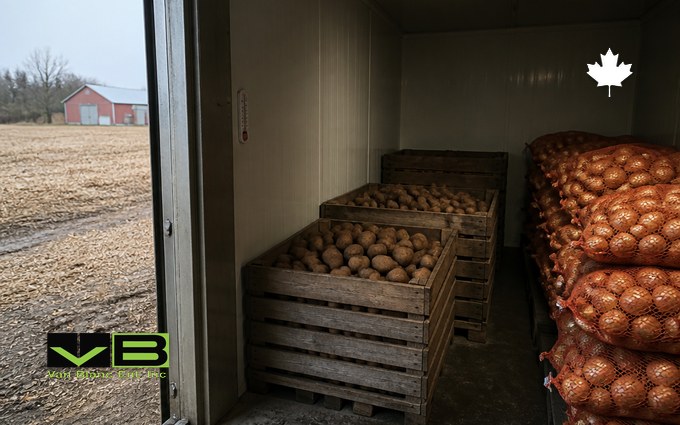
Quick Answer: Onion storage and potato storage need opposite air. OMAFRA’s Ontario vegetable guide puts dry onions at 0°C (32°F) and 65 to 70% humidity after a warm cure. Table potatoes cure at 15°C, then hold at 4.5°C to 5.5°C (40°F to 42°F), damp and dark. Never store the two crops together.
Inside This Potato and Onion Guide
- How Do You Store Potatoes and Onions?
- Onion Storage at 0°C and Dry Air
- Potato Storage Starts With a Warm Cure
- Onions and Potatoes Kept Apart
- Cold Room Basics in an Ontario Basement
- Market Gardens Outgrow the Basement
- One Insulated 20ft per Root Store
- The 20ft Shell, Measured
- Heating and Cooling, Kept Simple
- New or Used Steel Under the Foam
- A Root Store Season, Stage by Stage
- Delivery to Bradford, Barrie and Waterloo Region
- FAQs
Reading Time: 16 minutes
How Do You Store Potatoes and Onions?
Store potatoes and onions in two different places, each held at its own climate. A potato is a living tuber that wants cool, damp, dark air. A dry onion is a cured bulb that wants dry air close to freezing. One room cannot give both at once. Growers whose harvest has outgrown the basement can skip to a bermed steel cellar set into a hillside or the insulated boxes below.
Christian LeBlanc, second-generation operator, Van Blanc Ent. Inc.: “Growers ask whether one box can hold both crops. It can hold them, but it can only be set one way. Potatoes want the air damp and onions want it dry, so we walk people through two twenties side by side, one set up for each.”
Onion storage means holding cured, dry bulbs at 0°C with the humidity kept down. Potato storage means healing the skins in warmth first, then holding the tubers a few degrees above freezing in damp air with no light. Ontario’s agriculture ministry put both sets of numbers in its Guide to Vegetable Production in Ontario (Publication 839, 2024 edition), printed under the OMAFRA name. Iowa State University Extension gives close to the same advice for a backyard plot. Van Blanc sells containers from 4 Brantford yards, including insulated twenties fit for a root store. Every crop figure here comes from a named government, extension or grower source.
| Stage | Table potatoes | Dry onions |
|---|---|---|
| Cure temperature | 15°C (59°F) | 30°C (86°F), forced air |
| Cure humidity | 85 to 90% (Iowa State) | 60% |
| Cure length | 10 to 14 days | 3 to 4 days with heat; two to three weeks air-dried (Iowa State) |
| Cool-down after the cure | 1°C every 1 to 2 days | one or two degrees per week |
| Holding temperature | 4.5°C to 5.5°C (40°F to 42°F) | 0°C (32°F) |
| Holding humidity | 90 to 95% | 65 to 70% |
| Light | Dark, or the skins turn green (Iowa State) | Out of direct sunlight (National Onion Association) |
| Storage life | 5 to 10 months, late crop at 4°C | 1 to 8 months, by variety |
Figures in the table are OMAFRA’s from Publication 839 unless the cell names Iowa State, checked in October 2026. The potato humidity is OMAFRA’s late-crop figure. Its storage chapter adds a limit: as high as possible without water forming on the tubers or the walls. Wet walls come up again below.
Onion Storage at 0°C and Dry Air
Onion storage in Ontario aims at one setting: 0°C (32°F) and 65 to 70% relative humidity. OMAFRA gives dry onions a storage life of 1 to 8 months there. The Government of Saskatchewan’s onion guide ties the length to maturity and variety, and ranks yellow onions as the best keepers, then reds, whites and Spanish onions. OMAFRA adds that mature bulbs keep longer. Short-keeping cultivars, it notes, do not benefit from the sprout-inhibitor spray growers use on long keepers.
Warmth and damp are the two problems, and moving air handles the second. Van Blanc’s notes on how much air a closed steel box needs to stay dry matter more in an onion room than almost anywhere. Saskatchewan’s guide says temperatures above 0°C push stored onions to sprout, which leads to rot and moisture loss. Above 70% humidity, the same guide says, the roots start to grow. So an onion store runs drier than most of what a farm keeps over winter.
Cooling is slow on purpose. OMAFRA cools stored onions gradually so condensation does not form, dropping the room one or two degrees per week. Reaching 0°C can take one or two months. A room that steps down that evenly needs heat and controls, the subject of Van Blanc’s write-up on holding an insulated box just above freezing.
Curing Onions Before They Go In
Curing dries the neck and outer skins so the bulb seals itself. OMAFRA’s harvest notes say dry bulb cooking onions come off Ontario fields from late August to October. They are typically windrowed, then set into pallet boxes to cure. OMAFRA’s optimum is a heated forced-air building at 30°C (86°F) and 60% relative humidity for 3 to 4 days. Garden curing takes longer. Iowa State’s version is two to three weeks in a warm, dry, well-ventilated shed or garage. The tops and necks should be dry and the outer scales should rustle.
A heated cure frees the farm from September weather, and it sits well in a yard already running a container wash-pack beside the walk-in cooler. The payoff shows up months later. OMAFRA links proper curing and drying to less Botrytis neck rot in storage. It says heat curing often reduces problems in the humid parts of the province. It also has growers grade out onions with thick necks, nicks or bruises before storage.
Bags, Air Gaps and Stack Height
The National Onion Association’s handling tips read like a warehouse checklist. Keep bagged or boxed onions at least one foot from walls and other pallets so air can move around them. Keep stacks at five feet or less. Never wrap onions in plastic or store them in plastic bags, because trapped air shortens storage life. Mesh bags and open-sided pallet boxes both pass that test, on a garage shelf or inside a steel farm store. The association adds one more line: do not store onions with potatoes, or with other produce that gives off moisture.
Potato Storage Starts With a Warm Cure
Potato storage begins warm. Potato curing is the short warm spell after digging that lets cuts and bruises heal before the long hold. OMAFRA says healing runs fastest at a tuber temperature of 15°C (59°F). Growers cure at that temperature for at least 10 to 14 days at the start of storage. Iowa State’s home version is 50 to 60°F at 85 to 90% humidity for two weeks. After the cure, OMAFRA lowers the store by 1°C every 1 to 2 days to the holding temperature.
That slow step-down asks a lot of a basement. A cold room in October follows the weather and the house. It cannot hold 15°C one week and 5°C two weeks later on command. An insulated room with a thermostat heater and a way to cool can. Van Blanc’s guide to choosing the heater and the cooler for an insulated container belongs in the potato plan.
Holding Temperature by Use
OMAFRA sets three holding temperatures, and the right one depends on where the potatoes are going.
| Potatoes kept for | Holding temperature | What the range guards against |
|---|---|---|
| Eating (table stock) | 4.5°C to 5.5°C (40°F to 42°F) | Sweetening below 40°F, sprouting above 50°F (Iowa State) |
| Planting next spring (seed) | 3°C to 4°C (37°F to 39°F) | Sprouting (OMAFRA) |
| Chips and fries (processing) | 10°C to 12°C (50°F to 53°F), never below 5°C (41°F) | The build-up of sugars (OMAFRA) |
Iowa State explains the trade-off from the kitchen side. Below 40°F, potatoes develop a sweet taste, which fades again at room temperature. Above 50°F, the tubers may begin to sprout in two to three months. OMAFRA says the same in grower terms: a sprout inhibitor becomes necessary for long storage at 10°C.
Dark, Damp and Never Wet
A working 20ft reefer with its own refrigeration unit holds a set temperature by itself, while an insulated box needs that equipment added. Either way, potatoes need darkness first. Iowa State puts it plainly: potatoes turn green when exposed to light. They need humidity next. OMAFRA’s commercial table lists late-crop potatoes at 4°C and 90 to 95% relative humidity, with a storage life of 5 to 10 months. Iowa State’s home figure for average storage life is 5 to 8 months.
Wet tubers are the exception to the damp rule. If soft rot is widespread, or the potatoes go in wet, OMAFRA says to keep the humidity down until they dry. Its disease notes explain why: bacterial soft rot spreads rapidly in warm, humid conditions, and bruising opens the way in. Damp air also puts the walls in play, since moist air on cold steel ends up as drips. A potato store wants closed-cell foam sprayed over every wall.
Handling counts as well. OMAFRA’s seed potato advice keeps drops under 15 cm (6 in.) to limit bruising. It warns that cold tubers bruise more easily, and has growers warm seed to at least 7°C to 10°C (45°F to 50°F) before handling it. That advice is written for seed potatoes.
Onions and Potatoes Kept Apart
Onions and potatoes stored together fail on humidity first. The onion target is 65 to 70%, and the potato target is 90 to 95%. A room set for one is wrong for the other. Set the air for potatoes and the onions sit far above 70%, where Saskatchewan’s guide says their roots start to grow. Set it for onions and the potatoes sit well below the damp air OMAFRA lists for them.
Temperature splits them too, and it decides where each crop sits in a farm’s on-site storage. The onion room runs at 0°C, and Iowa State’s sweetening line for potatoes is 40°F. A potato held in the onion room turns sweet, and an onion held in the potato room drifts toward sprouting. Fruit is a third problem: Iowa State keeps apples away from stored potatoes, because ripening fruit gives off ethylene gas that promotes sprouting. Fruit belongs in an insulated cooler of its own. Garlic, on the other hand, travels with the onions. OMAFRA lists garlic at 0°C to 1°C (32°F to 34°F) and 60 to 70% humidity. It keeps 6 to 7 months there, close enough to share the onion setting.
Whole Onions, Cut Onions and the Fridge
Whole storage onions keep in a cool, dry, well-ventilated room, the National Onion Association’s advice for dry bulb onions. Its FAQ makes one exception: sweet onions hold more water, so they keep longer wrapped in paper towels in the fridge. Cut onions go there too and keep several days sealed. Whole potatoes stay out for another reason: Iowa State says they turn sugary below 40°F.
Cold Room Basics in an Ontario Basement
A cold room is an unheated basement room kept cold for preserves and root vegetables. Home inspectors describe it as an underground space, typically under a porch, with no insulation and vents for air exchange. The ground and the outside air do the cooling. They do the same job for a container cellar banked with soil on three sides, which Van Blanc covers in its own guide. A door and an inside wall keep the house out.
Natural Resources Canada’s Keeping the Heat In guide treats that inside wall as an outside wall. Insulate it on the heated side, and weatherstrip and insulate the door. If the room runs too warm or the floor above runs cold, insulate the cold room ceiling as well. Then check the winter temperature, the guide says, so the room can be adjusted before anything freezes. Set up that way, a basement cold room suits a household’s sacks of potatoes and shelves of preserves.
The limit is that a cold room has one climate, and the weather sets it. Basement contractors who repair cold rooms list the usual faults. Warm basement air leaks in and condenses on cold concrete, the same problem passive vents and powered fans fight in a container. The room runs too warm in summer and too cold in winter, and mould grows where those swings leave moisture. For potatoes and onions the bigger issue is simpler. One room cannot run damp for one crop and dry for the other.
The home workaround is to split them: potatoes in the cold room, onions somewhere cooler and drier. A market garden needs more than a workaround.
Market Gardens Outgrow the Basement
Market gardens that sell through the winter store their crop by the pallet box. Potatoes and onions are two of the crops that can carry sales from harvest into spring. OMAFRA’s storage table gives them months, where lettuce gets 2 to 3 weeks. A CSA with winter shares or a locked farm stand at the end of the lane draws on the same stored crop each week.
At that scale the cold room question changes. The harvest no longer fits a basement and the cure needs heat on demand. The two crops also need two climates for most of the winter. A barn bay can be walled and insulated too. A container arrives enclosed and lockable, Van Blanc can foam it in the shop before it ships, and it is sold outright.
Holland Marsh Onion Country
The Holland Marsh Growers’ Association counts more than 60 crops on 7,000 acres of drained muck between Bradford, Newmarket and Schomberg. It names onions beside carrots and salad greens among the marsh’s headline crops. In Farmtario’s centennial report, the manager of the Ontario Crops Research Centre in Bradford calls the marsh the largest pocket of muck soil in Ontario. Market gardens across Waterloo Region and Simcoe County face the same winter question at a smaller scale.
One Insulated 20ft per Root Store
An insulated 20ft container is a steel room with insulation in its walls and roof, and Van Blanc’s three insulated builds all sell outright. The first is a factory-insulated unit with panels in the walls, ceiling and floor. We usually hold one or two of those 20ft units in stock. The second is a standard twenty that our shop sprays with two to three inches of closed-cell foam, then lines. The third is a non-operating reefer: a used refrigerated box whose cooling unit no longer runs, factory panels intact.
One box per crop follows from the guides’ numbers. The potato box is set to run at 4.5°C to 5.5°C and 90 to 95% humidity, in the dark. The onion box is set to run at 0°C and 65 to 70%, with the garlic beside the onions. Both can start as new one-trip twenties with clean steel inside, the cleanest wall for foam to bond to. Two boxes give each crop its own air, which a basement cold room cannot do. A garden storing only potatoes starts with one box and adds the second when the onion crop grows.
The Potato Box
The potato box is the damp one. It starts the season as a curing room at 15°C for 10 to 14 days. Then it steps down 1°C every 1 to 2 days to the holding range. It needs a heater on a thermostat for the cure and the deep-cold weeks. It needs a way to shed heat on warm autumn days, and a humidifier for the dry stretches. The farmstead cheese room built inside a container holds damp air the same way, with a humidifier doing the work. Pallet boxes sit off the floor with gaps between them for air. The doors stay shut except for loading, because light greens the tubers.
The Onion Box
The onion box is the dry one, and with heat and fans it can run the cure itself. Held at 30°C and 60% humidity, with powered fans pushing air through the pallet boxes, an insulated twenty becomes the forced-air curing room OMAFRA describes. After 3 to 4 days the cure heat goes off. An outside-air controller or a cooling unit then steps the box down one or two degrees a week toward 0°C. Through the deep-cold weeks the heater stays on its thermostat, so the room holds near 0°C instead of following the weather down. The fans keep running all winter. When the humidity climbs past 70%, a dehumidifier or a small exchange of outside air brings it back down. Garlic shares the shelves.
The 20ft Shell, Measured
The 20ft dry container is the starting shell for both root stores, and the dry twenty’s full spec sheet on the Van Blanc site has every figure. Foam and liner take their thickness off each inside face, so measure the finished box before ordering pallet boxes or shelving. The table shows the bare shell and what each insulated build changes.
| Measure | Standard 20ft shell |
|---|---|
| Inside length | 19 ft 4 in (5.898 m) |
| Inside width | 7 ft 8 in (2.352 m) |
| Inside height | 7 ft 10 in (2.385 m) |
| Inside volume | 1,172 cu ft (33.2 m³) |
| Door opening | 7 ft 8 in wide by 7 ft 5 in high (2.343 m by 2.280 m) |
| Empty weight | 2,260 kg (4,982 lb) |
| Spray-foam build | Two to three inches of closed-cell foam, then a liner; inside shrinks by both |
| Factory-insulated build | Panels in the walls, ceiling and floor; inside shrinks by the panel |
The empty weight matters for the pad, and an insulated box weighs more than a bare one. A man door cut into the side wall means a February check does not swing the cargo doors open on a full store.
Heating and Cooling, Kept Simple
Insulation only slows the outside down, so holding a target takes equipment. Van Blanc’s shop can put vents, a man door and electrical rough-in on the build sheet before delivery. The rest of the list is short. It covers a heater on a thermostat, a fan or two for the bins, a way to cool and a thermometer that reads humidity too. One that sends an alert when the box drifts saves a cold walk at night.
Cooling can come two ways. One is outside air, through a fan on a controller that opens to the outdoors only when the night is colder than the store. The other is a refrigeration unit, the same kind of add-on that turns a reefer shell with a dead compressor back into a cold room. Sizing either one is a job for a refrigeration contractor. The final connection to power on your site is work for your own licensed electrician.
Foam placement matters most in the damp potato box. On a spray-foamed retrofit, the ribs and corner posts are still steel on the outside, and cold steel sweats where warm, wet air reaches it. Van Blanc’s piece on thermal bridges at the roof and posts shows where that happens and how to keep the potato air off the metal.
New or Used Steel Under the Foam
Van Blanc sells four grades. Under foam the grade matters more than anywhere, because the foam hides the wall for good.
- One-trip (new): one loaded voyage, factory paint and bare, clean steel inside. Our first pick for a foamed room that gets a liner and daily use.
- Cargo worthy: used and certified for shipping. A unit with a solid floor and rust-free inside walls bonds well to foam, and it suits most farm storage builds.
- Wind and watertight: used, sealing doors, no holes. Clean inside walls are the condition for foam, because rust under foam keeps working where nobody can see it.
- As-is: the project box with structural question marks, bought for parts and donor builds. It suits other jobs better than a root store.
To compare boxes before you call, seven sizes and four grades laid out on one sale page is the place to start. On a factory-insulated unit or a non-operating reefer, look at the liner instead of the wall. Check that the panels are unbroken and the door gaskets close tight, then step on the floor, which should stay firm. The guide to what each step up the grade ladder buys explains how grade moves the quote.
Price the Potato Box and the Onion Box
Tell us how many pallet boxes of potatoes and onions you carry into winter, where the boxes would sit and your postal code. We will say which insulated build fits each crop and send one all-in number with a real lead time.
Family-run in Brantford since 1995 · 4 Brantford yards · 4.9★ across 140+ Google reviews.
A Root Store Season, Stage by Stage
A two-box root store runs on a calendar the crops set. The table follows both boxes from the field to the last sale.
| Stage | Onion box | Potato box |
|---|---|---|
| Harvest | Onions lifted late August to October, cured 3 to 4 days at 30°C (86°F) and 60% | Box held at 15°C (59°F) for the cure |
| After the cure | Down one or two degrees per week toward 0°C (32°F) | After 10 to 14 days, down 1°C every 1 to 2 days |
| Winter hold | 0°C (32°F), 65 to 70%, fans running, garlic alongside | 4.5°C to 5.5°C (40°F to 42°F), 90 to 95%, dark |
| Weekly check | Pull sprouting or soft-necked bulbs | Look for wet spots and green skins |
| Last sales | Within 1 to 8 months, by variety | Within 5 to 10 months for a late crop |
The weekly check is easier in a box. A walk to a container with a lockbox on its doors and a light inside beats shifting sacks in a basement. Pulling one soft onion in November also keeps the rot from spreading through the bag.
Delivery to Bradford, Barrie and Waterloo Region
Van Blanc delivers on its own tilt-deck trucks. Stocked boxes get fast 1-3 day delivery to every region across Ontario, shipped from our 4 Brantford yards. A twenty that goes through the foam shop ships when the build is done, and every quote comes with a real lead time, not a hopeful one. Measured on the OSRM route planner from east Brantford, the run is about 49 km to Kitchener and the farm roads of Waterloo Region. It is about 149 km to onion growers working the muck near Bradford, by Highway 403, the 407, a short stretch of the 401 and Highway 400. It is about 179 km to Simcoe County farms on the Barrie side of the lake.
Timing matters more than distance. Onions start coming off Ontario fields in late August, so the box that cures them is best ordered in midsummer. That leaves time to have it set and powered before harvest.
Pad, Doors and the Truck’s Approach
A tilt-deck driver needs a 70-foot straight-line approach to the drop spot, with a level pad at the end of it. Packed gravel with blocks under the corner castings is the standard base. A compacted stone pad built in lifts holds the heavier insulated box without settling. The delivery-day sequence on a tilt-deck covers the truck side of the day.
Face the doors away from the prevailing wind, since doors are the weak point of an insulated box. Leave room between the two boxes for a pallet jack or a forklift to swing. Put the potato box where its humidifier can reach water. Permits are managed by your municipality, so check with your local building or planning department before you order.
Frequently Asked Questions
What is the best way to store onions to keep them fresh?
Cure them until the necks and outer skins are dry. Then keep them at 0°C (32°F) and 65 to 70% humidity, out of the light, with air moving through mesh bags or slatted crates. OMAFRA gives dry onions 1 to 8 months at that setting, and Saskatchewan’s onion guide says maturity and variety decide how long a crop keeps.
Is it better to put onions in the refrigerator or leave them out?
Leave whole storage onions out, in a cool, dry, well-ventilated room, as the National Onion Association advises for dry bulb onions. Sweet onions are the exception in its FAQ: they hold more water and keep longer wrapped in paper towels in the fridge. Sealed and refrigerated, cut onions keep for several days.
How do you store onions for 6 months?
Start with a storage variety, cure it fully and hold it at 0°C and 65 to 70% humidity. Saskatchewan’s onion guide ranks yellow onions as the best keepers, then reds, whites and Spanish onions. Cool the bulbs gradually, one or two degrees per week, and check them weekly for sprouts and soft necks.
What’s the best container to store onions?
Anything that lets air through: mesh bags, slatted crates or open pallet boxes, kept clear of the walls and stacked no higher than five feet. Plastic bags cut off the air and shorten storage life. For a market garden’s whole crop, a Van Blanc insulated 20ft shipping container works as the onion room. A thermostat heater, fans and a way to cool hold it at 0°C.
Can you store onions and potatoes together?
No. Potatoes want 90 to 95% humidity and onions want 65 to 70%, so a room set for one is wrong for the other. The National Onion Association also advises against storing onions with potatoes. Keep the two crops in separate rooms or separate insulated containers.
How long do potatoes last in storage?
OMAFRA lists late-crop potatoes at 5 to 10 months in commercial storage at 4°C and 90 to 95% humidity. Iowa State gives 5 to 8 months as the average for home storage. Cure them first and keep them dark and above 40°F so they do not turn sweet.
What is a cold room in a Canadian house?
A cold room, or cold cellar, is an unheated basement room, often under the front porch, kept cold for preserves and root vegetables. Natural Resources Canada advises insulating the wall and door between it and the heated basement. It also says to check the winter temperature so the room does not freeze.
Sources
- Ontario Ministry of Agriculture, Food and Rural Affairs (2024). Guide to Vegetable Production in Ontario, Publication 839: Table 3-1, the onion chapter (harvest, curing, Table 7-82, Botrytis neck rot) and the potato chapter (storage, seed handling, soft rot). OMAFRA Publication 839 guide page; Publication 839 full PDF, checked October 2026.
- Extension crop guides: Iowa State University Extension and Outreach, Storing Winter Storage Vegetables (A. Steil, 2025); Government of Saskatchewan, Onion. Iowa State winter storage vegetables guide; Saskatchewan onion growing and storage page, checked October 2026.
- National Onion Association. Storage and Handling. National Onion Association storage and handling tips; FAQs, National Onion Association onion FAQs, checked October 2026.
- Cold room guidance: Natural Resources Canada, Keeping The Heat In, Section 6: Basement insulation; Inspection Services Group, Cold Rooms: Are They Useful or Just a Source of Problems?; WetBasements, The Science Behind Basement Cold Rooms. NRCan Keeping the Heat In, basement section; Inspection Services Group cold room article; WetBasements cold room science article, checked October 2026.
- Holland Marsh: Holland Marsh Growers’ Association, Our Community; Farmtario (D. Martin, October 8, 2025), Holland Marsh marks a century of agricultural innovation and resilience. Holland Marsh Growers’ Association community page; Farmtario Holland Marsh centennial report, checked October 2026.
- OpenStreetMap OSRM route planner, driving routes from east Brantford (43.1525, -80.2370) to Kitchener City Hall, Bradford and Barrie City Hall. OSRM route to Bradford, checked October 2026.
See Insulated Twenties at Morton Avenue East
We have been supplying shipping containers across Ontario since 1995. Our public yard is at 90 Morton Avenue East, one of our 4 Brantford yards.
Van Blanc Ent. Inc., 90 Morton Ave E Unit 1B, Brantford, ON N3R 7J7, 519-754-6844.
Bring your harvest numbers: how many pallet boxes of each crop, and how long you sell into spring. Walk-in hours run Monday to Thursday 9:30 to 5 and Friday 9:30 to 4. We can open an insulated unit and a standard twenty next to each other, so you can see the foam and the liner before you decide. Worth the drive for unbeatable quality, family customer service with 30 years of experience.