
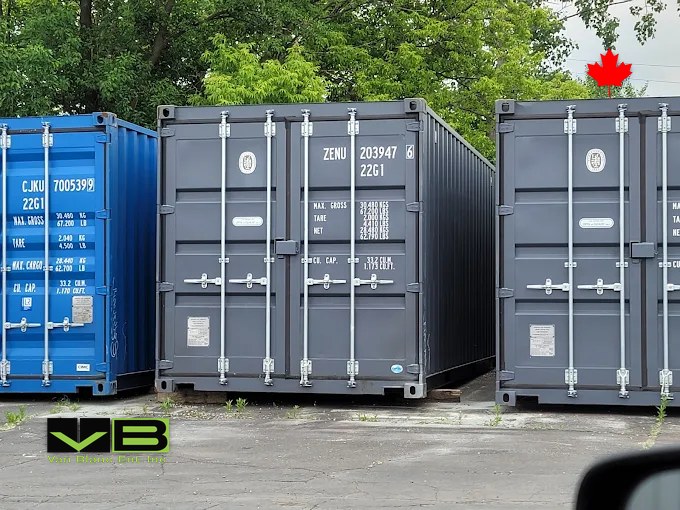
Quick Answer: Seasonal equipment storage works best when the storage sits where the equipment lives: a 20ft or 40ft container on your own property. Load the off-season fleet in one afternoon, swap it at the season change, and stop paying year-round for space you use twice. All of Ontario runs on this rotation.
On This Page
Reading Time: 8 minutes
Every Ontario Property Runs Two Fleets
Ontario’s climate quietly forces every property to own two of everything. There is a summer fleet, mowers, trimmers, patio sets, boats, bikes, gardening arsenal, and a winter fleet, snowblowers, sleds, shovels, sand buckets, the auger and the hut, and for roughly half of every year, half of that equipment is dead weight in the exact space the other half needs. Businesses live a bigger version of the same problem: the patio, the seasonal line, the winter machines, all of it stored at year-round cost for part-year use. The paddle craft in that summer fleet are the awkward ones, and where a kayak or canoe should spend the winter sorts the rack, the hoist and the tarp on the lawn.
The garage was never going to win this fight, and the locker across town only moves the problem somewhere less convenient at a monthly price that never sleeps. The tool that actually fits the shape of the problem is a steel sea can on the property: one dedicated home for whichever fleet is off duty, close enough that the seasonal swap takes an afternoon instead of a rented trailer and a lost Saturday.
Christian LeBlanc: “The seasonal customers are the happiest people on our delivery board, because their problem is completely solved twice a year, every year. The box eats the snowblower in April and the mower in November, and in between nobody thinks about it at all. That is what good storage is supposed to feel like: boring.”
The Rotation Method, Properly Done
The rotation is simple, and doing it well is mostly discipline. Twice a year, at the season change, the fleets trade places: everything coming off duty gets cleaned, dried, and fuel-stabilized, then goes into the container; everything coming on duty comes out, gets serviced, and goes to work. The container holds exactly one fleet at a time, which means it can be half the size a both-fleets building would need.
The Swap-Day Checklist
- Dry everything: moisture rides in on the equipment, so wash-and-dry happens before loading, never after.
- Stabilize fuel or drain it: small engines winter far better empty or stabilized than half-full.
- Batteries out, indoors: cold storage is fine for steel, unkind to batteries.
- Heavy on the floor, light on racks: machines roll in first, hand tools and totes rack above along one wall.
- Leave an aisle: the mid-season retrieval always happens; plan for it on load day.
What Actually Fits: Sizes Against Real Machines
| Size | Capacity | Holds, realistically |
|---|---|---|
| 20ft dry | ~33 m³ | Two sleds plus trailer gear, or a ride-on mower fleet, or a full patio season with the bikes |
| 40ft dry | ~67 m³ | A grounds crew’s summer arsenal, a small farm’s implement overflow, a restaurant’s whole patio |
| 40ft high cube | ~76 m³ | Racked seasonal stock at forklift height, tall implements, event infrastructure |
The honest sizing rule: measure the biggest single machine, then count the floor footprint of everything else. Equipment stores by floor space, not volume, because most of it cannot stack. A 20ft floor is roughly 6 metres by 2.4; walk the fleet through that rectangle mentally and the size question usually answers itself. When it does not, two photos of the pile and a call to the yard settles it in five minutes.
Who Rotates: Farms, Trades, Households, Main Streets
Farms invented the pattern: implements that work six weeks a year have wintered in steel since the first sea cans reached Ontario concessions, because a machine shed costs a barn’s price and the container costs a call. Grounds and landscaping trades run the commercial version, wintering the mower fleet in the same box that summers the plows and salters, and the box follows the company, not the lease. A golf course runs the same swap across a whole property, from the fall close of an Ontario golf course to the tee markers and carts that come in for winter.
The vocabulary shifts with the fleet, and the box does not mind. The farmer’s sea can, the contractor’s c-can, and the retailer’s storage bin are the same wind and watertight steel doing the same seasonal duty, and by the second season most buyers have stopped calling it anything but ours. That possessive is usually the first sign a second box is coming.
Households run it at driveway scale, cottage country runs it on the spring-out fall-in calendar, and main-street businesses rotate stock instead of machines: the patio season, the holiday season, and the sidewalk-sale inventory each taking their turn in steel behind the building. The event and production worlds run the deepest version, whole show seasons cached between bookings, and we keep dedicated walkthroughs for them in the festival equipment storage guide and the production equipment playbook. At a house, the patio set joins that rotation each October, and putting the patio set and its cushions away for an Ontario winter sorts it by material before it goes into the box.
Price a Seasonal Container
Tell us what the off-season fleet looks like and the address, and an all-in purchase number comes back, usually the same day. Recurring seasonal buyers adding a second box get the easiest quote in the book: we already know your corner.
Family-run from Brantford since 1995 · 4.9 stars across 140+ Google reviews · Real lead times, stated in the quote
Keeping a Parked Fleet Dry, Honestly
Equipment storage is where container condensation myths go to work, so here is the straight version. The box does not leak; wind and watertight grade means exactly that. What happens is that moisture rides in on the equipment, a washed quad, a dewy mower deck, damp tarps, and then breathes onto the ceiling through warm-cool cycles. The fix is loading dry, keeping machines off fresh wash days, and, for long hauls through humid months, passive vents that let the box breathe. The full logic lives in the ventilation guide’s container-rain walkthrough, and vents install at our yard before delivery when the duty calls for them.
Rodents get the same honest treatment: the sealed box shuts them out, and the discipline that matters is not leaving seed, feed, or upholstered bait inside. Fuel gets stabilized, batteries come indoors, and the fleet that goes in clean comes out ready for a service and a season.
Rent by the Season or Own the Corner
The purchase math for seasonal duty is friendlier than most buyers expect, because a box that only works six months a year still works every year, and a used wind-and-watertight unit costs about what a couple of seasons of rented space would. Van Blanc does not rent; households buy outright, and businesses that run the same rotation every year can finance the purchase through their own bank or equipment financer. Why we sell instead of metering steel is laid out on the page every rental searcher lands on, and the yard will size the box and quote the purchase on one call.
Twice a year, Ontario trades one fleet for another. The properties that do it calmly all have the same thing in common: a steel corner where the off season sleeps. A backyard rink is one more winter fleet, and a backyard rink from first flood to spring teardown shows where its boards and liner go in March.
Sold outright. Delivered in 1 to 3 days.
Van Blanc sells new and used shipping containers outright from our 4 Brantford yards, with delivery in 1 to 3 days and payment on delivery. We do not rent, lease or offer rent-to-own. Request a sale quote or call the yard at 519-754-6844.
Seasonal Equipment Storage FAQs
Can a rented container store a snowblower and mower year-round?
A container can, and Van Blanc sells them rather than renting them, so yours stays put through every swap. That alternating pair is the classic seasonal rotation: one machine works while the other sleeps in the box, trading places spring and fall. A 20ft handles both plus the hand-tool layer with room for an aisle, and the swap takes an afternoon at your own door.
Will small engines survive months in a container?
Yes, when they go in right: fuel stabilized or drained, batteries removed indoors, and the machine loaded dry. The container’s job is keeping weather and rodents out, and it does that; the engine’s winter is decided by the hour of prep before loading.
What size container does a landscaping crew need for winter?
Most one-crew operations winter the mower fleet, trimmers, and hand tools in a 40ft with an aisle to spare; a 20ft covers a lean setup. Measure the largest machine, count floor footprints for the rest, and send two photos with the quote if the answer is not obvious.
Is renting seasonally cheaper than a year-round locker?
Van Blanc sells rather than rents, so the comparison we can price is owning: a bought container stops costing anything once it is paid for, while a locker bills all twelve months every year, and equipment-scale lockers barely exist. The box also sits at your property, which turns every retrieval from a drive into a walk.
Can the same container serve a business every year?
Yes, and that is the case for owning it: the box holds the same corner every year with nothing to rebook, and it has paid for itself by about the second or third season.
Sources
- Ontario Ministry of Agriculture, Food and Agribusiness. (2025). Farm equipment storage and maintenance guidance. the ministry’s website
- Canadian Centre for Occupational Health and Safety. (2025). Small engine and fuel storage safety. CCOHS fuel storage safety
- International Organization for Standardization. (2013). ISO 1496-1:2013, Series 1 freight containers, Specification and testing. ISO 1496-1:2013 at iso.org
Reach Van Blanc in Brantford
We have been supplying shipping containers across Ontario since 1995. Our warehouse is at 90 Morton Avenue E in Brantford, and we deliver right across the province with honest quotes and real lead times.
Van Blanc Ent. Inc., 90 Morton Ave E Unit 1B, Brantford, ON N3R 7J7, +1 888-509-6658
Whichever fleet is about to go to sleep, the box for it can be on your ground this week. Call the yard and we will put a number on the box.