
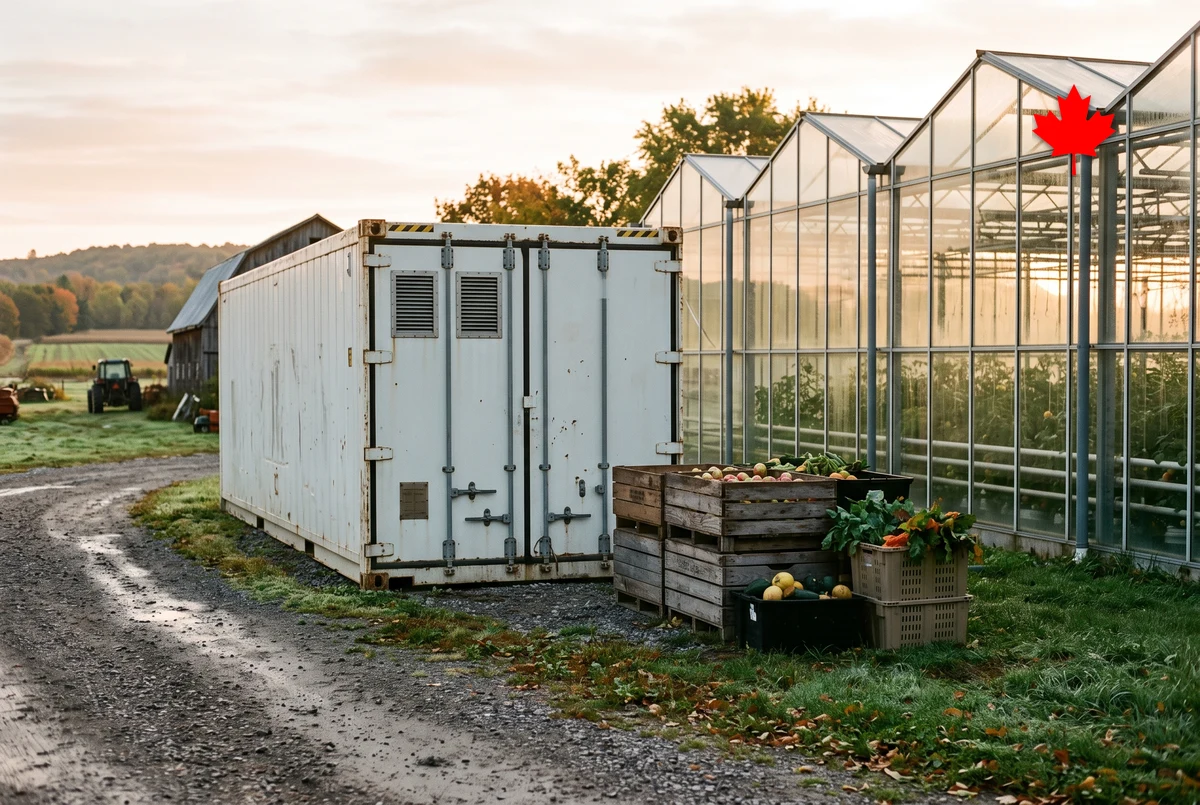
We sell containers. We do not rent.
Van Blanc sells shipping containers outright. We do not rent, we do not lease, and we do not offer rent-to-own. Renting comes up on this page because buyers compare it against owning, and that comparison is worth reading, but purchase is the only arrangement we offer. Stocked units deliver from our Brantford yards in 1 to 3 days. Request a sale quote or call the yard at 519-754-6844.
Quick Answer: Ontario’s harvest crunch runs August through late October, and a refrigerated shipping container is the fastest way to add cold storage on your own site. Van Blanc sells 20ft and 40ft high cube reefers from Brantford with 1-3 day delivery across Ontario, outright only; we do not rent. Order yours before pack-out season starts.
In This Guide
Reading Time: 9 minutes
Why August Is When Ontario Farms Call About Reefers
A reefer container is a refrigerated shipping container: an insulated 20ft or 40ft high cube steel box with a built-in refrigeration unit that holds product anywhere from roughly -30°C to +30°C. During Ontario’s harvest window, it works as instant, lockable cold storage parked right at the packing line, the orchard lane, or the loading dock. Van Blanc has supplied reefers from our Brantford yard since the days when most of them were coming off ocean fleets with plenty of compressor life left.
The calls follow the crops. Field tomatoes and peppers push pack-out from mid-August. Apples come off Norfolk and Georgian Bay orchards from early September into November. Greenhouse operations in Essex and Niagara clear late-cycle produce while the next planting goes in. Every one of those operations hits the same wall in the same month: the cooler that was big enough in July is not big enough in September.
Paul LeBlanc, Owner: “The harvest reefer calls start the first week of August, every year, like a clock. The growers who call us in August get their pick of the reefers. The ones who call the last week of September are choosing from whatever is left in every yard in Ontario, not just ours.”
That is the whole reason this article exists. If a reefer is part of your fall plan, the order happens now, in August, while units are still sitting in rows at the yard.
What Does a Reefer Container Do During Harvest?
A harvest reefer is buffer capacity. Product comes off the field faster than it can be graded, packed, or shipped, and every hour it sits warm costs shelf life. The Ontario Fruit and Vegetable Growers’ Association reports that just over half the apples grown in this province now go into controlled-atmosphere storage, which tells you how seriously Ontario growers take post-harvest cooling. A reefer at the packing line is the short-term version of the same logic: pull field heat out of the product the same day it comes off the plant, hold it stable, and ship on your schedule instead of the weather’s.
The Pack-Out Buffer, In Practice
A 40ft high cube reefer holds roughly 60 cubic metres of palletized product. During a typical pack-out day, that is the difference between stopping the line at 4 p.m. because the cooler is full, and running until the crew goes home. The container sits on gravel or asphalt beside the line, runs off site power, and locks like any other sea can overnight.
The other seasonal job is overflow. Fixed cold rooms are sized for an average year. In a heavy crop year, the average is wrong, and expanding a built cooler takes a construction season you do not have. A reefer lands in 1-3 days from our Brantford yards, and after the crop ships it stays on site for the next one. Every quote comes with a real lead time, not a hopeful one.
Three Operations That Put Reefers to Work Every Fall
The greenhouse packer clearing a cycle
Essex County and Niagara greenhouse operations run pack-out and replanting on overlapping schedules. When the fall crop clears, the packing area needs cold capacity for two or three weeks of peak volume, then the need disappears until spring. A 20ft reefer bought for the pack house covers that window and is ready again for the spring cycle. Ontario’s own end-of-season greenhouse guidance stresses moving cleared product quickly for pest and disease control, and cold-holding it on site is usually the fastest way to do that without booking extra reefer trucks.
The orchard waiting on storage space
Apples come off trees on the tree’s schedule. Controlled-atmosphere rooms fill in a set order, and there is often a two-to-four week gap where picked fruit needs conventional cold holding before a room opens up. Growers around Norfolk County, Simcoe, and the Georgian Bay apple belt use reefers as that gap capacity. It is cheaper than losing condition on early-picked fruit and far cheaper than turning pickers away.
The processor and the food bank
Fall is also when processors run seasonal contracts and food banks take in bulk donations of produce and frozen product. Both need certified-clean, food-grade cold space for a defined stretch. A reefer with documented service history does the job without a lease on warehouse freezer space. If your use is food-grade, say so when you call: we will match you to a unit with the right interior condition, and we will tell you plainly if a given unit is better suited to non-food duty.
Should You Rent or Buy a Reefer for Harvest?
Van Blanc only sells reefers, so the question we help with is which unit to buy and how many weeks a year it will work. For farms that harvest every year, an owned reefer container wins by the second season, and how renting compares with buying comes down to weeks of use per year.
| Your situation | Better fit | Why |
|---|---|---|
| Cold storage needed 6-12 weeks, once a year | Buy used, resell or keep for next season | Resale value comes back after the window, and the unit can sit powered down between harvests |
| Cold storage needed every year, 4+ months | Buy, financed through your own bank if needed | Ownership starts to beat repeat rentals; the unit earns its keep year-round |
| Year-round frozen or chilled inventory | Buy | A purchased unit with a healthy compressor is long-term infrastructure |
| First harvest at a new scale, unsure of volume | Buy one used unit first | One season of real numbers tells you whether to add a second |
What moves a reefer quote is the same short list every time: size, running condition and compressor hours, how far you are from Brantford, and how tight the seasonal supply is when you call. That last one is the quiet cost of booking late. Tell us the size, your postal code, and your dates, and we will send back an honest all-in number, usually the same day. If buying makes more sense for your operation, what it takes to run a reefer year-round is covered in our full refrigerated container guide.
Book the Harvest Window
Size, postal code, and your pack-out dates get an honest all-in number with a real delivery day attached. Reefer stock tightens every September; an August call gets first pick of the reefers.
Powering a Reefer on a Farm Site
The Electrical Question, Answered Before Delivery
Most reefer units want three-phase 460V power, which many farm sites have at the barn or pack house and many rural sites do not. The honest options: run off existing three-phase where it reaches, use a generator sized to the unit’s startup draw, or ask us about single-phase-capable units when we quote. Final hookup is your licensed electrician’s work; we spec the requirement clearly on the quote so nobody finds out on delivery day.
Site prep is simpler than most first-time renters expect: level gravel, asphalt, or packed ground that a tilt-deck truck can reach, with the doors facing where the forklift or hand-cart traffic will actually run. Our driver sets the container where you want it, within what the truck can safely do. If you want to see a running unit before you commit, visit the Brantford yard; buyers from across Ontario make the drive because walking a real unit beats any spec sheet.
One more seasonal note: when the crop ships, plenty of operations want a dry container on site for winter equipment and supply storage. That is a different, cheaper animal, covered in our guide to dry sea can rentals, and it can ride out on the same delivery as your reefer.
Frequently Asked Questions
How fast can a reefer arrive for harvest?
Delivery runs 1-3 days to every region across Ontario from our Brantford yards, subject to yard stock. In September, availability is the real constraint across the whole province, which is why an August order matters more than delivery speed.
What temperature range does a harvest reefer hold?
Typical working range is about -30°C to +30°C, set at the unit’s controller. Apples and most vegetables hold near 0°C to 4°C; frozen product runs at -18°C or colder. The unit holds its setpoint as long as it has steady power and the doors are managed sensibly.
Can I get a reefer for just six weeks?
Yes, as a purchase: Van Blanc sells reefers outright and does not rent them. A harvest reefer bought once and delivered from our Brantford yards can run as cold storage after pack-out, wait for next year’s crop, or be sold on, and when the harvest comes back every year, owning is the cheaper path by the second season.
Is a used reefer clean enough for food storage?
Units vary, and we say so up front. Ask for food-grade duty when you call and we will match you to a unit with the right interior condition and service history. If a unit is better suited to non-food storage, we will tell you before it ships, never after.
What does a reefer container cost in Ontario?
The quote depends on size, unit condition and compressor hours, delivery distance from Brantford, and seasonal demand. Send us your postal code and pack-out dates and we will fire back a real, everything-included number, generally the same day. The fastest answer is a call to the yard: 519-754-6844.
Sources
- Ontario Fruit and Vegetable Growers’ Association. (2025). Storage innovation and greenhouses allow local produce to flourish in winter months. OFVGA News Releases. the OFVGA news release
- Government of Ontario. (2025). End of season greenhouse clean-up. Ontario.ca. Ontario’s greenhouse clean-up guidance
- International Organization for Standardization. (2019). ISO 1496-2: Series 1 freight containers, Specification and testing, Part 2: Thermal containers. ISO 1496-2 thermal container standard
- University of Guelph, Ontario Agricultural College. (2025). Ontario Crops Research Centre, Simcoe. Plant Agriculture. the Simcoe research centre page
Reach Van Blanc in Brantford
We have been supplying shipping containers across Ontario since 1995. Our warehouse is at 90 Morton Avenue E in Brantford, and we deliver right across the province with honest, all-in quotes and real lead times.
Van Blanc Ent. Inc., 90 Morton Ave E Unit 1B, Brantford, ON N3R 7J7, +1 888-509-6658
If harvest cold storage is on your fall list, call before the September rush and we will hold the right unit for your dates.