
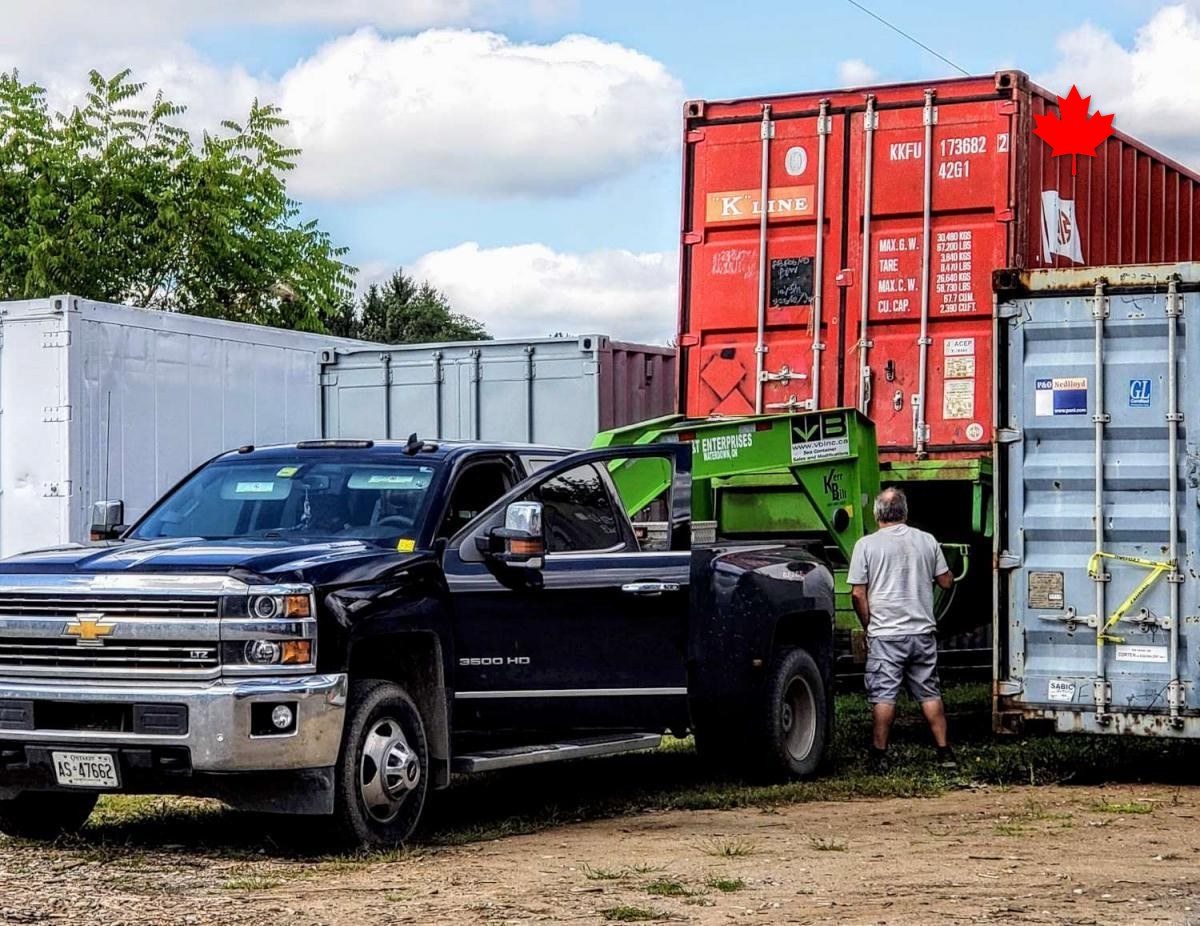
We sell containers. We do not rent.
Van Blanc sells shipping containers outright. We do not rent, we do not lease, and we do not offer rent-to-own. Renting comes up on this page because buyers compare it against owning, and that comparison is worth reading, but purchase is the only arrangement we offer. Stocked units deliver from our Brantford yards in 1 to 3 days. Request a sale quote or call the yard at 519-754-6844.
Quick Answer: Kitchener-Waterloo has no major container yard of its own, so storage containers arrive by truck. Van Blanc sells steel containers outright and delivers them across the tri-city in 1 to 3 days from our Brantford yards, forty minutes down Highway 24, where you can walk the rows and pick your unit first; we do not rent.
The tri-city is the fastest-moving construction market in Ontario right now. A new multi-modal transit hub broke ground in Kitchener this spring, residential building is climbing again after two flat years, and the region keeps adding jobs while most of the province holds its breath. Growth like that eats space. Contractors need lockups beside the work, growing companies outrun their leases, and every third residential street seems to have a renovation bin or a moving truck on it. This page covers how storage containers actually work in Kitchener, Waterloo, and Cambridge: who they fit, what they cost to get wrong, and how they arrive.
Where Does a Storage Container in Kitchener-Waterloo Actually Come From?
Not from the tri-city, for the most part. The region grew up on manufacturing and tech rather than freight yards, so nearly every container quoted into Kitchener or Waterloo rolls in from somewhere else: franchise depots, brokers reselling stock they have never seen, or real yards within trucking distance. Ours is the last kind, forty minutes down Highway 24 in Brantford, family-run since 1995, with 200-plus units you can inspect before any money moves, the sea cans stocked in those rows among them. The practical meaning of that geography is simple: since the box is coming by truck no matter who you call, the questions that matter are the yard behind the truck, the grade honesty of the quote, and whether the lead time is real. Delivery into the tri-city runs 1 to 3 days from our rows, on a tilt-deck, with an all-in number to your postal code.
The reason no big container yard sits inside the tri-city is land arithmetic, and it works in the buyer’s favour. Stacking hundreds of steel boxes takes acres, and acres near the tech corridor price like the tech corridor. Yards therefore sit where land is priced for stacking steel, Brantford being a forty-minute example, and compete into Kitchener-Waterloo on truck time instead of address. For you, that means the local-sounding option and the yard an hour away are often quoting the same delivery day, and the tiebreaker moves to what actually differs: whether anyone will show you the box, how the grades are called, and who picks up the phone in month eight when a door gasket needs attention. Distance is the least important number in the quote. The name on the gate is the most.
Construction Country: Sites, Lockups, and Schedules
The building boom is the loudest storage story in the region. Transit work in the core, subdivisions pushing out from every edge of Cambridge and Kitchener, infill going vertical in Waterloo: each active site needs secure steel beside the work, because tools that sleep in pickup beds change owners overnight. A 20ft with a lockbox is the standard site lockup, and a crew that owns it moves it between jobs on any tilt-deck. Site supervisors booking for a season should note the practical details: the unit needs about 30m (100ft) of straight approach, clear overhead, and blocking under the corners, and it should be positioned on day one where the crane and material staging will not bury it by month two. When the job wraps, the box follows the crew to the next site, or sells on to the next crew; a used lockup holds most of its value after a season.
General contractors running several tri-city sites at once tend to graduate from ordering boxes to managing a small set of owned units: three or four rotating between jobs, one semi-permanent at the shop, and a spare that floats. That pattern is worth naming to your supplier up front, because multi-unit buyers get scheduled differently than one-off drops, and a yard that knows your season can hold units ahead of your next mobilization instead of quoting you into a queue. It is the difference between a one-off purchase and a standing supply arrangement, and it is where a family yard with a phone number beats a booking portal every time.
Three Cities, Three Storage Personalities
Kitchener still carries its manufacturing bones, and its storage demand looks like a working city: contractor lockups, small-plant overflow, renovation containers in the old neighbourhoods between Victoria Park and the expressway, where driveways are real but narrow and the 10ft unit earns its keep.
Waterloo stores like a university-and-tech town, because it is one. Two universities generate a landlord economy with a ferocious spring turnover, and the tech corridor generates a quieter demand nobody writes about: scaleups whose office moves, lab gear, and event kit need a home between leases. A container behind the building costs less than the smallest warehouse sublet a growing company will find.
Cambridge is the freight-and-factory corner of the triangle, anchored by the Toyota plants and the parts web around them. Its storage runs industrial: 40ft high cubes behind supplier shops, seasonal tooling between contracts, and the farm fringe along the Grand where implements winter in steel. Cambridge buyers tend to know exactly what grade they want before they call, and they are usually right.
The Twice-a-Year Student Tide
Between the University of Waterloo and Laurier, tens of thousands of students churn through leases that mostly turn over in spring and late summer. For landlords, that means the same season London knows, multiplied: appliances, furniture, and reno materials cycling through laneways while units flip. For families, it means the August question of where a fourth-year’s apartment goes for four months. A shared container splits nicely across two or three households, and landlords running multiple doors keep the same unit year to year like a returning summer employee. The tide is predictable; yard stock in any one week is finite. Order ahead of the season, not inside it.
The Container as a Company’s Kit Room
Waterloo’s scaleups have a storage problem nobody names until they have it. A company doubles headcount, the office move happens on a weekend, and suddenly there are forty desks, a wall of monitors, the trade-show booth, and three racks of demo hardware with nowhere to live but a corner of the new space that was supposed to be a meeting room. The warehouse sublets that could absorb it start at sizes and terms a fifty-person company cannot justify. A 20ft or 40ft high cube behind the building absorbs all of it for a one-time number that approvals do not blink at, holds the booth between conference seasons, and stages the e-waste pile until the recycler run finally happens. When the next move comes, the box moves too, and it is already owned if the kit room turns out to be permanent. It usually does.
North of Waterloo: The Farm Belt Edge
Twenty minutes north of the tech corridor, the region changes character completely. Woolwich and Wellesley townships run on agriculture, and the St. Jacobs and Elmira farm economy buys containers the way it buys everything: practically, for decades, after looking at the thing properly. Forty-footers winter implements at the laneway’s end, 20-footers hold seed and shop tools, and the buying conversation is short because the buyers know steel. Deliveries up the farm roads need the gate width and any soft ground flagged at booking, and the tilt-deck does the rest. It is some of the most straightforward work we do, and some of the most loyal repeat business; a farm that buys one bin usually buys the next one from the same yard.
The Forty-Minute Visit That Settles Everything
Tri-city buyers make the Highway 24 run to Brantford weekly, and the visit runs the same way every time: down the rows, doors swung so you feel the gaskets, floors walked, and on used units the dents and rust patches pointed out before you ask. Christian, who grew up around the trade, puts the case plainly: “People drive down thinking they are coming to check the container. Really they are coming to check us. Ten minutes in the yard tells you more about who you are buying from than any website ever will.” Bring a tape measure if a tight placement is driving the size decision, and bring your skepticism; the seven-point questions any good supplier should survive are the ones we like answering in person. Buyers from Waterloo Region regularly leave with a different unit than the one they came for, and leave happier for it.
The Tri-City Booking Rhythm
Demand here has a calendar. Spring opens with the student turnover and the construction season landing in the same six weeks, and the yard books hardest from April through June. Summer runs on renovations and site work. September brings the second student wave, smaller but sharp. And late fall adds the quiet rush nobody plans for: businesses squaring away inventory before winter, farms closing out harvest, and site supervisors consolidating tools as jobs wind down ahead of the freeze. Stock runs deep, but any one week’s rows are finite, and the buyers who call two weeks ahead of their season get their first-choice size at the front of the delivery window. The ones who call mid-season get our apology and the next truck available.
Price Your Tri-City Delivery
Size, grade, postal code: that is the whole form. Kitchener, Waterloo, and Cambridge sit forty minutes from our rows, inside the standard 1-to-3-day window, and every quote comes with a real lead time, not a hopeful one. The fastest answer is a call.
Rent or Buy in a Growth Market
Growth changes the math, and we sit on one side of it: Van Blanc sells outright and does not rent. A contractor with eighteen months of booked work ahead is not renting a lockup; the box pays for itself before the backlog clears, and it holds value when the cycle turns. A startup between funding rounds looks like the opposite case, and renting from a fleet operator keeps storage off the balance sheet for a few months; past that, a used box bought once costs less than the rent would have and sells on at the next move. Where the cash needs spreading, spreading the cost through your own lender does it against a box you already own, and we supply the invoice and serial number. We run the numbers on every quote and say which door fits, including when the answer is neither and a locker across town serves better.
Down Highway 24: What Delivery Looks Like
Brantford to the tri-city is a forty-minute run, which keeps Kitchener, Waterloo, and Cambridge comfortably inside our 1-to-3-day Ontario window. The tilt-deck backs in, the deck angles down, and the unit settles onto the blocking you have set, ties or patio stones under the corner castings, slightly proud of grade so water sheds away from the door sills. Two tri-city specifics worth flagging when you book: the older core streets near the LRT line run tight for a 40ft delivery, so mid-block placements sometimes route around the corner, and new-subdivision sites with unfinished grading should mention soft ground so the driver brings the right approach. The full pad-prep walkthrough lives in our ground-readiness guide.
Sizes Against the Tri-City’s Lots
| Unit | External size | Tri-city fit |
|---|---|---|
| 10ft | 2.99m x 2.44m (10′ x 8′) | Old Kitchener narrow drives, downtown laneways |
| 20ft | 6.06m x 2.44m (20′ x 8′) | Site lockups, renos, landlord turnover, most driveways |
| 40ft | 12.19m x 2.44m (40′ x 8′) | Cambridge supplier lots, Grand River farm fringe |
| 40ft High Cube | 12.19m x 2.44m x 2.90m tall | Racking-height overflow behind growing businesses |
The 20ft remains the region’s default for the same reason it is everywhere else: it fits a double driveway with the doors clear, swallows a main floor or a site’s tools, and rides the truck without escorts or permits. When a buyer is torn between sizes, thirty years of deliveries say the same thing here as everywhere: small gets regretted, big gets filled.
Grades, Without the Sales Fog
Whoever you buy from in the tri-city, insist on hearing the whole ladder. New (one-trip): one loaded crossing from the factory, essentially new, the pick for anything visible, branded, or destined for conversion. Cargo Worthy: certified structurally sound used steel that could ship internationally again, worn on the surface, strong underneath. Wind and Watertight: the stationary-storage workhorse, sealed against weather and rodents, wearing its crossings honestly, and the usual right answer for a driveway or back lot here. As-Is: the cheap rung, sold with floor, frame, or door questions declared, for cladding projects and donor builds. A seller who skips a rung, in either direction, is steering the quote instead of fitting it. We stock all four at Brantford and point at the flaws first.
One Box, However You Learned It
Tri-city vocabulary runs the full Canadian range: sea can from the farm fringe, c-can from the trades, storage container from the search bar, and the occasional intermodal container from a procurement office near the 401. All of them describe the same 8ft-wide corten steel built to ISO 668, and all of them get the same quote line at our counter. Bring whichever word you grew up with. For purchase-side deep dives, the Kitchener container guide and its Cambridge counterpart cover the tri-city box by box.
Kitchener-Waterloo Storage Container FAQ
Where can I get a storage container in Kitchener-Waterloo?
Containers arrive in the tri-city by truck from yards outside the region. Van Blanc delivers from Brantford, forty minutes down Highway 24, in 1 to 3 days, and you can walk the rows at the yard and pick your exact unit before booking.
Do construction sites in Kitchener need a container lockup?
Most active sites use one: a 20ft with a lockbox is the standard secure store for tools and materials, positioned clear of the crane and staging on day one. When the job wraps, the same unit follows the crew to the next site, or sells on to the next crew.
How fast is container delivery to Waterloo or Cambridge?
One to three days for stocked units, on a tilt-deck truck from Brantford. The forty-minute run means tri-city orders often land on the early end of the window. Every quote carries a real lead time, not a hopeful one.
Can students or families use a container for the summer?
Yes, and splitting one 20ft across two or three households is common around the universities; Van Blanc sells the box outright, and a used 20ft bought once sells on in September for most of what it cost. Order ahead of the April-May tide rather than inside it; turnover season books the yard solid, and landlords keep the same units year after year.
What container grade fits a tri-city driveway?
Wind and Watertight, usually: sealed against weather and rodents with honest cosmetic wear priced in. Choose new (one-trip) when the box will be visible or converted, and Cargo Worthy only when it might genuinely ship again.
Can a container sit on a narrow Kitchener lot?
The older streets near the core often fit the 10ft where a 20ft cannot swing its doors. The driver confirms approach and placement on the phone before the truck rolls. Permits are managed by your municipality; check with your local building or planning department before you order.
What does a growing business do when it outruns its lease?
A 40ft high cube behind the building adds racking-height storage without a lease amendment, delivered in days. Tell your insurer, block it level, and it will carry the overflow until the next real move, then sell on or move with you.
Should I see the unit before delivery?
If you can spare the forty minutes, yes: walking the rows and kicking the doors beats any photo, and it is the single best protection when buying used steel. If not, we describe every flaw on the phone first, and you pay on delivery, not in advance.
Do you deliver to the townships around the tri-city?
Yes: Woolwich, Wilmot, Wellesley, North Dumfries, and the Grand River farm fringe are regular runs. Flag the gate width and any soft ground when you book and the tilt-deck handles the laneway, inside the same delivery window.
Can I spread the cost of a Kitchener-Waterloo container?
Van Blanc does not offer rent-to-own, leases, or rentals; every container is sold outright. Businesses that want the monthly shape run an equipment loan through their own bank or equipment financer against a box they own from day one, and we supply the invoice and serial number the lender asks for. Growing businesses and long renovations use it most, because temporary storage has a habit of becoming permanent.
What should I have ready when I call for a quote?
Five things make it a two-minute call: your postal code, a size guess, what surface the unit will sit on, your timeline, and whether you lean new or used. From that we return an all-in number with a real lead time, usually the same day.
Sources
- Canadian Manufacturers and Exporters. (2025). Manufacturing Industry in Kitchener-Waterloo Needs Further Investment in Workforce Development. cme-mec.ca
- BuildForce Canada, via Daily Commercial News. (2026). Ontario construction outlook brightens as residential growth returns. constructconnect.com
- Federal Economic Development Agency for Southern Ontario. (2025). Government of Canada supports Waterloo Region businesses to scale up and grow. canada.ca
- International Organization for Standardization. (2020). ISO 668: Series 1 freight containers, classification, dimensions and ratings. iso.org
- StorTrack. (2025). Self-Storage Pricing Trends, U.S. and Canada, December 2025. stortrack.com
Forty Minutes From the Tri-City, Worth the Drive
Van Blanc has supplied steel containers across Waterloo Region since 1995: family-run, 4.9 stars across 140+ verified Google reviews, and a real yard at 90 Morton Avenue East in Brantford where the rows are open for walking. Tri-city deliveries run 1 to 3 days. Paul or Christian will walk the rows with you, point at the flaws before you find them, and send you home with a straight number either way. That has been the whole business model since 1995, and Waterloo Region keeps proving it travels well.
Van Blanc Ent. Inc., 90 Morton Ave E Unit 1B, Brantford, ON N3R 7J7. 1-888-509-6658