
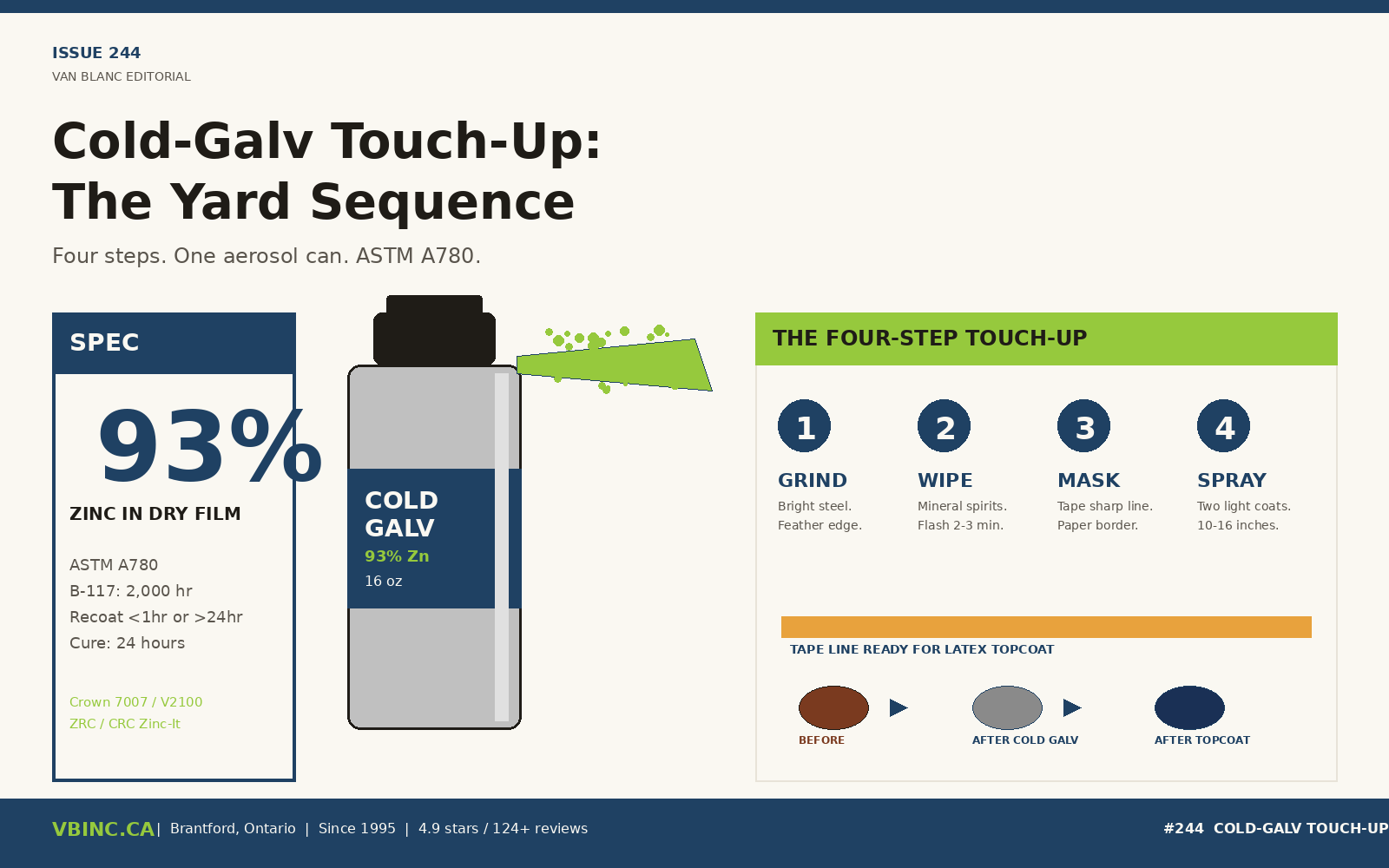
Quick Answer: Cold galvanizing spray for a shipping container in Ontario is a 93% zinc aerosol meeting ASTM A780 that you spray on cleaned spot rust to restore galvanic protection. Grind to bright steel, wipe, mask, hold the can 10 to 16 inches away, lay two light coats, then topcoat with latex once cured. Real Brantford yards, real reviews (4.9 / 140+), real 1-3 day delivery. Family-operated since 1995.
In This Guide
- Why Does Every Container Yard Keep Cold Galvanizing Spray on Hand?
- What Does 93% Zinc in Cold Galvanizing Spray Actually Mean?
- What Is ASTM A780, and Why Does It Matter for Ontario Buyers?
- Which Cold Galvanizing Spray Products Do We Reach For at the Yard?
- How Do You Apply Cold Galvanizing Spray in Four Steps?
- How Long Does Cold Galvanizing Spray Take to Dry and Recoat?
- Can You Topcoat Cold Galvanizing Spray, and With What Paint?
- How Does Cold Galvanizing Spray Hold Up Through an Ontario Winter?
- When Is Cold Galvanizing Spray the Wrong Call for Container Rust?
- How Do You Use Cold Galvanizing Spray Safely at the Yard?
- FAQs
Reading time: about 14 minutes.
Why Does Every Container Yard Keep Cold Galvanizing Spray on Hand?
Cold galvanizing spray earns its place on every container yard truck because it stops the one failure that turns a sound used bin into scrap: bare-steel rust that pits, then perforates. Every working yard in Ontario has the same can rattling in the back of the truck, gray cap, dusty, parked next to the grinder. That can is cold galvanizing compound, the single most useful product for keeping a Cargo Worthy or Wind and Watertight bin from turning surface rust into pit corrosion. Corten weathering steel oxidises on the surface and stabilises, but a deep scratch through factory paint into bare steel under a Brantford winter of road salt starts as a brown smudge, becomes a pit, then a hole three years later. Cold galv stops the chain. Spot-touching scratches the day a bin lands is the cheap end of the full rust-prevention playbook our crew follows on the lot, written down here so you can run the same sequence on your own bin.
Cold galvanizing spray is a zinc-rich aerosol holding 93 percent or more metallic zinc in its dried film. Sprayed on cleaned bare steel, the zinc corrodes before the iron does and sacrifices itself to shield the panel underneath. One 16-ounce can covers roughly 18 to 25 square feet of spot repairs and buys a used container years of extra service.
Paul LeBlanc, owner: “I have been around containers for nineteen years and steel a lot longer than that. The bins that outlast everyone else are not the fancy ones, they are the ones somebody walked once a season with a grinder and a can of zinc. Five minutes a spot. That habit is worth more than any coating you buy at the factory.”
The Honest Limit of Cold Galv Spray
A 16-ounce can covers roughly 18 to 25 square feet of touched-up area at proper film thickness. If you are looking at rust running down a full side panel, the answer is not a single can. It is a full primer-and-topcoat recoat, or honest acceptance that the bin is closer to As-Is grade than Wind and Watertight.
What Does 93% Zinc in Cold Galvanizing Spray Actually Mean?
The “93% zinc in dry film” label on cold galvanizing spray is a real industry specification, not a marketing number. The aerosol contains zinc dust in solvent and resin. Solvent flashes off, resin holds the zinc against steel, and because zinc is more electrochemically active than iron, it sacrifices itself when moisture and oxygen attack the surface. The iron stays intact. Galvanic protection, the chemistry that protects every hot-dip galvanized guardrail along Highway 403. Below 65% zinc you have gray paint that looks similar but offers no real protection. Crown 7007, Rust-Oleum V2100, ZRC, and CRC Zinc-It all hit 93 to 95%.
Zinc Content vs Real-World Performance
ASTM A780 requires 65% minimum metallic zinc in dry film. Professional cold galv compounds hit 93 to 95%. Crown 7007 tests at ASTM B-117 salt spray for 2,000 hours, which is the industry benchmark for accelerated corrosion exposure and translates to multi-year outdoor service in a salt-belt environment: the Ontario condition every winter.
What Is ASTM A780, and Why Does It Matter for Ontario Buyers?
ASTM A780 is the standard practice for repairing damaged galvanized coatings, and it is the spec to look for on the can if you want to know the touch-up your supplier uses is legitimate. Published by ASTM International as “Standard Practice for Repair of Damaged and Uncoated Areas of Hot-Dip Galvanized Coatings,” it defines what counts as a real field repair for galvanized steel. Cold galv falls under A780’s zinc-rich paint category.
CRC Bright Zinc-It meets A780. Crown 7007 exceeds it. ZRC is A780-compliant at 95% zinc. Rust-Oleum V2100 hits the same chemistry at 93%. The container itself was not built to A780, since new-build bins are painted with marine alkyd or epoxy at the factory in Asia, not hot-dip galvanized. The corner castings may be galvanized; the panels are not. So technically you are not “repairing galvanizing” when you spot-touch a container, you are providing galvanic protection to a bare steel area on a painted bin. The chemistry still works. The standard is your assurance the product was formulated for genuine corrosion service.
Which Cold Galvanizing Spray Products Do We Reach For at the Yard?
The cold galvanizing spray products we reach for at the Brantford yard come down to four. There are dozens of compounds on the market, but these are the ones we keep coming back to, with what we have learned about each over the years. Every used bin that leaves our lot gets walked for bare-steel spots first, and one of these four cans is what goes on them.
| Product | Zinc Content | Standard Met | Format | Where We Buy |
|---|---|---|---|---|
| Rust-Oleum V2100 Stops Rust Cold Galvanizing | 93% in dry film | Touch-up of galvanized | 20 oz aerosol | Home Depot Canada, industrial supply |
| CRC Bright Zinc-It Instant Cold Galvanize | 93%+ in dry film | ASTM A780 | 13 oz aerosol | Capital Electric Supply, industrial |
| Crown 7007 Cold Galvanizing Compound | 93% in dry film | ASTM A780, ASTM B-117 (2,000 hr) | 16 oz aerosol, 1 gal | Industrial safety supply |
| ZRC Cold Galvanizing Compound | 95% in dry film | ASTM A780 | 16 oz aerosol, gallon, 5 gal | Marine and industrial coatings dealers |
For everyday yard spot-touch, Rust-Oleum V2100 is the workhorse: on the shelf in Brantford, large enough can to last weeks of small jobs. CRC Bright Zinc-It is brighter, slightly lighter gray, useful when matching a galvanized component nearby. Crown 7007 is the premium choice for harsh-exposure bins (cottage waterfront, road salt corridor along Highway 401). ZRC is the marine-grade option for containers within 200 metres of a Great Lakes shoreline.
Christian LeBlanc, second-generation operator: “Dad used to do touch-up with a brush and a quart can. We moved to aerosol about ten years ago because the spray gets into corners and the texture matches the surrounding panel better. When a customer asks about small gray spots on a bin, I tell them straight: that is cold galv on a corner that needed it before delivery. Honest disclosure beats the call-back.”
How Do You Apply Cold Galvanizing Spray in Four Steps?
Applying cold galvanizing spray well comes down to four steps, and surface prep is 80% of the job. The actual spraying is 20%. We see customers and contractors get this backwards constantly. They reach for the can, lay down a quick coat over a flaky rust spot, and within six months the patch has lifted off the surface because nothing underneath was bonded steel. Here is the sequence we run on every spot at the Brantford yard.
Step 1: Grind to Bright Steel
Zinc protection will not bond over loose rust. We use a 4.5-inch angle grinder with a wire cup brush for shallow surface rust, or a flap disc for deeper pitting. Goal: bright, slightly textured bare steel across the repair area plus half an inch of border into the surrounding paint, feathered so there is no sharp line. For small spots, a hand wire brush works. A 12-inch square of medium rust takes five to ten minutes. Wear eye protection and a respirator: older container paint dust can include marine alkyd traces you do not want in your lungs.
Step 2: Wipe Down with Solvent
Grinding leaves dust, swarf, and oxidised debris. Wipe with a clean rag and mild solvent (mineral spirits or acetone, no chlorinated solvents). Steel should look clean and feel cool from solvent flashing off. Let dry two to three minutes. If wet or oily, the zinc binder will not adhere and the patch fails within months.
Step 3: Mask the Tape Line
Cold galv produces a gray finish visibly different from original container paint. Without masking you get a fuzzy overspray edge that looks worse than the rust. Use blue painter’s tape around the repair, leaving the prepped steel plus a quarter inch of feathered paint border so the zinc bonds slightly into the surrounding paint film. Press the tape down firmly. Lay cardboard around the area to catch overspray. On windy days double the masking distance: aerosol carries further than you think.
Step 4: Spray Two Light Coats
Shake the can hard for one full minute. Zinc settles fast: a poorly shaken can sprays watery solvent first and metallic dust last. Hold the can 10 to 16 inches from the surface and spray in a steady back-and-forth motion, overlapping each stroke 50%. Lay one light coat covering the steel. Wait five to ten minutes. Lay a second. For harsh exposure (waterfront, road-salt zone), lay a third. Two coats minimum. Do not cover in one heavy pass: that produces drips, runs, and a thick film that takes longer to cure and delaminates.
Yard Trick: Pre-Warm the Can
In a Brantford October when the yard sits below 10°C, the can sprays poorly: solvent does not flash and the pattern goes splotchy. We keep the can inside the truck cab at 18 to 22°C until use. A cold can is the most common reason a touch-up looks bad. Manufacturer surface-temperature range is typically 10°C to 32°C.
How Long Does Cold Galvanizing Spray Take to Dry and Recoat?
Cold galvanizing spray dries on a published schedule that is consistent across all four products: dry to touch in 15 minutes, dry to handle in one to two hours, fully cured at 24 hours. Recoat window: within one hour OR after 24 hours. Recoat between 1 and 24 hours and you get solvent re-attack, lifting, or wrinkling of the first layer because it has started curing but is not crosslinked. Get all coats down within 30 to 45 minutes, or come back the next day. We have made this mistake. The patch wrinkles like cheap oil paint over latex and has to be ground off and redone.
Can You Topcoat Cold Galvanizing Spray, and With What Paint?
You can topcoat cold galvanizing spray, but only with a latex paint, never an alkyd. Cold galv dries gray and does not match the navy, dark red, white, or industrial green of original factory paint. For appearance-critical bins (driveway, backyard studio, customer-visible job site), topcoat. The Rust-Oleum technical sheet is explicit: latex coating only, never alkyd or oil-based. The cured zinc surface interferes with oil-based film formation; latex (water-based acrylic) bonds mechanically. Alkyd over fresh cold galv blisters, peels, or develops pinholes within months. Wait the full 24 hours, then apply two coats of exterior acrylic latex such as Sherwin-Williams Industrial Acrylic or Benjamin Moore Direct-to-Metal.
Why Container Paint Colour Matching Is Hard
Original factory paints are proprietary marine alkyd formulations that paint stores across Ontario do not stock and cannot match precisely. Bringing a chip in gets you an approximate match at best. Two options: tolerate visible touch-ups and treat the bin as honestly utilitarian, or repaint the entire side wall after the spot repairs. Many customers go option two on bins they care. Cold galv first, full topcoat later.
How Does Cold Galvanizing Spray Hold Up Through an Ontario Winter?
Cold galvanizing spray holds up through an Ontario winter reasonably well for spot repairs, with a service life of one to three years on a properly applied touch-up. Ontario throws three hostile conditions at a container: freeze-thaw October through April, road salt spray within 100 metres of any highway December through March, and high humidity summers along the Great Lakes shoreline. Cold galv handles all three. Service life of a properly applied touch-up is one to three years. CRC’s published spec is “1 to 2 years of effective outdoor protection,” conservative. Low-exposure settings (sheltered farm property away from salt) hold five or six years. High-exposure settings (next to Highway 403, salt spray off Lake Erie, exposed western face) want annual recoats. Signs a patch needs redoing: dullness or chalking, brown rust bleeding back through, or any tape-line crack where the feathered edge has lifted. The bin is not maintenance-free. It is maintenance-light, which is different.
Norfolk, Haldimand, and the Salt-Belt Reality
Norfolk and Haldimand County deliveries get a different recommendation from our Toronto and Hamilton work. The agricultural belt south of Brantford has less road-salt loading because the snow-clearing budget skips rural concession roads. A bin on a farm property in Norfolk holds its original paint plus minor cold galv touch-ups years longer than the same bin would in a Toronto industrial yard. Walk the bin once a season and spray any new spots before they pit. Sub-30-minute annual ritual, years of extra storage life.
When Is Cold Galvanizing Spray the Wrong Call for Container Rust?
Cold galvanizing spray is the wrong call when rust has gone past a spot repair, and three situations call for a different system entirely. First: rust through the panel. If you see daylight, the steel is gone. No zinc spray rebuilds substrate. The fix is welding a patch in, galvanizing the weld zone, then topcoating. Holes larger than a quarter put the bin closer to As-Is grade. Second: large-area rust over two or three square feet on a single panel. A 16-ounce can covers about 20 square feet at proper film thickness; you burn through cans and budget faster than a brush-applied zinc-rich primer system would cost. Use a marine-grade primer like Sherwin-Williams Zinc Clad II or International Interzinc 22, then seal the panel with a two-part epoxy system the way we lay out in our walkthrough for sealing a full panel against salt and moisture. Third: full-bin recoats. For a Wind and Watertight bin restored to near-new appearance, an HVLP-sprayed primer-and-topcoat covers the panel uniformly at a fraction of cost per square foot. Cold galv is the spot-repair specialist, not built for full coverage.
Match the Tool to the Job
- One to four small spots, each under 6 inches square: Cold galv aerosol is perfect. One can does the whole bin.
- Five to ten spots, or one larger area up to 2 sq ft: Cold galv aerosol still works. Buy two cans. Plan a Saturday morning.
- One panel with extensive surface rust, 2 to 8 sq ft: Brush-applied zinc-rich primer covers ground faster and cheaper than aerosol here, and we break down how to roll one on in our brush-grade primer write-up for larger rust areas.
- Whole bin recoat or large panel restoration: Marine epoxy primer plus marine alkyd or polyurethane topcoat. Once that full system is on, fold cold galv back in as the seasonal spot-fix layer described in our broader guide to keeping a container ahead of rust.
- Holes through panel: Weld repair first. Cold galv on the weld zone afterward.
How Do You Use Cold Galvanizing Spray Safely at the Yard?
Using cold galvanizing spray safely comes down to ventilation and a respirator, because the aerosol is solvent-based: propellant and solvent are flammable, and zinc dust is a respiratory irritant. Not dangerous if you follow basics. Spray outdoors or in a ventilated structure (a closed container with doors shut is the wrong place to be with an aerosol). Wear a respirator with organic-vapour cartridges, safety glasses, nitrile gloves. Keep cans away from welding sparks, cigarettes, and the propane heaters used in cold-weather yards. Store upright on a cool, dry shelf. Unopened, a can lasts five years. Once shaken and sprayed, useful life drops to 18 months.
We keep four cans on the shelf at the Brantford yard at all times: Rust-Oleum V2100 for general use, CRC Bright Zinc-It for brighter galvanized matching, Crown 7007 for premium high-exposure bins, one ZRC for marine-grade requests. The whole shelf costs less than a single replacement door panel, and the value it returns to the operation is multiples of that every season.
Cold galv is one of those products where the price is so low people assume it does not matter. It matters more than almost anything else we buy. Two coats of A780-rated zinc properly applied stop a corrosion chain that would otherwise eat a panel in three winters. The Brantford yard runs through eight to ten cans a year between maintenance and customer touch-ups. Cheapest investment we make in keeping the inventory honest.
If you are taking delivery of a Wind and Watertight or Cargo Worthy bin from Van Blanc this week: ask your driver to point out any spots already touched up. Note them. In a year, walk the bin and check for new corrosion near those areas or elsewhere. Buy a 16-ounce can from the Brantford Home Depot, one of the cheapest items in the paint aisle, and run the four-step sequence. Save yourself the four-figure cost of a full repaint later. That same can-and-grinder habit is the first thing we cover when buyers ask how to read a used bin’s condition before they pay for it, and it is why we walk every customer through their container at our Brantford yard.
Frequently asked questions
What is cold galvanizing spray and how is it different from regular gray spray paint?
Cold galv is a zinc-rich aerosol containing 93% or more metallic zinc in dry film. Regular gray paint contains pigment but provides no galvanic protection. Cold galv sacrifices zinc to protect iron through electrochemistry. The difference shows up in two to five years on a container in Ontario weather.
Does cold galvanizing spray meet ASTM A780 for galvanized steel repair?
The professional products do. Crown 7007 exceeds A780. CRC Bright Zinc-It and ZRC are compliant. Rust-Oleum V2100 is formulated at 93% zinc to the same chemistry. Check the can label for the A780 reference and dry film zinc percentage. Anything below 65% zinc does not qualify as a legitimate galvanic repair material.
How long does a cold galv touch-up last on a shipping container in Ontario?
One to three years typical, longer in sheltered rural settings. CRC publishes 1 to 2 years of effective outdoor protection as a conservative estimate. Bins near Highway 401 or in Toronto industrial yards may need annual touch-up. Bins on Norfolk County farms in low-traffic locations can hold the same patch five years or more.
Can I topcoat cold galvanizing spray with regular spray paint to match my container colour?
Only with a latex (water-based acrylic) topcoat. Do not use alkyd or oil-based paint. The Rust-Oleum technical sheet is explicit. Oil-based topcoats can blister, peel, or wrinkle within months because the cured zinc surface interferes with alkyd film formation. Wait 24 hours, then apply quality exterior acrylic latex.
How do I prepare the container surface before spraying cold galvanizing compound?
Grind the rust to bright steel using a wire cup brush or flap disc on a 4.5-inch angle grinder. Feather the edge into surrounding paint by about half an inch. Wipe with mineral spirits or acetone and let the solvent flash off for two to three minutes. Mask with painter’s tape and a cardboard shield against overspray.
What is the recoat window for cold galvanizing spray and why does it matter?
Recoat within one hour OR after 24 hours, never in between. Inside the first hour the first coat is still chemically active and the second coat fuses into a single film. Between 1 and 24 hours a fresh coat can solvent-attack the first, causing wrinkling. After 24 hours the first coat is cured and a second bonds mechanically.
How much area does a 16-ounce can of cold galvanizing spray cover on a container?
About 18 to 25 square feet at proper film thickness with two light coats. That handles four to eight typical spot-rust repairs of three to six inches each. For rust over two square feet of a single panel, a brush-applied zinc-rich primer system or marine epoxy is more cost-effective.
Can cold galvanizing spray be applied in cold weather at the Brantford yard?
Manufacturer specs typically require surface temperature between 10°C and 32°C. Below 10°C in a Brantford October the can sprays poorly and the patch will not cure correctly. Warm the can in a heated truck cab and apply quickly, or wait for a warmer day. We do most yard touch-ups between April and October.
Is Rust-Oleum cold galvanizing spray the same as marine and industrial supplier products?
Rust-Oleum V2100 is a legitimate 93% zinc product at Home Depot Canada and performs the same chemistry as Crown 7007 or ZRC products from industrial channels. The differences are in finish appearance, packaging size, and tested salt-spray hours. For everyday Brantford yard spot repair, the Home Depot can is appropriate.
Does cold galvanizing spray work on the corner castings and frame of a shipping container?
Yes, and this is one of its best uses. Corner castings, door frames, and underside rails are the highest-rust-risk areas because they trap moisture and take physical abuse during handling. Grind, wipe, mask if needed, two light coats. The castings keep galvanic protection where the original paint has been chipped off.
Sources
- ASTM International. (2022). ASTM A780/A780M-20: Standard Practice for Repair of Damaged and Uncoated Areas of Hot-Dip Galvanized Coatings. ASTM. astm.org/a0780
- CRC Industries. (2020). Zinc-It Instant Cold Galvanize Specification Sheet, 13 Wt Oz. CRC Industries Technical Data. crcindustries.com (TDS PDF)
- Aervoe Industries. (2023). Crown 17007 Cold Galvanize Coating 93% Zinc Rich Product Data Sheet. Aervoe. aervoe.com (PDS PDF)
- Rust-Oleum Corporation. (2024). Professional Galvanizing Sprays Technical Data Sheet PRO-08. Rust-Oleum. rustoleum.com (PRO-08 TDS)
- ZRC Worldwide. (2024). ZRC Cold Galvanizing Compound: 95% Zinc, ASTM A780 Compliant. ZRC Worldwide. zrcworldwide.com
Reach Van Blanc in Brantford
We have been supplying shipping containers across Ontario since 1995. Our warehouse is at 90 Morton Avenue E in Brantford, and we deliver right across the province on a cash-on-delivery basis. No surprise fees, no chase-the-paperwork.
Van Blanc Ent. Inc. 90 Morton Ave E Unit 1B, Brantford, ON N3R 7J7 +1 888-509-6658
If you want to see how a 93% zinc cold galv touch-up actually looks on a Cargo Worthy or Wind and Watertight bin before you take delivery, walk the yard with Christian. We will point out the spots, hand you a can to take home, and show you the four-step sequence in person on a corner casting that needs it. Worth the drive for unbeatable quality, family customer service with 30 years of experience.
Related Reading
Ready to price your container?
Tell us the size and your postal code and we’ll send back an honest, all-in number, container, delivery, and placement, usually within 1-3 days. No pressure, no mystery fees.
Family-run in Brantford since 1995 · 200+ containers in stock · 4.9★ across 140+ Google reviews · every box graded by a person, walk it before it lands.