
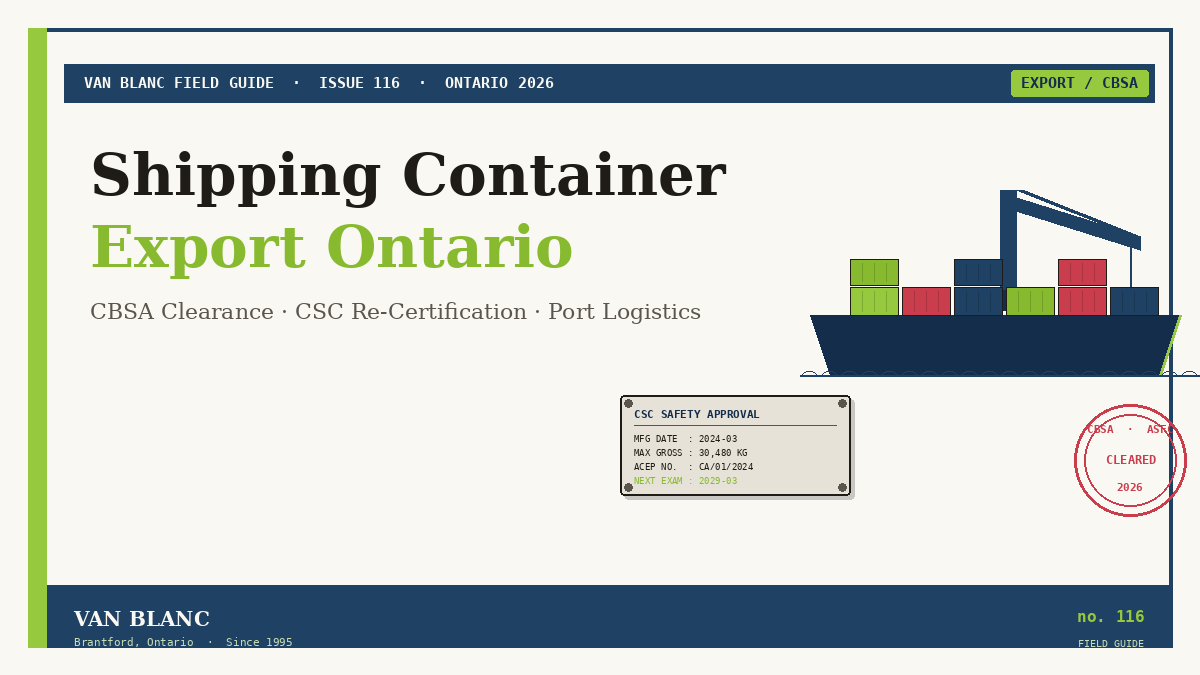
Quick Answer: Shipping container export from Ontario requires a valid CSC plate (often carried under an ACEP scheme), CBSA customs clearance under the 2026 CARM system, and intermodal rail or drayage to the Port of Montreal or Halifax. Cargo Worthy or one-trip grade is the minimum spec; expect a real 1 to 3 day yard pickup window from Brantford. Family-run Ontario shipping container supplier since 1995. 4.9 stars across 140+ Google reviews, 1-3 day delivery.
In This Guide
- What “Export-Grade” Actually Means in Ontario
- The CSC Plate Is Your Export Passport
- ACEP vs PES: Which Scheme Your Container Is On
- CBSA, CARM, and the 2026 Compliance Shift
- Documents the Carrier Will Demand
- Routing Through the Port of Montreal
- Routing Through the Port of Halifax
- Intermodal From Brantford to Tidewater
- Drayage vs Rail: Which One Wins on Cost
- Why Grade Matters More for Exports Than Storage
- Re-Certifying an Older Box for Re-Export
- Timeline and Budget
- Frequently Asked Questions
Reading Time: 18 minutes
What Does “Export-Grade” Actually Mean for an Ontario Container?
An export-grade shipping container is a Cargo Worthy or one-trip unit carrying a valid CSC safety plate, clean enough to satisfy an ocean carrier and survive repeated handling. Wind & Watertight and As-Is units are domestic storage grades only; they cannot legally load onto a vessel for international shipping.
An Ontario buyer who walks into our Brantford yard and asks for a container to export to Ghana is not asking the same question as the contractor who wants a job-site box. The grade of steel is similar. The paperwork is a different planet.
To put a container on a ship, the box needs to satisfy three independent checks at once: it has to carry a valid Container Safety Convention plate, it has to clear Canada Border Services Agency under whatever tariff classification its cargo falls into, and it has to physically arrive at the terminal in a slot the shipping line has already booked. Miss any one of those three and the box sits on a yard somewhere accruing storage fees while the shipper scrambles.
Most of the containers we have moved out of our Brantford yards over 30 years went to Ontario buyers for storage, site offices, or modification. A smaller but real slice went to export buyers, often Canadian companies sending finished goods to overseas markets, sometimes brokers re-positioning empties for ocean carriers. The export side has more friction. It also has more margin if you know what you are doing.
This guide walks the full path: what the CSC plate has to look like, what CBSA needs from you under the new CARM regime, how to choose between rail to Montreal or drayage to Halifax, and what to budget realistically from a yard in Brantford to a ship at tidewater. The export path is unforgiving of guesses. We will give you the operational reality.
Why “shipping container” and “intermodal container” mean the same thing here
For storage buyers, the terms are interchangeable. For export buyers, the words matter. Procurement systems and ocean booking software almost always classify the box as an “intermodal container” or “ISO container” under ISO 6346:2022, which is the international standard for coding and marking freight containers. The same 20ft or 40ft Corten-steel box becomes a different commercial object once it carries a valid CSC plate and a BIC-registered prefix. We deliver export-ready stock from our Brantford yards under either name.
What Is the CSC Plate and Why Does It Decide Whether Your Container Can Export?
Every container that loads onto an ocean vessel carries a metal plate, usually riveted near the doors, that certifies it under the 1972 International Convention for Safe Containers. The convention is administered by the International Maritime Organization, and the plate is the single most important piece of metal on a container destined for export. Without a valid plate, the container is not going on the ship, no exceptions made at the gate.
The plate records the manufacturer, the build date, the maximum gross weight, the stacking and racking test loads, and either a Next Examination Date or an ACEP scheme number. Carriers and terminals scan the plate at gate-in. If the date has lapsed and there is no ACEP coverage, the container is refused.
Most one-trip containers we sell carry a fresh CSC plate from the Asian factory, valid for the first five years from manufacture. Cargo Worthy units we carry have been re-inspected by an IICL-qualified surveyor inside the prior 30 months and have a valid Next Examination Date stamped or stickered on the plate. Wind & Watertight units, the most common used grade in Ontario for farm storage, almost always have expired CSC plates. WWT is a domestic storage grade. It does not export.
Paul LeBlanc, owner since 1995: “First thing I do with an export buyer is read the plate with them. I have got thirty years in containers, and the plate date is still the number that decides everything. A clean box with a lapsed date is a box that sits at the terminal. We would rather find that in the yard than have the carrier find it at gate-in.”
Walk the yard before you ship
The single best move for an Ontario export buyer is to come see the bin in our Brantford yard before you commit. Christian or Paul will walk you to the plate, read the date with you, and confirm whether the unit is CW with current paperwork or whether it needs a re-survey before it can leave the yard. Worth the drive for unbeatable quality, family customer service with 30 years of experience. Every quote comes with a real lead time, not a hopeful one.
ACEP or PES: Which CSC Examination Scheme Is My Container On?
Under the CSC convention, every container has to be inspected periodically. There are two acceptable schemes, and the difference matters when you are buying for export.
The Periodic Examination Scheme, or PES, says the container gets its first survey within five years of manufacture, then every 30 months thereafter, and the Next Examination Date is stamped on the plate. Simple, calendar-driven, easy to verify by reading the plate.
The Approved Continuous Examination Programme, or ACEP, is what most major ocean carriers and big lessors run. Under ACEP, the container is deemed examined every time it is inspected at an approved repair facility or every time a repair is carried out. The plate shows an ACEP scheme number rather than a Next Examination Date. Easier to track across a global fleet of millions of containers, but it requires the operator to maintain documented inspection records.
For a one-off Ontario export buyer, you almost never need to register your own ACEP scheme. You either buy a one-trip container with five years of factory PES validity, or you buy a CW container with a current 30-month PES date, or you arrange a fresh CSC survey on a used unit before it ships. The survey cost in Ontario depends on the surveyor and how far the unit is from a major hub.
How to Read a CSC Plate Before You Buy for Export
- Manufacturer and build date: Top of the plate. Anything built before 2000 needs careful inspection regardless of paperwork.
- Maximum gross weight: Standard 20ft is around 30,480 kg. Standard 40ft HC same. Confirm the cargo plan fits.
- Stacking test load and racking test load: Should match ISO 1496-1:2013. Mismatches are red flags.
- Next Examination Date OR ACEP number: One or the other must be current. No exceptions.
- BIC prefix and serial: Should match the door markings exactly. Mismatched prefixes signal swapped plates, which is a serious problem.
How Does CBSA Clearance and the 2026 CARM System Affect a Container Export?
CBSA clearance for a container export turned on a single big change over the past two years: the rollout of CARM, the CBSA Assessment and Revenue Management system. We break the filing mechanics down in our walkthrough of the export declaration step. As of early 2026, CARM is mandatory for commercial importers. Even though most container exports involve goods leaving Canada rather than entering it, the empty container itself, or the goods inside it, will touch the CARM system at some point if the shipper is a Canadian business with cross-border activity.
For pure export, the relevant CBSA process is the export declaration. Goods valued over the CBSA reporting threshold destined for any country other than the United States typically require an export declaration filed through the Canadian Export Reporting System. The carrier needs the eManifest data transmitted electronically before loading at marine terminals. Miss the cut-off and the container does not get loaded.
The practical buyer takeaway: if you are a one-time Ontario exporter sending a single container of equipment to family overseas, your freight forwarder handles the paperwork and bills you. If you are a regular exporter, you register in the CARM Client Portal, post financial security directly with CBSA, and file your own declarations or contract a customs broker. Either path, the timeline runs roughly 4 to 8 hours for clearance on a clean, low-risk shipment and 1 to 3 days for anything that triggers an inspection or permit verification.
What CBSA actually looks at when a container books out
The container itself is a tare object, not the dutiable item. CBSA cares about what is inside it: the commercial invoice, the harmonized tariff classification of the cargo, the country of origin certificate if a trade agreement applies, any permits required for the specific goods (controlled exports, dual-use technology, food and agricultural products). They also care about the export carrier being properly registered. The container’s CSC plate is the maritime safety side; CBSA is the customs side; they are parallel checks that both have to pass.
What Documents Does the Ocean Carrier Demand Before Loading?
The documents an ocean carrier or NVOCC needs before booking your container onto a ship form a paperwork stack before they will issue a bill of lading. Missing any one of these documents and the booking gets bumped to the next sailing, which is usually a week later.
| Document | Who issues it | What it proves |
|---|---|---|
| Commercial invoice | Shipper / exporter | Value, classification, sale terms |
| Packing list | Shipper | Container contents item-by-item |
| Export declaration | Filed via CERS to CBSA | Customs clearance for departure |
| Bill of lading (draft) | Ocean carrier or freight forwarder | Title of goods, shipping contract |
| CSC plate (visible on box) | Approved surveyor or factory | Container safety certification |
| Container interchange receipt | Terminal at gate-in | Condition and seal at terminal |
| Booking confirmation | Ocean carrier | Slot reservation on a named sailing |
| VGM (Verified Gross Mass) | Shipper, weighed at terminal | Total weight per SOLAS rules |
The VGM rule deserves its own paragraph. Under the SOLAS amendments that took effect a decade ago, every loaded container needs a verified gross mass before it can be loaded onto a vessel. The shipper, not the carrier, is responsible. Most Ontario shippers weigh the loaded container at a certified scale at the terminal or at a dedicated weighbridge en route and transmit the VGM electronically before the documentary cut-off. Misdeclared weight is the single most common cause of last-minute booking failures.
How Do You Route a Container Export Through the Port of Montreal?
For most Ontario exporters, the Port of Montreal is the default tidewater for a container export. The port handles over 1.7 million TEU annually and runs roughly a 50-50 split between import and export volumes. Direct services run to Northern Europe, the Mediterranean, the Middle East, and several Asian transhipment hubs.
The port is connected to both CN and CPKC rail networks plus Canada-wide intermodal carriers. CN runs a direct intermodal rail service between the Port of Montreal and Southern Ontario through a transload terminal on the Hamilton Bayfront, which is roughly an hour from our Brantford yards by truck. The Hamilton-to-Montreal CN service is the single most efficient export pathway for a southwestern Ontario shipper who is not in a rush.
For a typical export from Brantford, the workflow is: container leaves our yard by tilt-deck or chassis to Hamilton, transloaded onto CN intermodal, railed to Montreal terminal, gated in, weighed, and loaded onto a vessel within roughly a 5 to 10 day window depending on the booking and the season. Winter operations can stretch that timeline; the port stays open year-round but icebreaker fees and weather delays do affect transit.
Use Case: GTA Exporter Sending Equipment to West Africa
A Mississauga-based industrial equipment dealer regularly sources used machinery and ships it to Ghana and Nigeria. They buy CW 40ft High Cube containers from our Brantford yard, load at their Mississauga facility, transload at Hamilton to CN, and rail to Montreal for sailings to Tema and Lagos. Lead time from yard pickup to ship departure runs roughly 14 to 18 days door-to-vessel. The CW grade is essential because the container itself is re-sold at destination, which is a common business model for African import markets.
When Should an Ontario Exporter Route Through the Port of Halifax Instead?
The Port of Halifax is Canada’s deepest-water Atlantic gateway. PSA Halifax operates two terminals, the South End Container Terminal at the harbour entrance and Fairview Cove in Bedford Basin. Container throughput surpassed 600,000 TEU in 2022, an 18 percent increase from 2020, and the port handles fully laden post-Panamax vessels that the Montreal seaway cannot accommodate due to draft restrictions.
Halifax is two days closer to Europe and one day closer to Southeast Asia than any other North American East Coast port, which makes it the preferred choice for cargo where transit speed matters. The ice-free harbour with minimal tides means Halifax has fewer winter disruptions than Montreal.
The catch for Ontario exporters: distance. Halifax is roughly 1,700 km from Brantford, while Montreal is closer to 700 km. The freight cost differential typically only makes sense for high-value cargo, cargo bound for ports better served from Halifax than Montreal, or oversize cargo that needs the deeper-water terminal. Rail intermodal service from Toronto-area terminals to Halifax does exist via CN, and freight cost per TEU is competitive over distance, but transit times stretch to roughly 10 to 14 days from yard pickup to vessel.
When Halifax Makes Sense Over Montreal
Three scenarios swing the routing decision toward Halifax: (1) you are shipping post-Panamax volumes that Montreal’s draft cannot handle, (2) you are time-sensitive to European or Asian markets and the two-day Atlantic crossing saving offsets the inland transit, (3) you are shipping during a Montreal seaway closure window in late December through March when ice operations get expensive. For most southwestern Ontario shippers, Montreal wins on total cost and time. Halifax is the specialist choice.
How Does a Container Move by Intermodal From Brantford to Tidewater?
Brantford sits roughly an hour from the Hamilton Bayfront intermodal terminal and the Hamilton Container Terminal, both of which are CN-served and run direct rail service to Montreal, with the Vaughan intermodal hub as the CPKC alternative. The geography is good for export operations even if a buyer is not located in Brantford itself.
For most Ontario exporters, the operational sequence is:
- Container pickup at Van Blanc yard in Brantford, loaded onto your trailer or our tilt-deck.
- Drayage to your loading facility wherever in Ontario you are loading cargo. Tilt-deck delivery handles tight industrial yard access.
- Loading the cargo, applying the seal, weighing the loaded box for VGM.
- Drayage to the rail intermodal terminal, usually Hamilton Bayfront or Brampton depending on your routing.
- Rail transit to the port, Montreal or Halifax depending on routing.
- Terminal gate-in, where the container interchange receipt is issued, the CSC plate is verified, and the box is stacked for loading.
- Vessel loading, where the ocean carrier lifts the container onto the ship.
That seven-step path is the standard. Modifying a container for Ontario use cases involves a different workflow and is covered in a separate guide. For export, you want the box stock-standard, plate-current, and paperwork-clean.
The eManifest cut-off is the silent deadline
Under CBSA regulations, carriers and freight forwarders must transmit electronic cargo data to CBSA before loading in marine mode and before arrival in rail mode. The cut-off varies by carrier but typically runs 48 to 72 hours before vessel cut-off. Miss the eManifest deadline and your container does not get loaded, even if it is physically at the terminal on time. This is the single most common reason exports get rolled to the next sailing.
Drayage or Rail: Which One Costs Less for an Ontario Container Export?
For Ontario exporters, the choice between truck drayage all the way to the port and rail intermodal partway is usually decided by total cargo weight and routing flexibility. Drayage all the way to Montreal for a 40ft container from Brantford carries a premium that moves with fuel surcharges and trailer availability. Rail intermodal Hamilton-to-Montreal generally comes in lower per TEU, plus drayage at both ends. We point you to current carrier rate cards and quote the container itself.
Rail wins on cost for most loads. Drayage wins on speed and flexibility, particularly when the shipper cannot meet rail-terminal cut-off windows or needs custody control of the container the whole way. For high-value cargo, some shippers also choose drayage to reduce the number of times the box is lifted and the seal could theoretically be tampered with, though both modes are well-secured in practice.
| Mode | Relative cost | Transit time | Best for |
|---|---|---|---|
| Drayage end-to-end | Higher | 1 to 2 days | Time-critical, custody control |
| Rail intermodal via Hamilton | Lower | 1-3 days | Cost-sensitive, standard volume |
| Drayage end-to-end to Halifax | Highest | 2 to 3 days | Rare, oversize, time-critical |
| Rail intermodal to Halifax | Higher (long lane) | 7 to 10 days | Atlantic-favoured cargo |
The relative ranking above reflects 2026 public Canadian intermodal carrier rate cards. Get a real quote before committing; actual rates move with fuel, season, and lane capacity.
Why Does Container Grade Matter More for Export Than for Storage?
An Ontario buyer storing tools on a farm can use almost any grade of container. The box just needs to keep the rain out. An Ontario exporter loading cargo for ocean transit needs a grade that satisfies the CSC convention and survives the rough handling of a global container fleet.
Containers come in four functional grades. We walk through the full taxonomy in our deeper breakdown of how each grade is inspected and sold, but the export-specific picture is shorter.
One-trip / new build is the premium tier. Container manufactured in Asia, shipped to North America once with cargo to offset the freight cost, arrives in essentially new condition with five years of factory CSC validity. Right grade for any export buyer who wants a clean box, branded paint, no rust history. You can see the export-ready units we keep on hand on our in-yard container availability page, and we quote one-trip 20ft and 40ft HC units to your order.
Cargo Worthy (CW) is used containers re-inspected and surveyed for further international shipping. Multiple ocean crossings, surface rust spots, paint variance, occasional small dents. Structural frame and floor inspected for heavy-duty load capacity. Right grade for export when cosmetics do not matter and the container itself may be re-sold at destination. We quote CW 20ft and 40ft units to your order.
Wind & Watertight (WWT) is used containers guaranteed weather-resistant but not re-certified for further international shipping. Most common used grade in Ontario for farm storage and equipment shelter. WWT does not export. If a seller is offering you WWT for export, they are either confused or intentionally vague. Walk away.
As-Is is the lowest grade, sold for non-storage use like cladding or scrap reclamation. Never export. Never even close to export.
Christian LeBlanc, second-generation operator: “When someone calls us asking about export, the first question is always the same. What is the cargo, where is it going, and how long does the box need to last. If the answer is ‘one trip, then it gets sold in Lagos,’ that is a CW conversation. If the answer is ‘a multi-year leased asset crossing the Pacific four times a year,’ that is a one-trip conversation. Get the grade wrong and the math falls apart before the ship leaves the port.”
Can You Re-Certify an Older Container for Re-Export?
Sometimes an Ontario buyer wants to export a container that has been sitting on a property for a few years. The box was originally CW or one-trip but the CSC plate has lapsed because nobody re-surveyed it on the 30-month cycle. Can you re-certify it? Often, yes.
The process: an IICL-qualified surveyor inspects the container against the criteria in the IICL inspection standards. The surveyor checks the floor for soft spots and water damage, the doors for warping and seal integrity, the roof for dents that affect stacking, the corner castings for cracks or distortion, the sidewalls for rust-through, and the underside cross-members for corrosion. If the container passes, the surveyor issues a new CSC plate or updated decal with a fresh Next Examination Date or ACEP scheme number.
The survey itself carries a modest fee in Ontario, plus any repair work the survey flags. The survey work has to happen before the container is loaded onto cargo. If the box fails, you either invest in repairs (and major structural work, floor or frame, is the kind of fix that can outweigh the value of an older unit) or sell it as a domestic storage unit. Many Ontario exporters factor this risk into the original purchase decision and start with a freshly-plated unit rather than gambling on an older unit’s pass rate.
Time the survey to the loading schedule
Schedule the surveyor for the week before you plan to load cargo, not weeks ahead. The Next Examination Date starts ticking from the survey date, and you want to maximize the validity window in case anything in the export timeline slips. A container surveyed in May and loaded in June has 29 months of validity left at gate-in, which is comfortable. A container surveyed in May and loaded in March of the next year has 20 months left, which is still fine but less margin if the shipment gets delayed at destination.
What Is a Realistic Timeline for an Ontario Container Export?
An Ontario exporter starting from scratch should budget two timelines: the document and customs timeline, and the physical container timeline. Both run in parallel and have to converge at the terminal gate.
Document timeline (from booking to cut-off):
- Ocean carrier booking and slot confirmation: 1 to 2 weeks ahead of sailing
- CBSA export declaration filed via CERS: 2 to 3 days before loading
- eManifest data transmission: 48 to 72 hours before vessel cut-off
- Final documentary cut-off at carrier: 24 hours before vessel cut-off
- Physical cargo cut-off at terminal: roughly 24 hours before vessel sailing
Physical container timeline (from yard pickup to ship):
- Yard pickup at Van Blanc Brantford: 1 to 3 days from booking
- Drayage to loading facility and cargo loading: 1 to 3 days depending on cargo complexity
- Drayage to rail intermodal terminal: same day as loading completion
- Rail transit Hamilton to Montreal: 1-3 days
- Terminal gate-in, weighing, staging: 1 to 2 days
- Vessel loading: at the cut-off window
Total door-to-vessel runs roughly 14 to 18 days for a typical Brantford-to-Montreal export. Halifax stretches that to 20 to 28 days. Budget cash flow accordingly: most ocean carriers want the freight payment confirmed before the bill of lading is released.
Why Ontario exporters drive to our Brantford yard
An export-bound container is a more consequential purchase than a storage unit. The plate has to be right, the grade has to match the cargo, and the unit has to clear the terminal at gate-in without surprises. Buyers across Southern Ontario regularly drive 90 minutes to 3 hours to inspect bins at our Brantford yards before they commit, because the cost of buying the wrong unit and getting refused at the terminal is significantly more than the gas to drive here. We carry export-ready stock at 90 Morton Avenue East, with current CSC paperwork accessible for every CW unit on the lot.
Go Deeper: Detailed Topic Guides
For more depth on specific aspects of this topic, see our spoke articles:
More from this cluster
Deeper reads we’ve added since the original guide:
Ready to price your container?
Tell us the size and your postal code and we’ll send back an all-in number, container, delivery, and placement, usually within 1-3 days. No pressure, no mystery fees.
Family-run in Brantford since 1995 · 200+ containers in stock · 4.9★ across 140+ Google reviews · every box graded by a person, walk it before it lands.
Frequently Asked Questions
What grade of container do I need to export from Ontario?
You need at minimum a Cargo Worthy (CW) grade with a current CSC plate, either through the Periodic Examination Scheme with a valid Next Examination Date or through an ACEP scheme number. One-trip containers are also export-ready and carry five years of factory CSC validity. Wind & Watertight (WWT) and As-Is grades do not export.
How much does it cost to export a 40ft container from Ontario to Europe?
Container purchase is quoted to your order for a CW or one-trip 40ft. Inland transport from Brantford to Montreal moves by rail intermodal, and ocean freight to Northern Europe from Montreal varies with season and carrier. Add customs broker fees, terminal handling, and insurance. We quote the container and point you to current freight rates so you can budget the total.
What is the difference between ACEP and PES on a CSC plate?
PES (Periodic Examination Scheme) requires a fresh survey every 30 months, with the Next Examination Date stamped on the plate. ACEP (Approved Continuous Examination Programme) deems the container examined every time it is inspected at an approved repair facility, with the ACEP scheme number on the plate. Most ocean carriers run ACEP. Most one-off exporters use PES.
Does Van Blanc handle the export paperwork or just supply the container?
We supply the container with its CSC plate documentation. Customs declarations, ocean bookings, and intermodal logistics are typically handled by a freight forwarder or the exporter’s customs broker. We can recommend forwarders we have worked with over 30 years and confirm the container’s plate status for the exporter’s records.
How long does CBSA customs clearance take for an export shipment?
Standard clearance for a low-risk, well-documented shipment runs 4 to 8 hours. Higher-risk classifications or shipments missing documents can stretch to 1 to 3 days. Under the 2026 CARM rollout, registered commercial exporters file through the CARM Client Portal; one-off exporters typically use a customs broker who files on their behalf.
Should I ship through Montreal or Halifax?
Montreal wins on cost and inland distance for most southwestern Ontario exporters. Halifax wins on transit speed to Europe and Southeast Asia and handles deeper-draft post-Panamax vessels. Total cost is usually lower through Montreal for a standard 40ft shipment to Europe.
Can I export a used container that has been sitting on my property for years?
Possibly. An IICL-qualified surveyor needs to inspect the container against current standards and issue a new CSC plate or updated decal if it passes. The survey carries a modest fee in Ontario. Containers that fail the survey need repairs before re-survey, and a unit needing major structural work is often cheaper kept as a domestic storage box, or they get sold as domestic storage units.
What documents do I need to export a container of goods from Ontario?
Commercial invoice, packing list, CBSA export declaration via CERS, draft bill of lading, container interchange receipt at terminal gate-in, VGM (Verified Gross Mass) certification, booking confirmation from the ocean carrier, and any cargo-specific permits or certificates of origin if a trade agreement applies.
What is VGM and why does it matter?
VGM stands for Verified Gross Mass. Under SOLAS regulations, every loaded container must have its total weight verified and transmitted to the carrier before vessel loading. The shipper, not the carrier, is responsible. Misdeclared weight is one of the most common causes of last-minute booking failures. Weigh at a certified scale and transmit the VGM electronically before the documentary cut-off.
How fast can Van Blanc deliver an export-ready container in Ontario?
1 to 3 days to most regions across Ontario from our 4 Brantford yards. CW and one-trip stock with current CSC plates is in-yard and ready for pickup. Buyers who want to inspect the plate in person are welcome to walk our 90 Morton Avenue East yard during business hours. Every quote comes with a real lead time, not a hopeful one.
Do you accept payment on delivery for export-bound containers?
We follow our standard payment terms: draft cheque, cash, wire transfer, and credit card via authorization form. Many of our customers reference COD as a trust signal in their reviews. For export-bound containers we often arrange payment at yard pickup with the customs broker or freight forwarder coordinating downstream.
What is the lead time from order to vessel loading for a typical export?
Total door-to-vessel timeline is 14 to 18 days through Montreal and 20 to 28 days through Halifax. Yard pickup runs 1 to 3 days. Inland drayage and rail transit runs 5 to 10 days. Terminal staging and vessel cut-off runs 1-3 days. Budget cash flow for ocean freight payment before bill of lading release.
Sources
- International Organization for Standardization. (2022). ISO 6346:2022. Freight containers. Coding, identification and marking. iso.org/standard/82754.html
- International Maritime Organization. (1972, amended). International Convention for Safe Containers (CSC). imo.org
- Canada Border Services Agency. (2026). CBSA Assessment and Revenue Management (CARM) and importing commercial goods into Canada. cbsa-asfc.gc.ca
- Port of Montreal. (2024). New CN direct intermodal rail service between Port of Montreal and Southern Ontario. port-montreal.com
- Port of Halifax. South End Container Terminal (PSA Halifax) facility information. porthalifax.ca
- Bureau International des Containers (BIC). The Container CSC Combined Data Plate Explained. bic-code.org
- Transport Canada. (2025). Cargo Securement Standard 10. Containerized Cargo. tc.canada.ca
Reach Van Blanc in Brantford
We have been supplying shipping containers across Ontario since 1995. Our warehouse is at 90 Morton Avenue E in Brantford, and we deliver right across the province on a cash-on-delivery basis. Export-ready CW and one-trip stock with current CSC paperwork is in-yard and ready for inspection.
Van Blanc Ent. Inc. · 90 Morton Ave E Unit 1B, Brantford, ON N3R 7J7 · +1 888-509-6658
Planning a container export? Call us before you commit to a freight forwarder’s recommended supplier. We will walk you to the plate, confirm the grade, and give you a real lead time that fits the rest of your export schedule.