
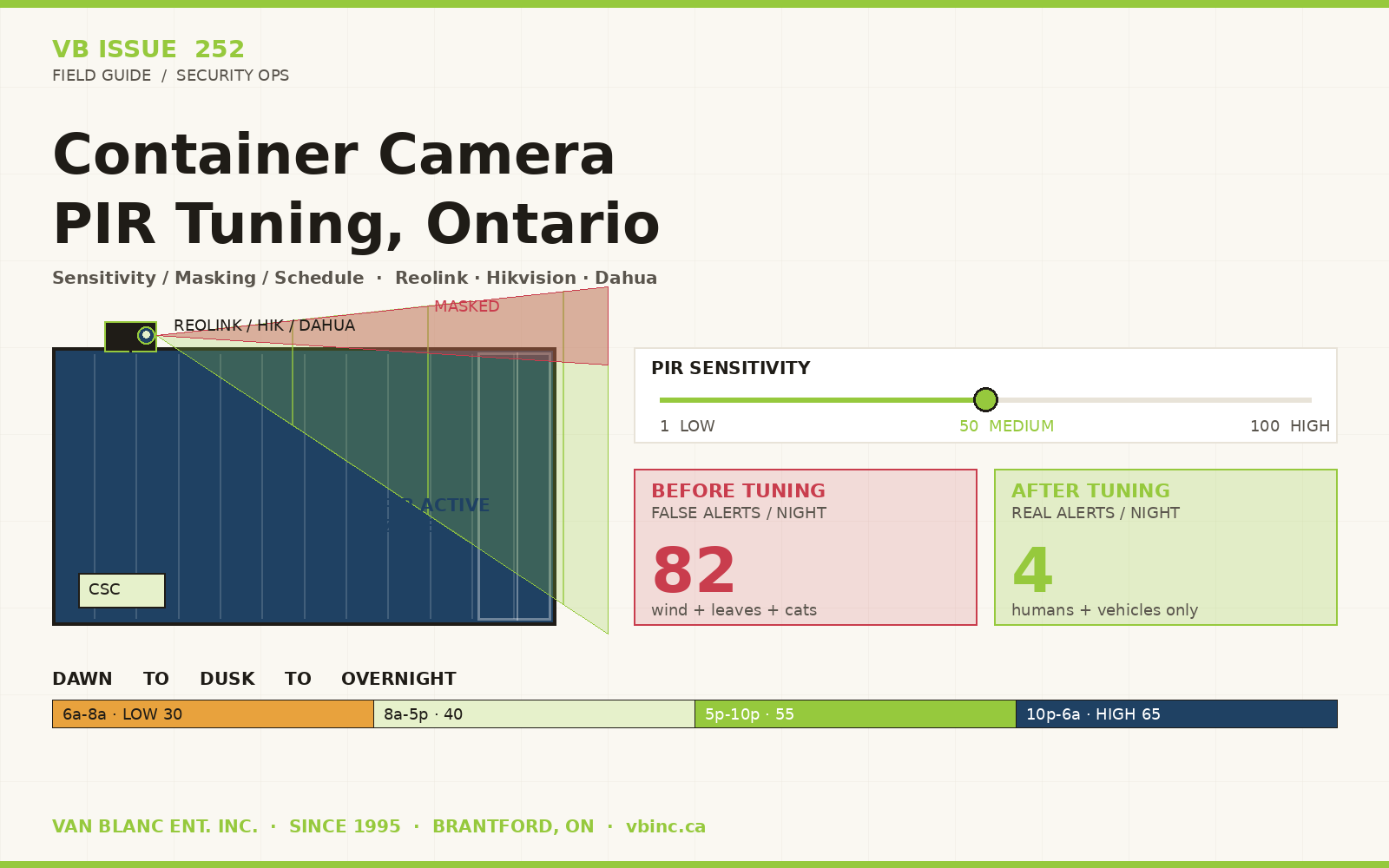
Quick Answer: A container camera with PIR motion sensing in an Ontario yard should run at medium sensitivity (level 50 to 60), mounted 2.4 to 2.7 m high, angled 15 degrees down, with zone masks over fence-line vegetation and a 3-second debounce. That single profile cuts false alerts from 80-plus a night to fewer than 5 without missing real intrusions. Van Blanc has supplied shipping containers across Ontario since 1995. Honest 4.9-star service, 1-3 day delivery from 4 Brantford yards.
In This Guide
- Why Do PIR False Alerts Spike on Container Yards?
- How Does a PIR Sensor Decide to Trigger?
- What PIR Sensitivity Should You Start a Container Camera At?
- How High Should You Mount a Camera on a Container?
- What Should You Zone-Mask on a Container Camera?
- How Do You Schedule a Container Camera Around Daily Traffic?
- How Do You Tune a Container Camera for Ontario Wildlife?
- Should You Adjust PIR Settings for Ontario Seasons?
- Can App-Side AI Filters Replace PIR Tuning?
- How Long Does It Take to Tune a Container Camera?
- Frequently Asked Questions
Reading time: 14 minutes.
Why Do PIR False Alerts Spike on Container Yards?
Container-yard PIR cameras spike with false alerts because the steel radiates stored heat at dusk, the surroundings are unmowed and brush-filled, and wildlife treats the perimeter as a corridor. A default residential profile reads all of that as motion. Correct sensitivity, mounting, and zone masking cut the noise to a handful of real events a night.
A residential PIR camera lives a quiet life. It watches a back patio. Heat sources are stable, the grass is mowed, the fence is solid. Default sensitivity works fine.
A container camera lives an entirely different life. The container itself is a slab of Corten weathering steel that absorbs sun all day and radiates heat back at dusk. The yard is rarely manicured. Long grass, scrub, fence-line poplars and the neighbour’s hedge fill the frame. Heavy equipment, snow piles, propane tanks and ventilation fans sit in the picture. Wildlife treats the property as a corridor: raccoons run the perimeter at 3 a.m., deer browse the back hedge in October, barn cats own everything in between.
Default sensitivity in that environment produces what Christian calls the spam profile. Eighty-plus alerts a night. Within a week most owners mute alerts or stop opening the app. The camera is technically working. Operationally it is dead.
Christian LeBlanc, second-generation operator: “People blame the camera. Nine times out of ten the camera is fine. It is pointed at a tree line on a hot container in a yard full of raccoons, running the same setting you would use on a back porch. Change the setting to fit the yard and the alerts go quiet overnight.”
The fix is correct tuning, not a fancier camera. Every Reolink, Hikvision, Dahua, Lorex, Swann, Eufy and Annke shipped in the last five years has the settings needed to suppress 95% of false alerts. Tuning takes one evening.
How Does a PIR Sensor Decide to Trigger?
A PIR sensor decides to trigger when a warm object moves across its field of view fast enough to swing the reading from one zone of the crystal to the next. PIR stands for passive infrared. The sensor does not emit anything. Inside the housing sits a pyroelectric crystal split into two or four zones behind a Fresnel lens. The lens chops the field of view into stripes. When a warm object moves across those stripes the sensor sees a rapid swing from one zone to the next, and the firmware reads it as motion.
The Three PIR Truths That Drive Every Tuning Decision
- PIR sees temperature change, not motion. A leaf shifting from shade into sun rises 8 to 12 degrees Celsius in three seconds. The sensor reads that as a warm body moving. A motionless deer behind a hedge is invisible. A swaying branch in dappled sunlight is a riot.
- PIR needs a thermal contrast of roughly 4 degrees between target and background to trigger. A coyote at 38 C against a 4 C October ground triggers easily. The same coyote against a 36 C July driveway is harder to detect.
- PIR sensitivity is a range, not a switch. Most cameras offer 1 to 100 (Reolink), Low / Medium / High (Hikvision), or 1 to 9 (Dahua). Each step changes the firmware threshold for what counts as a real swing. There is no universally correct value, only the correct value for this camera on this container in this yard.
That last truth is why the profiles we set up as part of a full container yard surveillance build are not a single number. They are a starting profile plus three weeks of small adjustments based on what the alert log actually shows.
What PIR Sensitivity Should You Start a Container Camera At?
Container camera PIR sensitivity should start at medium, the middle of whatever range your brand uses. Calibration always starts in the middle. Start high and tune down, you spend three nights watching 80 alerts an hour and never get clean signal data. Start low and tune up, you miss the actual intrusion test event and never know the floor. The middle gives you data in both directions on day one. Christian’s default ship profile is 50 on a 1 to 100 scale, which maps across brands as follows:
| Brand / interface | Equivalent starting value | Notes |
|---|---|---|
| Reolink (1 to 100 slider) | 50 | Default ship setting on our installs |
| Hikvision (Low / Med / High) | Medium | Some firmwares add Lowest / Highest, ignore the extremes |
| Dahua (DSS 1 to 9) | 5 | Map the slider exactly to mid-range |
| Swann (Low / Med / High) | Medium | Swann’s PIR is hotter than spec, treat Med as already aggressive |
| Eufy (1 to 9 with Optimal) | Optimal | Optimal is roughly 4 to 5, better than the slider on first run |
| Lorex (Low / Med / High plus Sensitivity 1 to 9) | Medium / 5 | Use both controls together |
| Annke (1 to 100) | 50 | Same map as Reolink |
From medium you move in 5 to 10 percent steps. Jump from 50 to 80 and you start over from scratch. Jump from 50 to 20 and you miss the test event. Small steps, three nights between adjustments, written log of what changed.
How High Should You Mount a Camera on a Container?
Mount a container camera 2.4 to 2.7 m above the ground and tilt it 12 to 18 degrees down. Most PIR tuning failures are mounting failures dressed up as sensitivity problems. A camera at the wrong height or angle cannot be tuned. You can move the slider all day and the false alerts keep coming because the Fresnel lens physics are working against you.
The Container-Mount Geometry That Actually Works
- Height: 2.4 to 2.7 m above ground. On a 20 ft container (8 ft 6 in / 2.59 m) that is right at the top corner casting. On a 40 ft high cube (9 ft 6 in / 2.9 m) just below the top edge. Lower than 2 m and every passing dog triggers; higher than 3 m and small intruders go missing because the Fresnel zones stretch past their useful range.
- Downward angle: 12 to 18 degrees. Most installers leave the bracket flat and the camera shoots straight out. That horizon stripe becomes the false-alert factory because tree movement, sky, clouds and distant heat sources all live in the upper half of the frame. Tilting down 15 degrees buries the horizon and puts the real intrusion zone (ground 5 to 15 m out from the container) into the sensitive middle of the Fresnel stripes.
- Mounting surface: corner casting or a welded steel bracket through-bolted into the container roof rail. Avoid magnetic mounts in high-wind exposure. A bracket that wiggles a few millimetres in a gust registers every gust as motion.
- Heat-source separation: 3 m minimum from the south or west wall in summer. Steel walls baking at 55 C radiate IR back into the lens for two hours after sunset, swamping the signal. Mount on the north or east face when coverage allows.
- Cable strain relief: a loop of cable swinging under the camera body picks up wind motion and reflects heat back into the housing. Strap it tight to the bracket arm and seal the entry point with a gland.
Christian: “Get the mount right and you spend an evening tuning. Get it wrong and you spend a month chasing settings. Mount first, tune second.”
If you would rather not drill the camera bracket yourself, a welded mount and the cable gland can be added when the box is built. We fold camera brackets into our yard-built modification work so the steel arrives drilled, sealed, and ready for the camera instead of you working on a ladder after delivery.
What Should You Zone-Mask on a Container Camera?
On a container camera, zone-mask the moving, heat-leaking parts of the frame: the sky and tree tops, the fence line and roadway, wind-blown vegetation, neighbouring exhaust vents, and any wildlife corridor you spot in the first few nights. Every camera worth its price sold since 2022 has motion-zone masking. The interface is usually a grid over a live frame. You drag your finger to colour cells either active (camera triggers there) or masked (camera ignores). It is the single highest-leverage setting in the entire app.
The Five Masks Every Container Yard Needs
- The top third of the frame covering sky, tree tops, building edges. Almost zero real threats come from above; almost all wind and weather false alerts do.
- The fence line and adjacent roadway if the camera sits within 8 m of a road. Headlights at night sweep heat into the frame and passing vehicles read as motion. Masking the road strip eliminates the 10 p.m. to 2 a.m. spike.
- Vegetation patches. Any grass, brush or hedge that moves in wind. A 2 m by 2 m patch of poplars gets masked entirely. Real intruders walk through gaps, not hedges.
- HVAC and ventilation outlets on neighbouring buildings. Heat exhaust from a furnace, dryer vent or propane heater pulses warm air at irregular intervals, and each pulse is a perfect PIR trigger. Mask the exhaust and the surrounding 1 m.
- Wildlife corridors identified during the first three nights of review. Most yards have one regular animal path. Mask the entry point and you keep the intruder coverage without the nightly wildlife buzz.
A correctly masked container camera ends up with roughly 40% of its frame active. That looks wrong on screen because the unmasked area feels small. Operationally it is exactly right.
How Do You Schedule a Container Camera Around Daily Traffic?
You schedule a container camera by lowering PIR sensitivity and muting push during predictable daytime traffic, then raising both overnight. Time-of-day scheduling is the second highest-leverage setting after zone masking. Most container cameras sit in low-traffic environments overnight and high-traffic environments during business hours. Running one sensitivity profile for both wastes the camera’s ability to discriminate. The default schedule we hand new owners, the same one covered in our broader camera installation guide, looks like this:
| Window | PIR sensitivity | Notification target | Rationale |
|---|---|---|---|
| 6 a.m. to 8 a.m. | 30 (low) | Push muted, recording on | Mail carrier, meter reader, regular morning traffic |
| 8 a.m. to 5 p.m. | 40 (medium-low) | Push muted on weekdays, on weekends | Business hours, deliveries expected |
| 5 p.m. to 10 p.m. | 55 (medium) | Push on, AI filter active | Evening transition, real intrusions start here |
| 10 p.m. to 6 a.m. | 65 (medium-high) | Push on, all categories alert | Quiet hours, any motion is meaningful |
That schedule reduces daily alert volume 60 to 70 percent on most yards without compromising overnight protection. Recording stays continuous in lower sensitivity windows so video review is available if something happens during the day.
Tip: Honour the One-Time Events
If the mower comes Tuesday morning, the propane truck arrives the first Wednesday of every month, or the irrigation system runs Thursday at 4 a.m., put those one-time events into a temporary schedule exception. Most apps let you do this in 30 seconds. The reward is no alert spam for a known harmless event, and clean baseline data for the rest of the week.
How Do You Tune a Container Camera for Ontario Wildlife?
You tune a container camera for Ontario wildlife by deciding which animals deserve a phone buzz, then setting sensitivity and masks to pass those and suppress the rest. Ontario yards have wildlife. Deer move through rural and semi-rural properties year-round. Raccoons run urban and rural alike. Coyotes work the agricultural edge. Barn and feral cats live everywhere there is shelter. Each is a heat source crossing your frame.
Wildlife tuning is about choosing which animals you want to know about and which you do not. A barn cat at 2 a.m. is rarely worth a phone buzz. A coyote following livestock might be. A pair of humans moving slowly past the container is the alert you built the system for.
Wildlife Heat Signatures and Sensitivity Implications
- Deer (large, slow, 37 to 38 C): triggers at any sensitivity above 30. To filter out, drop to 35 or mask the regular crossing line.
- Coyote (medium, fast, 38 C, often in pairs): short bursts of motion then stillness. Keep sensitivity 50-plus to ensure detection.
- Raccoon (small, slow, 38 C, low to ground): triggers at 50-plus consistently. Drop to 30 to 35 in overnight windows where raccoon activity is heavy; trade-off is some loss of crouching-human detection.
- Cat (small, very low, 38 C): triggers at 60-plus, often invisible below 40. Easy to suppress, but cats and crouching humans share a height profile, so tune cats out only if perimeter is otherwise secure.
- Rabbits, skunks, opossums, groundhogs: below 50 most are invisible. Default ship profile already filters these out.
Most yards land on sensitivity 50 overnight with zone masks on the known wildlife paths: that captures coyotes and deer (larger concerns) while suppressing raccoons and cats (routine and noisy).
Should You Adjust PIR Settings for Ontario Seasons?
Yes, you should adjust container camera PIR settings twice a year for Ontario seasons: raise sensitivity in summer when steel and air heat collapse the contrast, lower it in deep winter when every warm body flares against frozen ground. Ontario weather punishes PIR twice a year. Summer pushes ambient air toward 30 C with steel container surfaces hitting 55 to 65 C. The thermal contrast between a human (37 C) and the background (40 to 50 C) collapses, so sensitivity needs to rise. Winter swings the other way: ambient drops to minus 20, the steel surface to minus 10, and any heat source stands out like a flare. Sensitivity needs to drop or you trigger on a deer 100 m away.
| Season / temperature | Sensitivity adjustment | Other settings |
|---|---|---|
| Summer (above 25 C) | Raise by 10 to 15 points | Verify daytime AI active |
| Spring / fall (5 to 25 C) | Default 50 | Standard schedule |
| Winter (minus 10 to 5 C) | Slightly lower, 40 to 50 | Schedule may shift earlier |
| Deep winter (below minus 20 C) | Lower 10 to 15 points to 35 to 40 | Wildlife contrast is extreme |
Most installers skip the seasonal correction. They tune on a 15 C April evening, get a clean profile, never touch it again. By July the camera misses humans because thermal contrast collapsed. By February it triggers on every coyote within 80 m. Two adjustments a year carry you through.
Can App-Side AI Filters Replace PIR Tuning?
App-side AI filters cannot replace PIR tuning; they layer on top of it. The PIR has to trigger first, then the AI decides whether that trigger earns a notification. Every major brand offers app-side AI filters that classify the trigger event before the alert reaches your phone. Reolink calls it Smart Detection, Hikvision calls it AcuSense, Dahua calls it WizSense, Eufy calls it AI Detection. Categories vary but always include Person, Vehicle, and Animal.
AI filters do not replace PIR tuning, they sit on top of it. PIR has to trigger first, the AI decides whether the trigger gets through to a notification. Two-stage filtering produces cleaner alerts than either stage alone.
How to Stack PIR and AI for a Working Yard System
- PIR sensitivity: medium, 50 starting. Wide enough net to catch real motion, narrow enough to suppress wind and heat artifacts.
- AI filter: Person and Vehicle only for alerts. Animal triggers still record video but skip the push. You retain wildlife footage without the 3 a.m. buzz.
- Notification escalation: standard push for any Person or Vehicle event; SMS or audible alarm reserved for Person events overnight (10 p.m. to 6 a.m.).
- Confidence threshold: AI at 60 to 70 percent. Below 60 the AI itself generates false positives. Above 75 it gets too conservative and misses real events.
- Weekly review: scan animal clips once a week. If the same raccoon uses the same gap, that becomes your next zone mask.
How Long Does It Take to Tune a Container Camera?
Tuning a container camera takes about three weeks of light, deliberate work, not one afternoon of slider-dragging. The three-week discipline is the operational reality behind every quiet camera. Week one is high alert volume; you observe and write down patterns. Week two is targeted adjustments based on those patterns. Week three is fine tuning and confirmation. After three weeks the system is set-and-forget, with two seasonal adjustments per year.
Christian LeBlanc, second-generation operator: “First week, every customer gets the same instruction. Do not change anything. Watch the alerts, screenshot what you see, write down when they happen and what triggered them. Most people want to fix it on day one because their phone is going wild. Day one is data. Day eight is when we actually tune. By day twenty-one the camera is doing exactly what they bought it for.”
The Brantford Yard Reference Build
Our own 90 Morton Avenue East yard runs the same protocol we hand customers. Two cameras on the office container facing the entrance, two on rear containers facing the back fence and river-edge tree line. PIR at 55 evening, 65 overnight, top third and fence-line vegetation masked. AI filter on Person and Vehicle for alerts, Animal events record only. The entrance pair also feeds the plate-capture setup we use for gate traffic, which leans on the same clean-trigger discipline. Average overnight alert volume after the third week: 3 to 5 events, almost all of which are real. We test what we sell. This is the exact profile behind the wider camera systems we set up for Ontario yards, running on our own property first.
Frequently Asked Questions
What PIR sensitivity should I start my container camera at?
Start at medium, which is 50 on a 1 to 100 scale (Reolink, Annke), Medium on a Low/Med/High toggle (Hikvision, Swann, Lorex), or 5 on a 1 to 9 slider (Dahua, Eufy). From medium you adjust in 5 to 10 point steps over three weeks based on what your alert log actually shows.
How high should the camera be mounted on a shipping container?
Aim for 2.4 to 2.7 m above ground, angled 12 to 18 degrees downward. On a standard 20 ft container that is essentially at the top corner casting. On a 40 ft high cube it is just below the top edge. Lower than 2 m triggers on small animals; higher than 3 m starts missing small intruders.
Why does my container camera trigger on tree branches and grass?
PIR sensors detect rapid temperature changes, not motion. A leaf shifting from shade into sun can rise 10 C in three seconds, and the sensor reads that as a warm body. The fix is zone masking the vegetation patches and the top third of the frame, not lowering sensitivity, which would also miss real intrusions.
Will lowering sensitivity cause me to miss a real intruder?
At sensitivity 40 to 50 with correct mounting you will still catch any human walking upright in the camera’s field of view within 12 to 15 m. You start losing reliable detection of crouching humans below sensitivity 35 and small animals (cats, raccoons) below sensitivity 40. Medium is the sweet spot for human intrusion detection.
How do I stop the mail carrier from triggering daily alerts?
Use scheduling. Set sensitivity to 30 (low) during the 6 a.m. to 8 a.m. or 8 a.m. to 5 p.m. window when the mail carrier passes, and mute push notifications during that window. Recording stays on so you have video review available. Most apps let you set a recurring weekday schedule in 30 seconds.
Do I need a separate camera for thermal motion detection?
For most container yards, no. A standard PIR camera tuned correctly handles 95% of detection scenarios at a fraction of the cost. Thermal imaging cameras run 5 to 10 times the price and are typically reserved for very large industrial yards, fog-prone marine sites, or properties where total darkness coverage is critical.
How does the heat from the container itself affect PIR detection?
A south-facing container wall can hit 55 to 65 C on a summer afternoon and continue radiating IR for two hours after sunset. That heat swamps the sensor and either masks real motion or generates false triggers. Mount the camera on the north or east-facing wall when possible, and keep 3 m of separation from any sun-heated wall in summer.
What is zone masking and how is it different from sensitivity?
Zone masking covers part of the camera’s frame so the sensor ignores motion there entirely. Sensitivity controls how strongly the sensor responds to motion in the active zones. You use both together. Mask the tree row and the sky, then tune sensitivity to medium for the remaining active area. Most apps overlay a grid you tap to mask cells.
Should I adjust PIR settings differently in winter and summer?
Yes. In summer (above 25 C) raise sensitivity by 10 to 15 points because thermal contrast between humans and the warm background collapses. In deep winter (below minus 20 C) lower sensitivity by 10 to 15 points because every heat source stands out like a flare and wildlife triggers spike. Two adjustments a year, late May and late October.
Can app-side AI filters replace PIR tuning?
No. The AI sits on top of PIR, not in place of it. PIR has to trigger first before the AI classifies the event. If your PIR is wildly mis-tuned the AI gets overwhelmed with thousands of triggers per day and starts dropping events. Tune PIR first to medium with correct masking, then enable AI filters for Person and Vehicle only.
Sources
- International Organization for Standardization. (2022). ISO 6346:2022, Freight containers, Coding, identification and marking. iso.org/standard/82754.html
- Reolink Support. (2025). How to Set up PIR Sensitivity via Reolink Software. support.reolink.com
- GW Security. (2025). What Is PIR Sensitivity and How Does It Affect False Alarms? gwsecurityusa.com
- SafeHome.org. (2024). Testing and Calibrating PIR Motion Sensors. safehome.org
- Axis Communications. (2024). Multiple methods for motion detection. axis.com
Reach Van Blanc in Brantford
We have been supplying shipping containers across Ontario since 1995, and the PIR tuning protocol on this page is the same one we install on our own yard. Our warehouse is at 90 Morton Avenue E in Brantford, and we deliver right across the province with a real lead time, not a hopeful one.
Van Blanc Ent. Inc. 90 Morton Ave E Unit 1B, Brantford, ON N3R 7J7. +1 888-509-6658
If you bought a container from us and want help dialing in the camera, call Christian. He has run this protocol on dozens of yards and can usually diagnose a bad alert profile from a screenshot of the log. Still shopping for the box itself? Start with the steel we have ready in the yard and tell us where the camera needs to watch.
Related Reading
Ready to price your container?
Tell us the size and your postal code and we’ll send back an honest, all-in number, container, delivery, and placement, usually within 1-3 days. No pressure, no mystery fees.
Family-run in Brantford since 1995 · 200+ containers in stock · 4.9★ across 140+ Google reviews · every box graded by a person, walk it before it lands.