
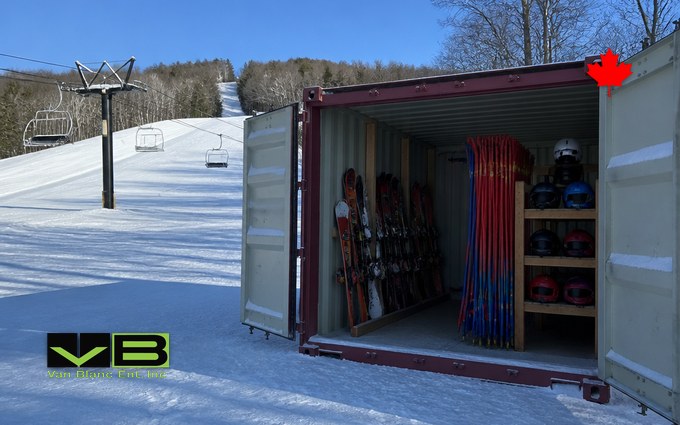
Quick Answer: To store skis for the off-season, clean and dry them and leave thick wax unscraped. Ease the binding DIN, strap tip and tail, and keep them cool and dry. A ski club or small hill does the same at fleet scale, in vented 20ft or 40ft containers at the base.
What This Ski Storage Guide Covers
- How do you store skis for the off-season?
- Why off-season ski care pays
- Upright or flat on the rack
- Ski boots, poles and helmets
- Garages, sheds and temperature swings
- Old skis and the ten-year binding line
- How an Ontario ski club runs a season
- Alpine Ontario race programs
- Ski patrol at the hill
- Snowmaking hoses and guns in summer
- Ski rental shop fleets
- Ski club boxes at the base
- Inside a 20ft and a 40ft
- Racking a rental fleet
- Keeping skis dry in a steel box
- Grades for a hill base
- Winter delivery to a hill base
- Hills from Collingwood to Ottawa
- Before the club calls
- Ski storage FAQs
Reading Time: 17 minutes
How Do You Store Skis for the Off-Season?
Off-season ski storage is the routine that carries a pair of skis from the last spring run to the first fall tune. Done right, the pair comes out without rust, a dried-out base or a tired binding spring. SKI magazine’s version has seven steps and, by the magazine’s count, takes about one hour. Clean the bases, polish the edges, lay on a thick coat of wax and leave it unscraped. Have the binding DIN turned down, by a technician if you have never done it. Strap the pair at tip and tail and put the skis somewhere that holds a steady temperature. Van Blanc, a Brantford container seller since 1995, sells the steel box a ski club or small hill uses for that last step. An insulated container that slows the summer heat comes up again further down.
The steps below are the same whether the pile is one family’s skis or a club’s whole fleet. What changes at club scale is the count, the paperwork and the room it all has to fit in. Van Blanc’s answer for that room starts with graded used steel boxes sold outright, and the last row of the table is where they come in.
| Step | What the source says | At club scale |
|---|---|---|
| Wipe, dry, inspect | River & Trail: wipe the gear down, inspect for damage and make sure it is dry before storage | Each pair checked at the counter on closing weekend, damaged pairs set aside, the bag-and-tag habit curling clubs use |
| Polish the edges | SKI: run a gummy stone over all four edges to take off rust and burrs | A bench job for the club’s tuning crew, done in batches |
| Wax and leave it | SKI: a generous layer, no scraping; Kawartha Nordic: hot storage wax, left unscraped | One iron, one wax, one afternoon per rack |
| Ease the DIN | SKI: turn the toe and heel down for the summer, and reset before the first ski day | A certified technician does it and logs each setting |
| Strap the pair | SKI: a padded strap near the tip and tail; Kawartha Nordic: snug enough to hold, never tight enough to press out the camber | Straps or ties on every pair, sized tags on the rack |
| Pick the room | HEAD: dry, well ventilated, protected from moisture, dust and fluctuating temperatures | A room the whole fleet fits in, such as a high cube racked on both walls |
Why Off-Season Ski Care Pays
Ski storage pays because the damage happens slowly and out of sight. River & Trail Outdoor Company puts it plainly: a bare base can dry out and edges can rust. Both cost material when a shop grinds them back. Kawartha Nordic Ski Club, in the Kawarthas north of Peterborough, gives the cross-country version. A bare base exposed to air all summer dries, whitens and oxidizes, so the club’s advice is to bury it in wax. Wax does its job best in a dry room, which is where insulated steel for Canadian weather enters the story later on.
For a private owner the cost is one tune. For a club it multiplies by the fleet. HEAD, the ski maker, notes that sharp edges last around ten days of skiing, depending on the snow. A rental pair that starts the season rusty eats into those ten days before the first lesson. A race pair starts the season slower than a rival club’s freshly tuned skis. Vents and shelving both appear among the custom options Van Blanc lists for its boxes, and a stored fleet needs both.
Upright or Flat on the Rack
Skis can be stored upright or flat. HEAD’s guidance is that it does not matter which, as long as they are kept away from moisture, dust and swinging temperatures. HEAD also suggests the pair go base to base, held loosely with a strap at each end, with no pressure points around the bindings. River & Trail adds one rule: nothing heavy on top that could bend the skis and change their shape.
A wall rack suits a crowd of skis. It holds each pair upright by the tips or the waist, so the bases stay off the floor and nothing leans on anything else. At a club the rack is also the inventory, with a slot per size and a tag per slot. Above the racks, wall-mounted shelving over the ski racks holds boots and helmets along a container’s long walls.
Christian LeBlanc, second-generation operator, Van Blanc Ent. Inc.: “Clubs usually call about the racks first. I ask two things. How long is the longest pair in the race room, and how many pairs come off the hill in April? The first number tells me the skis can stand up inside. The second tells me twenty or forty.”
Christian’s first question has a short answer for most fleets. A Van Blanc 20ft or 40ft standard box is 7 ft 10 in (2.385 m) tall inside. Any pair shorter than that stands upright along the long walls of a twenty-foot box, with room above the tips.
Ski Boots, Poles and Helmets
Ski boots need more care than poles and less than skis. HEAD’s routine is to pull the liners, clean them with a damp cloth and let both parts dry away from sun and strong heat. Then the liners go back in and the buckles are fastened lightly so the shell keeps its shape. SKI adds a zippered boot bag, which keeps critters out of a warm liner. In a container, the bags sit on shelving bolted along the side walls, clear of the floor. Kawartha Nordic says the same for cross-country boots: insoles out, bone dry, loosely buckled.
Poles are the easy ones. River & Trail says to wipe them and store them hanging, lying down or leaning, as long as nothing bends them. Helmets and goggles go in non-scratch bags, kept together. HEAD adds one warning worth repeating at any club: check the helmet for damage before it goes away, because a cracked helmet can be fatal.
In a club’s storage room, boots belong on shelves at waist height, sorted by size, with bags or bins per row. Helmets hang or sit in labelled bins above them. A container with a second way in that skips the cargo doors lets a volunteer fetch one size without swinging both doors open in a February wind.
Garages, Sheds and Temperature Swings
A garage is where most people store skis, and SKI says so outright. The magazine’s ideal is somewhere with better temperature control, because big swings can hurt the metal edges and may warp a base. River & Trail calls garages, attics, sheds and unfinished basements not the best option: too much moisture rusts edges and too much heat can delaminate. It also warns against setting skis straight on concrete, which gives off moisture.
A plain steel container sits in the same camp as a garage on that score, because steel tracks the weather outside it. What changes the picture is the build. Van Blanc’s page on insulated boxes for sale explains that an insulated box slows the change rather than holding a set temperature. That is what a stored fleet asks of it. The container floor also matters. It is marine plywood, and the 40ft spec puts it 170 mm (6.7 in) above the ground, so skis never sit on a slab.
Summer Sun on a Ski Box
Set the box where it gets afternoon shade and order it in a light colour. Then fit vents placed high and low on opposite walls so warm air has a way out. All three are decided when the box is ordered, before it ever reaches the hill.
Old Skis and the Ten-Year Binding Line
Twenty-year-old skis are usually done, and the binding is the reason. Skiis & Biikes is an Ontario ski shop with stores in Mississauga, Collingwood and Toronto. It explains that an indemnified binding is one whose maker will support the shop’s certified technician in the event of legal action. The shop adds that a binding typically stops being indemnified after about 10 years, and that is when it is time to retire it. The Hamilton Ski & Snowboard Swap notes that shops will not mount or service non-indemnified bindings.
For a club the ten-year line is a fleet rule, written into the rental log. Pairs that cross it come off the rack, and the space goes to the pairs that replace them. A storage room with tagged slots, such as a box with racks and shelving inside, makes that audit a walk down one wall in October.
How an Ontario Ski Club Runs a Season
An Ontario ski club is a membership organization that runs a hill, a race program or both. Some own their hill. Mountain Life counted four private clubs in 2015 along the Blue Mountain ridge outside Collingwood, beginning with Osler Bluff, incorporated in September 1949. Others are racing clubs that train at a resort. Nordic clubs groom trail networks with volunteers. All of them share one calendar: a short, busy winter and a long off-season with the gear in storage.
The year turns on a few dates. Snowmaking starts when the cold arrives. Lessons and race training fill the weekends to March Break. Then the fleet comes off the hill, the race gates come down and the patrol empties its first aid room. From April to November the gear sits, and that is the stretch this guide is about. The curling clubs that summer their stones in steel face the same half-year problem from the other side of the calendar.
Alpine Ontario Race Programs
Alpine Ontario Alpin (AOA) is the provincial sport organization for alpine ski racing. It represents four divisions: Southern Ontario, Northern Ontario, National Capital and Lake Superior. Its Southern Ontario Division covers clubs from Belleville to London to Peterborough, with its densest population of skiers around Collingwood. That division’s racers make up over 80 percent of AOA, and it races at U12, U14, U16 and U18/U21.
The U16 program shows what a race team carries. It is for athletes aged 14 and 15, and AOA recommends a maximum of 18 domestic technical race starts a season. Its program page says athletes should have SL and GS specific skis, so every racer brings at least two pairs. Add the club’s gates, drills, timing gear and bibs, and a race program’s kit fills a room before the rental fleet is counted. A graded cargo worthy unit from our used stock makes a plain race-hut shell.
The Race Hut
A race hut is the club’s base at the bottom of the course. Gates and drills stand in racks, timing gear sits on a bench, and bibs go in bins beside a wax bench for race morning. A twenty-foot box with a 7 ft 8 in door opening takes the gate bundles straight in through the cargo doors. With a man door and a window added, coaches can work inside it.
Ski Patrol at the Hill
The Canadian Ski Patrol (CSP) is a national volunteer organization that gives advanced first aid at ski areas. Its history page says that in 1940 the Canadian Amateur Ski Association asked Dr. Douglas Firth, a young Toronto osteopath, to organize a first aid and rescue group. Today the CSP reports over 4,000 volunteer members in more than 200 ski areas. Blue Mountain Resort named a run “The Dr. Doug” after him in 1990.
Patrol gear needs a home between shifts and between seasons. In The Hills magazine photographed patrollers at Hockley Valley Resort making a run with the rescue toboggan. Toboggans, first aid stock and signage all need a dry, locked steel room from spring to fall. A small box near the lifts, set wherever a truck can reach, keeps a spare toboggan close at hand in January. The CSP’s Muskoka Zone lists Hidden Valley Ski Area and Arrowhead Nordic Ski Club as the hills it serves, so the Huntsville end of Muskoka has both kinds of patrol.
Snowmaking Hoses and Guns in Summer
Snowmaking is what lets a southern Ontario hill open on a schedule. Bill Creighton is CEO of Chicopee Ski Club in Kitchener. He told CBC News in January 2024 that temperatures need to be at -2 C for staff to make snow. Above zero, he said, the club cannot make snow no matter how much it invests in equipment. A year earlier he explained why natural snow is not enough. In his example, 6 to 12 inches on a lawn becomes about half an inch once a 2,000-pound groomer packs it. A bare container roof is rated below the design snow loads Ontario’s building code sets for Toronto and Ottawa. A container roof under Ontario snow load sets out the clearing, peaked-roof and stiffener options for a box at the base.
A snowmaking system is plumbing on a big scale. Massanutten Resort, a Virginia hill, describes air lines, water lines, electrical lines, water hydrants and snow guns, fed from holding ponds. It also says a foot of snow over one acre takes 175,000 gallons of water. The buried lines stay put in summer. The hoses, couplings, gauges, spare nozzles and any guns that come off the trails need a dry, locked place until the next cold snap. A forty-foot box beside the pump house holds hose reels along one wall and guns on the floor.
Ski Rental Shop Fleets
A ski rental shop at a club or small hill runs a fleet. Skis, boots, poles and helmets come in every size, fitted and adjusted at a counter. Skiwax.ca, a Thunder Bay ski supplier, describes the club rental program as a way to get families on snow without buying gear. In its account, one club’s Jackrabbit program grew from 28 to 78 skiers in three seasons after starting rentals.
The fleet is also the biggest storage job a club has. Rental gear turns over every season, wears in predictable places and needs a technician’s attention before it goes back out. Skiwax’s suggested kit for a club fleet includes a team ski bag that holds 10 to 12 pairs. A club that wants its rental store to look the part beside the lodge can start from a one-trip box still in its factory paint. In April all of it comes back at once, wet. It needs drying, waxing and racking before it can be locked away, ideally in a box with louvre vents that keep air moving.
Ski Club Boxes at the Base
Ski club storage in a shipping container puts each job in its own locked steel room at the base. Van Blanc has sold containers across Ontario since 1995, and the simplest plan is one box per job, so one to four boxes. The table matches each job to a size. It is a starting point to adjust on the phone, with no claim that any club needs all four.
| Job at the hill | Box that usually suits | What goes inside |
|---|---|---|
| Race hut | 20ft, man door, window, insulated | Gates, drills, timing gear, bibs, a wax bench |
| Rental store | 40ft standard or high cube, insulated, racks both walls | Skis upright, boots and helmets on shelves |
| Patrol cache | 20ft at the base, or by a lift within a tilt-deck’s reach | Toboggans, first aid stock, signage |
| Snowmaking store | 40ft standard near the pump house | Hose reels, couplings, guns, spare parts |
Start with the rental store if the fleet is what fills the base lodge’s back room. A race hut and a patrol cache can follow in later seasons. Graded used boxes for a club compound cover the working jobs, and the grade section below sets out all four grades.
Inside a 20ft and a 40ft
Inside dimensions decide what fits, so Van Blanc prints them from its own product pages. Both standard boxes share the same width and height. The 40ft roughly doubles the length, which on a rental store means twice the wall for racks.
| Measurement | 20ft standard | 40ft standard |
|---|---|---|
| Inside length | 19 ft 4 in (5.898 m) | 39 ft 6 in (12.040 m) |
| Inside width | 7 ft 8 in (2.352 m) | 7 ft 8 in (2.337 m) |
| Inside height | 7 ft 10 in (2.385 m) | 7 ft 10 in (2.388 m) |
| Door opening | 7 ft 8 in by 7 ft 6 in (2.340 m by 2.292 m) | 7 ft 8 in by 7 ft 6 in (2.340 m by 2.292 m) |
| Volume | 1,172 cu ft (33.2 m³) | 2,395 cu ft (67.8 m³) |
A club that wants overhead room for a second row of shelves can look at a 40ft high cube with 8 ft 10 in inside. That extra foot carries boot shelves above the tips of the skis.
Racking a Rental Fleet
Racking a rental fleet in a Van Blanc container is arithmetic on the wall length. Measure how much wall your rack uses per pair, then divide. As a worked example only, at 15 cm a pair, one long wall of a 20ft carries about 39 pairs in a single row. The same spacing gives about 80 pairs per wall in a 40ft. Use your own rack’s number, because ski widths and rack designs vary.
Racks on both long walls leave an aisle down the middle, wide enough for a volunteer with an armful of skis. Boots and helmets can go on shelves at the far end. Keep the door end clear for loading in April, when the whole fleet arrives at once. A club with a full rental counter can look at a forty-foot store for the whole counter’s fleet. The 20ft suits a Nordic club with a smaller fleet.
- Tag each slot by length so the fall fitting starts at the right rack.
- Hang the race skis on their own wall, apart from the rental pairs.
- Store the DIN log in the box, in a bin by the door.
- Leave one empty rack for the pairs that come back damaged.
Keeping Skis Dry in a Steel Box
A dry box is the whole point, and three things make one. The first is airflow. Van Blanc’s ventilation guide recommends vents in pairs, high and low on opposite walls, so air moves through rather than sitting. The second is insulation. Van Blanc’s insulated container page describes factory-insulated boxes and spray-foamed boxes with two to three inches of closed-cell foam behind a liner.
The third is the floor and the pad. The box sits on blocks under its corner castings, which keeps the steel out of meltwater. Wet gear goes in only after it has dried. A box sealed on a load of damp boots in April will smell like it in November, whatever the walls are made of. A dehumidifier can follow once the box has power, wired by the club’s own licensed electrician.
Pricing a Box for the Hill
Count the rental pairs, the race pairs and the toboggans, and pick the spot at the base. Give us those counts, the spot and your postal code. We will tell you which 20ft and 40ft units fit, in which grade, with one all-in number and a real lead time.
Family-run in Brantford since 1995 · 4.9★ across 140+ Google reviews · see your unit by its container number first.
Grades for a Hill Base
Van Blanc sells four grades, and at a ski hill the choice usually follows who sees the box. A rental store beside the lodge is seen by every family in the lift line. A snowmaking store behind the pump house is seen by the crew. Each grade has its place, and the club picks.
- New (one-trip): one loaded voyage from the factory, with clean paint and tight doors. It suits a box guests walk past, and a new one-trip box for the lodge side of the hill starts with straight walls for the racks.
- Cargo worthy: boxes 8 to 15 years old with a valid CSC re-certification, doors that seal and surface rust on the outside. It is the working grade for a race hut or patrol cache.
- Wind and watertight: boxes 12 or more years old, roof and floor sealed, more rust on the panels. It fits long-term storage at the back of the compound, such as snowmaking spares.
- As-is: donor stock, sold with every defect written down, for heavy cutting or scrap value.
Paint goes on the same Van Blanc quote as the box, so a cargo worthy unit can arrive in a colour that sits quietly against the trees. Every size and grade on Van Blanc’s lots this week is listed in one place for a board that wants to compare.
Winter Delivery to a Hill Base
Winter delivery to a ski hill works, because ground that has frozen hard holds up a loaded tilt-deck better than wet ground does. Van Blanc’s winter delivery page sets the conditions. The approach has to be plowed and sanded or salted, and the spot has to be scraped down to firm ground. On a hill road, the page names glare ice on a grade as what stops the truck, and an unplowed laneway as the most common cause of a rescheduled drop. What a winter drop asks of the approach covers the checklist in full.
The same page gives the space a tilt-deck needs. A 20ft wants roughly 75 to 100 feet of straight approach and a 40ft about 120 to 130 feet, with about 12 feet of width. Overhead it wants roughly 14 to 16 feet, more for a high cube, and snow-loaded branches hang lower than in summer. Snowbanks also narrow a lane, so plow wide. The geometry behind a tilt-deck drop shows why the run has to be straight.
Where a base has no straight run, a HIAB truck lifting from firm footing is the other way in. Our page marks the spring thaw, from about March into April, as the stretch to skip, since soft topsoil sits over frozen ground. The same page names late summer or early fall as the best time to book, before wet late-fall ground and the first plowing. Set the box on a crowned gravel pad under the castings.
Hills From Collingwood to Ottawa
Ontario’s ski country is spread out, and Van Blanc delivers across the province from four Brantford yards. The densest cluster sits on the Blue Mountain ridge west of Collingwood, where the private clubs and Blue Mountain Resort share the escarpment. Clubs along the Blue Mountain escarpment near Collingwood get a stocked box in 1-3 days.
Closer to Lake Simcoe, CBC places Snow Valley in Minesing, just northwest of Barrie, and Horseshoe Resort in Barrie itself. Hills in the Barrie and Minesing area are on the same 1-3 day schedule. Muskoka has Hidden Valley in Huntsville. East, AOA’s National Capital Division lists Calabogie Peaks among its clubs, and Ontario-side hills around Ottawa take 1-3 days as well.
Walking the Rows Before Winter
A club board can send someone to Brantford to see the boxes first. All four of our yards are in Brantford, and a buyer can read the CSC plate on the exact unit before paying. Every quote comes with a real lead time, not a hopeful one. Worth the drive for unbeatable quality, family customer service with 30 years of experience.
Before the Club Calls
A ski club quote goes fastest with a few numbers in hand. These are the ones Van Blanc asks for, by phone or through the contact form, counts attached.
- Count the rental pairs and the race pairs, and measure the longest ski in each group.
- Count boots and helmets, since they decide the shelf length.
- List the race hut, patrol and snowmaking gear by type.
- Pick the spot at the base and photograph the approach, the overhead lines and the branches.
- Decide which boxes need insulation, vents, a personnel door for volunteers or power.
- Pick the delivery window, ideally before the first snowmaking night.
Frequently Asked Questions
Is it better to store skis upright or horizontally?
Either works. HEAD’s guidance is that orientation does not matter as long as the skis stay dry, dust-free and away from temperature swings. Store each pair base to base with a strap at the tip and tail, with no pressure on the bindings and nothing heavy on top. On a club’s wall racks, upright saves floor space.
Is it okay to store skis in the garage?
Most people do, but SKI magazine prefers a space with steadier temperatures, since big swings can affect edges and warp bases. River & Trail adds that garages and sheds risk rust from moisture and delamination from heat, and that skis should not sit on concrete. Vents, shade and insulation narrow those swings in any building, including an insulated steel box at a club.
Is it okay to use 20 year old skis?
Usually not, because of the binding. Skiis & Biikes, an Ontario shop, says a binding typically stops being indemnified after about 10 years. The Hamilton Ski & Snowboard Swap notes that shops will not service non-indemnified bindings. Take a 20-year-old pair to a certified technician before anyone skis it.
What is the best way to store skis at home?
Clean and dry them, then leave a thick coat of wax unscraped. Back the DIN down if you know how, and strap them at the tip and tail. Kawartha Nordic Ski Club advises a cool, dry place away from extreme temperature swings or heat. A wall rack keeps the bases off the floor.
Which box sizes suit a ski hill base?
A small Nordic fleet or a race hut usually fits a 20ft, which is 19 ft 4 in long inside. A rental store with racks on both walls usually suits a 40ft with 39 ft 6 in of floor. Plan one box per job, so one to four in all, and the count of pairs settles the sizes on the phone.
Can a container be delivered to a ski hill in winter?
Yes. Frozen ground carries a tilt-deck well, so the limits are traction and space. The approach must be plowed and sanded or salted, and the spot scraped to firm ground. A 40ft wants about 120 to 130 feet of straight run, and crane delivery for a tight base is the fallback. Delivery takes 1-3 days in most of Ontario, Eastern Ontario included.
Sources
- SKI magazine. SKI, How to Properly Store Your Ski Gear for the Summer (updated May 29, 2025), checked October 2026.
- HEAD. HEAD, How to Store Ski Gear at the End of the Season; River & Trail Outdoor Company. River & Trail, How to Store Your Ski Gear During the Off Season, checked October 2026.
- Kawartha Nordic Ski Club. Kawartha Nordic, Summer Hibernation: Off-Season Care for Your Nordic Skis (April 11, 2026), checked October 2026.
- Skiis & Biikes. Skiis & Biikes, Bindings Services; Hamilton Ski & Snowboard Swap. Hamilton Ski Swap, What to Know About Ski Binding Indemnification, checked October 2026.
- Alpine Ontario Alpin. AOA, Southern Ontario Division; AOA, Clubs; AOA, U16 Racing Program; Mountain Life. Mountain Life, History Lesson: Private Ski Clubs Ontario (February 12, 2015), checked October 2026.
- Canadian Ski Patrol. Canadian Ski Patrol, History and Alumni; Canadian Ski Patrol, About Our Organization; CSP Muskoka Zone, About Us; In The Hills. In The Hills, The Canadian Ski Patrol at Work in Headwaters (November 22, 2017), checked October 2026.
- CBC News Kitchener-Waterloo. CBC, Chicopee ski hill working to make enough snow to open as soon as possible (January 3, 2024); CBC, Southern Ontario ski resorts wait patiently for Mother Nature (January 5, 2023), checked October 2026.
- Massanutten Resort. Massanutten, Snowmaking 101; Skiwax.ca. Skiwax.ca, Building Your Club’s Rental Fleet, checked October 2026.
Ski Club Boxes From Four Brantford Yards
We have been supplying shipping containers across Ontario since 1995. Our office is on Morton Avenue East in Brantford, and all four of our yards are in Brantford too.
Van Blanc Ent. Inc., 90 Morton Ave E Unit 1B, Brantford, ON N3R 7J7, 519-754-6844.
If the fleet is coming off the hill and the back room is already full, call with the pair counts, the spot at the base and your postal code. Before the call ends you will know which boxes fit, and the date a truck can reach the base. Worth the drive for unbeatable quality, family customer service with 30 years of experience.