
Quick Answer: A sealed steel container sweats: warm moist air inside meets cold steel and condenses into “container rain” that rusts the box and soaks your goods. The fix for most Ontario storage is a pair of passive louvre vents mounted high and low on opposite walls, plus smart loading. Powered options exist for harder cases.
In This Guide
- What Is Container Rain, and Why Does Ontario Make It Worse?
- How Much Ventilation Does a Storage Container Need?
- Every Vent Type, From Louvres to Solar Fans
- Loading Habits That Ventilate Better Than Hardware
- When Ventilation Is the Wrong Answer
- Vents Installed at the Yard, Before Delivery
- Ventilation FAQs
Reading Time: 8 minutes
What Is Container Rain, and Why Does Ontario Make It Worse?
Container rain is condensation on the underside of a container roof that gathers into drops and falls onto whatever is stored below. The physics is kitchen-window simple: air holds moisture, steel changes temperature faster than air, and when humid interior air touches steel that has cooled past the dew point, water forms. The international CTU Code, the UN-backed handbook for packing cargo transport units, devotes a full annex to exactly this problem, because it ruins cargo on ocean crossings the same way it ruins furniture in a backyard.
Ontario is a strong place to make container rain. Humid continental summers load the air with moisture; then the season snaps, and a container that baked at 35 degrees in August is freezing and thawing daily by November. Every one of those swings drags the steel through the dew point. The classic call we get is the October one: someone loaded a bin with a damp lawn tractor and a stack of cardboard in September, opened it at Christmas, and found frost on the ceiling and mildew on the boxes.
Christian LeBlanc: “People assume a leak. Nine times out of ten there is no leak; the water came in as humidity, on the contents, on a wet quad, in the cardboard. The container did not let water in. It just would not let the moisture out. That is the whole ventilation conversation in one sentence.”
How Much Ventilation Does a Storage Container Need?
For ordinary Ontario storage duty, the honest answer is: less than the accessory market wants to sell you, but more than the zero most containers ship with. Factory containers carry only small pressure vents, designed to equalize air pressure at sea, and they move almost no air. What stored goods need is gentle, continuous air exchange so interior humidity tracks outdoor humidity instead of accumulating.
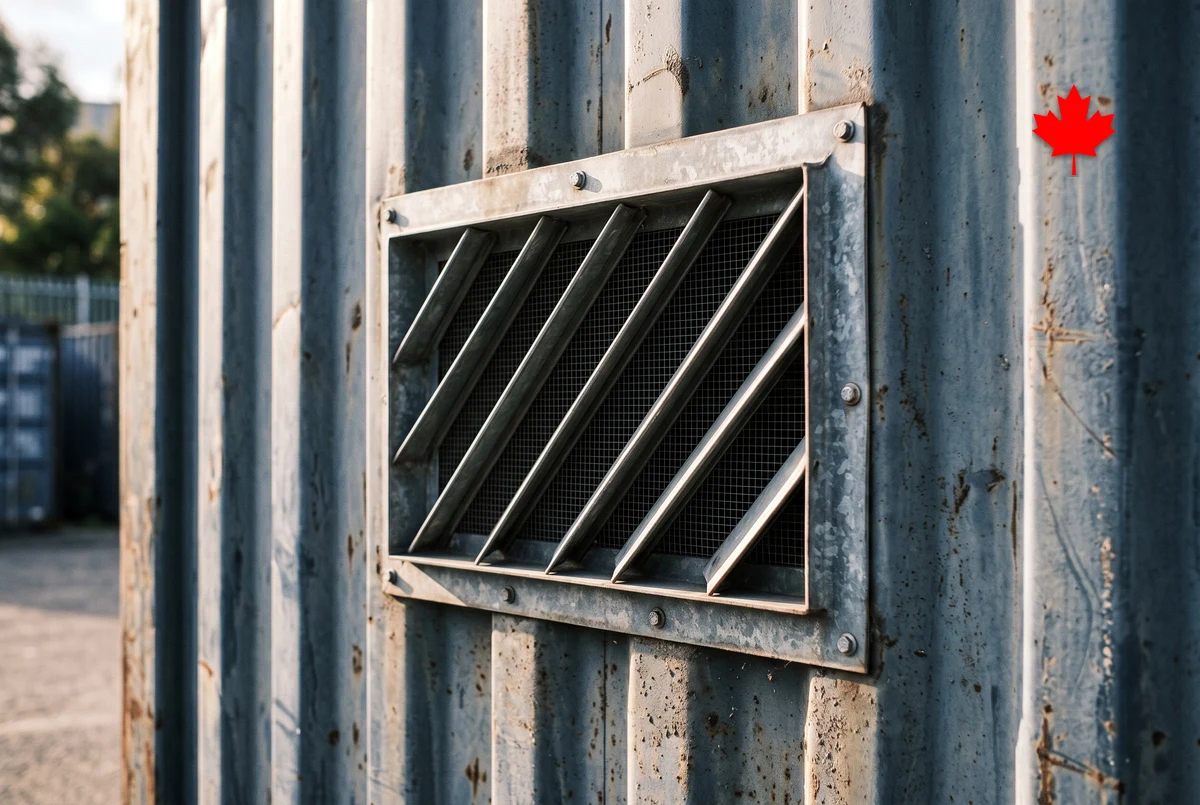
The baseline that solves most cases: two louvre vents, roughly 12 by 12 inches, mounted on opposite walls, one low on the prevailing-wind side, one high on the far side. Cool air enters low, warms, rises, and exits high, a passive stack effect that runs day and night, costs nothing, and has no moving parts to fail at minus twenty. Containers used as workshops, or holding anything that people or engines breathe inside, step up from there.
Every Vent Type, From Louvres to Solar Fans
| Vent type | How it works | Right for | Ontario notes |
|---|---|---|---|
| Fixed louvre vent | Angled slats pass air, shed rain; screened against insects | General storage; the default | Pairs beat singles; mount high-low on opposite walls |
| Turbine (whirlybird) | Wind spins a roof turbine that pulls air up and out | Containers in open, windy placements | Moves real volume free; bearings dislike ice storms, so buy quality |
| Solar-powered fan | Panel-driven extractor runs whenever the sun shines | Workshops, off-grid sites, high-humidity contents | Runs hardest on hot days, exactly when you need it |
| Wired exhaust fan | Continuous powered extraction, optional humidistat | Converted spaces: offices, shops, grow support rooms | Needs the electrical rough-in done properly; final hookup by your licensed electrician |
| Factory pressure vents | Tiny baffled openings for pressure equalization | Ocean transit | Not a ventilation plan; assume they do nothing for storage |
Passive louvres cover the great majority of storage placements. The upgrade path is honest and short: add a turbine or solar fan when the container holds moisture-heavy contents, sits in full sun, or gets opened rarely. A container converted to occupied space plays by different rules entirely, its ventilation is part of the build design, handled alongside insulation and electrical in the modification program at our yard.
Loading Habits That Ventilate Better Than Hardware
The cheapest ventilation is the kind you load in. The CTU Code’s moisture guidance boils down to three habits any Ontario storage user can copy:
The Dry-Load Rules
- Load dry things dry. A power washer job the morning of loading day puts litres of water inside the box. Machines, tarps, and outdoor furniture go in dry, every time.
- Keep air moving under and around. Pallets or dunnage under the load, a hand’s width off the walls, and a gap row down the middle turn the whole load into a chimney the stack effect can actually work through.
- Watch the cardboard. Cardboard arrives carrying moisture and keeps absorbing it. For long stays, plastic totes beat boxes; if boxes are what you have, get them off the floor and away from the walls.
- Add desiccant for the shoulder seasons. A couple of refillable desiccant buckets take the edge off October-to-December swings. Swap or recharge them when you check the container.
When Ventilation Is the Wrong Answer
Straight talk, because it saves both of us a bad call later: ventilation equalizes your container with outdoor air. It cannot make the interior drier, cooler, or warmer than the weather outside. Anything that needs a controlled environment, artwork, instruments, fine furniture over multi-year terms, paper archives, belongs in climate-controlled space, and a vented steel box is not that. What ventilation does do, reliably, is stop the accumulation that creates container rain, mildew, and rust bloom in ordinary storage. Know which problem you have, and if you are not sure, describe the contents when you call and we will tell you which side of the line you are on.
Order the Container Breathing
Ask for the vent pair on your container quote and it arrives installed, sealed, and screened. Describe the load and the recommendation gets sized to the actual duty, sometimes downward.
Vents Installed at the Yard, Before Delivery
Vent installation is work we do ourselves at the Brantford yard: cut, frame, seal, and screen, done before the truck leaves, so the container lands on your site already breathing. Lockboxes, doors, windows, and insulation ride the same work order when the job calls for them. Ordering the vents with the container beats retrofitting in a field every time, in cost and in weather-sealing quality. Parts-only is fine too: we stock and source vents, gaskets, and hardware for people who like doing their own cutting; ask in your quote or call the yard.
What moves the cost is simple: vent type, how many, and whether they join a larger modification order. Tell us what you are storing and where the container will sit, and the quote comes back with a vent recommendation sized to the actual duty. The fastest answer is a call to the yard: 519-754-6844. If you are still choosing the box itself, the grades and sizes we keep in the rows is the place to start.
Ventilation FAQs
Do shipping containers need ventilation for storage?
For anything beyond short-term dead storage, yes. Factory pressure vents move almost no air, so interior humidity accumulates and condenses on the steel through Ontario’s temperature swings. A high-low pair of louvre vents is the inexpensive baseline that prevents most condensation damage.
Where should vents be placed on a storage container?
Opposite walls, different heights: one low on the side facing prevailing wind, one high on the far wall. Air enters low, warms, rises, and exits high. Two vents on the same wall, or both at the same height, short-circuit the airflow and waste the second vent.
Will vents let rain, snow, or mice into the container?
Not when installed right. Louvre vents angle downward to shed water, carry insect screens, and get sealed into a framed cutout. Mice enter containers through door gaskets and floor gaps far more often than through a properly screened vent, which is a reason to have the cutting and sealing done at a yard rather than freehand on site.
Can a vented container stop condensation completely?
It removes the accumulation that causes container rain, which solves the problem for ordinary dry goods, tools, and equipment. It cannot beat physics on climate-sensitive contents: a vented box still tracks outdoor temperature and humidity.
Can Van Blanc add vents to a container I already own?
Yes. Retrofit installs happen at the Brantford yard, and we also sell the vents and hardware for self-installs. If the container cannot travel, call the yard and we will talk through the options for your situation honestly, including when a local welder is the practical answer.
Sources
- International Maritime Organization, International Labour Organization, UNECE. (2014). IMO/ILO/UNECE Code of Practice for Packing of Cargo Transport Units (CTU Code), Annex 3: Prevention of condensation damages. CTU Code, Annex 3
- Government of Canada. (2025). Canadian Climate Normals, Ontario stations. Environment and Climate Change Canada. Canadian Climate Normals data
- USA Containers. (2025). Shipping Container Ventilation: The Complete Guide. USA Containers’ ventilation guide
- International Organization for Standardization. (2013). ISO 1496-1: Series 1 freight containers, Specification and testing, Part 1: General cargo containers. ISO 1496-1 Part 1 listing
Reach Van Blanc in Brantford
We have been supplying shipping containers across Ontario since 1995. Our warehouse is at 90 Morton Avenue E in Brantford, and we deliver right across the province with honest quotes and real lead times.
Van Blanc Ent. Inc., 90 Morton Ave E Unit 1B, Brantford, ON N3R 7J7, +1 888-509-6658
Ordering a container and want it breathing from day one? Ask for the vent pair on your quote and it lands installed.