

Quick Answer
A 10ft dry shipping container is the compact box for sites where a 20ft will not land. It measures roughly 9 feet 10 inches long outside, 8 feet wide and 8 feet 6 inches tall. Inside it holds about 560 cubic feet, on a footprint of half a parking stall. We carry 10ft units in standard and high cube across our Brantford yards in every grade, factory-built tens and honest cut-downs both. You can walk the row and pick yours before paying a dollar.
10 Foot Shipping Container for Tight Sites
A 10ft shipping container is bought for where it can go. It fits through gates a 20ft cannot approach and lands in courtyards, laneways, and side yards where the tilt-deck has no room to stretch out. On site it sits on an 8-by-10 pad, literally half a parking stall. Per cubic metre it costs more than the bigger sizes, because supply is thin and the tight-site demand that wants one never lets up. What that premium pays for is steel in the exact spot the job needs it. If the site has room for more length, the 20ft dry container sits in the same rows for a side-by-side look.
Toronto laneway lots and older Hamilton and Brantford side yards are typical 10ft sites. So are cottage properties where the drive narrows between trees, and condo corporations tucking grounds equipment behind a fence line. That 10ft customer list in Ontario has barely changed in thirty years.
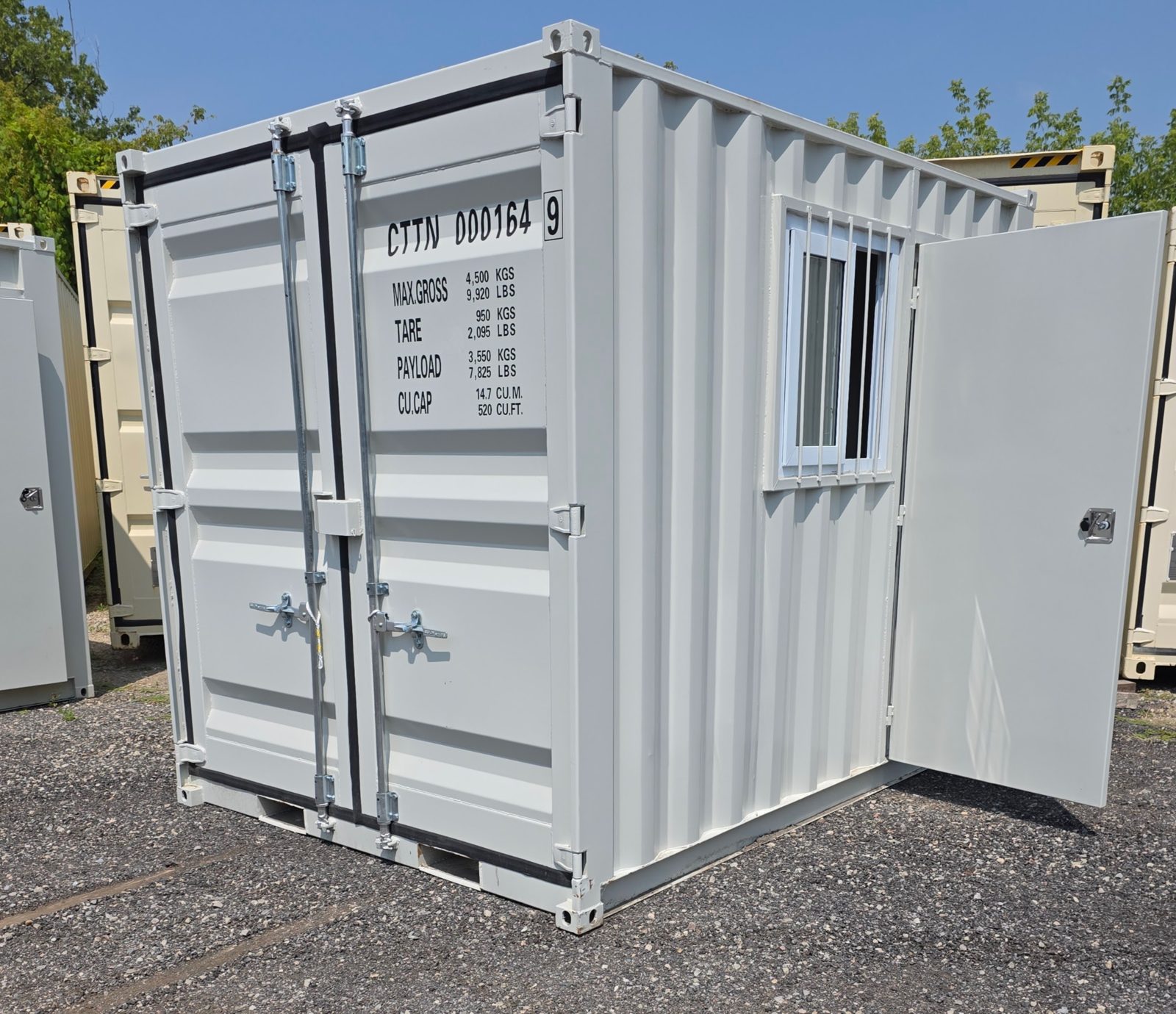
Christian LeBlanc, Paul’s son and the second generation at Van Blanc, walks the yard with buyers who want to see a ten in person before they pay. Recent 10ft stock across our 4 Brantford yards has included new true 10s and new cut-downs made from a 20ft. Other tens arrived already fitted with an oversized man door, a roll-up door, or cargo doors plus a man door and window. The recent 10ft stock rundown further down covers each one.
How Big Is a 10ft Shipping Container?
The 10ft is a true ISO-series container: same 8-foot width, same corner castings, same door hardware as its bigger siblings, shortened to a nominal ten feet. The numbers that matter are below, with the 20ft alongside for scale.
| Spec | 10ft Dry | 20ft Dry (for comparison) |
|---|---|---|
| External length | 2.99 m (9’10”) | 6.06 m (19’10”) |
| External width | 2.44 m (8’0″) | 2.44 m (8’0″) |
| External height | 2.59 m (8’6″) | 2.59 m (8’6″) |
| Internal volume | approx. 16 m³ (560 ft³) | 33.2 m³ (1,172 ft³) |
| Tare weight | approx. 1,300 kg (2,870 lb) | approx. 2,260 kg (4,982 lb) |
| Footprint | 8 ft x 10 ft (half a parking stall) | 8 ft x 20 ft (one parking stall) |
| Floor-loaded pallets | 4 standard pallets | 10 standard pallets |
ISO 668, the international standard for series 1 freight containers, lists the 10 ft length as designation 1D. The standard sets it at 2,991 mm (9 ft 9.75 in) long and 2,438 mm (8 ft) wide, with a maximum gross rating of 10,160 kg (22,400 lb). Inside, a published 10 ft spec sheet for a 10′ DC unit gives 2,840 mm of length, 2,350 mm of width and 2,393 mm of height. Its door opening is 2,342 x 2,280 mm.
Van Blanc still reads the door of the actual unit, because ratings differ by builder. Take one recent 10ft with cargo doors, a man door and a window. Its door carries a stencilled max gross of 4,500 kg, a tare of 950 kg and a payload of 3,550 kg, with 14.7 m³ (520 cu ft) of capacity. Stationary storage rarely comes near those numbers, but a loaded lift can, so plan around the stencil and plate on your own box.
Every dimension in the table is the standard spec. Individual units vary by manufacturer and build year, which is one more reason we put the exact unit in front of you before you commit. The full size family, 10ft through 53ft, is laid out in our complete dimensions guide.
True 10s vs Cut-Down 20s
Most 10ft containers in Canada started life as 20ft containers, and almost no listing volunteers it. Factories build far fewer true tens than the market wants, so fabrication shops cut 20s in half and weld a new end on. A well-executed cut-down is a perfectly good storage box. A badly executed one hides its sins in the weld line and the frame, and you will not find them in a depot stock photo.
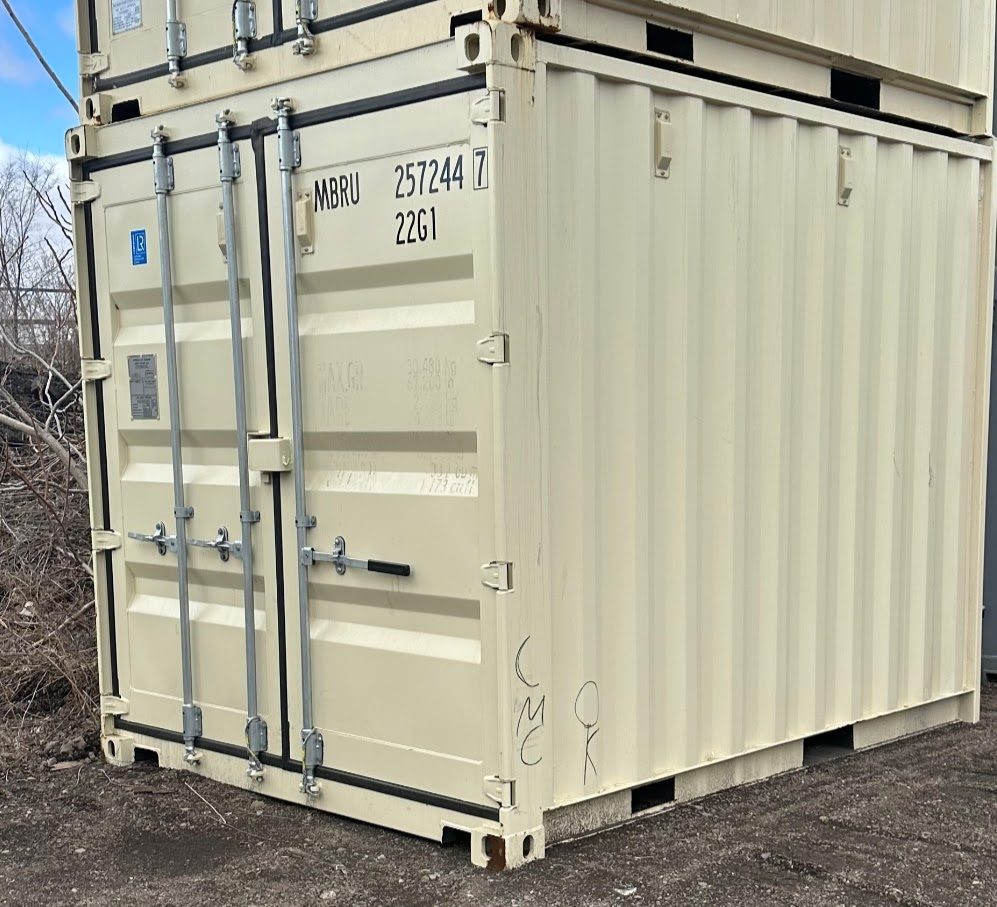
A true 10 is a container built as a 10ft at the factory, with one welded frame, its own corner castings and fork pockets placed for the shorter box. A cut-down 10 begins as a 20ft: the shop cuts it to length, then welds a new end wall and corner posts onto the shortened frame. The cut-downs in recent Van Blanc stock were made from new 20s, so the steel, paint and floor started out fresh. Their cargo doors are the original 20ft door set, cam rods and all. You can still read the faded 1,173 cu ft rating of the parent 20ft on one of those doors. A true 10 gives you a single factory frame with fork pockets sized for it. A cut-down from a new 20 gives you new steel, a full cargo door set with an easy handle, and several vents along the walls.
Spotting a Cut-Down in the Yard
- Corner castings: a factory ten has all eight castings integrated into one continuous frame. On a cut-down, the new end’s castings are welded onto the shortened rails; look for the fresh weld collar.
- The second door end: many cut-downs finish with a welded blank panel where the cut was made. Straight, sealed, and primed is fine. Wavy, patched, or already blooming rust is a walk-away.
- CSC plate: the original 20ft plate does not certify the shortened box. A cut-down being sold “with valid CSC” deserves hard questions; for stationary storage it does not matter, but the honesty of the seller does.
- Floor seams: the plywood floor should be re-secured at the cut end, not floating on the last cross member.
We stock both kinds, we label them as what they are, and we price them as what they are. Walk the row at 90 Morton Avenue East and you can put your hand on the weld line yourself, which is exactly the buying experience a depot-photo listing cannot offer. If you want the deeper background on how tens trade across the country, our 10ft container guide for Canada covers the market end to end.
New (One-Trip) 10ft Containers
Buyers search for a new 10ft shipping container; the industry calls the same unit one-trip, because it made a single loaded voyage from the factory. For a ten, the new (one-trip) question matters more than it does on bigger boxes. A factory-built one-trip ten gives you a 10ft with original paint, an integrated frame, and no fabrication history at all. They are genuinely scarce, they hold value stubbornly, and when a batch lands in the new container lineup from Brantford they do not sit long. If a visible placement, a conversion base, or simple buy-once-cry-once economics are driving the purchase, tell us early and we will flag the next arrivals.
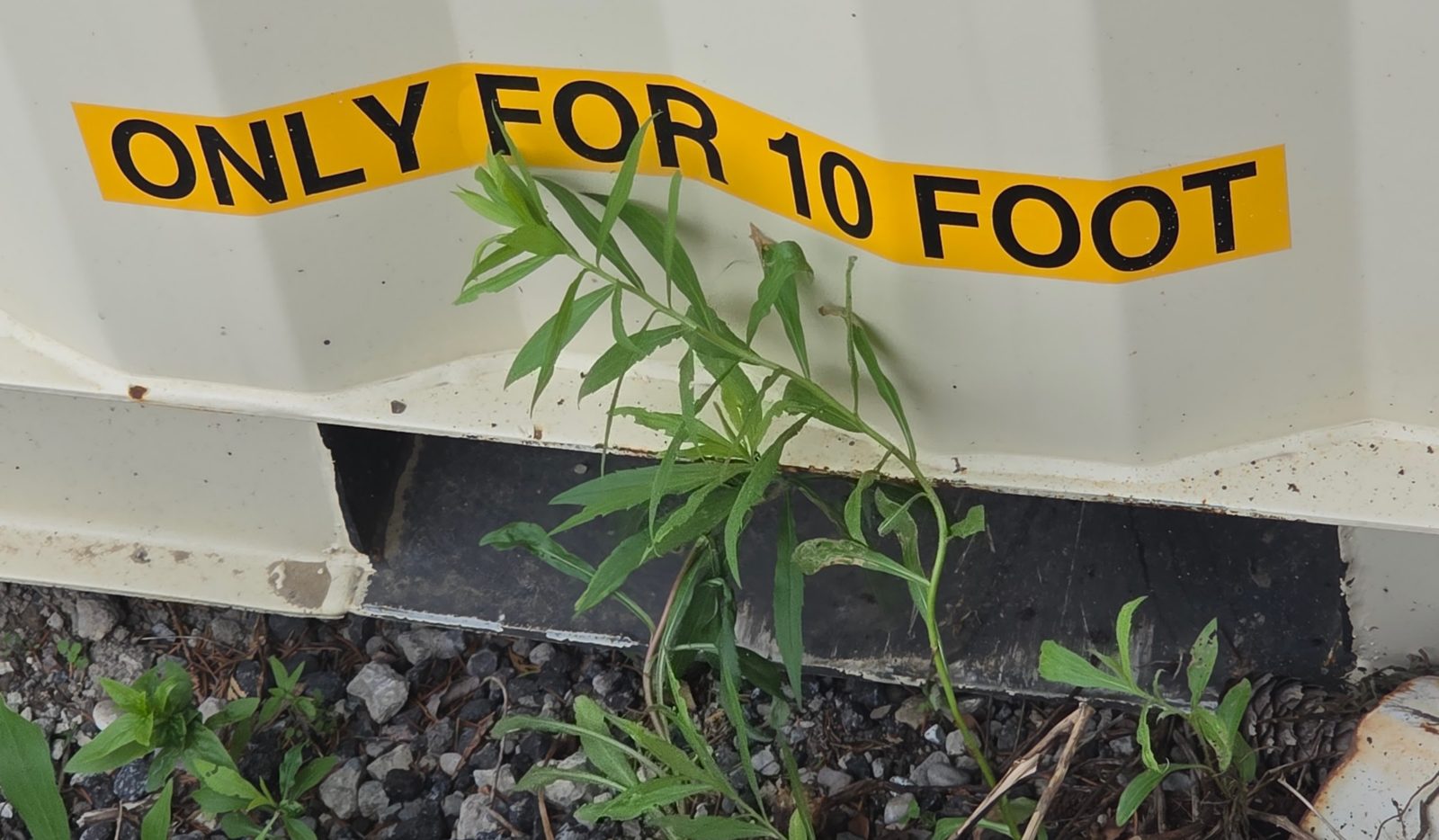
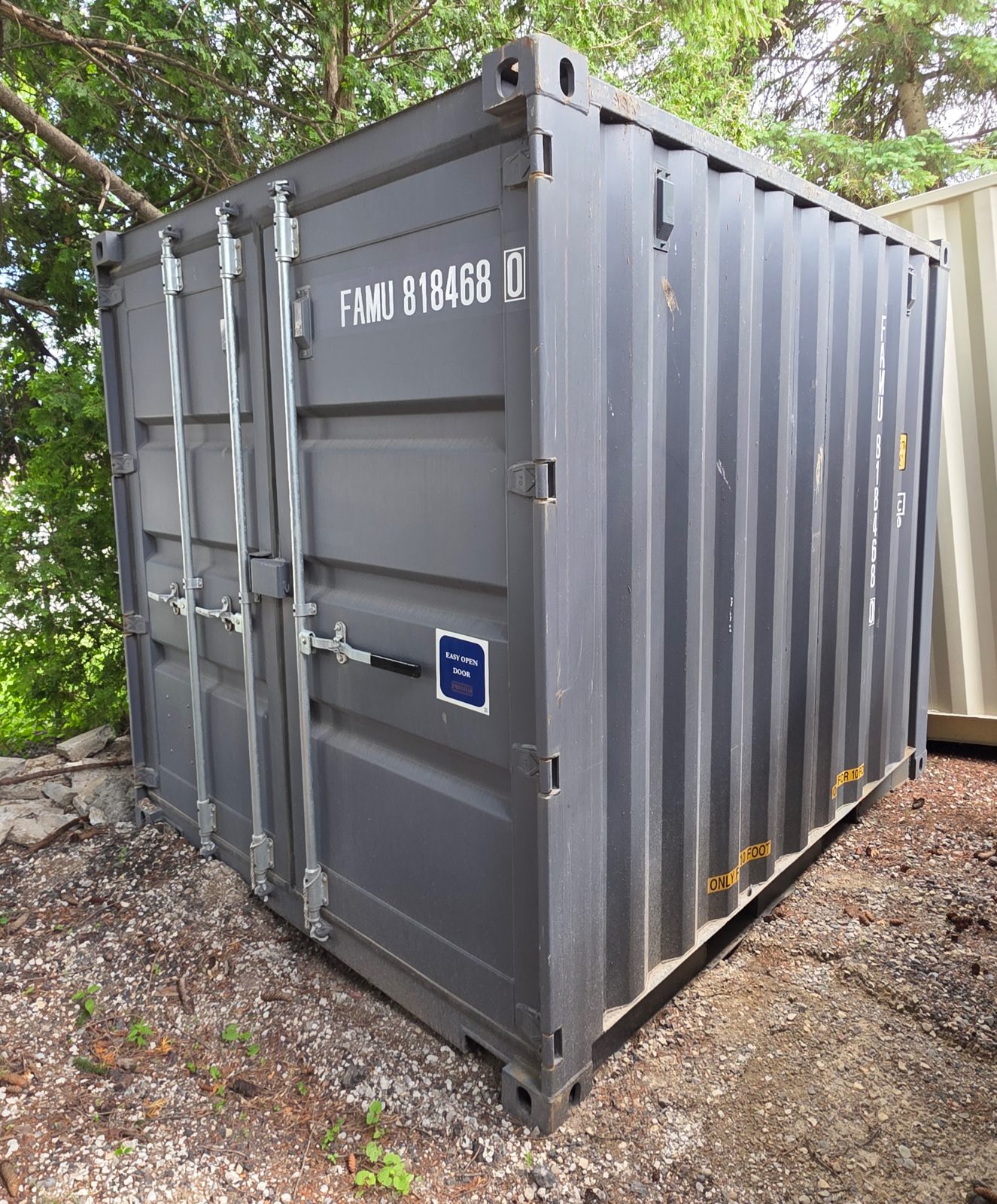
The new true 10s in recent Van Blanc stock came in beige and dark grey. Each has factory fork pockets, vents, a 3-bar easy handle on the cargo doors, and corner pockets top and bottom. Yellow “ONLY FOR 10 FOOT” decals sit beside the fork pockets. The single-lever door is worth a look in person, and our guide to easy-open, comfort height and standard door handles explains what changes when you open it every day.
10ft Containers in Recent Stock
A 10ft container at Van Blanc can arrive plain or already fitted with its own set of doors and windows. The units below are the kinds of tens that have come through our Brantford yards lately. Stock rotates quickly, so call 519-754-6844 for what is on the ground this week.
| 10ft unit | How it was built | Openings | Worth knowing |
|---|---|---|---|
| New true 10 | Built as a 10ft at the factory | Cargo doors, 3-bar easy handle | Factory fork pockets, vents, beige or dark grey |
| New cut-down 10 | Cut from a new 20ft, new end welded on | Original 20ft cargo doors, easy handle | Multi-vented, beige |
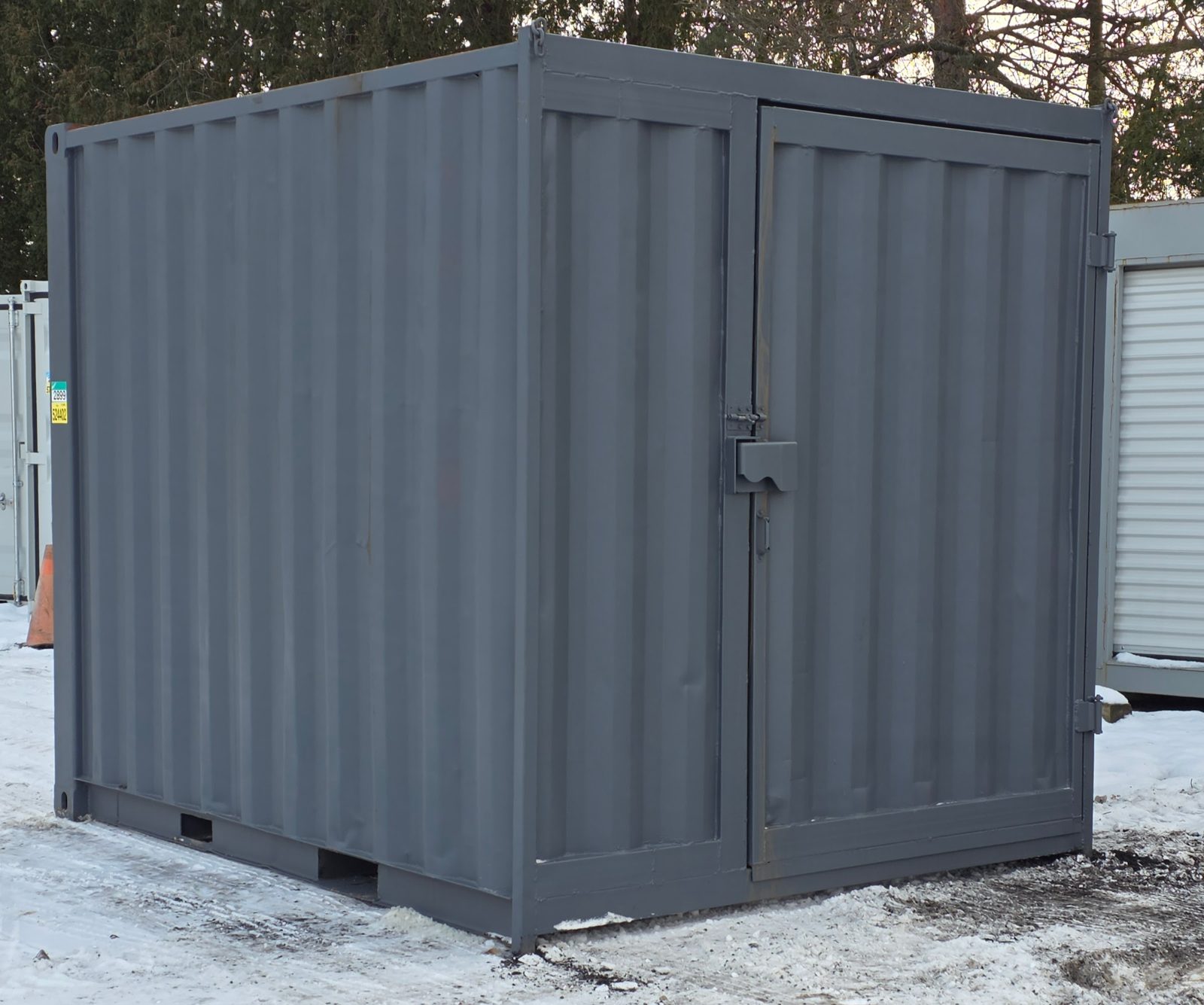
| 10ft with oversized man door | Door cut in and framed | One wide man door | Fork pockets, grey |
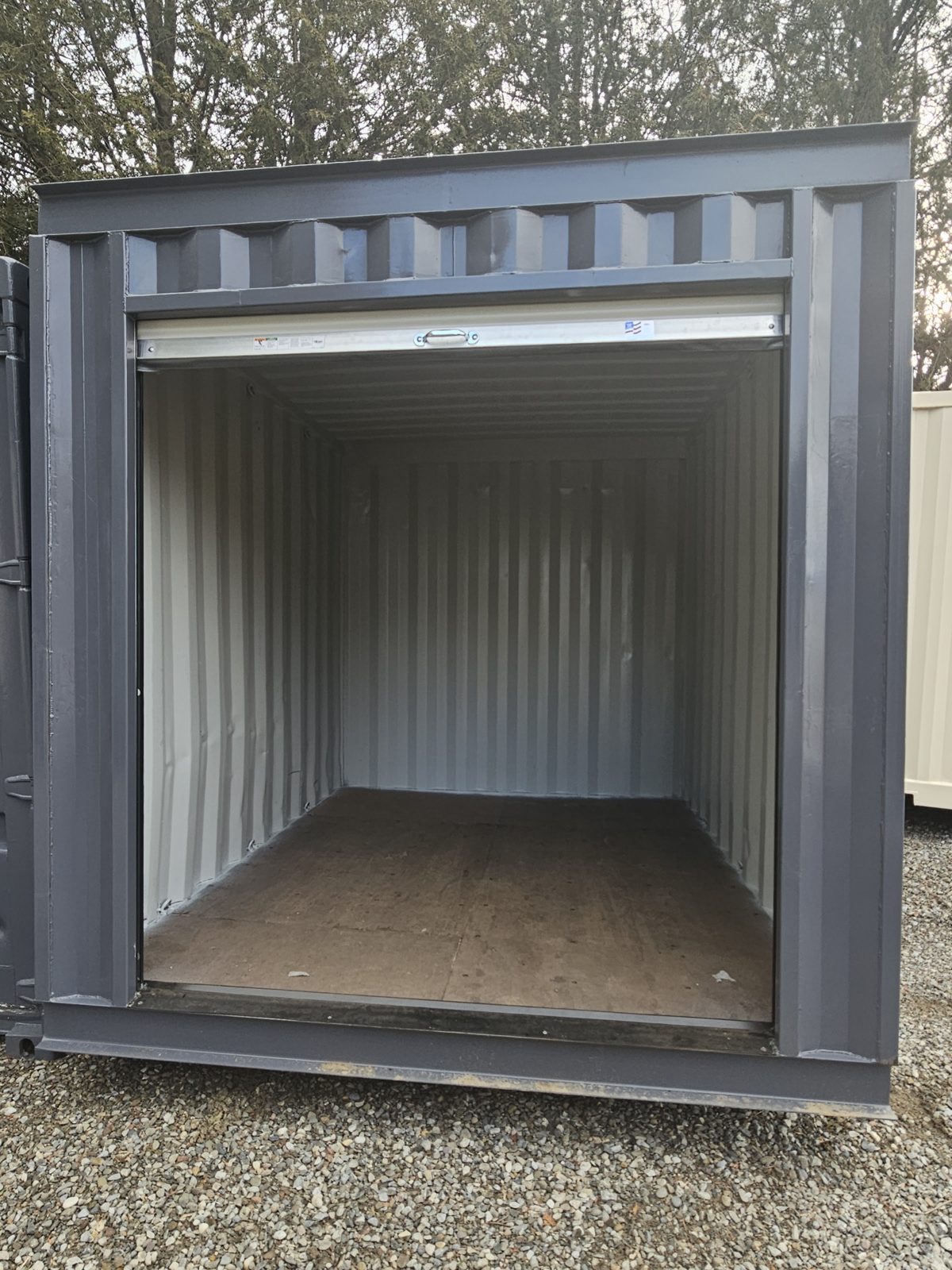
| 10ft with roll-up door | Roll-up door framed into the steel | Roll-up door with a sill plate | Light grey or charcoal |
| 10ft with cargo doors, man door and window | Man door and window added | Cargo doors, man door, window with bars | Light grey, ratings stencilled on the door |
The roll-up units suit a ten that gets opened many times a day. A roll-up door lifts straight up into a coil at the top of the opening, so nothing swings into a tight side yard. The steel sill plate across the bottom of the opening gives the door a clean edge to close onto. Our roll-up door container page covers the door sizes and how the frame is welded in.
Vents earn their place on a small box too. The multi-vented cut-downs and the vented true 10s let damp air out. That matters on spring and fall nights, when the steel cools faster than the air inside and condensation forms on the roof. Our guide to venting a container against condensation covers how many vents a box needs and where they go.
The oversized man door ten is a walk-in box: one wide hinged door, a hasp for a padlock, and fork pockets under the floor. For a jobsite tool crib or a grounds locker, it opens like a closet rather than a cargo box. The ten with cargo doors, a man door and a window gives you all three at once. The cargo doors take a mower or pallets, the man door handles daily use, and a barred window lets in light. Our notes on steel man doors cut into a container go through the framing.
Moving a small box around your own property is where fork pockets earn their keep. A forklift with long enough forks can pick up an empty ten by the pockets and shift it along a yard. Our piece on forklift loading around containers covers the fork length and clearance to check first. Delivery itself is still a Van Blanc tilt-deck drop. If the job calls for something shorter than a ten, the small shipping containers from 5 ft to 9 ft are listed on their own page.
10ft Sea Can Uses in Ontario
1. The laneway and infill build
Toronto and Hamilton infill projects rarely have room for a full stall of steel. A ten holds the tools, fasteners, and weather-sensitive materials for a laneway-house or garden-suite build, inside the fence, off the street, and gone the week after final inspection.
2. The side-yard shed replacement
An 8-by-10 garden shed costs real money, takes a weekend to assemble, and can be opened with a cordless drill. A 10ft container lands in an afternoon, shrugs off every winter, and locks like what it is: marine steel. For homeowners on older streets where the side yard is the only option, this is the classic order.
3. Grounds equipment for condo corporations and property managers
Mowers, blowers, salt, and seasonal signage need to live somewhere that is not the parking garage. A ten behind the fence line carries the load without consuming visitor parking, and a lockbox and venting package from the yard turns it into a purpose-built grounds locker.
4. The kiosk and booth base
Coffee stands, ticket booths, parking attendant shelters, scorekeeper boxes: the ten is the smallest container that converts into occupied space without feeling like a phone booth. Man door, window, insulation, and electrical rough-in happen at our Brantford yards before delivery, with final connections by your licensed trades on site. Where the box will sell tickets or take parking fees, a buyer’s guide to ticket and parking booths sets it beside prefab and steel kiosks.
10ft Container Price Drivers
Four things move a 10ft quote. Build and grade come first: a true 10 or a cut-down, plus any doors or windows already fitted. Then come what the steel market is doing that quarter and where in Ontario the box is landing. Tens hold their price even when 20ft prices soften, because far fewer are built. One US container builder makes the same point from the supply side: there are far fewer 10-foot containers in circulation than 20s or 40s. Tell us the site and your postal code and Van Blanc sends back an all-in number with a real lead time, usually the same day.
Delivery Day for a 10ft
A ten rides the tilt-deck like everything else, but it also shares trailer space. A 10ft delivery can often pair with another load heading your direction and split the freight leg. On site it needs the shortest straight run of any box we place: if a pickup truck can reach the spot and back out, the ten can usually land there. Standard 1-3 day delivery across Ontario runs from our Brantford yards, quoted per order. The two-minute site conversation before dispatch is what makes the drop boring in the way deliveries should be.
A level pad keeps the doors square on a small box as much as on a large one. Our guide to sizing a gravel pad under a container gives the depth and levelling to aim for before the Van Blanc truck arrives.
Frequently Asked Questions
Will a 10ft container fit in a residential driveway or side yard?
Almost always. The footprint is 8 feet by 10 feet, half a standard parking stall, and the height matches a garden shed at 8 feet 6 inches. The practical question is the approach: the truck needs a straight run to set it down, so a phone photo of the path saves everyone a surprise.
How much does a 10ft shipping container cost in Ontario?
It depends on factory-built versus cut-down, grade, the current steel market, and delivery distance. Tens carry a real per-cubic-metre premium because supply is thin, and any doors or windows already fitted change the number too. Call the yard or send the quote form and you will get an honest, all-in number, usually the same day.
Can I buy a new (one-trip) 10ft container?
Yes. Factory-built one-trip tens move through the yard quickly. If you need one for a conversion or a visible placement, tell us early and we will flag the next batch that arrives at our Brantford yards.
Is a cut-down 10ft container safe to buy?
A well-built cut-down is a perfectly good stationary storage box, and it is usually the more affordable path to a ten. The risk is workmanship you cannot see in photos: the weld collar, the blank end panel, the floor at the cut. That is exactly why we let you walk the row and inspect the specific unit before you pay.
Can Van Blanc move my 10ft container to a new spot later?
We deliver the container you buy and set it where the truck can reach. Relocating a placed or loaded container later is a third-party hauling service you arrange, not something we offer, and we will say so plainly on the first call. If a future move is likely, keep the pad simple so any hauler can reach it.
What is the difference between a 10ft container and a garden shed?
Steel, security, and lifespan. A ten is marine-grade corten with a marine plywood floor and container-rated doors; it needs no assembly, no shingles, and no maintenance beyond keeping the door gaskets clean. A comparable-footprint shed is lighter, prettier out of the box, and far easier to break into. Most buyers who compare both at the yard leave with the steel.
Why are 10ft containers so expensive?
Fewer 10ft containers are built than 20s or 40s, so each true 10 carries more factory overhead. A cut-down adds the labour of cutting a 20ft and welding on a new end. Demand from tight city lots and cottage sites stays steady on top of that. Van Blanc quotes the specific unit, with its doors and delivery, as one all-in number.
Are there 10 ft wide shipping containers?
No standard ISO shipping container is 10 ft wide. ISO 668 sets a uniform width of 2,438 mm (8 ft) for series 1 freight containers. A 10ft container is 10 ft long and 8 ft wide, the same width as a 20ft or a 40ft.
Do they make 10 ft shipping containers?
Yes. ISO 668 lists the 10 ft length as designation 1D, and factories build true 10s with their own frame, corner castings and fork pockets. Far fewer are made than 20s, so many tens on the market are cut down from a 20ft. Van Blanc’s recent stock has included both, labelled as what they are.
Sources
- International Organization for Standardization. (2020). ISO 668:2020, Series 1 freight containers: Classification, dimensions and ratings (preview). Tables 1 and 2, checked September 2026.
- Published 10 ft spec sheet. 10′ DC ISO shipping container technical details. Checked September 2026.
- US container builder. (2026). 10-Foot Shipping Container Dimensions and Uses. Checked September 2026.
Walk the 10ft Row in Brantford
We have been supplying shipping containers across Ontario since 1995. Our warehouse is at 90 Morton Avenue E in Brantford, and we deliver right across the province on a cash-on-delivery basis. No surprise fees, no chase-the-paperwork.
Van Blanc Ent. Inc. | 90 Morton Ave E Unit 1B, Brantford, ON N3R 7J7 | 519-754-6844
Tens are the box people most regret buying from a photo. Come put your hand on the weld line, compare a factory ten against a cut-down in the same row, and decide with your own eyes. Fifteen minutes in the yard beats an hour of zoomed-in listing photos.