
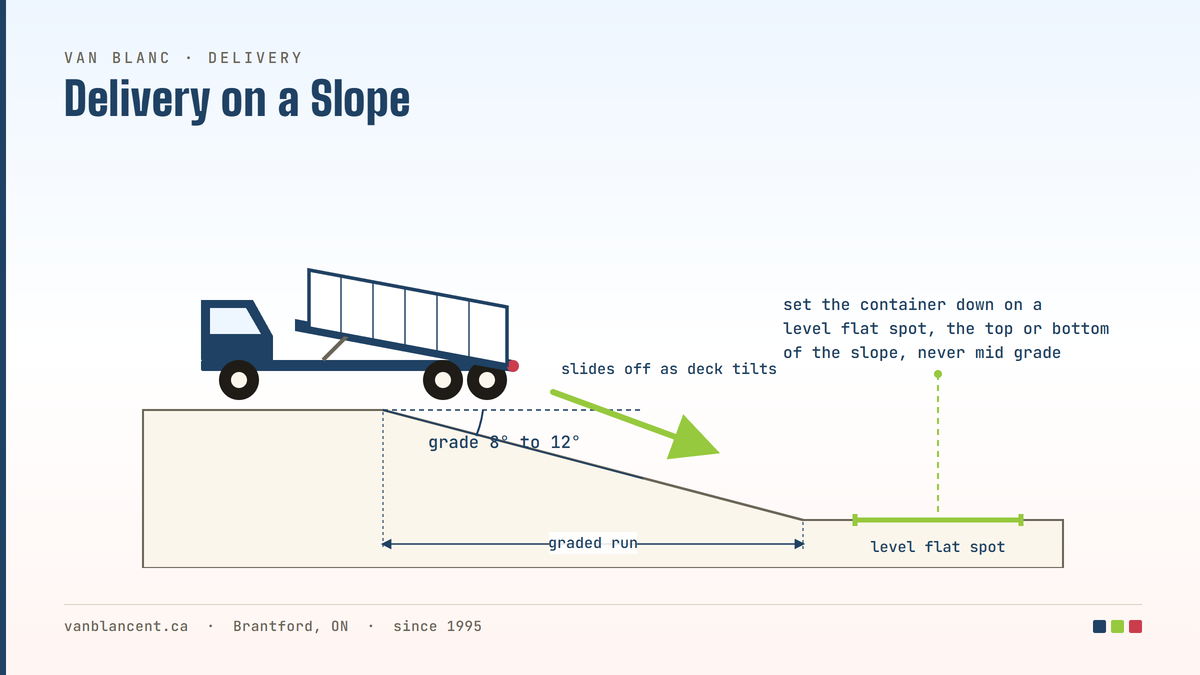
Quick Answer: Shipping container delivery on a steep or sloped driveway is possible, but a tilt-deck truck needs level footing to slide the box off safely. On a real grade we either drop at a flat spot or place it with a crane. Call our Brantford yard and describe the slope first.
In This Guide
Reading Time: 11 minutes
Why a slope changes everything on delivery day
Shipping container delivery on a sloped driveway is one of the most common site questions we field at our Brantford yard, and it is the one buyers most often discover too late. A 20ft container is a 4,500 to 5,000 lb steel box. A 40ft high cube runs closer to 8,500 lb. The truck carrying it, loaded, weighs tens of thousands of pounds. Gravity does not negotiate. When you put that much weight on a grade, two things start fighting you: the box wants to slide, and the truck loses the traction it needs to control the slide.
A tilt-deck delivery works by tilting the trailer bed up at an angle, letting one end of the container touch the ground, then pulling the truck forward so the box slides off the back of the deck and settles into place. The whole method depends on the box sliding in a controlled, predictable way down a deck that is itself sitting on level ground. Add a driveway slope underneath that already-tilted deck and the geometry stops being predictable. That is the core of the problem, and everything else on this page follows from it.
Most national delivery guides cover this in a single line: “the ground must be flat and firm.” That is true, but it does not tell an Ontario buyer with a sloped laneway what to actually do. We have delivered onto hillside cottage lots near the Grand River, into Brant County farm yards that grade away to a drainage ditch, and onto Hamilton-mountain driveways that climb at an angle most people never measure until a 53ft truck is sitting at the curb. So here is the honest, operational version of what happens on a grade, and what your options are.
What “level” means to a delivery driver
Two surfaces matter, and they are different. The placement pad is where the container will live: it needs to be close to level so the doors hang true, the frame is not racked, and water drains away instead of pooling under the steel. The truck path is the lane the tractor and trailer sit on while the box slides off: it needs to be straight, firm, and level enough that the truck keeps traction during the pull-forward. A driveway can fail on one, the other, or both. When we ask about your grade, we are really asking about both surfaces at once.
What a tilt-deck actually does on a sloped driveway
A tilt-deck (also called a tilt-bed or roll-off-style flatbed) is the workhorse for ground-level container delivery. On flat, firm ground it is fast, clean, and the most economical way to set a box down, and because the container lands directly at ground level there is no crane and no second piece of equipment to coordinate. On a slope, the same method runs into three separate problems.
Problem one: the box slides too fast or binds
When the trailer tilts and the truck pulls forward, the container is meant to ease down the deck under gentle, controlled motion, usually with a cable or winch managing the descent. Point the truck downhill and gravity adds to that motion, so the box wants to come off faster than the driver wants it to. Point the truck uphill and the deck angle plus the grade can stack up past what the cable can hold cleanly. Either way you lose the controlled-slide that makes tilt delivery safe.
Problem two: the truck loses traction
The pull-forward is the moment the whole delivery hinges on. The tractor has to inch ahead under load while the trailer is tilted and the container is part-on, part-off. On a downhill grade, gravel, frost, wet leaves, or a skim of ice take away the grip the drive wheels need, and a loaded truck that starts to creep on a slope is a serious problem, not an inconvenience. Dock-engineering references put the safe working grade for heavy loads at roughly 5 percent, with around 10 percent treated as a hard ceiling for heavy operations. A driveway that feels “a bit slanted” to you can already be past that.
Problem three: the box lands out of level
Even if the slide and the traction both behave, a container set down on a slope sits out of level. Doors that should swing and latch on their own will drift open or jam, the frame can rack over time, and water runs toward the low corner instead of off the roof. This is why the placement pad matters as much as the truck path. A box that lands crooked is a problem you live with for years.
Paul LeBlanc, Owner: “People think the slope is about the box tipping. It almost never is. It is about the truck losing its feet on the pull-forward, and about the doors not closing once it is down. I have nineteen years in containers and I have turned down deliveries onto a grade that the customer swore was flat. Send me a photo and the rise, and I will tell you on the phone whether the tilt-deck works or whether we bring the crane.”
How steep is too steep?
There is no single magic number, because slope interacts with surface, weather, and container length. But here is the honest working reality from thirty years of Ontario deliveries. A gentle grade, the kind you barely notice walking up it, is usually fine for a tilt-deck on firm gravel or pavement in dry conditions. A grade you can clearly feel in your legs is where we start asking hard questions. A driveway that climbs noticeably, or one that runs downhill toward a house, garage, or ditch, is where tilt delivery often stops being the right tool.
The other half of the equation is run-out length, and this is what catches people. A tilt-deck does not just need a level spot the size of the box. It needs a straight, clear pull-out lane so the truck and trailer can line up and move forward as the container comes off. The figures below are typical and depend on the truck, but they show why a short, sloped driveway is doubly hard: there is rarely enough flat, straight room to work.
| Container length | Typical straight pull-out room | Access width | Overhead clearance during tilt-off |
|---|---|---|---|
| 20ft standard / high cube | roughly 75 to 100 ft | about 12 ft | about 14 to 16 ft |
| 40ft standard / high cube | roughly 120 to 130 ft | about 12 ft | about 14 to 16 ft (a high cube needs the upper end) |
Treat these as planning numbers, not promises. The tilt-off clearance figure is the height the raised end of the deck and the box reach while the trailer is tilted, which is why low branches, eaves, and hydro lines over a sloped laneway matter so much. On a grade, the slope eats into both the usable length and the working height, so a driveway that would be tight on the flat can become impossible once it is tilted into the picture.
The Brant County hillside cottage
A buyer near the Grand River wanted a 20ft Wind and Watertight unit set beside a cottage at the top of a sloped lane that fell away toward the water. The pad up top was fine, close to level and firm. The problem was the lane itself: too steep and too short for a loaded truck to safely pull forward with the deck tilted. We delivered the box to the flat gravel turnaround at the bottom of the property and the owner moved it the last stretch with equipment already on site at planting time. Same container, same day, just delivered to where the truck could work instead of where the box would eventually live.
Option one: deliver at the flat top or bottom
The simplest fix for a sloped driveway is often the cheapest: deliver the container to the flattest, firmest spot the truck can reach, even if that is not the box’s final home. Many properties with a graded laneway still have a level area somewhere, a turnaround at the top, an apron at the bottom, a flat shoulder along the road, or a firm pad near the barn. If the truck can line up and pull forward there, a standard tilt-deck delivery works.

From there you have choices. Some buyers move the box the final distance themselves with a tractor, skid steer, or telehandler they already own or rent, which is common on farms and acreages where that equipment is on hand. Some leave the container at the accessible flat spot permanently once they realize it serves the purpose just as well there. And some decide the final position genuinely matters enough to justify a crane, which is the next option.
The point is that a slope rarely means “no delivery.” It usually means “let us find the spot the truck can safely work, then decide how the box gets to its final home.” That decision is exactly the kind of thing worth a two-minute phone call before you order, because the answer depends on your specific laneway, not on a generic rule.
Not sure your driveway can take a tilt-deck? Describe the slope and we will tell you on the spot. The fastest answer is a call to the Brantford yard.
Option two: crane placement on the grade
When the box has to land somewhere a tilt-deck cannot safely reach, a crane is the answer. The common tool is a truck-mounted knuckle-boom crane, often called a HIAB after the original manufacturer. Instead of sliding the container off the back of a tilted deck, the crane lifts it off the truck and sets it down precisely where you want it, including over a fence, up a short bank, or onto a spot the truck itself cannot drive to.
Crane placement changes the site requirements in a few ways worth knowing before you ask for it. First, the crane truck extends outriggers, the legs that stop it tipping while it lifts, and with those out the working width is wider than the truck itself, often in the range of 16 ft. Second, the ground under those outrigger feet has to be firm, because the entire lifted weight transfers through them; the driver sets pads under the feet, but soft or saturated ground is still a problem. Third, the crane needs clear airspace above the lift, so hydro lines and tree limbs over a sloped driveway become a real planning factor.
Crane work costs more than a tilt-deck because it is a different truck, a different setup, and more time on site. That is the honest trade-off: you pay for placement precision and for reaching spots the tilt method cannot. For a deeper side-by-side of the two methods, our guide on how tilt-deck and HIAB crane delivery compare in Ontario walks through when each one wins. And the whole subject of getting a box from our yard to your site sits inside our broader overview of how a shipping container actually gets delivered.
Firm and dry beats flat and soft
A surprising amount of slope trouble is really ground-bearing trouble in disguise. A loaded delivery truck, and even more so a crane on outriggers, needs ground that will not give way under concentrated weight. A level lawn that turns to mush after spring melt is worse than a firm gravel grade. If your site is both sloped and soft, the timing of delivery matters: dry, frozen, or recently compacted ground carries the load far better than saturated soil. When you call, mention the surface and the season, not just the angle.
How to measure and describe your driveway before you call
You do not need a survey. You need a few honest observations that let us picture the site. The better your description, the more accurately we can plan the right truck and avoid a wasted trip. Here is what actually helps us.
- The rise and the run. Pick the steepest stretch of your driveway. Roughly how much does it climb (the rise) over how much length (the run)? Even a rough “it goes up about 3 ft over 30 ft” tells us the grade.
- Where the box has to end up. Is the final spot at the top, the bottom, or partway along the slope? Is there a level area anywhere the truck could reach instead?
- The surface. Pavement, gravel, grass, or dirt, and whether it stays firm in wet weather. Note any soft, low, or recently dug areas.
- The straight run-out. How much straight, clear length is there for a truck and trailer to line up and pull forward? Fences, parked cars, and tight corners all count against it.
- Overhead. Any hydro lines, tree branches, or eaves crossing the path or the drop spot. These matter for both tilt-off and crane lifts.
- A couple of photos. One looking up the driveway, one looking down, and one of the final spot. A photo tells us more in five seconds than a paragraph does.
Send that, or just call and describe it, and we will tell you whether a tilt-deck works, whether we deliver to a flat spot and let you finish the move, or whether the job calls for a crane. We deliver across Ontario from our Brantford yard, and every quote comes with a real lead time, not a hopeful one.
Sloped lots are normal in our delivery area
Between the Grand River valley, the Hamilton escarpment, cottage country to the north, and the rolling farm country across Brant, Norfolk, and Haldimand, a lot of Ontario driveways are not flat. We have been placing containers on these kinds of lots since 1995. A grade is a planning question, not a dealbreaker. The buyers who run into trouble are usually the ones who bought a box first and asked about access second. A short conversation up front is the whole fix.
Frequently Asked Questions
Can you deliver a shipping container to a steep or sloped driveway?
Often yes, but the method depends on the grade. On a gentle slope with firm, level footing and enough straight run-out, a tilt-deck truck can usually set the box down at ground level. On a steeper grade we either deliver to a flat spot the truck can safely reach, or place the container with a crane. Describe your driveway when you call and we will tell you which option fits.
Why can’t a tilt-deck truck just back up the slope and drop the container?
A tilt-deck slides the container off a raised deck while the truck pulls forward, and that needs level footing. On a grade the box can slide too fast or bind, and the loaded truck can lose traction during the pull-forward, which is unsafe. Heavy-load guidance treats roughly 5 percent grade as a safe working limit and around 10 percent as a ceiling, so a driveway that feels only slightly slanted can already be too steep.
How steep is too steep for container delivery?
There is no single cutoff, because slope works together with the surface, the weather, and the container length. A grade you barely notice is usually workable on firm, dry ground; a grade you clearly feel in your legs is where we start asking detailed questions. The safest answer is to tell us the rough rise and run of your steepest stretch, and we will judge it against the specific truck and box.
Does the spot where the container sits also need to be level?
Yes. Even if the truck can deliver, a container set on a slope sits out of level, so the doors may drift open or jam, the frame can rack over time, and water pools at the low corner instead of draining off. The placement pad should be close to level and firm. If it is not, levelling the pad first, or choosing a flatter spot, saves you years of door and rust headaches.
Is a crane the only option if my driveway is too steep?
No. The most common fix is simply delivering to the flattest, firmest spot the truck can reach, then moving the box its final distance with equipment already on site, or leaving it where it landed. A crane is the right call when the final position genuinely matters and the truck cannot work there. We will walk through both options on the phone before you order so there are no surprises on delivery day.
Sources
- International Organization for Standardization. (2022). ISO 6346:2022 Freight containers Coding, identification and marking. iso.org
- Transport Canada. (2025). National Safety Code Standard 10: Cargo Securement. tc.canada.ca
- Quality Material Handling Inc. (2023). Essential Guidelines for Safe and Efficient Dock Ramp Slopes. qmhinc.com
- Hiab. (2024). Shipping Container Moving Equipment: Forklifts, Cranes and Hooklifts (Application Overview). hiab.com
Reach Van Blanc in Brantford
We have been supplying shipping containers across Ontario since 1995. Our warehouse is at 90 Morton Avenue E in Brantford, and we deliver right across the province on a cash-on-delivery basis. No surprise fees, no chase-the-paperwork.
Van Blanc Ent. Inc., 90 Morton Ave E Unit 1B, Brantford, ON N3R 7J7, 519-754-6844
Before you order, send us a photo of your driveway and the rough rise. We will tell you whether the tilt-deck works, whether we drop at a flat spot, or whether the grade calls for a crane.