
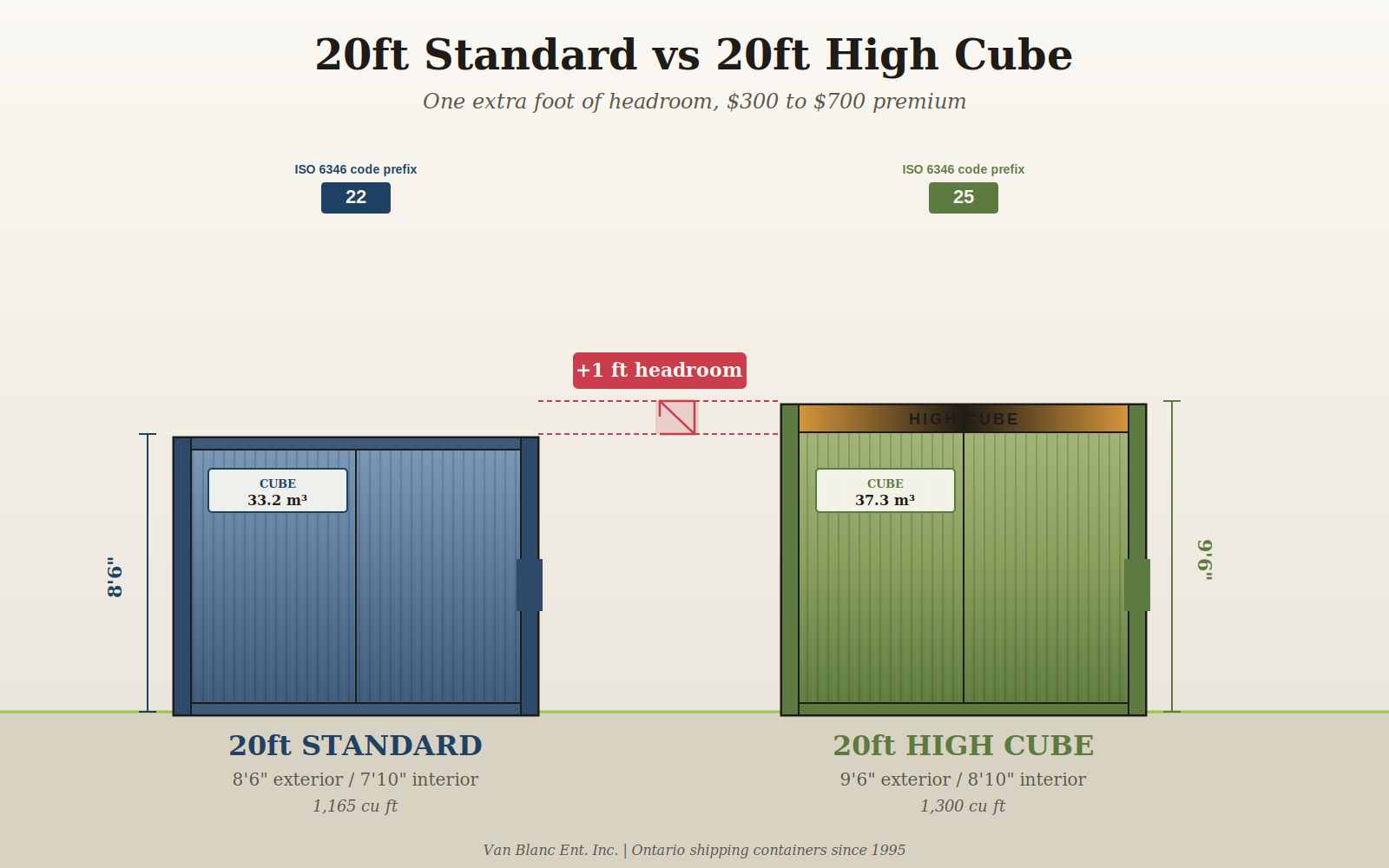
Quick Answer: High Cube vs Standard height distinctions are codified in ISO 668:2020 dimensional tables. A 20ft High Cube gives you one extra foot of interior headroom (8’10” vs 7’10”) for a modest premium over the Standard in Canada, with the gap driven by grade, supply, and origin yard rather than a fixed figure. Choose HC for tall cargo, pallet jack clearance, or insulated office conversions. For refrigerated storage at the next length up, see the 40ft high cube reefer and its 45R1 specs. Choose Standard for typical storage, lower foundations, and tight transport clearances. Van Blanc carries both heights at our 4 Brantford yards. Family-run since 1995 with COD-honest pricing, call for a same-day quote tailored to your site.
Buying a 20ft? Pick Your Height
We sell 20ft containers for sale in both heights, standard and high cube, new and used, from our 4 Brantford yards, delivered across Ontario in 1 to 3 days. Tell us which height the job needs and we will tell you what is on the ground today.
In This Guide
- What Is a 20ft Standard Container?
- What Makes a 20ft High Cube Different?
- When Should You Choose the High Cube?
- When Is the Standard the Better Buy?
- How Much More Cube Does the High Cube Hold?
- Why Does a 20ft High Cube Cost More?
- How Do You Buy a 20ft High Cube From Van Blanc?
- Will a 20ft High Cube Clear Your Delivery Route?
- FAQs
- Reach Van Blanc
Reading Time: 14 minutes
What Is a 20ft Standard Container?
A 20ft Standard container is the original ISO 668 freight box measuring 20 feet long, 8 feet wide, and 8 feet 6 inches tall, with about 7 feet 10 inches of interior headroom. It is the most common size in Canadian yards, suits typical storage, and sits lower for tight-clearance delivery sites.
When a Canadian buyer says “20ft sea can” without further qualification, the picture in their head is almost always the 20ft Standard Dry. It is the original ISO 668 freight container, the one that has been crossing oceans since the mid-1960s, and the one that defined the global intermodal supply chain. Its external footprint is 20 feet long, 8 feet wide, and 8 feet 6 inches tall. Convert to metric and you get 6.06 m by 2.44 m by 2.59 m.
Inside, after you subtract the steel wall thickness and the marine plywood floor, you are working with roughly 5.90 m of length, 2.35 m of width, and an interior height of about 2.39 m. In feet that final number lands at 7 feet 10 inches of headroom from floor to ceiling. That is the number every Canadian buyer needs to remember because it is the dividing line between “this fits standing up” and “you need a high cube.”
The Steel That Makes a 20ft Standard
The 20ft Standard frame is built from Corten weathering steel (ASTM A588 or equivalent) with a 14-gauge corrugated wall panel and an 11-gauge corner post. The floor is 28 mm marine-grade plywood treated with anti-fungal compounds. Tare weight runs roughly 2,300 kg (5,070 lb). Maximum gross weight per ISO 668 is 24,000 kg, which leaves you about 21,700 kg of payload capacity. Most Canadian buyers never come close to the payload ceiling because the cube fills before the weight does.
What Makes a 20ft High Cube Different?
The 20ft High Cube is the same 20ft length and the same 8ft width as the Standard. The only dimensional difference is that one foot of vertical height. Externally it stands 9 feet 6 inches (2.89 m). Internally the headroom jumps from 7’10” to 8’10”, which is 2.69 m of clear ceiling. That single foot changes what the box can do, and the 20ft we stock in both heights is where most buyers meet the difference.

The 20ft HC is a newer addition to the global container fleet than the 40ft HC, which has been common since the early 1990s. Van Blanc keeps the new 20ft HC in stock beside the 20ft Standard.
The Quick Identification Trick
Walk a yard and look at the top of any 20ft container. A High Cube wears a yellow-and-black diagonal stripe band along the top rail and reads “HIGH CUBE” stencilled in 6-inch letters. ISO 6346 markings on the door confirm it: the size-type code for a 20ft HC starts with “25” while a 20ft Standard starts with “22.” If you cannot read the door panel from where you parked, that yellow band along the top is the fastest visual tell.
When Should You Choose the High Cube?
You should choose the 20ft High Cube when its extra foot of headroom earns its premium, and three buyer profiles consistently find that it does.
Tall Cargo or Stacked Pallets
If you are storing anything taller than about 7 feet 6 inches on a pallet, the Standard becomes a puzzle. A standard 48″x40″ GMA pallet stacked to 6 feet of product height plus the pallet thickness puts you at 6 feet 5 inches. Add any kind of slip sheet, banding, or protective foam and you are bumping the ceiling. The HC gives you that breathing room. Canadian beverage distributors, lumber dealers, and equipment movers who run a lot of tall stock pay the HC premium because their loading patterns demand it.
Pallet Jack and Forklift Clearance
An electric pallet jack with the operator standing on a rider platform measures around 7 feet 4 inches tall. A walk-behind pallet jack with the handle raised vertical hits 6 feet. Neither one survives a 7’10” Standard ceiling if you raise the load. The HC ceiling at 8’10” gives a rider operator a foot of safe clearance and lets a walk-behind handle clear without hitting hanging lights or insulation. If your operation involves moving inventory in and out daily, the HC pays back its premium in operator productivity inside a year.
Office, Workshop, or Conversion Builds
This is where the HC earns its keep most often in our yard. The minute a buyer adds a ceiling layer, insulation, lighting, and a finished floor, they lose 8 to 14 inches of headroom. A Standard 20ft converted to an insulated site office leaves you with about 6’10” of finished interior height, which is technically Code-compliant for most occupancies but feels claustrophobic to anyone over 6 feet. The HC converted with the same buildout finishes at 7’10” of clear height, which is the comfort threshold that buyers actually want.
The Brantford Backyard Office Buyer
A buyer last fall called us about a 20ft for a backyard workshop. He wanted spray foam, mini-split HVAC, a drop ceiling for recessed lighting, and laminate flooring. We walked him through the math on a Standard versus an HC. The Standard would have finished at about 6’9″ once you added 2 inches of spray foam, a 1.5-inch drop ceiling, and 0.5 inch of flooring. The HC finished at 7’9″ with the same buildout. He is 6’2″. The HC was a premium that made the difference between a workshop he enjoyed and a workshop he ducked through.
When Is the Standard the Better Buy?
The 20ft Standard is the better buy when the job lives near the floor, the site sits low, or the route is tight. The Standard outsells the HC in Canada by a wide margin. Three scenarios where the Standard fits.
The Cube Does Not Matter for Your Use Case
Garage overflow, garden equipment, off-season tires, dry goods, tools, hunting gear, cottage closing storage, construction material caching. These loads fill floor area rather than height, and the Standard gives the same 19 feet 4 inches by 7 feet 9 inches of floor as the HC.
Foundation Height and Site Profile
If you are placing the container on a concrete pad, sonotube piers, or a wood-cribbing foundation that adds 12 to 18 inches of lift off grade, the HC’s overall sitting height starts to feel like a barn. A Standard on 12 inches of pier lands its top at 9’6″ off the ground. An HC on the same pier lands at 10’6″. For rural buyers in plain view of a municipal road, the HC silhouette can look intrusive in a way the Standard does not. Lower-profile foundations matter for sight lines, for tarp-shed aesthetics, and for any property where the buyer wants the box to read as “shed-ish” rather than “industrial.”
Transport Clearance and Tight Access
This is the practical one. A 20ft container on a tilt-deck trailer adds roughly 4 to 5 feet of trailer-deck height to the container itself. A Standard on a tilt-deck rides at about 13’6″ total clearance, which fits under every Ontario bridge and through every typical garage-door opening on a rural property. An HC on the same trailer rides at 14’6″. That foot is the difference between fitting and not fitting under a residential carport, a low-clearance gate, or a tree-canopy laneway. Paul has lost count of the times a customer asked us to swap an HC delivery for a Standard because their site access turned out to be tighter than the tape measure suggested at the planning call.
How Much More Cube Does the High Cube Hold?
The 20ft High Cube holds about 12 percent more interior volume than the Standard, the place where its extra foot turns into a measurable spec. The Standard interior volume sits at roughly 33.2 cubic metres or about 1,165 cubic feet. The 20ft HC interior comes in at 37.3 cubic metres, or roughly 1,300 cubic feet. That is a 12 percent gain in cube for that one foot of height. If you are still weighing this 20ft choice against a 40ft footprint, our full breakdown of every container length and height sold in Canada lays the options side by side.
| Spec | 20ft Standard | 20ft High Cube |
|---|---|---|
| External length | 6.06 m (20’0″) | 6.06 m (20’0″) |
| External width | 2.44 m (8’0″) | 2.44 m (8’0″) |
| External height | 2.59 m (8’6″) | 2.89 m (9’6″) |
| Internal length | 5.90 m (19’4″) | 5.90 m (19’4″) |
| Internal width | 2.35 m (7’9″) | 2.35 m (7’9″) |
| Internal height | 2.39 m (7’10”) | 2.69 m (8’10”) |
| Interior volume | 33.2 m³ / 1,165 cu ft | 37.3 m³ / 1,300 cu ft |
| Tare weight | ~2,300 kg (5,070 lb) | ~2,400 kg (5,290 lb) |
| Max payload | ~21,700 kg | ~21,600 kg |
| ISO size-type code prefix | 22 | 25 |
The 12 percent gain in interior cube is the headline metric, but notice the payload column. The HC carries slightly less weight at maximum gross because the box itself weighs about 100 kg more. For nearly every Canadian land-based use, payload is irrelevant since the cube fills before the weight does. The number matters only to buyers running heavy industrial cargo on a road haul.
Why Does a 20ft High Cube Cost More?
A 20ft High Cube costs more than a Standard because it uses more steel and travels a longer freight chain. Across Canadian yards in 2026, the HC premium on a 20ft is typically a modest step up over a comparable Standard at the same grade. How wide that gap runs flexes depending on grade, supply, and origin yard. We see the same pattern in our 4 Brantford yards: the premium is largest at the One-Trip grade, narrows at the Cargo Worthy grade, and narrows again at the Wind & Water Tight grade. These numbers shift with shipping markets, but the relative band has been stable for two years.
For context inside our broader pricing structure, see our shipping container cost by size comparison for full grade-by-grade tables.
Why HC Costs More: The Cost Drivers
The HC premium comes from two real cost differences and one supply-and-demand effect. Cost driver one: more steel. The 20ft HC uses about 5 percent more steel by weight than the Standard, mostly in the taller wall panels and the longer corner posts. Cost driver two: longer freight chains. Newer 20ft HC stock typically gets manufactured in Asia and trans-shipped to North America, where Standard 20ft sometimes circulates from existing fleet retirements with less transport cost baked in. The supply-and-demand effect: buyers willing to pay the HC premium are usually conversion buyers, and conversion buyers are less price-sensitive than storage buyers, so the market clears at a higher number.
How Do You Buy a 20ft High Cube From Van Blanc?
You buy a 20ft High Cube from Van Blanc the same way you buy a Standard. The new 20ft High Cube is in stock at our 4 Brantford yards, ready for your order, and it delivers across Ontario in 1 to 3 days.
What the Extra Foot Gives You
The High Cube keeps the 20ft footprint and adds 12 inches of height. Inside, you stand under 8’10” of ceiling instead of 7’10”. The door opening grows with it, from about 7’6″ to about 8’6″, so a taller load rolls in upright. The cube comparison above shows what that foot adds in volume.
When the High Cube Is Worth It
Pay for the foot when height decides the job. A site office or workshop with insulation and a ceiling finishes near 7’9″ in a High Cube and near 6’9″ in a Standard. Loads taller than the 7’6″ standard door, such as high pallet stacks, a rider pallet jack with a raised load or a tall machine, need the higher door. For boxes, bins and garden gear, the Standard does the same work and costs less.
Christian LeBlanc, second-generation operator: “The 20ft HC is really a specialist box. We stock it for the buyer converting to an office or moving tall pallets, and that buyer is glad to pay for the foot.”
How to Ask for One
Call 519-754-6844 or use the quote form, and say “20ft High Cube” by name. Give us your postal code and anything about the drop site, such as a carport, a low branch or a tight gate. We confirm the unit and send one all-in number for the box and the delivery. If you want to see it first, walk the yard and pick the box before it ships, or start from our new container lineup.
Will a 20ft High Cube Clear Your Delivery Route?
A 20ft High Cube may not clear your delivery route, because its extra foot pushes the loaded trailer height to roughly 14’6″ and complicates two transport scenarios that the Standard breezes through.

Tilt-Deck Delivery Height
A tilt-deck trailer parks the container roughly 4 to 5 feet above grade during transit. Add the 9’6″ HC and you are at around 14’6″ of total height. Standard residential garage doors clock 7 feet of clearance, residential carports run 8 to 9 feet, and most highway underpasses in Ontario are stamped at 14 feet or higher. The 14’6″ HC clears legal highway, but it does not clear residential structures with carport-style overhangs or tree-canopy laneways trimmed for 13’6″ delivery vehicles. We have rescheduled HC deliveries multiple times when a customer’s “wide gravel laneway” turned out to have a 13-foot maple branch canopy halfway down it. Standard at 13’6″ total height fits through tighter sites with less drama.
Rail Bridge and Intermodal Clearance
If you are buying a One-Trip HC that came in by rail from a Pacific or East Coast port, ask your seller which intermodal lane it travelled. Some older Canadian rail bridges on CN and CP routes have clearance constraints that affect HC double-stack moves. This is rarely a concern for the buyer since by the time a container reaches a yard it is already past the rail constraints, but if you are arranging direct intermodal delivery to your site from a port, confirm with your drayage provider that the route accommodates HC dimensions; buying direct off the port against buying from a yard is the wider version of that question.
Brantford Yard Reality on HC vs Standard Stock
Our 4 Brantford yards carry both the 20ft Standard and the new 20ft HC, and both are on hand. Tell us the height when you call and we confirm the unit for your address. Both heights ship in 1-3 days from our 4 Brantford yards. Every quote includes a real lead time, not a hopeful one.
Foundation Engineering
The HC’s slightly higher tare weight (2,400 kg vs 2,300 kg) does not change foundation requirements in any practical sense. Both boxes sit on four corner castings, both transfer load through the bottom rail, and both work fine on sonotube piers, concrete blocks, gravel pads, or compacted aggregate. The difference is sight-line aesthetic, not structural. If you are placing the box where it will be visible from a road or neighbouring property, the Standard’s lower silhouette reads less imposing than the HC’s. If you are placing it behind a treeline or inside a fenced industrial yard, the difference is invisible.
Frequently Asked Questions
How much taller is a 20ft High Cube than a 20ft Standard?
The High Cube is exactly one foot taller than the Standard. The Standard measures 8 feet 6 inches externally (7’10” interior headroom). The High Cube measures 9 feet 6 inches externally (8’10” interior headroom). The length and width are identical at 20ft long by 8ft wide. Only the height differs.
What is the price difference between a 20ft High Cube and Standard in Canada?
In Canadian yards in 2026, a 20ft High Cube typically carries a modest premium over a comparable 20ft Standard at the same grade. The gap tends to be widest at the One-Trip grade, narrower at the Cargo Worthy grade, and narrowest at the Wind & Water Tight grade. Supply and yard origin flex where the premium lands within that band, so the surest figure is a same-day quote on the grade you actually want.
Is a 20ft High Cube worth the extra cost?
It depends on what you are storing or building. The HC is worth the premium if you are converting it to an office or workshop, if you need pallet jack clearance, or if you are storing cargo taller than 7’6″ on pallets. For typical garden, garage, or storage use, the Standard gives the same floor at a lower height, and the HC adds a foot of headroom if the load may grow upward. Most Canadian buyers buy the Standard.
Are 20ft High Cube containers harder to find in Canada?
Not at Van Blanc. The new 20ft HC is in stock at our 4 Brantford yards and delivers across Ontario in 1 to 3 days. Tell us the height and your postal code when you call.
Will a 20ft High Cube fit under my carport or through my gate?
Probably not without measuring. A 20ft HC on a tilt-deck trailer rides at roughly 14 feet 6 inches total height during delivery. Residential carports typically run 8 to 9 feet of clearance and tree-canopy laneways often sit below 14 feet. Measure your delivery route before you order. A 20ft Standard at 13’6″ total height clears tighter sites.
How much interior headroom does a 20ft High Cube actually give after insulation?
Spray foam insulation typically claims 2 inches of headroom and a drop ceiling for lighting claims another 1.5 inches. Add 0.5 inch for a finished floor. After a full buildout, a 20ft High Cube finishes at roughly 7’9″ of clear interior height, compared to 6’9″ for a Standard with the same buildout. The HC stays comfortable for anyone over 6 feet tall.
Can a 20ft High Cube ship by rail in Canada?
Yes, but some older Canadian rail bridges on CN and CP routes have clearance constraints for HC double-stack moves. By the time a container reaches a Canadian yard, it has already cleared any rail restrictions. If you arrange direct intermodal delivery to your site from a port, confirm with your drayage provider that the route accommodates 9’6″ HC dimensions.
Does a 20ft High Cube weigh more than a Standard?
The HC weighs about 100 kg more empty (2,400 kg vs 2,300 kg) because of the extra steel in the taller wall panels and longer corner posts. The max gross weight rating is the same per ISO 668, so the HC has slightly less maximum payload capacity. For typical Canadian land storage, the difference is irrelevant since cube fills before weight does.
What ISO code identifies a 20ft High Cube on the door panel?
The ISO 6346 size-type code on the door panel starts with “25” for a 20ft HC and “22” for a 20ft Standard. Visually, the HC also wears a yellow-and-black diagonal stripe band along the top rail with “HIGH CUBE” stencilled in 6-inch letters. If you cannot read the door code, the yellow band is the fastest field identification.
Can Van Blanc deliver a 20ft High Cube to my site?
Yes. Van Blanc ships both 20ft Standard and 20ft High Cube containers across Ontario from our 4 Brantford yards. Lead time is typically 1-3 days for both heights. Call 519-754-6844 to confirm current inventory and get a real lead time tailored to your delivery address.
Ready to price your container?
Tell us the size and your postal code and we’ll send back an honest, all-in number, container, delivery, and placement, usually within 1-3 days. No pressure, no mystery fees.
Family-run in Brantford since 1995 · 200+ containers in stock · 4.9★ across 140+ Google reviews · every box graded by a person, walk it before it lands.
Sources
- International Organization for Standardization. (2020). ISO 668:2020. Series 1 freight containers, classification, dimensions and ratings. iso.org/standard/76912.html
- International Organization for Standardization. (2022). ISO 6346:2022. Freight containers, coding, identification and marking. iso.org/standard/82754.html
- International Maritime Organization. (1972, amended). International Convention for Safe Containers (CSC). imo.org
- Transport Canada. (2025). Cargo Securement Standard 10, Containerized Cargo. tc.canada.ca
- Hapag-Lloyd AG. (2024). Container Specifications: 20ft Standard and 20ft High Cube Dry. hapag-lloyd.com
- Conterm. (2025). Standard vs. High Cube Shipping Container, Canadian Buyer Guide. conterm.ca
- Metropolitan Logistics. (2025). Shipping Container Dimensions: The Complete Guide for Canadian Importers. metropolitanlogistics.ca
Reach Van Blanc in Brantford
We have been supplying shipping containers across Ontario since 1995. Our warehouse is at 90 Morton Avenue E in Brantford, and we deliver right across the province on a cash-on-delivery basis. No surprise fees, no chase-the-paperwork.
Van Blanc Ent. Inc., 90 Morton Ave E Unit 1B, Brantford, ON N3R 7J7. Call 1-888-509-6658 or 519-754-6844.
Trying to decide between a 20ft Standard and a 20ft HC for your project? Come walk both at our Brantford yards before you pay. Paul or Christian will show you what each one finishes at with the buildout you have in mind, and you will see the headroom difference with your own eyes rather than reading it on a spec sheet.