
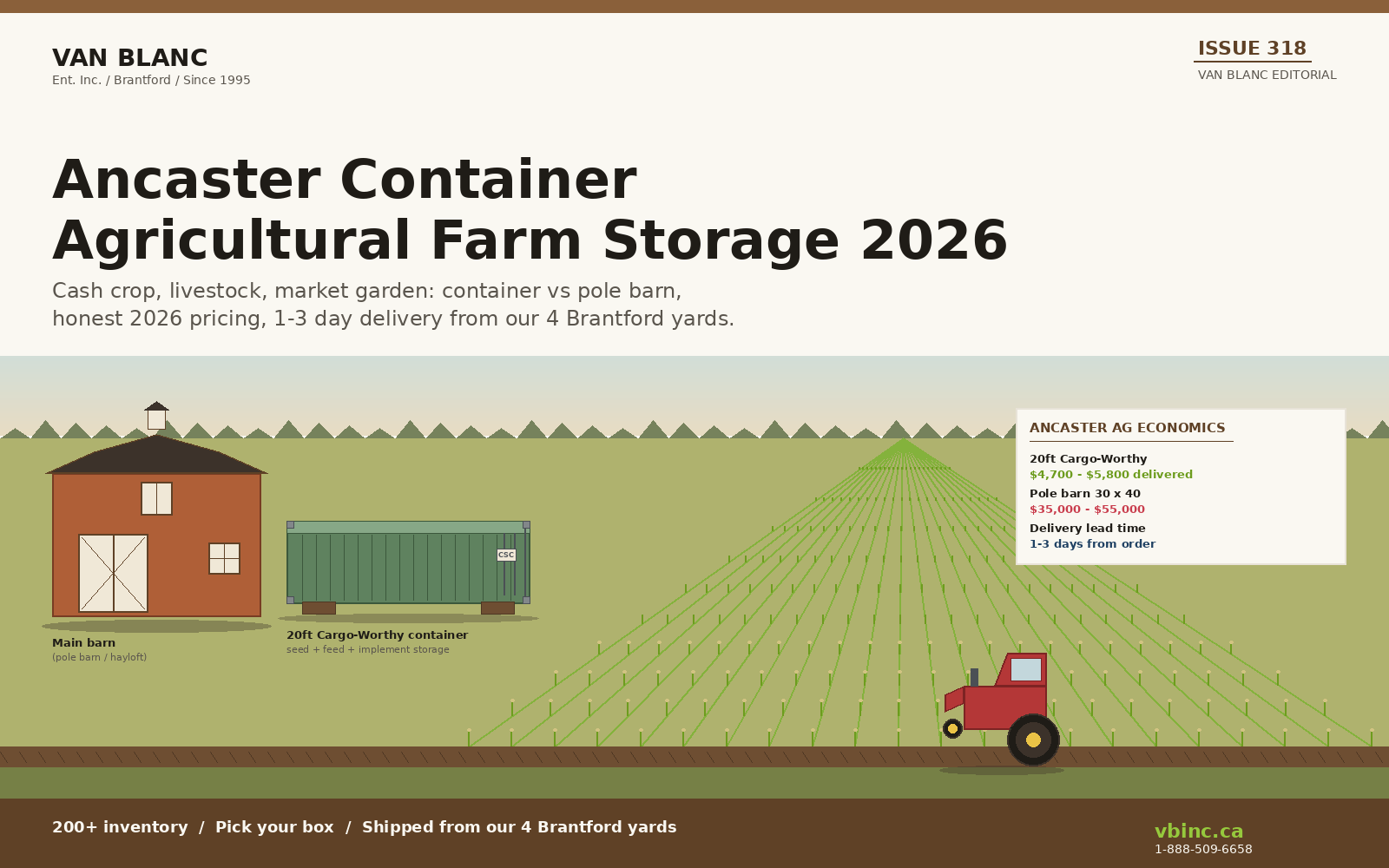
Quick Answer: Ancaster working farms use 20ft and 40ft steel shipping containers for secure feed and seed storage, implement winterization, livestock supplement protection, and harvest staging because the boxes are rodent-tight, wind-and-water-tight, and deliver in 1-3 days from Van Blanc’s 4 Brantford yards. Per the World Shipping Council, a standard 20ft box gives 160 square feet of sealed steel storage, and most farms add two or three of them instead of committing to a single fixed structure. Tilt-deck delivery is quoted as a separate line item that moves with distance and lane access. Pick the exact box in person before paying, never wire deposits to Facebook Marketplace sellers, and read the CSC plate before money changes hands. Real Brantford yards, real reviews (4.9 / 140+), real 1-3 day delivery. Family-operated since 1995.
In This Field Guide
- Who buys farm storage containers in Ancaster?
- Is a shipping container cheaper and faster than a pole barn?
- How should you lay out feed and seed storage in a container?
- Can a container store farm tools and implements over winter?
- What drives the price of an agricultural container in 2026?
- How does tilt-deck delivery work on a working farm?
- What is a farm container worth when you resell it?
- How do Facebook Marketplace container scams target farmers?
- Frequently asked questions
Reading time: about 14 minutes. This article sits under our local coverage for buyers across Ancaster and pairs with a companion piece for hobby-farm and acreage homeowners on the other side of the fence line.
Who Buys Farm Storage Containers in Ancaster?
Ancaster farm container buyers fall into three groups: cash crop operators needing seed and harvest storage, livestock farmers protecting feed and mineral supplement, and market gardeners wanting cooler-room and wash-station shells. All three want secure, rodent-tight dry storage that arrives in days, not a 20-year structure that takes months to build and ties up capital.
Ancaster sits along the rural southern boundary of Hamilton-Wentworth where the urban edge gives way to working farmland running to the Brant County line. The Hamilton-Wentworth Federation of Agriculture has represented this farm community for decades and the Ancaster Agricultural Society has been running shows since 1850. The buyer who calls Van Blanc from an Ancaster rural address is usually one of three profiles.
The cash crop operator runs corn, soybeans, and winter wheat on rented or owned ground in the 80 to 600 acre range. The container question for this buyer is seed storage in spring, harvest staging in fall, and tool-and-parts security year-round. The livestock buyer runs dairy, beef, sheep, or poultry and needs feed supplement protection, mineral and salt storage, equipment parts inventory, and sometimes a clean lockable space for veterinary supplies that has to be off the main barn. The market garden buyer runs five to forty acres of intensive vegetable production with cooler-room conversion potential, washing and packing station shells, and dry storage for season-extension supplies (row cover, irrigation drip tape, transplant trays).
Paul LeBlanc, owner: “I have been selling containers to Ancaster farms for nearly two decades and the call usually starts the same way. The barn ran out of room three years ago, the implement shed leaks, and the customer needs something secure that arrives this week instead of next year. A 20ft box on cribbing solves it. They walk our yard, pick the cleanest unit, and we deliver inside 1-3 days. No three-month build window.”
All three buyer profiles have the same underlying question: the fastest, cheapest, most secure way to add 160 square feet of dry storage to a working operation without committing capital to a 20-year structure. The container is usually the right answer.
Is a Shipping Container Cheaper and Faster Than a Pole Barn?
For most Ancaster farms, a shipping container wins on both speed and capital: it lands in 1-3 days versus months for a build, and a few 20ft boxes cover the same secure square footage as the smallest legitimate pole barn for comparable dollars. The container-versus-pole-barn math is closer than most operators think. Two 20ft containers plus a 40ft container give you 640 square feet of secure dry storage for roughly the same dollars as the smallest legitimate pole barn build, with delivery measured in days instead of months. Most Ancaster farms do not need a single 1,200 square foot structure; they need three or four 160 square foot secure boxes spread strategically across the operation, and you can browse the steel we have ready to drop on a farm pad before you decide on sizes. One by the seed bin for spring loadout. One by the implement shed for off-season tooling. One by the livestock barn for mineral and supplement security.
How Should You Lay Out Feed and Seed Storage in a Container?
A well-laid-out feed and seed container loads slow-rotation product at the closed end, keeps this season’s bags within the first 6 to 8 feet of the door, adds passive vents high on each end-wall, and pallets everything off the floor. Feed and seed storage is where containers earn their reputation on a working farm. The factory-sealed corten steel shell, welded corner castings, gasketed door seals, and marine plywood floor combine into a structure that is wind-and-water-tight and rodent-tight in a way most barn rooms are not. Industry references confirm shipping containers protect feed from rodents, moisture, and sun exposure when the box is sealed properly and kept clean. The internal layout that works best is built around four principles.
Load path. The doors of a 20ft container are at one end, so load from the door end and store slow-rotation product (long-term seed inventory, salt blocks, mineral pallets) at the closed end. Fast-rotation product (this season’s seed, current feed bags) sits within the first 6 to 8 feet of the door. The single biggest layout error new buyers make is putting heavy slow-rotation pallets at the door end and having to unload every time they need a seed bag.
Ventilation. A factory-sealed container is wind-and-water-tight but does breathe slightly through door gaskets. Most Ancaster ag buyers add one or two passive vents (4-inch louvered, mounted high on each end-wall) to cycle humid air during summer storage. Vents are an inexpensive add-on relative to the box itself and prevent the condensation cycling that can dampen seed bags resting against the cooler back wall in shoulder seasons.
Moisture control. Pallet your seed and feed bags off the floor. A 4-inch pallet base creates an air gap that prevents wicking from incidental floor moisture. Calcium chloride or silica gel desiccant tubs in the back corner absorb residual humidity for high-value seed.
Rotation. Label every pallet with month and year of receipt. First-in-first-out rotation is what keeps a multi-year seed stock viable.
Field Tip: Rodent Audit Every Spring
Even a factory-sealed container can develop a rodent entry if a door gasket gets pinched, a vent screen tears, or a hinge corrodes open enough for a young field mouse to squeeze through. Once a year, in early spring before grain handling starts, walk every container with a flashlight and check the four door corners, the vent screens, and any cable pass-throughs. Replace door gaskets at 7-10 years; they are cheap and they are the one part of the box that wears predictably.
For larger operations carrying multi-tonne grain bin overflow, the container is not a primary grain bin substitute. It is a secondary staging area, a tool-and-parts secure space, and a seed and supplement room. Real grain handling stays in the silo or the proper grain bin.
Can a Container Store Farm Tools and Implements Over Winter?
Yes. A shipping container is the cheapest secure way to overwinter farm tools and small implements: the lockbox-protected door takes a single padlock, and the wind-and-water-tight steel shell stops the rust-creep that destroys cold steel tools through a Hamilton-Wentworth winter. Winter tool and implement storage is the second high-value use case for an Ancaster farm container. The category includes hand tools, power tools, small implements (rototillers, sprayers, walk-behind brush cutters, ATV attachments), seasonal hardware (irrigation fittings, fence wire, post drivers), and the inventory of consumable parts that every working farm accumulates. This inventory is what gets stolen first when a barn is not lockable, and what fails first when stored in an unheated, leaky implement shed. The container solves both: a single padlock on a lockbox-protected door secures a full container of tools and parts, and the wind-and-water-tight steel shell prevents the rust-creep that destroys cold steel tools over a Hamilton-Wentworth winter.
The layout principle here is different from seed storage. Working pattern is occasional access for service or borrowing, so visibility matters. Most Ancaster operators run shelving along both side walls (16-inch deep wall shelves on french cleats), hooks along the door-end walls for hand tools, and floor space down the centre for the larger walk-behind units. Lighting is solar-LED battery-pack strip lights mounted to the ceiling at three points. No grid electrical.
Paul LeBlanc, owner: “The implement winterization use case has grown the most in the last decade. Twenty years ago, an Ancaster farm had one tractor and a few hand tools. Now they have an ATV, a side-by-side, three small motorized implements, and a wall of cordless tools. A 20ft container with shelving is the only structure that secures all of that for a fraction of what a new outbuilding would cost.”
For dual-purpose containers (seed storage in spring, implement storage in fall), build the shelving as modular french-cleat panels that come off the walls when the seed pallets need the floor space. See our container shelving systems guide for the full layout.
What Drives the Price of an Agricultural Container in 2026?
The price of an agricultural container in 2026 is driven by four things: container size (20ft versus 40ft), condition grade (Wind-and-Water-Tight, Cargo-Worthy, or One-Trip), the steel and diesel market on the day, and the delivery distance to your farm. Pricing on agricultural containers delivered to Ancaster from Van Blanc’s 4 Brantford yards moves with the steel market, diesel pricing, and the season, so the 20ft and 40ft figures live on our dated list of box prices and the table below maps each container and grade to the use it fits best and the main factor that drives its relative cost. Call the yard for a live, all-in quote to your exact rural address.

| Container | Condition Grade | What Drives Its Relative Cost | Best Use |
|---|---|---|---|
| 20ft Standard | Wind & Water Tight (older, sound) | Lowest of the grades: older steel, cosmetic wear, no current CSC plate | Tool and parts storage, implement winterization |
| 20ft Standard | Cargo-Worthy (CSC plate current) | Mid-range: current CSC plate and intact seals add a premium over WWT | Seed storage, feed supplement, multi-use |
| 20ft Standard | One-Trip (near-new) | Top of the 20ft range: near-new condition and clean paint command the most | Cooler-room conversion, market garden wash station |
| 40ft Standard | Wind & Water Tight | More steel than a 20ft WWT, so it sits a step up on size alone | Harvest staging, large implement winter storage |
| 40ft Standard | Cargo-Worthy | Size plus a current CSC plate stack two cost factors together | Combined seed plus implement, dual-zone with partition |
| 40ft High Cube | Cargo-Worthy | Extra foot of interior height adds to the 40ft CW baseline | Tall implement clearance, hay loft alternative |
| 20ft Refrigerated (reefer) | Working unit | Highest per foot: the refrigeration unit and insulation carry most of the cost | Market garden cold-chain, dairy supplement chill |
For most Ancaster agricultural use cases, Cargo-Worthy grade is the price-to-quality sweet spot. CW containers carry a current CSC plate, have intact door seals, and are sound for stationary on-farm use for 15-plus years. Wind-and-Water-Tight grade is cheaper and works for tool storage where a current CSC plate is not needed. One-Trip, near-new with clean paint, is the usual start when the container becomes a cooler-room or workshop conversion, the kind of yard build-out we finish before the box ever leaves Brantford. Our 2026 Ancaster delivered prices reflect honest Ontario steel market conditions and tilt-deck delivery cost from Brantford. The full pricing logic is broken down in our deeper look at how Ontario steel pricing works.
How Does Tilt-Deck Delivery Work on a Working Farm?
Tilt-deck delivery works like this: the truck arrives with the container chained to a hydraulic tilt-deck trailer, backs to the placement spot, tilts the deck, and slides the box off onto pre-positioned railway ties or cribbing in 20 to 40 minutes. Container delivery to an Ancaster working farm is a tilt-deck operation in 95 percent of cases, and the farm requirements are concrete and learnable.
Lane width. A standard farm lane should be 12 feet wide minimum for the truck and trailer combination. Most Ancaster farm lanes built for combine and tractor traffic clear this easily, but newer hobby-farm laneways with mature tree growth can be tight. If it does not fit, we reposition closer to the road and the container lands at the lane head. Lane height needs 14 feet for transit and 13.5 feet for the container in tilt position. Trim branches before delivery day.
Ground conditions. The loaded truck weight is 50,000 to 60,000 lbs. Soft spring ground after rain will not support that without rutting. Either deliver in late spring or summer after the ground firms, or drop on gravel at the lane edge and position later with a tractor and lift straps. Frozen winter ground takes the weight fine; muddy spring ground does not.
Placement pad. Most Ancaster operators run two railway ties or a gravel pad with 4 inches of compacted 3/4-clear under each end. The container is rated to sit on its four corner castings, so a full slab is overspec. The pad sets the box about 8 inches off-grade, enough air gap to keep the floor plywood off seasonal moisture and voles off the floor from below.
Field Tip: Mark the Placement Spot With Spray Paint
Before delivery day, paint two parking lines on the placement pad about 8 feet apart (the container is 8 feet wide). The driver can back the trailer between the lines without dismounting to check measurements. This shaves 10 to 15 minutes off the delivery and prevents the most common positioning errors (off-square placement, drift toward a tree or building).
If the container needs to land somewhere a tilt-deck cannot reach (back of a 40-acre field, behind a hedgerow, on a hillside), the delivery option is a crane lift from the road. Crane lifts add to the delivery cost depending on reach distance, but they place the container exactly where the operator wants it. We cover the full delivery decision tree in our shipping container delivery Ontario guide.
What Is a Farm Container Worth When You Resell It?
A farm container holds its value well: a 10-year-old Cargo-Worthy 20ft box typically resells for 60 to 75 percent of its original purchase price in the Ontario market, because it is portable equipment with a documented secondary market rather than a fixed structure. The pole barn is bolted to the land, and its resale value is only whatever the farm sale adds for storage.
Why this matters: agricultural operations evolve. The cash-crop operator who needed three seed containers in year one may need one container and two reefers in year ten when the market garden side of the business expands. The livestock operator who needed feed-supplement storage in year one may need a workshop conversion in year fifteen. Selling and replacing containers is a real option; demolishing and rebuilding a pole barn is not. Containers also transfer cleanly when a farm sells: a retiring operator can keep them as portable equipment or include them in the sale at a documented value. For operators planning estate transition, that documented-value status makes containers easier to allocate among heirs than fixed structures. For buyers thinking past the first purchase, it helps to understand how grade and condition shape long-term value.
How Do Facebook Marketplace Container Scams Target Farmers?
Facebook Marketplace container scams target farmers with an urgent, seasonal “farm special” listing, collect an e-transfer deposit, then go silent before any container arrives. This is the single most important section to read before an Ancaster operator writes a cheque. The Facebook Marketplace container scam is well-documented by CBC News and the Canadian Anti-Fraud Centre, and agricultural buyers are a top-three target demographic because farms have money, rural addresses (harder to drive to and verify), and urgent seasonal need.
The pattern: a Marketplace listing appears for a 20ft container. The photo is polished and the seller pitches an “agricultural special” or “farm price.” The pitch is urgent and seasonal: spring seed loading is coming, get a box this week, e-transfer the deposit today. The buyer sends e-transfer. The seller goes silent. No container arrives. E-transfers cannot be reversed once accepted. The Canadian Anti-Fraud Centre and CBC News have documented heavy individual losses, with victims reporting four-figure and five-figure hits and one Hamilton-area buyer left with nothing after paying upfront. Aggregate losses on this specific pattern run into seven figures per year nationally and farmers are over-represented in the victim demographic.
The defences for an Ancaster operator are concrete:
- Price floor. Every grade has a real Ontario market floor set by steel cost, and a 20ft Wind & Water Tight quoted well below that floor is suspicious. A quote at roughly half the going rate for a real Cargo-Worthy 20ft delivered to Ancaster is near-certain scam. If the number is too good to be true, walk.
- Yard visit before money. A legitimate Ontario supplier has a physical yard you can drive to. Van Blanc has 4 yards in Brantford, all walkable by appointment, all stocking the inventory we sell. Ancaster to Brantford is a 30-minute drive on Highway 403. Use it.
- Read the CSC plate. Every legitimate shipping container has a CSC (Container Safety Convention) plate riveted to the door listing serial number, manufacture date, and inspection history. A seller who cannot give you the CSC plate serial for the specific box you would be paying for does not have access to a real container. See our CSC plate verification guide for what should be on it.
- Payment on delivery. Real Ontario suppliers accept credit card, certified cheque, or e-transfer on delivery once the container is on your farm. E-transfer before delivery is the scam-default. Credit card is reversible; e-transfer is not.
- Verifiable business history. Van Blanc has been in business since 1995 with verifiable Google reviews (4.9 stars, 137 reviews), a documented Brantford address, and 30 years of agricultural supply records. New Marketplace profiles with no posting history are the dominant scam signal.
Field Tip: The Pre-Wire Phone Call for Ag Buyers
Before sending any deposit to a container seller, ask these five questions over the phone (not over Marketplace messenger): (1) What is the street address of your yard and can I come walk it tomorrow morning? (2) What is the CSC plate serial on the specific container I would be paying for? (3) Will you accept payment on delivery instead of upfront e-transfer? (4) Can you give me three Ontario farm references with addresses and phone numbers I can call? (5) Are you registered with the Canadian Anti-Fraud Centre as a verified business? Any hesitation, deflection, or “we do not operate that way” answer is the scam signal. Hang up and call a transparent local supplier instead.
Sold outright. Delivered in 1 to 3 days.
Van Blanc sells new and used shipping containers outright from our 4 Brantford yards, with delivery in 1 to 3 days and payment on delivery. We do not rent, lease or offer rent-to-own. Request a sale quote or call the yard at 519-754-6844.
Frequently Asked Questions
What size container is best for an Ancaster cash-crop farm seed storage?
A 20ft Cargo-Worthy container suits most Ancaster cash-crop operations under 500 acres for seed, fertilizer, and tool storage. The 160 square feet of interior space holds roughly 30 to 40 pallets of bagged seed. Larger operations above 500 acres typically pair a 20ft container for fast-rotation seed with a 40ft container for harvest staging and slow-rotation product. We break down what moves the cost in our guide to what drives a container quote.
Is a shipping container actually rodent-proof on a working farm?
Yes, when factory-sealed and kept sealed. The corten steel walls, welded corner castings, and gasketed door seals prevent rodent entry on a working farm. The two failure points to watch are door gaskets (replace at 7-10 years; pinched or worn gaskets create entry gaps) and any post-purchase vents (use rodent-grade hardware cloth, not fly mesh). Walk the box once each spring with a flashlight and check the four door corners and vent screens. Van Blanc supplies containers to working farms across Ontario and our team can talk through how other Ancaster ag buyers have sealed and laid out their boxes.
How long does delivery take from Van Blanc to Ancaster?
1 to 3 days from order. Ancaster sits roughly 30 kilometres from our 4 Brantford yards on Highway 403, so delivery is a single-day tilt-deck run once the container is selected and the placement pad is ready. Tilt-deck unload takes 20 to 40 minutes on the farm.
What grade container does Van Blanc recommend for agricultural storage?
Cargo-Worthy is the price-to-quality sweet spot for most Ancaster ag use cases. A CW container carries a current CSC plate, has intact door seals, and is sound for stationary on-farm use for 15-plus years. Wind-and-Water-Tight is cheaper and works for tool storage where a current CSC plate is not needed. One-Trip is the near-new grade to choose when the box is becoming a cooler-room or workshop conversion. Full grade breakdown in our more on container purchasing.
How much does delivery to a rural Ancaster address add to the container price?
Tilt-deck delivery from Brantford to a rural Ancaster address is priced on distance, lane access, and placement complexity, so the figure scales with how far and how awkward the drop is. Crane lifts, for back-field placement a tilt-deck cannot reach, add a further amount on top that depends on the reach required. We quote delivery as a line item on the original order so the all-in price is on the contract before any money changes hands.
Do you rent containers for harvest season?
No. Van Blanc does not rent, and we say so plainly. Operators needing one-season harvest staging can buy a used Wind and Watertight unit that resells after the season for most of its price, or, as a farm business, finance the purchase through their own bank or FCC so the payments sit against a box they own. We never charge a deposit. What a used box still fetches after the season is laid out in our container resale value guide.
Is a 20ft container big enough for an Ancaster market garden cooler conversion?
For a small market garden (under 5 acres), a 20ft container converts cleanly to a CoolBot-style walk-in cooler holding 30 to 50 stacked produce bins. Add R-30 spray foam insulation, a CoolBot controller, and a 10,000 BTU window air conditioner, and the conversion cost lands well under that of a purpose-built cold room while the container is reusable if the operation changes. Larger market gardens use a 40ft High Cube for 320 square feet of cooler space and two-tier stacking clearance. See our container cooler conversion guide.
Will the container floor support a 1-tonne pallet of seed?
Yes. Standard container floors are 28mm marine plywood (keruing or apitong) on steel cross-members rated for distributed loads of roughly 130 lbs per square foot. A 1-tonne (2,200 lb) pallet on a 4-foot by 4-foot footprint distributes at about 138 lbs per square foot, which is at the high end of rated load. For multi-pallet stacking or forklift point-loading, place pallets on the steel cross-member lines (visible from underneath) to spread load through the frame.
How do I avoid the Facebook Marketplace container scam as an Ancaster farmer?
Three rules: never wire money before visiting the supplier yard in person and reading the CSC plate on the specific container; know that every grade has a real Ontario market floor and a 20ft Wind-and-Water-Tight quoted well below it is suspicious; use a supplier with verifiable Ontario business history, a physical yard you can walk, and Google reviews going back years. Van Blanc has been in business since 1995, 4 Brantford yards walkable by appointment, 4.9 stars across 140+ Google reviews, 30-minute drive from Ancaster. See the Canadian Anti-Fraud Centre to verify a suspicious listing.
Ready to price your container?
Tell us the size and your postal code and we’ll send back an honest, all-in number, container, delivery, and placement, usually within 1-3 days. No pressure, no mystery fees.
Family-run in Brantford since 1995 · 200+ containers in stock · 4.9★ across 140+ Google reviews · every box graded by a person, walk it before it lands.
Sources and Further Reading
- Ontario Federation of Agriculture. Hamilton-Wentworth Federation of Agriculture profile. ofa.on.ca
- Ancaster Agricultural Society. Show roster and agricultural education programs since 1850. ancasterfair.ca
- Government of Ontario. Farm buildings, equipment, and environment guidance. ontario.ca
- Government of Ontario. Farm pesticide storage facility requirements. ontario.ca
- Canadian Anti-Fraud Centre. Online purchase scam reporting and prevention. antifraudcentre-centreantifraude.ca
- CBC News. (2021). Fraudsters across Canada taking in thousands of dollars a day in shipping container scam. cbc.ca
- Statistics Canada / Ontario Agri-Food Data. Ontario farm data by county. data.ontario.ca
Reach Van Blanc in Brantford
We have supplied shipping containers to Ontario farms since 1995, with a 200+ container inventory at our 4 Brantford yards, 1-3 day delivery Ontario-wide, and a 30-minute drive from Ancaster on Highway 403. You are welcome to walk our yards, read CSC plates, and pick the exact container that will sit on your farm before any money changes hands. We never charge deposits, and we do not rent. Purchase payment is collected on delivery.
Van Blanc Ent. Inc. 90 Morton Ave E Unit 1B, Brantford, ON N3R 7J7 +1 888-509-6658
If you are weighing a container against a pole barn or a leaky implement shed, call us. We will walk you through the math for your specific farm operation, the grade that fits your use case, and the honest 2026 delivered price to your Ancaster rural address.
Have your placement spot picked and a firm pad ready before delivery day. A quick call to the yard lets us match the right container and the right drop method to your laneway and ground conditions.
Related Reading
- What we deliver around the Ancaster area
- Containers for Ancaster acreage and rural homes
- A plain-language walkthrough of buying your first box
- What makes one quote higher than another
- Vents, lockboxes, shelving and other add-ons
- Buying a box for one season and selling it on
- Reading the plate riveted to the door
- How a box gets to your gate across the province