
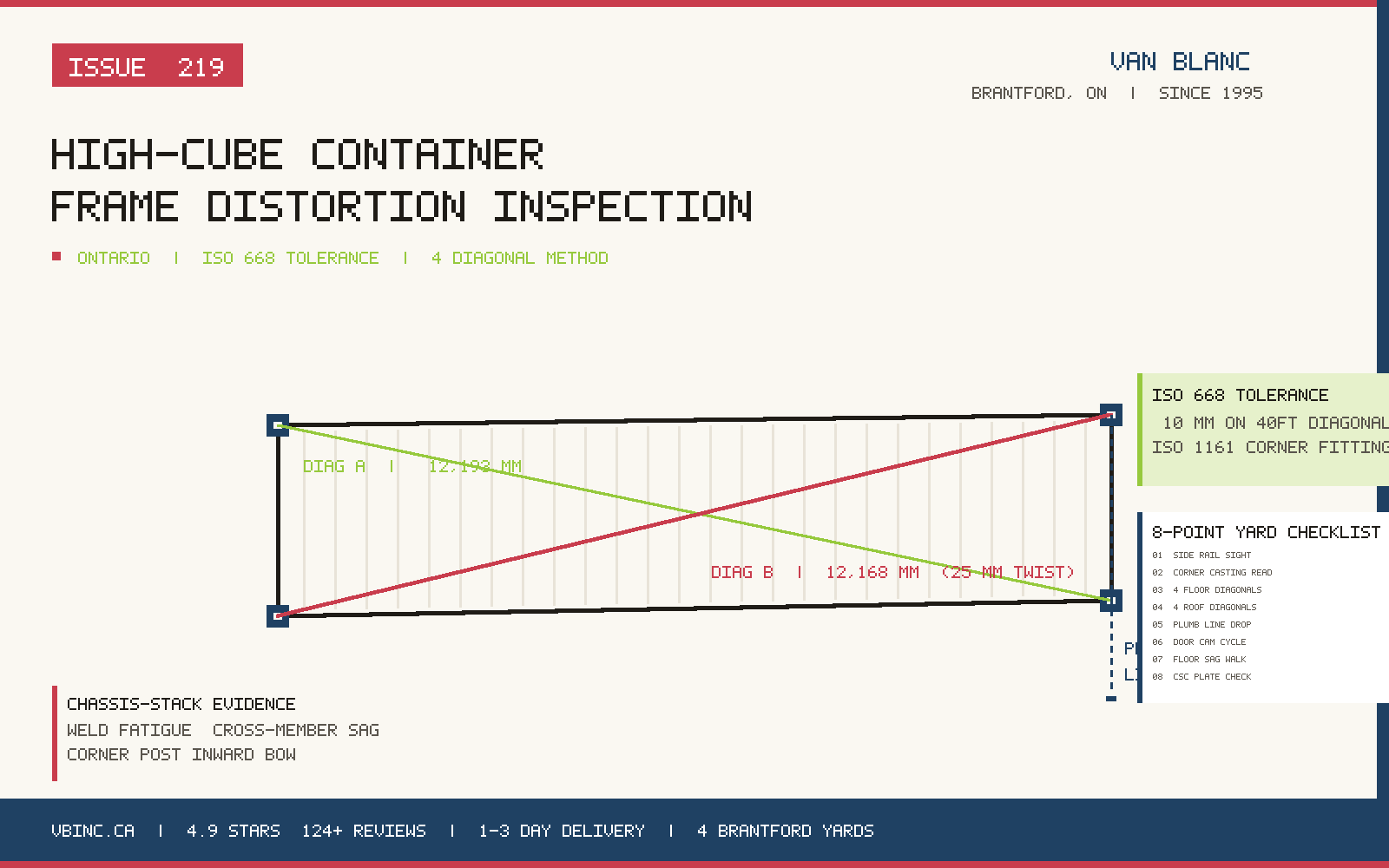
Quick Answer: A high-cube frame distortion inspection in Ontario measures the four diagonals on the floor and roof to confirm the box is square within ISO 668 tolerance (about 10 mm across a 40HC corner diagonal), checks all eight corner castings for plumb, and verifies the doors close and seal without binding before delivery. The LeBlanc family has run Van Blanc Ent. Inc. since 1995, with 140+ verified Google reviews at 4.9 stars and 1-3 day Ontario delivery.
In This Guide
- Why does a 40HC distort more than a 20ft?
- What does ISO 668 tolerate for frame twist?
- How do you measure distortion with the four-diagonal method?
- What do the eight corner castings tell you?
- What is racking, and why do the doors bind?
- How does chassis stacking cause frame fatigue?
- What does a 40HC yard walk look like in Brantford?
- When should you walk away from a twisted high cube?
- What site prep prevents distortion after delivery?
- What can we fix in the yard, and what won’t we?
- Frequently Asked Questions
Reading time: 14 minutes.
Why does a 40HC distort more than a 20ft?
A 40HC distorts more easily than a 20ft because the extra foot of headroom makes the side rails a longer, taller lever. A 20ft is short, stout, and stiff. On a 40HC, an off-axis lift, an uneven chassis, or a steep tilt-deck drop shows up as twist at the corner castings.
A high cube is a forty-foot box with an extra foot of headroom (9 ft 6 in exterior height instead of 8 ft 6 in). That foot of steel above the side rails is also why a high cube is more vulnerable to frame distortion than a 20ft or a standard 40.
The longer the lever arm, the more force shows up at the corner casting when something goes wrong. A 20ft is short, stout, and stiff. A 40HC is long, tall, and over a four-tonne tare before you load anything. Lift it on one corner instead of all four, stack it on an uneven chassis, drop it onto a tilt-deck at a steep angle, and the corner castings absorb the geometry change before the side rails bow. By the time you see a twist with the naked eye, the box has lived through several quiet abuses.
Christian LeBlanc, second-generation operator: “The first 40HC I ever turned away looked perfect in the paint and bound on one door. I learned that day that a high cube hides its history in the geometry, not the colour. I grew up flying to Asia with my dad from age 15, and the lesson that stuck was to trust the tape over the eyeball every time.”
That is why the full pre-purchase walk-through we run on every used box starts with frame trueness for anyone shopping a 40HC. You can repaint a high cube. You cannot un-rack it. If you want to see the difference between a clean frame and a worked one, the fastest answer is a call to the Brantford yard, where we keep enough high-cube stock to put a true box and a borderline one side by side.
Why container geometry matters beyond aesthetics
The whole intermodal system depends on a single dimensional promise: a forty-foot box has external corner castings within a couple of millimetres of where they belong. Twistlocks at port terminals, spreader bars at rail yards, kingpins on chassis, the next container in the stack above. All use the corner casting holes as the registration point. A racked 40HC fights every piece of handling equipment that touches it for the rest of its life.
What does ISO 668 tolerate for frame twist?
ISO 668 frame tolerance is tighter than most buyers assume. Buyers ask if there is a published number for how out-of-square a container can be before it counts as distorted. There is. ISO 668 (Series 1 freight containers: classification, dimensions and ratings) sets the external geometry of every container in the global intermodal network. ISO 1161:2016 sets the corner-fitting specifications, including the millimetre tolerances on the holes twistlocks engage.
The practical tolerance most yard inspectors work with is roughly 10 mm of diagonal difference on a corner-to-corner measurement of a 40-footer (12.19 metres long). The standard does not allow more than a handful of millimetres on the corner-casting hole positions, because the lifting equipment depends on those holes being where the spreader bar expects them. A diagonal that is off by 25 mm or more is a different category of problem.
If the seller cannot let you measure the diagonals yourself before paying, that is a yellow flag on its own. Our yard is set up for this. Bring a long tape and a chalk line if you want. Nobody on our team rolls their eyes at a buyer who wants to measure.
Bring a long tape: what to measure on a 40HC
You only need two numbers. The floor diagonal from bottom-front-left to bottom-rear-right, and the opposite diagonal from bottom-front-right to bottom-rear-left. Subtract one from the other. On a true forty-footer the difference is in single-digit millimetres. Two centimetres or more means the frame has worked. Repeat on the roof. A twisted box reads different on the roof than on the floor.
How do you measure distortion with the four-diagonal method?
The four-diagonal method measures frame distortion by comparing the two floor diagonals and the two roof diagonals of a 40HC. Industry inspectors call it the diagonal check, and it is the single most useful test for frame distortion on a high cube because it costs nothing, takes three minutes per container, and catches geometry problems that visual inspection misses. Here is how a 40HC inspection runs in our Brantford yard.
First, walk the long sides. Stand at one bottom corner casting and sight down the side rail to the opposite corner. A gentle bow tells you the side took an impact and the steel never came back. A sharp kink means a forklift tine or chassis bunk hit that exact spot.
Second, measure the two floor diagonals as described above. The difference between the two numbers is your twist budget. Single-digit millimetres is acceptable. Two centimetres or more means the frame has worked under load.
Third, measure the two roof diagonals. A 40HC under stacking compression sometimes shows the twist on the roof before the floor. Clean floor diagonals with 20 mm roof spread mean the upper corner castings are no longer in plane with the lower ones.
Fourth, drop a plumb line from each top corner casting to the matching bottom corner casting. On a true container it falls right against the corner post. On a racked box it hangs an inch away at one or two corners. That single visual is often more convincing than the tape numbers.
What do the eight corner castings tell you?
The eight corner castings tell you the box’s load history, because they are the most stressed pieces of steel on any container. They are forged or cast, machined to ISO 1161:2016 tolerances, and welded into the corner posts. Every lift, every stack, every twistlock engagement runs through these eight points. They are also the easiest place to read the box’s history if you know what to look for.
Look at the casting holes. Hole elongation, where the steel above the hole has yielded slightly and the opening looks teardropped, is the signature of overload or a misaligned lift. Twistlocks still engage but with play, so the container will move on the chassis under braking.
Look at the weld beads where the casting meets the corner post and the rails. The original factory welds are continuous and uniform. A repair shows as a fresh bead with grinder marks beside it. Repaired castings are not a deal-breaker, but price the repair into the offer.
Look at the cast face for cracks. Hairline cracks radiating from the holes are the catastrophic finding. Walk away from any 40HC with a cracked corner casting. Cutting it out and welding a new one in costs more in labour than the price difference between a damaged box and a clean one.
What we look at first in our Brantford yard
Christian and Paul both start at the same place when a customer walks up to a 40HC: the front-right bottom corner casting. The reason is that in a typical yard layout, the front-right is the corner that gets nicked most often during chassis-on, chassis-off, and forklift positioning. If the front-right casting is clean, the rest of the box is usually clean. If it is bashed, dig deeper. Thirty years of grading containers in and out of our Brantford yards has taught us this is the tell.
What is racking, and why do the doors bind?
Racking is the industry word for a container frame that has gone out of square under load, and binding doors are its most common evidence. The cargo doors on a 40HC are heavy, the cams and keepers are precise, and the door gear depends on the rear frame being a perfect rectangle. The moment the frame twists, the cams stop seating cleanly and the doors will not close or open without a kick.
When a buyer asks why the doors on a used 40HC are sticking, the first thing we check is whether the container is sitting level. A box on an uneven yard surface racks under its own weight and the doors bind even though nothing is wrong with the frame itself. Reset on four level blocks and the doors usually free up. If they still bind after the unit is level, the frame has taken a real twist.
The reverse is also true. A 40HC that closes with both cams seating cleanly is almost certainly square within tolerance. Door gear is a sensitive instrument. A bound cam is the container telling you it has been racked. A free, cleanly seating cam is the container telling you the frame held up.
This is why we always demand both door gear actions during a yard walk. Open fully, all the way back against the side panels. Close fully, cams seated. Do it on the high cube you are considering, in our yard, with you watching. If the doors hesitate, the frame has a story we both need to hear. Once a true box is on your pad, keeping the door gear and gaskets in shape is a separate, easier job that has nothing to do with the frame.
How does chassis stacking cause frame fatigue?
Chassis stacking causes frame fatigue slowly, not in one bad lift. Most distortion on a high cube builds over years of being stacked on a chassis or stacked five-high in a port terminal, with the bottom box absorbing the dead weight of every container above. Frame fatigue from stacking shows up in three places on a 40HC.

First, corner post compression. A box bottom-of-the-stack for a long time shows slight inward bow on the corner posts near the bottom castings. Run your hand down the post from top to bottom. A bow means the post carried weight beyond what it was designed for and the column buckled microscopically.
Second, floor rail sag. Step inside and walk the centre of the floor. A spongy floor or a visible dip means the cross-members under the plywood have taken stacking compression from below or load compression from above. The plywood can be replaced. A sagged cross-member frame is not coming back.
Third, weld fatigue at the cross-members and at the corner-to-rail joins. Look at the underside of the box. Old weld beads with hairline cracks running parallel to the bead are fatigue cracks. They develop because the box flexes every time the chassis takes a road bump, and over thousands of kilometres the welds work-harden and crack. The IANA chassis inspection guide documents the same pattern for chassis frame rails.
What does a 40HC yard walk look like in Brantford?
A 40HC yard walk in Brantford is an eight-step frame check that takes about 15 minutes per box. Most of our high-cube inventory lives at one of our 4 Brantford yards. When a buyer drives in, this is the sequence we walk through on every 40HC.
- Stand at the front and sight down each long side. Bow, kink, or straight line.
- Walk the corners and read the eight castings. Holes, welds, cracks.
- Run the four diagonals with a 50 ft tape. Floor first, then roof.
- Drop a plumb line at the four corners. Check the line falls against the post.
- Open and close both cargo doors. Watch the cams seat. Listen for hesitation.
- Step inside and walk the floor centre-to-corners. Read for sag.
- Eyeball the underside crossmembers and weld beads.
- Confirm the CSC plate is present and frame numbers tally with the unit.
If all eight checks pass, the buyer leaves with a high cube within ISO 668 tolerance, ready to accept a twistlock without play and a stack above it without further yield. If two or more fail, we steer the buyer to a different unit from the high cubes we have ready on the yard. The operating principle is simple: the inspection runs first, and the sale happens only if the box clears.
Paul LeBlanc, owner: “A 40HC is a forty-foot lever. Whatever bent it, bent it through a long arm. When I started bringing containers in from Asia I learned to read the corner castings before I read the paint. The paint is honesty about how old the box is. The castings are honesty about how hard a life it had.”
When should you walk away from a twisted high cube?
You should walk away from a twisted high cube when the distortion is structural rather than cosmetic or functional. The distinction comes down to three categories. Cosmetic means the doors close, the diagonals are within tolerance, but a side panel has a visible bow from an impact. Functional means the doors bind and the diagonals show 15 to 25 mm of twist, but the castings are intact and the cross-members are sound. Structural means hairline cracks at the corner castings, a sagged floor, weld fatigue, or diagonals over 25 mm out.
| Distortion level | What you see | Diagonal difference | Our recommendation |
|---|---|---|---|
| Cosmetic | Doors close and seal, side panel shows an impact bow | Within single-digit millimetres | Buyable for storage; price reflects the dent, not the frame |
| Functional | Doors bind, castings intact, cross-members sound | 15 to 25 mm of twist | Buy only if the price covers the labour to reset on level blocks |
| Structural | Cracked castings, sagged floor, weld fatigue | Over 25 mm out | Walk away unless you need scrap or cladding stock |
The 40HC market in Ontario has plenty of clean inventory. There is no reason to buy a structurally compromised one unless you are sourcing scrap for cladding or one-time non-storage use. Even then, the price has to be deep into As-Is territory before the math works. If you are weighing a worked used box against a fresh one, our factory-paint high cubes that have made a single loaded voyage skip the racking question entirely, because the frame has never carried a stack.
What site prep prevents distortion after delivery?
Site prep that prevents distortion after delivery comes down to four level, stable blocks under the corner castings. A 40HC that passes inspection in our yard can still rack on delivery if the site is not prepared. The most common cause of post-delivery distortion is uneven ground under the four corner castings. The frame relies on the four castings sitting in the same plane. If three are on solid ground and one is on soft earth, the box racks under its own four-tonne weight within hours.
The rule is simple. Set the container on four level blocks, one under each bottom corner casting. Blocks can be concrete cribbing, hardwood, or proper container blocks rated for the gross weight. Each block must be on stable ground. Wet clay settles. Topsoil settles. Crushed stone compacted on subgrade does not.
On agricultural land in Norfolk, Brant, or Haldimand, this means setting the box on a gravel pad with the corners on dedicated blocks rather than on the gravel directly. On residential property, this means a modest run of concrete cribbing instead of letting the box rest on grass. We talk through site prep with every customer before delivery, because a racked box from poor site prep is on the customer, and we would rather prevent it than collect a service call later. The fastest way to get it right is to describe your ground over the phone and let us tell you what the four corners need.
The four-block rule
Four blocks, one at each bottom corner casting, each level with the others within 25 mm. The blocks carry the entire box weight. The ground under them must not settle. We have postponed a delivery rather than dropping a 40HC onto unsuitable ground. It costs nothing to wait a week. It costs a lot to re-block a box after it has racked.
What can we fix in the yard, and what won’t we?
What we fix in the yard is cosmetic and minor: our Brantford yards run a small repair operation on our own inventory. Side panel dents, door gear adjustments, replacing a door gasket, repainting, swapping a damaged cargo flooring sheet. That is yard work and we do it regularly, and it sits alongside the larger door, vent, and insulation conversions we build before delivery.
Frame distortion is different. Re-squaring a racked container requires cutting the corner posts and re-welding the casting back to true position. A few specialty shops in Ontario do it on minor twists. Most yard operators, including us, do not. The labour cost, the loss of factory continuous welds, and the future inspectability of a yard-squared box all argue against it. We would rather move that bin to scrap and bring in a fresh 40HC.
The honest version of the conversation, when a buyer asks why we do not just fix a racked one, is that the math does not work. A clean 40HC retails for what a re-squared one would have to retail for after the labour, with no resale premium. Twenty years in containers and thirty years operating across Ontario has taught us the right answer to a racked high cube is almost always “sell it as scrap and bring the next clean one off the chassis.” This is exactly the judgment the wider used-box checklist we hand every buyer is built to support. The inspection is the filter. Everything downstream depends on it.
Frequently Asked Questions
How do you tell if a high-cube container is bent or warped?
Measure the four corner-to-corner diagonals on the floor and on the roof. On a true 40HC the two floor diagonals match within single-digit millimetres. Anything over 25 mm of diagonal difference means the frame has racked. Combine that with a visual check for bowed side rails and binding cargo doors.
What is racking on a shipping container?
Racking is the industry word for a container that has gone out of square under load. The frame is no longer a perfect rectangle. Visible evidence is door binding (cams will not seat in the keepers cleanly) and a plumb line from a top corner casting that falls inches away from the post.
Can you straighten a racked 40HC container?
Theoretically yes, by cutting the corner posts and re-welding the castings to true position. Practically, almost no yard operator in Ontario does this commercially because the labour cost wipes out the price difference between a damaged unit and a clean one. The market answer is to sell the racked box as scrap.
Are high cubes more prone to frame distortion than standard containers?
Yes, marginally. The extra foot of height adds leverage on off-axis impacts, and the longer corner post is harder to keep in plane under compressive stack load. A 20ft is the stiffest because it is short and stout. A 40HC needs the most careful inspection of any standard-inventory container.
What is the ISO 668 tolerance for a forty-foot container?
ISO 668 specifies nominal dimensions and strength requirements. The practical inspection tolerance most surveyors apply is around 10 mm on a 40-foot diagonal measurement, well under one percent across the 12.19-metre length. Corner casting hole positions are held to a few millimetres because twistlock equipment depends on them.
Why do the doors on a used 40HC bind?
Two reasons. The container is sitting on uneven ground, which racks the frame under its own four-tonne weight, or the frame has taken a real twist in its history and the rear opening is permanently a parallelogram. Re-level on four uniform blocks. If the doors still bind, the frame is racked.
What does a damaged corner casting look like?
Hole elongation, where the twistlock opening looks teardropped instead of a clean oval, is the signature of overload. Hairline cracks radiating from the holes are the catastrophic finding and a reason to walk away. Fresh weld beads at the casting-to-rail interface suggest a prior repair.
Can frame distortion happen after delivery?
Yes, if site prep is wrong. A 40HC dropped onto uneven ground, or onto blocks that settle differently, will rack under its own weight within hours or weeks. The fix is the four-block rule: one block under each bottom corner casting, all four level within 25 mm, on ground that does not settle.
What is chassis stacking and how does it damage a container frame?
Chassis stacking is the reality that intermodal containers spend much of their life riding on a chassis trailer that gets stacked on end when not in use. The box flexes every time the road takes a bump, and over thousands of kilometres the weld beads at cross-members and corner-to-rail joins develop fatigue cracks.
How long does a frame-trueness inspection take in your Brantford yard?
About 15 minutes per 40HC, walked at a normal pace with the buyer present. Eight checks: side rail sight, corner casting read, four floor and roof diagonals, four plumb lines, both door cycles, floor walk, underside cross-member scan, CSC plate confirmation. Bring a 50-foot tape if you want to measure yourself.
Ready to price your container?
Tell us the size and your postal code and we’ll send back an honest, all-in number, container, delivery, and placement, usually within 1-3 days. No pressure, no mystery fees.
Family-run in Brantford since 1995 · 200+ containers in stock · 4.9★ across 140+ Google reviews · every box graded by a person, walk it before it lands.
Sources
- International Organization for Standardization. (2020). ISO 668:2020. Series 1 freight containers. Classification, dimensions and ratings. iso.org
- International Organization for Standardization. (2016). ISO 1161:2016. Series 1 freight containers. Corner and intermediate fittings. Specifications. iso.org
- Intermodal Association of North America. (2018). Chassis Stacking Task Force Recommended Practice. intermodal.org
- Intermodal Association of North America. The IANA Guide to Chassis Inspection and Repair. intermodal.org
- Container Handbook. Section 3.1.2 CSC and structural and testing regulations. Akademischer Verein Hütte. containerhandbuch.de
Reach Van Blanc in Brantford
We have been supplying shipping containers across Ontario since 1995. Our warehouse is at 90 Morton Avenue E in Brantford, and we deliver right across the province on a cash-on-delivery basis. No surprise fees, no chase-the-paperwork.
Van Blanc Ent. Inc. 90 Morton Ave E Unit 1B, Brantford, ON N3R 7J7. +1 888-509-6658
If you are shopping for a 40HC and want to run the four-diagonal check before you pay, drive in and ask for Paul or Christian. We keep enough high-cube inventory in our 4 Brantford yards that a frame-trueness walk-through is part of every sale, not an extra. Worth the drive for unbeatable quality and family customer service with 30 years of experience.