
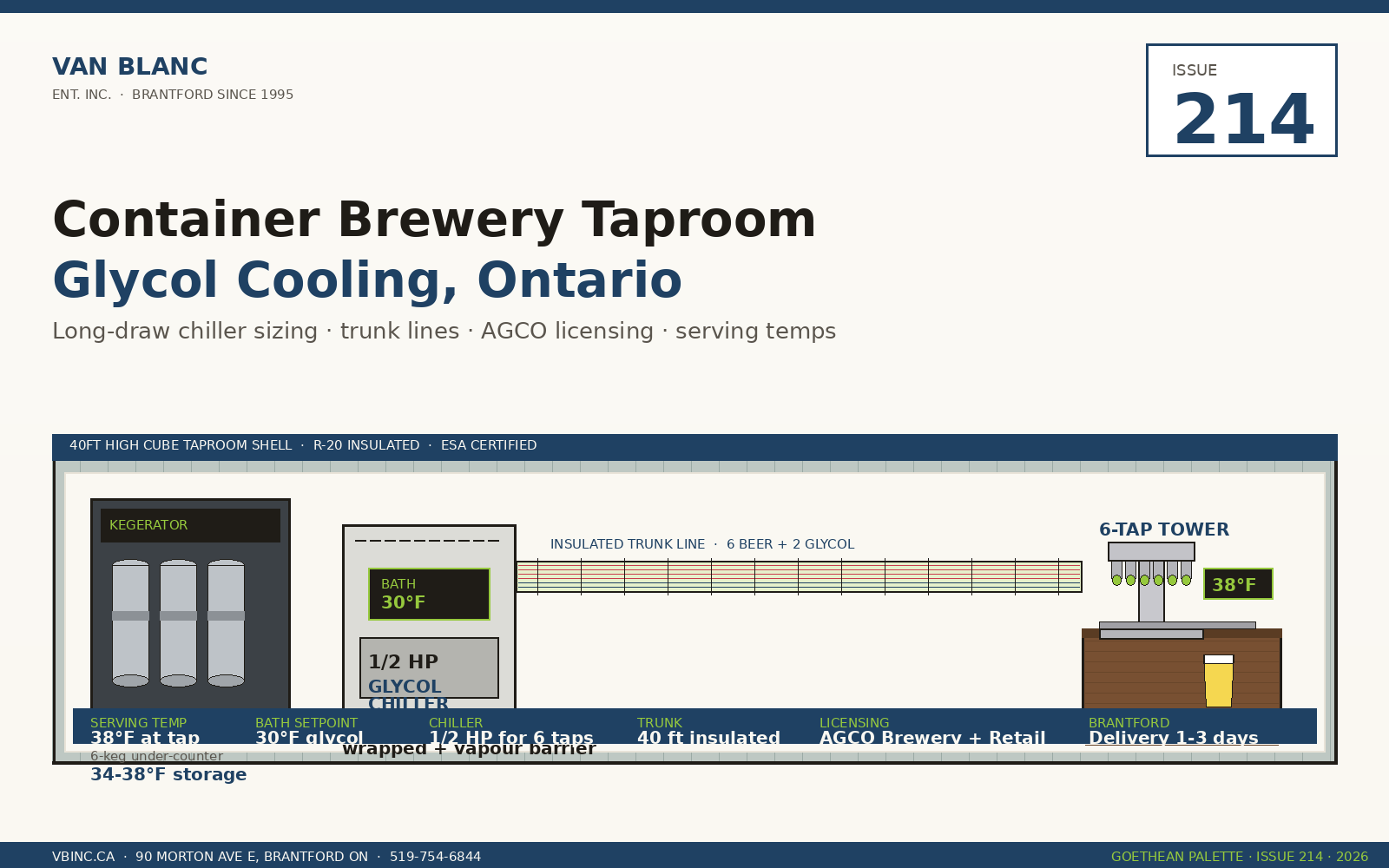
Quick Answer: Container brewery taproom glycol cooling in Ontario keeps draft beer at 34 to 38 degrees F across long-draw lines using a food-grade propylene glycol loop, sized 1/4 HP for 4 to 6 taps under 25 feet of trunk. The bath itself runs 5 to 8 degrees colder than the beer to pull heat through the line. Van Blanc delivers 40HC taproom shells from our 4 Brantford yards in 1 to 3 days, and we have shipped containers across Ontario since 1995. 4.9-star service, and every quote carries a real lead time.
In This Guide
- Why Does a Container Taproom Need a Glycol Loop?
- Direct-Draw or Long-Draw: Which Fits a 20ft or 40ft Box?
- What Size Glycol Chiller Do You Need for Your Taps?
- What Serving Temperature and Bath Setpoint Stop the Foam?
- How Do You Build the Trunk Line in a Container Taproom?
- What Goes Into the Tap Tower, Drip Tray, and Kegerator Station?
- What AGCO Licensing Does an Ontario Container Taproom Need?
- How Much Electrical Service and ESA Certification Does It Take?
- How Do You Handle Summer Heat and Ontario Winters at the Service Window?
- What Drives the Cost of the Container Shell and Cooling Buildout?
- FAQs
Reading time: about 13 minutes.
Most Ontario craft breweries that open a satellite taproom in a shipping container get the steel right and the cooling wrong. The bar top goes in, then somebody asks: how do we keep six taps at 38 degrees on an August Saturday in Brantford? Building on our wider walk-through of building out a container bar in Ontario, this piece drills into the glycol loop, chiller sizing, trunk line, and AGCO licensing.
Why Does a Container Taproom Need a Glycol Loop?
A container taproom needs a glycol loop because the steel envelope traps summer heat and a draft line cannot stay cold on its own across a long run. The loop circulates chilled food-grade propylene glycol alongside the beer lines in one insulated trunk, holding the beer at 34 to 38 degrees F from keg to faucet. Without it, the draft program foams by lunchtime.
A 20ft container is 19’10” long, 8′ wide, and 8’6″ tall on the outside. Frame the walls, insulate, and drop a bar in, and the usable serving floor shrinks fast. A 40ft High Cube adds a foot of headroom and double the floor area, which is why most Ontario brewery taprooms we deliver are 40HC builds. Glycol cooling holds beer in that 34 to 38 F window, the range where CO2 stays in solution and pours land cleanly. It lets you remote-mount the kegs, freeing bar real estate. And it scales: a six-tap container today can grow to twelve next summer without ripping out the infrastructure.
Paul LeBlanc, owner: “A brewery will spend months perfecting the recipe and then try to pour it through a warm line in a hot steel box. The glycol loop is the part nobody photographs and the part that decides whether the first pint of the day looks like the last. We have been delivering these taproom shells out of Brantford since 1995, and the build that skips the loop is the one we hear back from in July.”
The window that decides everything is narrow, and the bath that drives it sits even colder. Here is the spread a tuned system holds.
The temperature window that actually matters
Industry guidance from glycol specialists puts the beer cooler between 34 and 38 F, with the bath itself at 29 to 32 F. The bath sits 5 to 8 degrees colder than the beer, which creates the heat-pull through the trunk line. Bath too warm: tap-end climbs. Bath too cold: you freeze the first inch of beer line after the coupler.
Direct-draw parks the kegs in a refrigerated cabinet under the bar with beer lines under five feet. It works for two to four taps, but every brewer we have sold a 40HC to in the last three years has gone glycol. Once you cross four taps, the kegerator under the bar eats a four-foot stretch of floor that should belong to customers.
Direct-Draw or Long-Draw: Which Fits a 20ft or 40ft Box?
The choice between direct-draw and long-draw in a container taproom comes down to tap count and floor space. Direct-draw parks the kegs in a cooled cabinet right under the bar and suits two to four taps; long-draw remote-mounts the kegs and runs a glycol-cooled trunk, which is the only practical way past four taps. Most Ontario container taprooms fall into three operational shapes, and each has a preferred draft architecture.
| Container size | Typical tap count | Recommended system | Rationale |
|---|---|---|---|
| 20ft Standard Dry | 2 to 4 taps | Direct-draw kegerator | Limited floor area, low SKU rotation |
| 20ft, festival pop-up | 4 to 6 taps | Compact long-draw, 1/4 HP chiller | Mobile remote walk-in or jockey box |
| 40ft Standard Dry | 6 to 8 taps | Long-draw glycol, 1/2 HP chiller | Adjacent walk-in, 25 to 50 foot trunk |
| 40ft High Cube | 6 to 12 taps | Long-draw glycol, 1/2 to 3/4 HP | Premium taproom, full tap wall, headroom for trunk routing |
| 45ft HC | 10 to 16 taps | Long-draw glycol, 3/4 to 1 HP | Brewery flagship taproom on a vineyard or rural site |
Direct-draw makes sense for a 20ft pop-up at a festival or a clubhouse pouring two house lagers and one rotating tap. Anything past four taps and a full long-draw build starts to look a lot like the layout we cover in a cocktail-station fit-out where the back bar runs remote.
Long-draw works because glycol is the only practical way to keep beer cold across a run longer than 25 feet. The Micromatic 5-Cs (Cooling, CO2, Construction, Cleanliness, Calibration) treats glycol as the foundation of any commercial draft system past a handful of taps. In Ontario builds, the walk-in usually sits in a second 20ft container parked end-to-end with the taproom, with the trunk running through an insulated chase.
What Size Glycol Chiller Do You Need for Your Taps?
Glycol chiller sizing comes down to two variables: how many beer lines need to stay cold, and how long the trunk is. A four-tap taproom under 25 feet of trunk runs a 1/4 HP power pack; a twelve-tap wall on a 50 to 100 foot trunk wants 3/4 HP with dual pumps. Industry sizing tables work off these benchmarks:
Chiller HP by tap count and line length
- 1 to 4 taps, under 25 ft trunk: 1/4 HP, 1,800 to 2,400 BTU/hr, single-pump power pack.
- 5 to 8 taps, 25 to 50 ft trunk: 1/2 HP, 3,000 to 4,500 BTU/hr, reservoir sized for stable bath.
- 9 to 12 taps, 50 to 100 ft trunk: 3/4 HP, 5,000 to 6,500 BTU/hr, dual-pump for redundancy.
- 12+ taps, 100+ ft trunk: 1 HP or larger, 7,000+ BTU/hr, remote condenser if the room runs hot.
Two adjustments matter. Ambient temperature: a 40HC on a south-facing pad in Brantford can hit 95 F inside the mechanical chase by 2 PM in July. Every 10-degree rise adds 15 to 20 percent load. Size up one bracket or add exhaust. Tap expansion: add 10 to 15 percent margin if you expect to grow from six to eight taps within two years. Stepping from a 1/4 HP to a 1/2 HP power pack adds only a modest premium up front. Replacing an undersized chiller two summers later costs a Saturday of warm beer plus the labour to swap it.
BTU rule of thumb
Budget 10 BTU per foot of trunk per beer line, plus 1,000 BTU per keg under refrigeration, plus a 20 percent safety multiplier. A 40-foot trunk with six beer lines and four kegs in the walk-in works out to about 7,700 BTU/hr total: cleanly in the 3/4 HP bracket once you account for hot ambient months.
What Serving Temperature and Bath Setpoint Stop the Foam?
Draft beer in a container taproom serves cleanest at 34 to 38 degrees F, and the glycol bath that delivers it sits at 29 to 32 degrees F, roughly 5 to 8 degrees colder so it can pull heat out of the line. Foamy pours almost always trace to four problems: bath setpoint too warm, trunk insulation gaps, CO2 pressure mismatched to line length, or dirty lines. Glycol sits at the centre of all four.
The bath setpoint on a tuned system runs 29 to 32 degrees F. If the bath drifts to 36 F because the chiller is undersized, the trunk cannot pull enough heat out of the beer line. By the time beer reaches the faucet it has warmed to 42 or 44 degrees, CO2 comes out of solution, and the bartender pours half the keg down the drain.
CO2 pressure has to match line resistance. Rule of thumb: 0.3 PSI per foot of 3/8-inch beer line plus 1 PSI per foot of vertical rise. On a 40-foot trunk with two feet of lift, you are looking at roughly 14 PSI total, so the regulator sits at 12 to 14 PSI for standard ales and lagers. Witbier or hefeweizen run 16 to 18 PSI. Cask ales sit at 8 to 10 PSI on beer gas.
Why Ontario container taprooms over-foam in August
Every July we field calls from Brantford and Hamilton-area operators whose pours have gone sideways. The pattern: chiller was sized for 60 F ambient in the keg room, but the room is hitting 85 by mid-afternoon. Compressor cycles short, bath drifts up, foam starts. Two-stage fix: add ventilation to drop ambient 15 to 20 degrees, then verify the bath setpoint still lands.
How Do You Build the Trunk Line in a Container Taproom?
The trunk line in a container taproom is the bundled run of beer lines and glycol supply/return wrapped in a single insulated sleeve so the cold follows the beer from keg to faucet. A six-tap taproom routes six beer lines, two glycol lines, and one air line. The whole bundle gets 1 inch of closed-cell foam plus a vapour-barrier jacket.
Three rules:
- No exposed runs. Every foot of trunk outside the sleeve is a foam machine waiting to happen. Route through framed wall cavities or an enclosed soffit above the bar.
- Continuous insulation from keg to faucet. The cold has to follow the beer. Common failure point: the last 18 inches between trunk termination and tap tower. Use a tower cooler kit if vertical rise exceeds 4 feet.
- Minimum bend radius. 3/8-inch beer line bends to about 6 inches inside radius without kinking. Plan trunk path above those minimums at the keg-room corner.
An insulated 4-beer/2-glycol trunk is priced by the foot, so a 40-foot run carries roughly double the material of a 20-foot run before you add fittings. Line count, bundle diameter, and the grade of insulation jacket drive the rest of the cost. The wall framing, soffit chase, venting, and roll-up service window that the trunk routes through are exactly the kind of work scoped at the yard before delivery; you can see the full menu of build-outs finished on a container before it leaves Brantford.
What Goes Into the Tap Tower, Drip Tray, and Kegerator Station?
The tap tower, drip tray, and kegerator station are the customer-facing end of a container draft system: the tower holds the faucets and presents the brand, the drip tray catches spillage to a drain, and the kegerator station chills kegs if you skip a separate walk-in. The tap tower is the stainless or chrome upright that holds your faucets and presents the brand. A 6-tap tower comes in T-bar or column format, and the finish drives the cost: stainless reads premium. Powder-coated black is picking up in cocktail-influenced taprooms.
Below the tower sits the drip tray, plumbed to a drain line exiting through a sealed floor fitting. Going without a drain line produces a smelly bar within two weeks. A six-keg under-counter kegerator (if you run one alongside or instead of a walk-in) needs 36 to 48 inches of width and 30 inches of depth. Leave 4 inches of clearance behind for compressor venting and route a small exhaust fan to outside air.
Tap tower temperature indicators
Modern tap towers can include integrated thermometers reading temperature at the faucet end of the trunk. Set the alarm threshold at 40 F. If the faucet end climbs past 40, either the bath setpoint has drifted, insulation has a gap, or the keg room has overheated. Catch it early: unfoamed lunch service. Catch it late: a Saturday of comped pints.
What AGCO Licensing Does an Ontario Container Taproom Need?
An Ontario container taproom needs the same AGCO licensing as a stick-built one: a Brewery Licence to manufacture beer for sale, plus a Brewery Retail Store Endorsement to sell sealed product to take home. AGCO regulates alcohol sale and service in Ontario, and two layers matter.
First, the Brewery Licence. A brewery must hold one to manufacture beer for sale. The application requires floor plans of the manufacturing facility and any retail store layout at the production site. The container taproom counts as a retail outlet, so its layout has to be on the submitted plan, not retrofitted.
Second, the Brewery Retail Store Endorsement. Attached to the brewery licence, it authorizes sale of the brewery’s beer at any location on the production site. Without it, the taproom pours samples but cannot sell sealed product to take home. The endorsement opens up the four-pack to go and the howler fill.
What AGCO requires for a container taproom buildout
- Floor plan submission: Container interior layout showing bar, tap location, keg storage, washroom, and emergency egress. Goes in with the original Brewery Licence application or as an amendment.
- Same-property relationship: The taproom container sits on the same property as the brewery (or a contiguous lot, with AGCO confirmation).
- Smart Serve certification: Every staff member who serves, delivers, or takes liquor orders must hold a valid Smart Serve certificate.
- Sale container size limit: AGCO restricts retail container size to 5 litres or less. A 32-ounce howler or 64-ounce growler both fall under. A 5-litre mini-keg sits at the threshold.
- Permitted hours: Ontario allows licensed sale and service from 9 AM to 2 AM under the provincial framework.
The process takes 60 to 90 days. Start the paperwork before the container arrives. Christian has watched two brewery operators in the Niagara region delay opening by a full season because they applied for the endorsement after the taproom was already built.
How Much Electrical Service and ESA Certification Does It Take?
A container brewery taproom typically draws 60 to 80 amps at 240V and must carry an Electrical Safety Authority inspection sticker before final hookup. A 40HC taproom with a glycol chiller, six-tap kegerator station, walk-in compressor, lighting, POS, and HVAC pulls 60 to 80 amps at 240V. The glycol chiller alone runs 6 to 12 amps at 240V for a 1/2 HP unit and 12 to 18 amps for a 3/4 HP. The walk-in condenser adds 8 to 15 amps.
Ontario’s Electrical Safety Authority (ESA) requires any container modified into a commercial occupancy to carry an inspection sticker before final hookup. The inspection covers panel sizing, receptacle layout, grounding and bonding, GFCI in wet areas, and branch-circuit labelling. Plan 8 to 12 weeks between final wiring and ESA approval.
Glycol chillers are sensitive to voltage drops. A long extension run from the brewery panel can drop voltage at the chiller far enough to cause compressor short-cycling. The fix is a dedicated 240V feed to a subpanel inside the container, sized for the full load with 25 percent headroom.
Christian LeBlanc, second-generation operator: “I heard from three brewery taproom builds last year where the operator tried to run the glycol chiller off a regular 15-amp circuit from the main brewery panel. Every one cycled the compressor short within a week. The fix is always the same: dedicated 240V subpanel inside the container, sized for the full taproom load. It is a small electrical upgrade that saves a chiller from premature failure.”
How Do You Handle Summer Heat and Ontario Winters at the Service Window?
An Ontario container taproom handles both extremes with closed-cell spray foam insulation to about R-20, which keeps the box cool in summer and warm in winter independently of the beer-cooling glycol loop. A bare container heat-soaks to 110 F on a sunny August afternoon and freezes to minus 20 in February. Insulation has to handle both.
Closed-cell spray foam to R-20 is the standard we recommend on every 40HC taproom. The foam adheres to corrugated steel, creates a vapour barrier, and adds rigidity. It runs separately from the glycol chiller, so beer cooling and ambient cooling never compete for the same compressor.
The Brantford-yard insulation reality
Every container we sell leaves Brantford as uninsulated steel. Insulation is a separate trade, done by an installer we can point you toward or by the brewery’s contractor. The biggest budget surprise on every first taproom build is always the insulation. Plan for a full spray-foam package on a 40HC, materials and labour combined.
What Drives the Cost of the Container Shell and Cooling Buildout?
The cost of a container brewery taproom is driven by the shell condition, the cooling system size, insulation, electrical scope, and HVAC, with the steel shell usually the smallest line of the bunch. A complete container brewery taproom with full glycol cooling breaks into a predictable set of line items, and each one moves with a few clear variables. Here is how every part of the budget behaves, from our Brantford yard experience:
| Line item | What moves this line up or down | Notes |
|---|---|---|
| 40HC one-trip container shell | Condition tier and steel-market pricing; one-trip sits at the top of the shell range | Premium tier, essentially new, ideal when the box gets turned into a finished hospitality space |
| 40HC cargo-worthy container | Age, cosmetic wear, and availability; the most budget-friendly shell option | Used, surface cosmetic wear, fine if interior gets framed and finished |
| Insulation package (spray foam, full) | Square footage to cover and target R-value; labour is the larger share | R-20 walls, R-30 ceiling, R-15 floor |
| Glycol chiller (1/2 HP) plus power pack | Horsepower bracket, pump count, and reservoir size needed for your tap count | Mid-range, suitable for 6 to 8 taps |
| 6-line trunk line (40 ft run) | Trunk length, number of beer lines, and grade of insulation jacket | Insulated bundle, before fittings |
| 6-tap tower, drip tray, faucets | Finish (stainless vs powder-coat), faucet count, and drain plumbing | Stainless mid-tier with drain plumbing |
| Kegerator station or walk-in cooler | Whether you choose a full walk-in or an undercounter unit; walk-in costs more | Higher end if walk-in, lower if undercounter |
| Electrical buildout plus ESA | Subpanel size, run length from the brewery panel, and inspection scope | Dedicated 240V subpanel, branch wiring, inspection |
| Mini-split HVAC (ambient comfort) | BTU rating sized to the box and the local summer heat load | 12k to 18k BTU heat pump |
| Approximate total turnkey | Cooling, insulation, electrical, and HVAC combined typically run two to three times the shell | Container plus cooling system, before bar finish, signage, POS, furnishings |
The container shell is the smallest line item. Cooling, insulation, electrical, and HVAC together add up to two or three times the steel. Cheapest path: a cargo-worthy 40HC with a 1/4 HP chiller and four taps. Premium path: a one-trip 40HC with a 3/4 HP chiller, walk-in, and eight taps. The industry calls a one-trip box “one-trip” because it made exactly one loaded voyage, so if you want the cleanest steel to build a branded taproom around, start with our factory-fresh 40HC stock that has only crossed the ocean once. If you are still mapping out the whole build sequence, the broader container taproom planning guide ties the stages together.
Christian and the team at our Brantford yard walk every brewery operator through container selection. We deliver across Ontario in 1 to 3 days from our 4 Brantford yards. Every quote comes with a real lead time. Many people call us saying they found a bin far below the market on Facebook. Two weeks later they call back saying they got scammed. The bin that is suspiciously cheap on Facebook is the bin that never arrives, so don’t fall for it.
Frequently asked questions
Can I run a long-draw glycol system inside a 20ft container?
Yes, but only at low tap counts. A 20ft with 4 to 6 taps and a 1/4 HP chiller works for festival pop-ups and small clubhouse taprooms. For anything past 6 taps or a permanent commercial taproom, step up to a 40HC and put the keg cooler outside the box.
What concentration of propylene glycol should I run in the chiller bath?
Food-grade propylene glycol at 35 to 40 percent by volume in water is the standard ratio for brewery beer line cooling. That concentration gives freeze protection down to about minus 5 degrees F. Always use USP food-grade propylene glycol, never the industrial automotive version.
How long should my trunk line be in a container taproom?
Keep it as short as practical. For a 40HC with a walk-in directly adjacent, the trunk usually runs 15 to 40 feet. Runs over 50 feet require larger chillers and tighter insulation. Our Ontario builds typically park the walk-in (often a second 20ft) end-to-end with the taproom, keeping the trunk under 30 feet.
Does AGCO require my taproom container to be on the same property as the brewery?
Yes. The Brewery Retail Store Endorsement authorizes sale of the brewery’s beer at any location on the licensee’s production site. A container taproom on a non-contiguous lot is treated as an independent retail outlet and needs a different licensing path. Most builds get parked beside or behind the production building on the same property.
How much electrical service does a container brewery taproom need?
A 40HC with a 1/2 HP glycol chiller, walk-in, mini-split, lighting, and POS pulls 60 to 80 amps at 240V. Plan a dedicated 100-amp subpanel inside the container fed from the main brewery panel. ESA inspection is mandatory before final hookup. Budget for the electrical buildout including the cert.
Will the glycol chiller run year-round in an Ontario winter?
Yes. The chiller cabinet sits inside the conditioned space where the mini-split keeps ambient between 18 and 22 degrees C. The chiller does not care about outdoor temperature. If the taproom shuts for the season, drain the beer lines and run the glycol loop at a maintenance setpoint.
What foam-to-pour ratio should I target?
A clean glycol-cooled pour produces about three-quarters of an inch of head on a 16-ounce pint. If you are getting more than an inch consistently, check three things in order: bath setpoint (29 to 32 F), CO2 pressure (match line resistance), and line cleanliness. Most over-foam complaints in Ontario container taprooms trace back to bath drift in summer.
Can I use a single glycol loop to cool both the beer lines and the walk-in?
Not advisable. The walk-in runs warmer (34 to 38 F) than the trunk bath (29 to 32 F). Sharing one chiller forces compromises that lead to either warm beer or frozen kegs. Keep the walk-in on its own compressor and the glycol chiller separate. Higher capital cost, dramatically better operational reliability.
How often does the glycol bath need to be replaced?
Food-grade propylene glycol in a clean closed loop lasts 3 to 5 years before pH drift or microbial growth. Test annually for pH (8 to 9) and inhibitor levels. Replace the full bath every 3 to 5 years, sooner if testing shows degradation. Top up with fresh USP food-grade glycol at the original concentration. Never top up with water alone.
Where do I park my taproom container on the property?
Three practical constraints drive placement: line of sight from the brewery entrance so customers can find it, proximity to the brewery panel for the 240V feed, and level ground or a poured concrete pad so the box sits true and stays rust-free underneath. The tilt-deck carrier will place the unit precisely where you mark it, and we talk through the pad and approach with you when you book delivery.
Sources
- Alcohol and Gaming Commission of Ontario. (2026). Section 3: Brewery Licence. agco.ca
- Micromatic. (2025). The 5-Cs Check List for a Glycol Cooled Long Draw Beer System. micromatic.com
- Renny’s Draft Solutions. (2025). Glycol System Beer Line Cooling: Essentials for Craft Breweries. rennysdraftsolutions.com
- Beverage Craft. (2025). Food Grade Propylene Glycol: A Guide for Breweries. beveragecraft.com
- CSA Group. (2023). CSA B52:23 Mechanical Refrigeration Code. csagroup.org
Reach Van Blanc in Brantford
We have been supplying shipping containers across Ontario since 1995. Our warehouse is at 90 Morton Avenue E in Brantford, and we deliver right across the province on a cash-on-delivery basis. No surprise fees, no chase-the-paperwork.
Van Blanc Ent. Inc., 90 Morton Ave E Unit 1B, Brantford, ON N3R 7J7. Call +1 888-509-6658.
If you are scoping out a glycol-cooled brewery taproom on a 40HC shell, come walk our Brantford yard. Christian or one of the team will pull you through the units in stock and we will talk through your tap count, trunk run, and chiller sizing before you commit a dollar.
Related Reading
Cold-side brewery work sits alongside the other commercial container fit-outs finished at the Brantford yard.
Ready to price your container?
Tell us the size and your postal code and we’ll send back an all-in number, container, delivery, and placement, usually within 1-3 days. No pressure, no mystery fees.
Family-run in Brantford since 1995 · 200+ containers in stock · 4.9★ across 140+ Google reviews · every box graded by a person, walk it before it lands.