
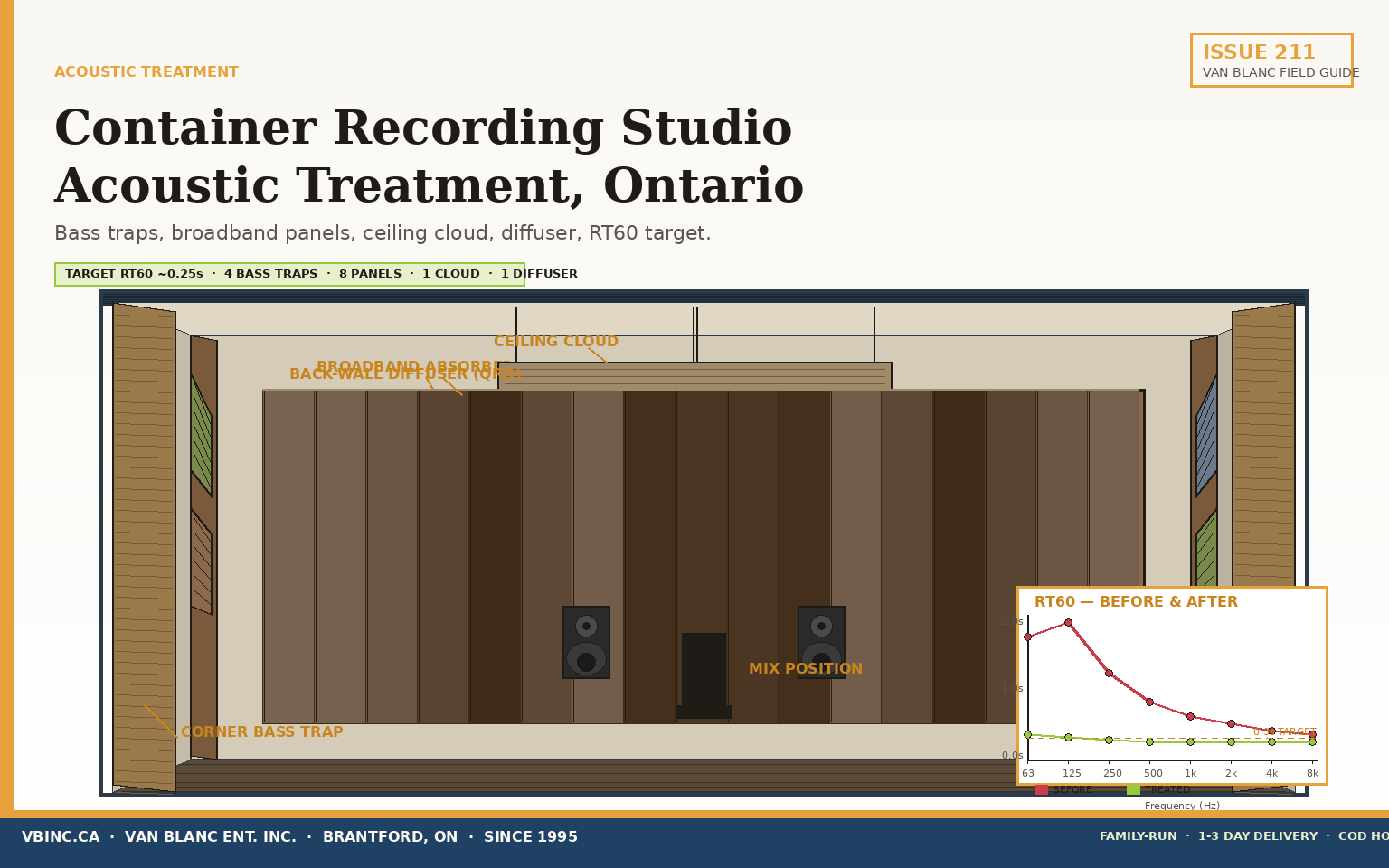
Quick Answer: Acoustic treatment for a container recording studio in Ontario targets an RT60 of roughly 0.25 seconds inside a 20ft or 40ft steel box. Plan four corner bass traps, broadband absorbers at the first reflection points, a ceiling cloud above the mix seat, and a back-wall diffuser. Treatment shapes the sound inside the room, not exterior isolation. Van Blanc is Brantford-based since 1995, family-operated, 4.9 stars across 140+ verified Google reviews, with 1-3 day delivery across Ontario.
In This Guide
- Is Acoustic Treatment the Same as Soundproofing?
- Why Does a Steel Container Ring the Way It Does?
- What RT60 Should You Target Inside a 20ft or 40ft Container?
- Where Do Corner Bass Traps Go in a Container?
- Where Do Broadband Absorbers Go at First Reflection Points?
- Do You Need a Ceiling Cloud Above the Mix Seat?
- Should You Add Diffusion on the Back Wall?
- Which Materials Work: Rockwool, Owens Corning 703, or Foam?
- What Ontario Build Realities Affect Treatment (Humidity, Cold, Vapour)?
- How Do You Measure RT60 Before and After Treatment?
- Frequently Asked Questions
Reading time: about 14 minutes.
Is Acoustic Treatment the Same as Soundproofing?
Acoustic treatment and soundproofing are two different jobs, and container-studio forums confuse them almost every week. Soundproofing keeps outside noise from reaching your microphone. Acoustic treatment shapes the sound that bounces around inside a container recording studio once the doors are closed. They use different materials, and treatment will not solve a soundproofing problem.
Quick Definition: Acoustic Treatment vs Soundproofing
Acoustic treatment is the set of absorbers and diffusers that control reflections, room modes, and reverberation time inside a sealed room. Soundproofing is the mass, decoupling, and air sealing that stops sound from passing through the walls. A container studio needs both, and the two budgets do not overlap.
If you have not yet handled exterior isolation, start there. The interior buildout work that turns a raw steel box into a finished shell comes first, and the parent guide to building a music studio in a shipping container covers dense walls, decoupled inner shells, mass-loaded vinyl, and STC ratings. If exterior isolation is still on your list, the companion walkthrough on STC ratings and blocking outside noise is the place to begin. This article assumes that work is already done.
Treatment is also where most owner-builders save real money. A 20ft or 40ft container with a decoupled inner wall does not need an expensive acoustic consultant to sound recordable. It needs four bass traps, six to eight broadband panels, a ceiling cloud above the mix seat, and one diffuser on the back wall. That kit makes the difference between a steel echo chamber and a room you can actually mix in.
The Functional Split
Soundproofing buys signal-to-noise from outside. Acoustic treatment buys a clean reflection signature inside. Great isolation with zero treatment records a quiet vocal that sounds like a metal locker. Perfect treatment with no isolation records a balanced room tone interrupted by every passing truck. You need both, with different budgets.
Why Does a Steel Container Ring the Way It Does?
A steel container rings because bare metal walls reflect nearly every frequency back at full strength, and two parallel walls trap that energy into standing waves. A standard 20ft shipping container is 8 feet wide, 8 feet 6 inches tall, and 19 feet 10 inches long on the outside. Once you decouple an inner shell and add wall depth, the usable interior drops to roughly 7 feet wide by 7 feet 8 inches tall by 18 feet long. If you want the full size breakdown, the rundown of sea can dimensions and what fits inside each one lays out every model. A 40ft high cube buys another 20 feet of length and a foot more headroom; the width stays the same. That width is the single biggest acoustic challenge in any container build.
Christian LeBlanc, second-generation operator: “I grew up around these boxes, and the first thing I tell a musician at the yard is to stop thinking about the steel and start thinking about the shape. A clean 20ft and a clean 40ft both ring, because both have walls 8 feet apart. The wall you can hear is the one you treat first.”
Parallel walls 7 feet apart produce a fundamental room mode at roughly 81 Hz, with harmonic stacks at 162 Hz and 243 Hz. That math is unforgiving. It piles bass energy at the centre of the room whether you want it to or not. The 40 high cube spreads out length-axis modes, but the width problem stays identical.
Steel adds a second issue. Bare metal walls reflect almost every frequency back at near-original amplitude. The Sound on Sound case study on building a studio inside a shipping container called out the same observation: untreated steel rings, transmits vibration, and produces flutter echo between any two hard parallel surfaces. Once the inner shell is decoupled and drywalled, surface ring goes away. What is left is geometry, and geometry is what treatment handles.
What Ontario Container Studios Sound Like Before Treatment
Buyers come to our Brantford yard regularly to walk a 20ft and a 40ft side by side before they commit. The first thing most musicians notice is the slap-back when you clap your hands at the centre of the box. That clap is parallel-wall flutter echo plus the length-axis mode around 28 Hz. You hear the problem before you start building. Do the clap test in any container, on any lot. It is the cheapest acoustic diagnostic in the industry.
What RT60 Should You Target Inside a 20ft or 40ft Container?
RT60 is the time it takes a sound to decay by 60 decibels after the source stops, and inside a container recording studio the target is short. For recording rooms under 50 cubic metres of volume, the recommended figure is roughly 0.3 seconds. A treated 20ft container has roughly 23 cubic metres of usable interior; a treated 40ft sits around 47. Both fall inside the small-room bracket, so both want decay times in the 0.20 to 0.35 second range depending on use.
Practical container targets:
| Container | Interior volume after build | RT60 target | What it sounds like |
|---|---|---|---|
| 20ft tracking booth (vocals) | ~23 m³ | 0.20-0.25 s | Dry, intimate, no audible tail |
| 20ft mix room (no tracking) | ~23 m³ | 0.25-0.30 s | Controlled with slight life |
| 40ft tracking + mix combined | ~47 m³ | 0.30 s | Balanced, instruments breathe |
| 40ft HC live room (drums/amps) | ~52 m³ | 0.35-0.45 s | Slightly longer for natural decay |
Numbers matter more at the low end than the high. A flat 0.3 second decay from 200 Hz up is achievable with broadband panels alone. Trouble starts below 200 Hz, where modal energy produces RT60 spikes reaching 1.5 to 2.0 seconds at specific frequencies. Container builders routinely report two-second decay times at 80 Hz and 160 Hz even with six absorption panels hung. The reason is always the same: not enough corner bass trapping.
Where Do Corner Bass Traps Go in a Container?
Corner bass traps go in all four vertical corners of a container, floor to ceiling, because low frequencies build up at room boundaries. Two boundaries at a corner double that buildup; three boundaries at a tri-corner triple it. Every credible small-room treatment plan starts with corner bass traps, not wall panels.
A container has four vertical corners. Fill each floor-to-ceiling with a triangular or straddled rectangular absorber at least 4 inches deep from the apex. Rigid mineral wool or rigid fiberglass (Rockwool Safe’n’Sound or Owens Corning 703 at 4 to 6 inch thickness) work well. Stack two 2-inch panels if 4-inch stock is not locally available.
The depth-versus-frequency rule: a porous absorber needs to be roughly a quarter of the target wavelength deep to absorb that frequency. The wavelength of 80 Hz is about 4.3 metres; a quarter is 1.07 metres. You cannot put a metre of absorber across a container corner. What you can do is straddle the corner with the absorber 8 to 12 inches away from the apex, leaving an air gap behind, which extends effective depth without consuming a metre of floor space. This is the single most effective acoustic intervention in any container studio.
Bass Trap Build Pattern for a 20ft Container
- Four vertical corner traps: 6-inch deep Rockwool or rigid fiberglass, straddled 10 inches from the corner apex, floor to ceiling.
- Two ceiling-wall tri-corner traps: across the short end walls, where the ceiling meets the wall, 4-inch panels at 45 degrees.
- One floor-corner trap behind the mix seat: often forgotten, but the reflection that travels behind the listener and bounces off the back wall and the floor stacks badly.
- Cloth wrap: burlap, breathable cotton, or proper acoustic fabric. Anything that lets air pass through without trapping moisture against the mineral wool.
Where Do Broadband Absorbers Go at First Reflection Points?
Broadband absorbers go at the first reflection points, the sound paths from speaker or instrument that hit a wall or ceiling once before reaching your ears. Once corner bass is under control inside the container, these reflections are the next problem. They arrive a few milliseconds after the direct sound and smear the stereo image. In a container they are worse because parallel walls produce flutter echo on top of the first arrivals.
The mirror trick locates them quickly. Sit in the mix position. Have a friend slide a small mirror flat against each side wall. Anywhere you can see your speaker reflected is a first-reflection point. Mark it with painter’s tape. Repeat for ceiling and the wall behind the speakers. A typical 20ft layout produces six to eight marked spots.
Each marked spot gets a 2-inch broadband absorber, typically 24 by 48 inches, mounted on the wall or with a 1 to 2 inch air gap behind for extended low-mid absorption. Foam panels work above 500 Hz but do almost nothing below that, which is why a foam-only treatment plan leaves a thick low-mid problem at 200 to 400 Hz that the panels were never going to fix.
The Side-Panel Honesty Check
If the side-wall panels are working, your stereo image should snap into focus when you sit in the mix seat. Pull the panels off and listen. The image should smear and the centre vocal should pull toward whichever side has more reflection. Put the panels back and the image returns. If pulling them off makes no audible difference, the panels are either too thin, in the wrong spot, or the bass problem is so dominant it is masking everything above it. Treat the corners first.
Do You Need a Ceiling Cloud Above the Mix Seat?
Yes, a container recording studio needs a ceiling cloud above the mix seat, because ceiling reflections are easy to forget and the ceiling is the hardest first-reflection surface to ignore. In a container the ceiling is parallel to the floor at roughly 7 feet 8 inches after the inner build. That gives a vertical-axis room mode around 75 Hz and a vertical flutter echo path bouncing straight up and down through the mix position.
A ceiling cloud is a broadband absorber suspended above the listening position, hung 4 to 8 inches below the ceiling to create an air gap that extends low-frequency absorption. A 4-foot by 4-foot cloud at 4-inch thickness, hung with eye bolts and aircraft cable, covers most ceiling first-reflection paths. A 40ft length lets you hang two clouds: one above mix seat and one above the tracking position.
Placement matters as much as size. Centre the cloud above the engineer’s head, not the console. The reflection point you are absorbing bounces off the ceiling between monitors and ears, forward of where you sit by roughly the same distance the monitors are in front of you. Measure that geometry and place accordingly.
Should You Add Diffusion on the Back Wall?
You should add diffusion on the back wall of a container studio whenever the room is long enough for it to work, because pure absorption everywhere kills the room. If you put absorption on every surface, the room dies. Decay gets so short that vocals sound unnaturally close, drums lose tail, and the space feels oppressive. The GIK Acoustics knowledge base calls this the “dead room” trap, and it is what container builders fall into when they put 12 panels in a 20ft and call it done.
The fix is back-wall diffusion. A diffuser scatters reflections in many directions instead of absorbing them, preserving room liveliness without piling up flutter. Standard small-room advice is a one-dimensional quadratic residue diffuser (QRD) or a poly-cylindrical diffuser on the back wall, opposite the monitors. The reflection returns scattered rather than focused.
One caveat: diffusers need distance to work. Inside an 18-foot tracking length, a QRD on the back wall provides roughly 12 feet of return path, which is enough. In a 20ft where the back wall is only 6 feet behind the mix seat, the benefit drops and a couple of broadband panels can substitute. The 40ft gives diffusion the room it needs.
Acoustic Treatment Ratio for a Container
Roughly 50 to 60 percent absorption, 10 to 20 percent diffusion, and 20 to 40 percent untreated reflective surface is the working balance for a treated container studio. The exact ratio shifts with use case. A vocal-only booth pushes toward 70 percent absorption with no diffusion. A live drum room in a 40ft pushes toward 40 percent absorption with two diffusers and more reflective wall area. The clap test plus a measured RT60 reading tells you which way to adjust.
Which Materials Work: Rockwool, Owens Corning 703, or Foam?
The materials that work for container treatment are dense mineral wool and rigid fiberglass, not acoustic foam. Foam is the material beginners reach for first because it is light, easy to glue to a wall, and looks like what studios use on TV. The problem is that 1-inch and 2-inch foam barely absorbs below 500 Hz. In a container, where the worst problems sit between 60 and 300 Hz, foam alone is a near-total miss.
Mineral wool and rigid fiberglass do the actual work:
- Rockwool Safe’n’Sound: mineral wool batt, sold at Home Depot and Lowes in Ontario, around 3 lb per cubic foot density. Works well stacked 2x for 6-inch corner traps.
- Owens Corning 703: rigid fiberglass board, 6 lb per cubic foot, 2-inch and 4-inch thicknesses through specialty suppliers. Higher absorption coefficient than Rockwool but more expensive and harder to source.
For most Ontario builds, Rockwool is the practical choice. Locally available, roughly half the cost, performs within a few percentage points of OC 703 across the audible spectrum.
Fabric matters too. Mineral wool fibres can irritate skin and lungs if disturbed. Wrap every panel in acoustic-grade fabric (Guilford of Maine, FR701) or breathable burlap. If you can blow through it, the panel absorbs through it. If you cannot, the panel becomes a reflector.
What Ontario Build Realities Affect Treatment (Humidity, Cold, Vapour)?
The Ontario build realities that affect container treatment are humidity, cold, and vapour, a moisture problem the California build guides do not mention. Steel walls swing 50 degrees Celsius between February and August. Warm interior air meets cold steel and condenses on the surface, behind the wall finish, inside the insulation cavity. Mineral wool that gets wet loses density, loses absorption, and grows mould.
The fix is vapour-barrier sequencing during the original build: steel exterior, insulation inside, 6 mil poly vapour barrier on the warm side of the insulation between insulation and interior drywall. That barrier blocks interior humidity from reaching cold steel. If the original build skipped this step, no acoustic panel will stay dry through an Ontario winter cycle.
Heating is the other Ontario reality. Mineral wool and rigid fiberglass perform consistently across temperature ranges, which is one reason they outperform foam in seasonal builds. Foam stiffness changes with cold. Mineral wool stays mineral wool at minus 20 and at plus 35.
Why Brantford Buyers Build Studios in Steel
Music producers across Hamilton, Kitchener-Waterloo, London, and the GTA buy from our 4 Brantford yards because a container studio costs roughly half a stick-built backyard studio of comparable interior dimensions. The catch is the acoustic problem steel adds. Buyers who walk our yard can clap inside a 20ft and a 40ft and hear what they are getting into. When you are ready to pick a shell for the build, you can see which 20ft and 40ft units we have ready to deliver and reserve the one you walked. Worth the drive for unbeatable quality and family customer service with 30 years of experience. Every quote comes with a real lead time, not a hopeful one.
How Do You Measure RT60 Before and After Treatment?
You measure RT60 with free software and an inexpensive measurement microphone, because you cannot tune a room you cannot measure. Free Room EQ Wizard (REW) is the small-studio standard. It pairs with an inexpensive USB measurement microphone (Dayton EMM-6, MiniDSP UMIK-1) and outputs an RT60 plot per frequency band plus modal frequency response.
The measurement workflow:
- Set up monitors at the mix position. Place the microphone where the engineer’s head will be when seated.
- Run REW’s sweep tone through each monitor and then both together for stereo response.
- Look at the RT60 graph. Anything above 0.3 seconds in the 100 to 500 Hz range needs more corner bass trapping.
- Look at the frequency response. Sharp dips and peaks below 300 Hz mark the modal frequencies. These are where bass trapping does its work.
- Treat, measure, treat, measure. Three rounds typically land a container studio in the 0.20-0.30 second target range.
Measurement is the only honest feedback loop. Ear judgement is unreliable below 200 Hz; the microphone is not.
Paul LeBlanc, owner: “Music guys come to the yard with a treatment plan they downloaded off a forum. I tell them the same thing every time: walk inside, clap your hands, listen for the slap. The container will tell you what it needs before you have spent a dollar on panels. The job is not magic. It is geometry and mineral wool.”
Frequently Asked Questions
What RT60 should I target inside a 20ft container studio?
For vocal tracking or mixing inside a 20ft container, target an RT60 of roughly 0.20 to 0.30 seconds across the 100 Hz to 4 kHz band. Smaller volumes call for shorter decay times to avoid muddy bass buildup; the 0.3 second figure comes from the recommended target for recording rooms under 50 cubic metres.
Do I need bass traps in all four corners of a container studio?
Yes. Every container has four vertical corners and the low-frequency buildup at each one is significant. Fill all four corners with at least 4-inch mineral wool or rigid fiberglass, ideally straddled 8 to 12 inches off the corner apex to extend low-frequency absorption through the air gap. Skipping any corner leaves a measurable bass mode.
How thick does mineral wool need to be for container treatment?
For broadband absorption down to 100 Hz, mineral wool panels should be at least 4 inches thick. Wall panels at first reflection points can be 2 inches, but corner bass traps should be 4 to 6 inches and ideally straddled with an air gap behind. Thicker is better at low frequencies because porous absorbers need depth proportional to wavelength.
Should I use diffusion or just absorption in a 40ft container?
A 40ft container has enough length for back-wall diffusion to work. Use a quadratic residue diffuser or a poly-cylindrical diffuser opposite the monitors, with broadband absorption on side walls and corners. In a 20ft, the back wall is too close for diffusion to have time to scatter; use broadband panels there instead.
What is the difference between acoustic treatment and soundproofing?
Soundproofing blocks sound from entering or leaving the room, using mass, decoupling, and air seals on the walls, ceiling, and door. Acoustic treatment shapes the sound inside the room, using absorbers and diffusers to control reflections, modes, and reverberation time. Both are required for a usable container studio.
Will carpet, blankets, or paint count as acoustic treatment?
Carpet absorbs high frequencies on the floor but does almost nothing below 500 Hz, where container problems live. Blankets help a small amount at mid frequencies. Acoustic paint is mostly marketing. Real treatment needs porous absorbers at least 2 inches thick made of mineral wool or rigid fiberglass, framed and wrapped properly.
Can I record acoustic guitar in an untreated container?
Not well. An untreated container produces slap echo and a thick low-mid reflection signature that smears the guitar’s body resonance and harmonic content. Two to four broadband panels at first reflection points plus a single corner bass trap is the minimum treatment for usable acoustic recording. Below that, the recording will sound boxy.
How many broadband absorbers do I need for a 20ft vocal booth?
A 20ft vocal-only tracking booth typically needs four corner bass traps (4-6 inch mineral wool), six to eight broadband side-wall panels (2-inch mineral wool at first reflection points), and one ceiling cloud above the recording position. That kit drives RT60 below 0.25 seconds and removes the audible slap echo entirely.
Where do first reflection points go in a container studio?
Mirror trick: sit in the recording or mix position, slide a mirror flat against each wall and the ceiling, and mark any spot where you can see your speaker or microphone reflected. Typically six to eight spots per 20ft: two on each side wall, one or two on the ceiling, and one or two on the front wall behind the monitors. Place panels at every marked spot.
Does the same treatment plan work for a mixing room and a tracking room?
Roughly, yes, but priorities shift. A mixing room benefits from tighter RT60 (0.20-0.25 s) and more diffusion at the back wall to preserve stereo imaging. A tracking room wants slightly more liveliness (0.30-0.35 s) so instruments breathe naturally. Both rooms need the same corner bass traps, but the absorption-to-diffusion ratio shifts toward diffusion on the tracking side.
Sources
- International Organization for Standardization. (2008). ISO 3382-2:2008 Acoustics – Measurement of room acoustic parameters – Part 2: Reverberation time in ordinary rooms. iso.org/standard/36201.html
- Sound on Sound. The Shipping Container Studio. soundonsound.com/techniques/shipping-container-studio
- Acoustical Surfaces. How to Measure RT60 and Control Reverberation Time in Any Space. acousticalsurfaces.com/blog/acoustics-education/measure-rt60
- GIK Acoustics. How Do Bass Traps Work. gikacoustics.com/blogs/knowledge-base/how-bass-traps-work
- Room EQ Wizard. RT60 Graph Help Documentation. roomeqwizard.com/help/help_en-GB/html/graph_rt60.html
Reach Van Blanc in Brantford
We have been supplying shipping containers across Ontario since 1995. Our warehouse is at 90 Morton Avenue E in Brantford, and we deliver right across the province on a cash-on-delivery basis. No surprise fees, no chase-the-paperwork.
Van Blanc Ent. Inc., 90 Morton Ave E Unit 1B, Brantford, ON N3R 7J7. Call +1 888-509-6658.
If you are planning a studio build and want to clap your hands inside a 20ft and a 40ft, drive to our Brantford yard. Walking the box is the cheapest acoustic test you can run.
Related Reading
- How to block outside noise and hit a usable STC rating
- The full Ontario container studio build sequence, start to finish
- What to know before customizing a steel box
- Interior dimensions for every sea can size
- Compare the container models we keep on the lot
Once you have mapped out where the corner traps, broadband panels, ceiling cloud, and back-wall diffuser fit together, the next step is walking a real bin. Paul or Christian will meet you at the Brantford yard and run the clap test inside whichever size you are considering. The geometry is the same in a 20ft and a 40ft; only the panel count changes.
Ready to price your container?
Tell us the size and your postal code and we’ll send back an honest, all-in number, container, delivery, and placement, usually within 1-3 days. No pressure, no mystery fees.
Family-run in Brantford since 1995 · 200+ containers in stock · 4.9★ across 140+ Google reviews · every box graded by a person, walk it before it lands.