
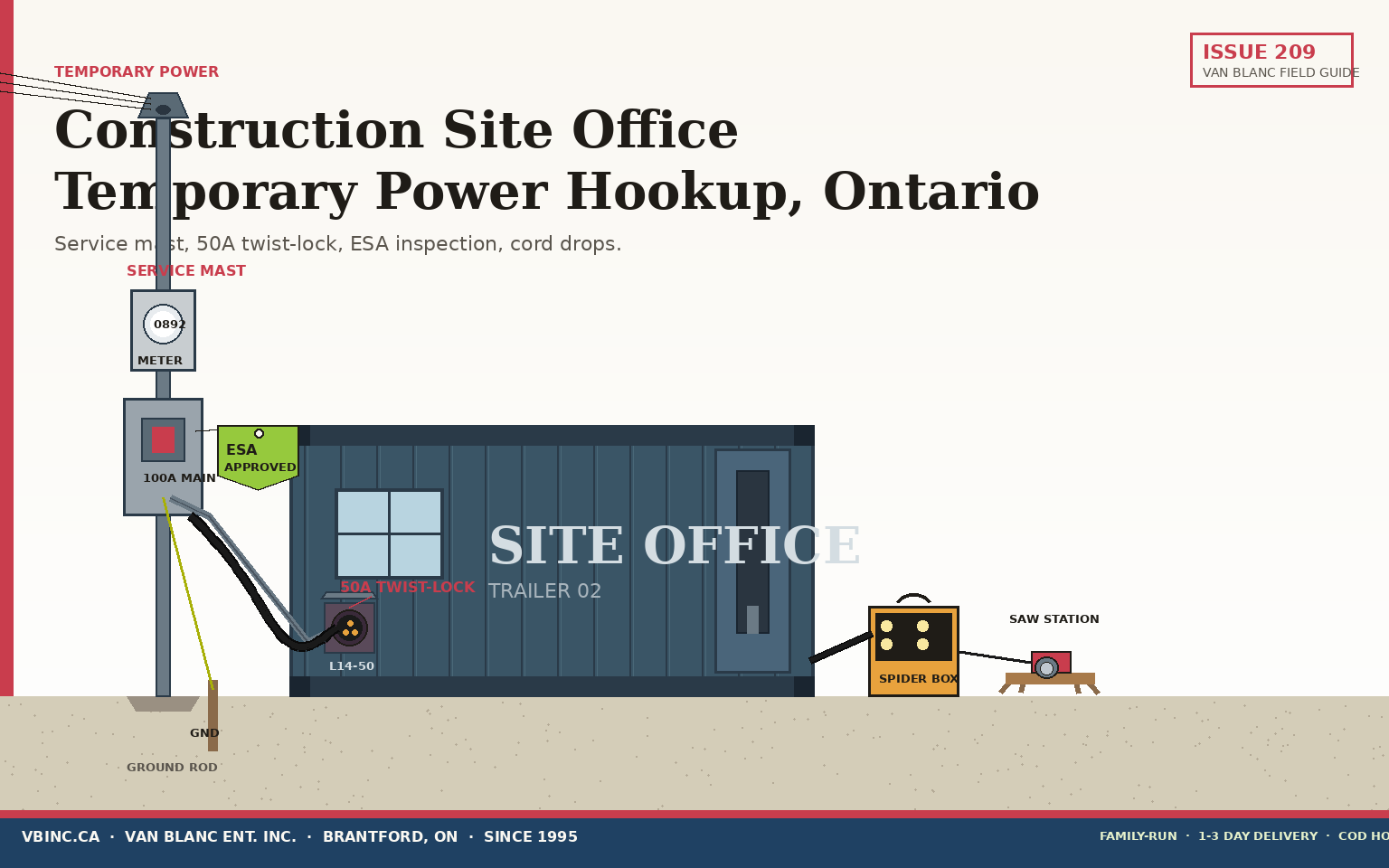
Quick Answer: A construction site office temporary power hookup in Ontario starts with a 100A service mast wired to a meter base, runs through an ESA-notified main panel, and feeds the container office build via a 50A twist-lock receptacle. The box itself we deliver in 1-3 days from our 4 Brantford yards. Pick up the phone and we will talk through the right setup in 5 minutes, Christian or Paul, 519-754-6844.
In This Guide
- Why the jobsite power hookup is the first real money decision on a container office
- Picking the right service size, 60A through 200A, for the actual tool load
- Anatomy of a compliant temporary service mast on a container office
- The 50A twist-lock receptacle, cord drop, and inlet pattern that crews actually use
- ESA notification, inspection, and the green tag that keeps work going
- Grid hookup vs portable generator vs hybrid for a container site office
- Cord drops, spider boxes, and saw stations downstream of the container
- Weatherproofing the hookup for Ontario winter and shoulder seasons
- Paul on the call we get every fall from a frozen-out site
- Frequently asked questions
Reading time: about 13 minutes.
Why is the jobsite power hookup the first real money decision on a container office?
A construction site office temporary power hookup is the licensed-electrician install that brings grid power to a jobsite trailer. In Ontario it runs from a service mast and meter base, through an ESA-notified main panel, out to a 50A twist-lock drop that feeds the container office. Sizing it to the real tool load is the decision that sets the cost.
Christian LeBlanc, second-generation operator: “Half the calls we get from Ontario site supers, the container has already landed and nobody scheduled the electrician. We tell them on the phone, book the licensed contractor the same week you book the box. The steel shows up clean, the inlet wall is ready, and the trades plug in on day one instead of week two.”
Most general contractors order the container office before they order the power. By the time the tilt-deck rolls onto site, the trades are already asking where to plug in the kettle, the laptop, the heater, and the saw. If you have not lined up the temporary service ahead of the drop, the first week of the project becomes a daisy chain of extension cords running from a neighbour’s garage or a fuel-thirsty 5-kilowatt generator that wakes the whole subdivision at 6:30 a.m.
The fix is boring. Order the container, and at the same time, schedule a licensed electrical contractor to design and install a temporary service. In Ontario that means a properly anchored service mast, a meter base, a main panel sized to the site load, an ESA notification filed before the panel goes live, and a 50A twist-lock outlet drop that lands inside or beside the container so the trailer’s interior panel can be fed from one cord.
This guide walks the hookup specifically for a container site office. The geometry of a Corten steel box changes the bonding picture, the cord-management picture, and the weather-sealing picture. If you are still scoping the trailer itself, the longer walkthrough on building a container jobsite office covers layout, doors, and windows; this page picks up where that one leaves off, at the power. Both are built around 30 years of delivering containers into active Ontario construction sites, so they account for the parts the generic temp-power guides leave out. The office conversions themselves, including the exterior inlet wall, come out of our yard conversion program in Brantford.
What size electrical service does a container site office need?
The electrical service size for a container site office runs from 60A for a single trailer up to 200A or more for a multi-trade commercial site. Service size is the first decision and the one most crews get slightly wrong. Too small and the main breaker trips every time the table saw and the kettle run together. Too large and you have paid for a 200A service when 100A would have carried the load with margin. The right number comes from a load calculation, not from a guess.
Typical jobsite load profiles, container office included
A bare container office with HVAC, lights, a laptop, a kettle, and a small heater pulls about 25 to 40 amps continuous. Add a table saw, a chop saw, an air compressor, and a battery-charging cart, and you are easily into 60 to 80 amps. Add a welder or a concrete vibrator, and you are pushing 100A. A multi-trade site with two saws, two compressors, hoists, and lighting trees needs 200A or more. ESA expects a real load calc, not a sticker on the panel.
For a small residential infill build with a single container office and three or four trades, 60A or 100A is usually plenty. For commercial projects or roads/bridges contracts with welders, 200A is the default. The cost spread between tiers is small enough that overshooting by one tier is a fine insurance policy on a 12-month build.
| Service size | Typical site profile | Continuous load it comfortably carries |
|---|---|---|
| 60A | Single trailer, light tools, no welder, short build | HVAC, lights, laptop, kettle, small heater (about 25 to 40 amps) |
| 100A | Container office plus 2-3 tool stations, residential build | Office load plus a saw, compressor, and charging cart (60 to 80 amps) |
| 200A | Commercial site, multiple containers, welders, hoists | Multi-trade draw with welder and two saw stations running together |
| 400A | Major commercial or industrial site, tower crane adjacent | Heavy simultaneous load across several containers and a crane circuit |
The installed cost covers the mast, meter base, main panel, grounding electrode system, and temporary feed to the container. It does not include the utility’s connection charge (billed separately) or the container office itself. What a steel box costs before the electrician ever shows up is its own question, and our breakdown of what drives the price of a container in Canada lays out the size, grade, and delivery variables. When you are ready to pick a unit, the containers we have on the yard for sale are listed by size and grade.
What goes into a compliant temporary service mast on a container office?
The service mast is the visible vertical pipe with the cap on top and the meter pan halfway down. On a permanent house it is bolted to the wall. On a temporary jobsite, it is anchored to a sturdy stand, a wall-mount bracket attached to the container, or a freestanding pressure-treated post buried below frost line. The Ontario Electrical Safety Code (OESC) governs the height of the weatherhead, the depth of the service entrance conductor, the grounding, and the bonding back to the steel container body.
Components of a temporary service for a container office
- Weatherhead: The hooded fitting on top of the mast that lets the utility drop run in without taking water.
- Service mast: Schedule 80 PVC or rigid steel, sized to the service amperage (typically 2-inch for 100A, 3-inch for 200A).
- Meter base: The boxy enclosure where the utility’s meter snaps in. Must be approved by your local utility.
- Main breaker: The disconnect that everything downstream runs through. Sized to the service.
- Grounding electrode system: Two ground rods, 3 metres apart, or a properly bonded plate. The steel container body is bonded back to this system, not used as a substitute.
- Distribution panel: Inside the container office or weatherproof outdoor enclosure. Breakers for the 50A twist-lock outlet, interior receptacles, lights, and HVAC.
- 50A twist-lock receptacle: The outlet that everything portable downstream plugs into. NEMA L14-50 is the common spec.
On a container office, the mast is most often mounted to a freestanding stand placed next to the container, with a short conduit run feeding the panel inside the trailer through a code-compliant penetration. Some crews wall-mount the mast directly to the container, which is fine if the steel is reinforced and the penetration is properly bonded. On projects where the container will move between phases, we steer crews toward the freestanding stand, because demobilizing a stand is faster than unhooking a wall-mount.
The 50A twist-lock receptacle, cord drop, and inlet pattern that crews actually use
The 50A twist-lock is the universal handshake between a permanent temporary service and the portable distribution that lives inside the container office. The receptacle on the service end is a NEMA L14-50R. The cord is a 6/3 SOOW with male twist-lock on the supply end and either a hardwired termination or an L14-50P inlet on the container end. From there, the trailer’s interior panel feeds the receptacles, lights, baseboard heater, and the spider box drops to the saw and compressor stations.
One cord, not three
The temptation on a busy site is to run three or four extension cords from the service to the container, the saw station, and the lighting tree separately. Run one 50A feed to the container and use the container’s interior panel as the distribution hub. Less rope across the site, fewer trip hazards, fewer breaker trips. The cord drop is the choke point of the whole hookup design, so size it once and right.
The 6/3 SOOW cord is rated for outdoor jobsite use, takes mechanical abuse, and is heavy enough to keep voltage drop within the OESC’s 3 percent target over a typical 15-metre run. For longer runs, jump to 4/3 SOOW. If the cord crosses a vehicle path, run it under a steel cable protector or, better, trench a short section of buried conduit. The most common failure mode on a 50A twist-lock drop is not the cord itself, it is the connection point where someone yanks the cord coiling it back up at the end of the day. Cable strain reliefs and a wall-mounted L14-50 inlet on the container exterior fix that.
Do you need ESA notification for a container office power hookup in Ontario?
The Ontario Electrical Safety Authority (ESA) regulates every electrical installation in Ontario, including temporary construction service. Before any utility will hang a meter on a temporary mast, the contractor must file a notification of work with ESA, complete the installation to OESC standards, and pass a service inspection. The inspector signs off, the local distribution company is notified, and the meter goes in. Without the green tag, the meter does not get hung, and the site runs on the noisy generator.
The notification of work is filed online by the licensed electrical contractor (LEC) doing the install. The permit and inspection fee varies by service size and ESA region, and the licensed contractor typically carries it as a separate line item on the quote. The inspection itself happens after the mast, meter base, panel, and grounding electrode system are in place but before energization. The inspector checks bonding, grounding, conductor sizing, breaker sizing, weatherproofing, and the load calc supporting the breaker selection.
What the inspector looks at on a container office service
Bonding of the steel container body back to the grounding electrode system, mechanical protection of the service entrance conductors where they enter the panel, weather sealing at the mast penetration, proper labelling on the breakers, accessible disconnect within reach of the container door, and adequate working space in front of the panel (typically 1 metre of clear floor space, no stored materials in front of the panel). The container’s interior panel is usually mounted on a plywood backer attached to the container wall, with the disconnect within easy reach.
The temporary service permit is typically valid for the project duration, with the expectation that the installation is decommissioned at the end. Do not run a temporary permit indefinitely on what is functionally a permanent installation, ESA will catch that on a follow-up. If the container becomes permanent on site, the path usually involves the kind of permanent modifications buyers convert offices into plus a permanent service application filed in place of the temporary one.
Should you run a container site office on grid power or a generator?
The grid-vs-generator decision is almost always answered by the project’s duration and the site’s distance from utility infrastructure. A 12-month commercial build with a utility pole at the property line should always go to grid power, the math is unambiguous. A 3-week roadside paving job that moves every four days is generator country.
| Power option | Best for | What drives the running cost |
|---|---|---|
| Grid temporary service | Builds 4+ weeks, utility infrastructure within 100m | Metered consumption plus the utility’s temporary service fees |
| Portable diesel generator (rental) | Short builds, remote sites, fast mobilization | Rental term, diesel burn, and scheduled generator servicing |
| Hybrid (grid + standby generator) | Sites with reliability concerns, critical loads | Grid consumption plus standby unit rental and fuel for outage runtime |
| Solar-plus-battery (specialty) | Off-grid remote sites, environmental sensitivity | System rental and sizing of the battery bank to the daily load |
For a typical Ontario builder running a 6 to 12 month container-office project on a serviceable lot, grid wins by a wide margin. The one-time hookup cost amortizes over the build, the running cost is metered consumption only, and the noise and emissions on site drop to zero. For a road, bridge, or rural infrastructure project where the container office sits in a temporary work zone with no utility access, a 25 to 60 kW diesel generator is the standard call.
The hybrid setup, grid as primary with a small standby generator for outages, is increasingly popular on commercial sites where a power outage during a concrete pour would be expensive. The standby handles critical loads only (office HVAC, security cameras, IT cabinet) and stays off when grid power is healthy.
Cord drops, spider boxes, and saw stations downstream of the container
The container office is the hub. Everything else on the site, the saw station, the lighting tree, the welder receptacle, the trailer-mounted compressor, the EV charging point for the foreman’s truck, runs from drops downstream of the container’s interior panel. The standard tool for that distribution is a spider box, a portable enclosure with one 50A or 100A feed in and four to eight 20A or 30A receptacles out.
Site office plus saw station plus lighting tree, 100A service
A 100A temporary service to a 20-foot container office, with a 50A twist-lock drop to the container, feeds the trailer’s interior panel. From the interior panel, a 30A feeder runs out to a spider box parked beside the saw station. The spider box distributes to the table saw, the chop saw, the compressor, and a small auxiliary heater for the saw operator. A separate 20A circuit from the interior panel runs to a daisy-chained lighting tree along the building perimeter. Total simultaneous draw, about 65 amps, well within the 100A main.
Spider boxes are rented from your local power-supply yard or purchased outright. They include GFCI protection on every receptacle (mandatory on Ontario construction sites since the early 2010s) and integrated cord reels. A site with two saw stations, a welder bay, a compressor, and trailer lighting typically uses two spider boxes downstream of the container, each fed from its own breaker.
Weatherproofing the hookup for Ontario winter and shoulder seasons
Ontario weather is the variable that decides whether the temporary service holds up for the full project or starts tripping on the first cold snap. The cord at the 50A twist-lock takes the biggest beating, ice loads, freeze-thaw cycles on the cord jacket, and the inevitable forklift swing that brushes the cord while pulling material out of the container. The container office’s exterior inlet (the L14-50 receptacle on the wall) is where weather usually wins.
Three weatherproofing details that prevent winter call-backs
Mount the exterior inlet under a small steel rain hood or recessed into a weatherproof box with a hinged cover. Use a cord with cold-weather-rated jacket (SOOW or SJEOW marked for low-temperature use, not the cheap PVC cord that goes brittle at -20°C). And inspect the strain relief at the inlet weekly during winter, ice ingress at the cord clamp is the single most common cause of a tripped breaker in February.
Grounding rods can frost-heave in shallow soil. Drive them at least 1.5 metres deep and confirm the bonding conductor has slack. Pre-winter, walk the service with a clamp meter and confirm balanced loads across the legs, an unbalanced 100A service is one welder away from a tripped main in a cold snap.
Paul on the call we get every fall from a frozen-out site
Paul LeBlanc, owner: “Every November we get the call. Site office froze last night, the heater tripped the breaker, the foreman drove to Tim’s at 6 a.m. because the trailer was 4 degrees inside. Usually the breaker was sized right, it was the cord at the inlet that iced up. The hookup is not the part you build once and walk away from. It is the part you walk past every Monday morning for ten months.”
The container office hookup is one of those parts of the job where doing it right at the start saves a year of small frustrations. Get it sized properly, get it inspected, and weatherproof the cord drop. The container does the rest.
Frequently asked questions
Do I need an ESA permit for a temporary power hookup to a container office in Ontario?
Yes. All temporary electrical installations in Ontario require a notification of work filed with the Electrical Safety Authority before energization. The licensed electrical contractor doing the install files the notification, completes the work to Ontario Electrical Safety Code standards, and the ESA inspector signs off before the local utility hangs the meter.
How much does a temporary power hookup cost for a container site office?
A 100A temporary service for a container office in Ontario covers the mast, meter base, main panel, grounding system, and the 50A twist-lock drop to the container, so the quote tracks the service size, the grounding work, and the run length to the panel. The utility’s own connection charge is billed separately, and the licensed contractor itemizes both on the estimate.
What service size do I need for a container office plus tool stations?
For a single container office with HVAC, lights, a kettle, and a small toolset, 60A is usually adequate. Add saws, compressors, and battery charging carts, and 100A is the right pick. For commercial sites with welders, hoists, and multiple containers, plan on 200A or more. A licensed electrical contractor performs the load calculation.
Can I run the container office on a generator instead of a grid hookup?
Yes, especially on remote sites or builds shorter than four weeks. A 25 to 60 kW diesel generator handles a single container office plus tool stations, but the monthly fuel burn and scheduled servicing typically run well above the grid alternative. For projects longer than a month with utility access at the property line, grid wins.
What is a 50A twist-lock receptacle and why is it the standard for container offices?
A 50A twist-lock (NEMA L14-50) is the heavy-duty outlet used to feed a portable trailer or container office from a temporary service panel. The twist-lock design prevents accidental disconnection from cord tug or vibration, and the 50A rating covers a fully loaded container office with HVAC, tool stations, and lighting drops downstream.
How is the steel container office bonded to the temporary service grounding system?
The steel body of the container is bonded back to the grounding electrode system at the temporary service using a bonding conductor sized per OESC Table 16. The container is bonded to the ground rods, not treated as a substitute for the grounding electrode itself. Bonding is checked during the ESA inspection before energization.
Can the temporary service mast be wall-mounted directly to the container office?
Yes, if the container wall is appropriately reinforced and the penetration is sealed and bonded. Most container office hookups in Ontario use a freestanding service stand next to the container instead, which is easier to demobilize at the end of the project and lets the container move between phases without disturbing the service.
What happens if my temporary service trips during winter on a container office?
The most common cause is ice ingress at the 50A cord inlet or an unbalanced load when a high-draw heater kicks on. Pre-winter, switch to a cold-weather-rated cord, mount the inlet under a rain hood, and verify load balance across the panel legs. A weekly walk-around during freeze-thaw season catches most issues before they trip the main.
Does Van Blanc handle the electrical install or just the container itself?
Van Blanc delivers the container office. The electrical install (mast, meter, panel, ESA notification, inspection) is handled by your licensed electrical contractor, who knows the local utility and the Ontario Electrical Safety Code. We can recommend the kind of penetration and exterior inlet pattern the electrician should plan for, and we coordinate the delivery timing so the container lands before the electrician’s first site visit.
How long does the ESA inspection process take for a temporary service?
From notification of work to green tag is typically 1-3 days in Ontario, longer in rural areas or during peak summer construction. Schedule the inspection as soon as the mast, meter base, and panel are installed, well before you need the meter hung. A practical move is to book the inspection for the same day the licensed electrical contractor arrives on site to set the mast.
The yard side of the electrical, rough-in and panel provisions, happens during the office build before it ships.
Ready to price your container?
Tell us the size and your postal code and we’ll send back an honest, all-in number, container, delivery, and placement, usually within 1-3 days. No pressure, no mystery fees.
Family-run in Brantford since 1995 · 200+ containers in stock · 4.9★ across 140+ Google reviews · every box graded by a person, walk it before it lands.
Sources
- Electrical Safety Authority. (2025). Notifications and Inspections, Ontario Electrical Safety Code Compliance. esasafe.com/compliance/what-you-need-to-know
- Electrical Safety Authority. (2025). Ontario Electrical Safety Code, 28th Edition, Temporary and Construction Wiring. esasafe.com/electrical-contractors/oesc
- Toronto Hydro. (2025). Temporary Service Installation Request, Process and Timelines. torontohydro.com/for-home/service-connections/temporary-service-installation-request
- International Organization for Standardization. (2022). ISO 6346:2022, Freight Containers, Coding, Identification and Marking. iso.org/standard/82754.html
- FutureGen Consulting. (2025). Temporary Power Design in Ontario, Construction Site Engineering Practice. futuregenconsulting.ca/temporary-power-design
Reach Van Blanc in Brantford
We have been supplying shipping containers across Ontario since 1995. Our warehouse is at 90 Morton Avenue E in Brantford, and we deliver right across the province on a cash-on-delivery basis. No surprise fees, no chase-the-paperwork.
Van Blanc Ent. Inc. 90 Morton Ave E Unit 1B, Brantford, ON N3R 7J7 +1 888-509-6658
If your container site office is going up this season and you want a hookup-ready container that lands clean with the right exterior wall for the inlet, call Christian or Paul, or come walk the yard. We can show you which units have the prep work already done, the ones that save the electrician a half day of cutting and sealing on site. For the broader trailer build, the full container jobsite office guide covers everything upstream of the power.
Related Reading
- Mobile Construction Site Office Rental Cost Ontario
- Container Construction Site Office Ontario: 2026 Job Site Build and Rental Guide
- Shipping Container Cost in Canada, Real 2026 Ranges
- Customizing Your Shipping Container, Ontario Modifications
- Container Workshop Lighting and Power, Ontario Setup Guide