
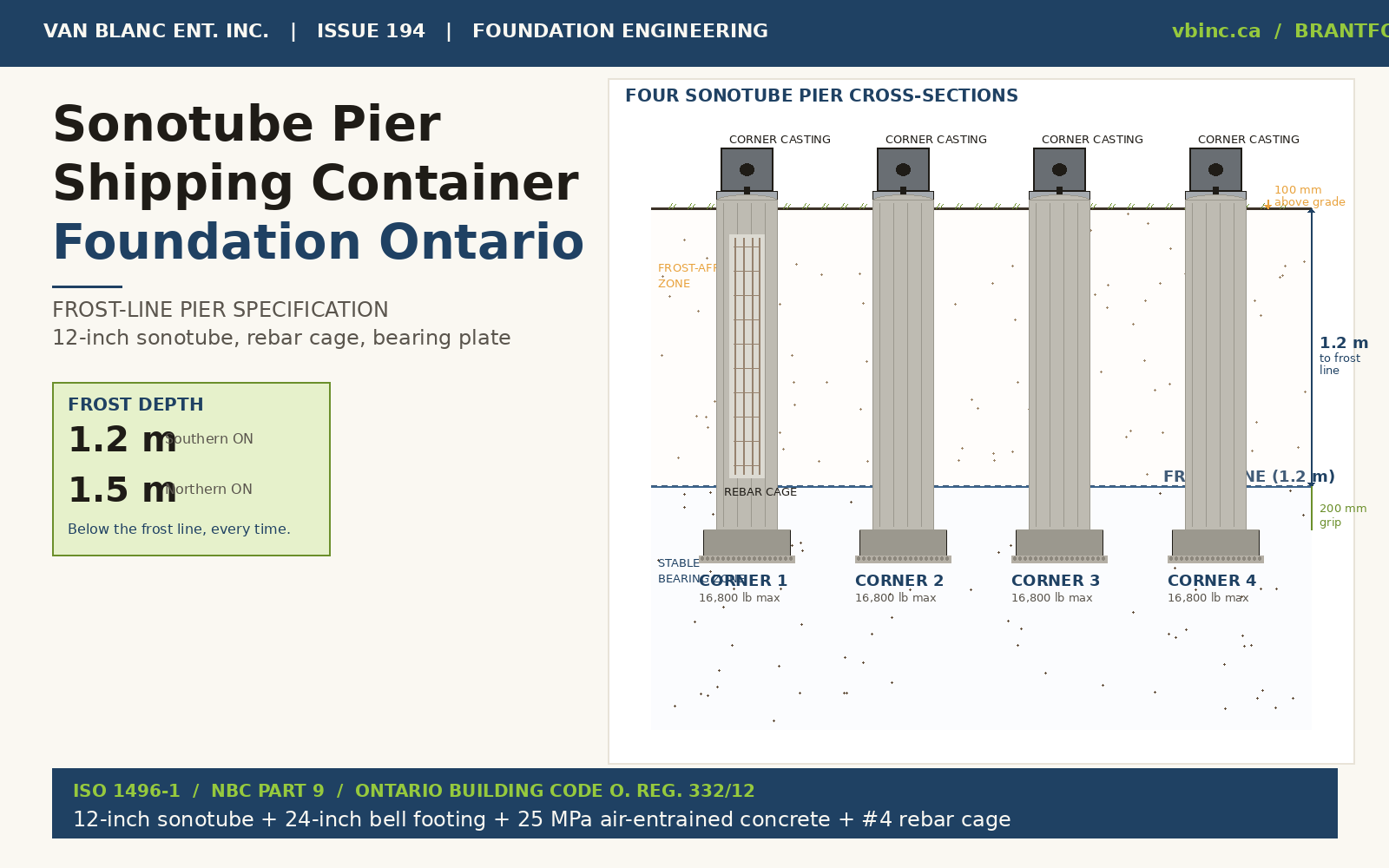
Quick Answer: A sonotube pier shipping container foundation in Ontario places four 12-inch concrete piers below the frost line (1.2 m in Southern Ontario, 1.5 m in Northern Ontario) under each corner casting. Each pier holds 8,000-12,000 lbs cleanly. The cost depends on whether you DIY or hire a crew, the bell-footing spec, and the steel bearing plates. Forty-foot bins want two mid-span piers added. Tell us your delivery address and we will send back an honest, all-in number, no anchored figures, just real pricing. Real Brantford yards, real reviews (4.9 / 140+), real 1-3 day delivery. Family-operated since 1995.
In This Guide
- Why Do Piers Suit a Container’s Load Path?
- How Deep Is Ontario’s Frost Line?
- Where Does the Container’s Weight Land?
- How Many Piers Per Container Size?
- What Sonotube Size and Footing?
- What Rebar, Mix, and Cure Time?
- What Drives the Pier Foundation Cost?
- What Goes Wrong on Wet Lots?
- When Does FPSF Beat Deep Piers?
- What Is the Pour-to-Delivery Sequence?
- Frequently Asked Questions
Reading time: about 14 minutes.
Most buyers calling Van Blanc about a 40-foot bin (the measurements are in our size breakdown) have the container picked out before they think about what it sits on. The bin shows up, the driver tilts it onto the gravel pad, and three winters later the corners have walked sideways because nothing went below the frost line. That walk costs more to fix than the pier-foundation site-prep we recommend would have cost in the first place. This guide walks through the sonotube pier approach the way Paul and Christian explain it on yard tours: real numbers, real frost depths, and the exact reason a container wants pin-point pier support rather than a continuous strip footing.
Why Do Piers Suit a Container’s Load Path?
A sonotube pier foundation suits a shipping container because the container channels its entire weight through four corner castings, not across a floor. A concrete pier set directly under each casting puts support exactly where the steel pushes down, which makes piers the most material-efficient base in well-drained Ontario soil.
A shipping container is not a house. It does not spread its weight across the floor. Every pound of cargo and every pound of snow on the roof funnels through those four corner points. That load path is why container engineers favour pier foundations over a continuous slab in well-drained soil. A slab supports weight the container never asks it to carry, while a pier directly under each corner casting wastes nothing. Paul LeBlanc, who founded Van Blanc in 1995 and has spent 19 years in the container trade, puts it plainly on yard tours: “People want to pour a giant slab because it feels safer. The container does not care about the middle of the slab. It only ever pushes down on four corners, so that is where you put the concrete.” For slab and helical-pile alternatives, the team’s guide to prepping a container site walks through the trade-offs.
Corner Casting Load Reality
Per ISO 1496-1 (Series 1 freight container testing standard), a loaded 40-foot container can transfer up to 30,480 kg gross through its four bottom corner castings. That works out to roughly 7,620 kg or 16,800 lbs per corner at maximum gross. Most yard or residential loads run well below that, sitting closer to 8,000-12,000 lbs per corner. Either way, the concentrated point load demands a pier rated for the maximum case, not the average.
How Deep Is Ontario’s Frost Line?
The Ontario frost line is the depth at which the ground stays unfrozen through a normal winter, and it ranges from about 1.0 metre in the milder south to 1.5 metres in the north. Anything above that line gets pushed up when the soil freezes and dropped back when it thaws, which is why a sonotube pier has to reach below it. The working depths Van Blanc uses across our delivery zones:
| Region | Frost Line Depth | Pier Hole Depth |
|---|---|---|
| Niagara, Halton, Hamilton, GTA core | 1.0-1.1 m (40-44″) | 1.2 m (48″) |
| Brantford, Waterloo, Wellington, London | 1.1-1.2 m (44-48″) | 1.2 m (48″) |
| Peterborough, Kawarthas, Eastern Ontario | 1.2-1.3 m (48-52″) | 1.3 m (52″) |
| Northern Ontario (Sudbury, North Bay, Sault, Timmins) | 1.4-1.5 m (56-60″) | 1.5 m (60″) |
| James Bay lowlands, far north | 1.8 m+ (72″+) | Engineer-spec required |
The pier sits 100 mm above grade so the bottom rail clears wet ground. The hole goes below the frost line so the concrete column anchors into stable, unfrozen soil. If the pier base is at 1.2 m and the frost line is at 1.0 m, the column has 200 mm of grip in stable ground. That grip stops the lift.
Brantford and Grand River Valley Specifics
Buyers who pick up their bins from our Brantford yard typically sit in the 1.1-1.2 metre frost depth band. We see most pier installs go to 1.2 m exactly across Brant County, Norfolk, Haldimand, and Waterloo. North of Highway 9, that working depth lifts to 1.3 m without much argument. Worth the drive for unbeatable quality, family customer service with 30 years of experience.
Where Does the Container’s Weight Land?
The container’s weight lands on its four corner castings, the welded steel blocks at each corner, and nowhere else should touch the foundation. The bottom rail between the castings is not a load path. If a pier pushes up on the middle of the bottom rail, the bin deflects, doors hang funny, and the corner seal breaks.
That is why the bearing plate matters. We recommend a 200 mm by 200 mm by 12 mm steel plate seated directly under the corner casting, bedded on grout or hard rubber. The plate spreads minor pier-top imperfections so the casting beds evenly.
Field check Christian runs on most site visits: place a four-foot level across the diagonal of the four piers before delivery. If the diagonal is more than 6 mm out of plane, shim the low corner. Doors that close cleanly on day one stay closing cleanly on year ten.
How Many Piers Per Container Size?
The number of piers a container needs depends on its length: four corner piers are mandatory on every size, and longer bins add mid-span piers under heavy load. The corner castings always take the mandatory four. Whether you add mid-span piers comes down to whether the floor will be loaded heavily enough to bounce.
| Container Size | Minimum Piers | Recommended Piers | Mid-Span Notes |
|---|---|---|---|
| 20ft Standard / HC | 4 (corners only) | 4 | Bottom rails span 19’10” reliably without mid-support |
| 40ft Standard / HC | 4 (corners only) | 6 (corners + 2 mid) | Mid-piers at ~13’4″ intervals stop floor deflection under heavy load |
| 45ft HC | 4 (corners only) | 6 (corners + 2 mid) | Same 13’4″ intervals; the extra 5 feet sits at the tail |
| Two stacked 40ft | 4 (corners only) | 4 corners + engineer-spec mid | Top container’s corner load doubles bottom load; treat as engineered structure |
For a 20-foot bin, four corner piers is the full answer. The bottom rail is engineered to span the 19-foot-10-inch length with cargo loaded. Mid-piers waste concrete.
For a 40-foot bin loaded heavily (workshop tools, racked inventory, vehicle storage), the bottom rail can flex under concentrated mid-floor loads. Two mid-span piers split the floor into three bays of 13 feet, 4 inches and stop the bounce. Empty or lightly loaded 40-footers can run on four corner piers for years. The mid-piers are insurance for heavy use.
Cheaper Mid-Pier Trick
Mid-span piers can stop at 900 mm capped with a steel base plate touching the bottom rail. Corner piers carry structural load; mid-piers only stop floor bounce, not frost heave. Shorter mid-piers trim concrete volume and dig time, so they cost less than full-depth corner piers.
What Sonotube Size and Footing Should You Use?
For a shipping container, the 12-inch sonotube on a 24-inch square bell footing is the standard. The 12-inch tube handles a 12,000-pound corner load with margin and sizes cleanly to that footing. Bigger diameters (14, 16 inch) are overkill. Smaller diameters (8, 10 inch) are used on decks but undersize the corner load math.
The bell footing is the wider concrete pad at the bottom. A 12-inch pier on a 24-inch square footing spreads the corner load across 576 square inches. At the OBC’s presumptive bearing for Ontario clay-loam (75 kPa or 1,500 psf), that footing handles 6,000 lbs of allowable load with margin. On packed gravel the bearing climbs and the footing can shrink. On soft clay or organic soil, the footing grows or an engineer weighs in.
The bearing plate at the top is 200 mm by 200 mm by 12 mm hot-dip galvanized steel, with a 16 mm anchor bolt set into wet concrete and projecting through the plate. Some installers add a small angle bracket that hooks the casting lip for lateral restraint, mostly for high-wind sites or stacked configurations.
What Rebar, Mix, and Cure Time Do Piers Need?
A sonotube pier needs a four-bar rebar cage, a 25 MPa air-entrained concrete mix, and a 7-day minimum cure before any load. The rebar cage gives the pier tensile strength when frost or wind tries to bend the column sideways, because concrete handles compression well but cracks under bending. Standard cage spec for a 12-inch pier going 1.2 m deep:
- Four #4 (12 mm) vertical bars, evenly spaced around the inside of the tube, 50 mm cover from the form wall
- #3 (10 mm) ties every 300 mm down the length, plus an extra tie 75 mm from the top and bottom
- One 16 mm anchor bolt protruding 75 mm above the finished pier top, threaded for the bearing-plate nut
- Vertical bars extend into the bell footing if a bell is used, with at least 200 mm embed
Concrete should be 25 MPa (3,600 psi) ready-mix with 6-8% entrained air. The entrained air is critical in Ontario freeze-thaw because it gives the cured concrete room to expand without cracking when water freezes. Non-air-entrained mix surface-scales after four or five winters. Air-entrained mix lasts decades.
Cure window: 7 days minimum at 10-20°C. Cold-weather pours (below 5°C) need accelerator and insulated curing blankets, extending safe cure to 10-14 days. If the bin shows up before concrete is fully cured, the corner casting punches the bearing plate into still-soft concrete and you lose the level alignment.
Christian LeBlanc, second-generation operator: “Piers fail one of two ways. Either someone skips the frost-line depth and the corners walk in three winters, or they pour in November without air-entrained mix and the tops scale apart by year five. Both are avoidable. Get the pier right, the bin lasts thirty years. I have watched Paul deliver to Norfolk farms where the 1998 piers are still flat and the bin is still locked tight.”
What Drives the Cost of a Sonotube Pier Foundation?
The cost of a sonotube pier foundation is driven by who does the work and how much depth and footing your site demands. A four-pier install spans a wide band: a DIY pour sits at the low end, while a full contractor crew with bell footings and steel bearing plates sits at the high end. What moves your number is the line items below, the depth you dig to (frost line by region), the bell-footing size your soil demands, and whether you rent the auger or hire it out:
| Line Item | DIY Scope | Contractor Scope | Notes |
|---|---|---|---|
| 12-inch sonotube (4 ft length) | You buy it | Included in crew quote | Building Boxes Brantford or Home Depot |
| Rebar (#4 verticals + #3 ties) | You buy it | Included in crew quote | Pre-tied cages available at concrete yards |
| Anchor bolt (16 mm threaded) | You buy it | Included in crew quote | Galvanized for outdoor exposure |
| Concrete (0.12 m³ for 1.2 m × 12″ pier) | You buy it | Included in crew quote | Air-entrained 25 MPa ready-mix |
| Excavation (auger or hand-dig) | Auger rental share | Crew machine time | Auger rental by the day from Brantford Rent-All |
| Bearing plate (200×200×12 mm galvanized) | You buy it | Supply plus fitting | Local fabrication or pre-made plates |
| Gravel base in hole (50 mm clear) | You buy it | Included in crew quote | Drainage layer at bottom |
| Labour (per pier) | Your time | Crew labour | 2-3 hours per pier including dig, set, pour, finish |
| Cost driver | Materials plus your weekend | Materials plus crew labour and machine time | Per-pier gap is the labour and equipment line |
A 20-foot bin needs four corner piers; a 40-foot bin with mid-span support needs six, so the 40-footer runs roughly 50 percent more in materials and labour than the 20-footer for the same per-pier scope. Either way, a pier foundation costs a fraction of a full concrete slab across a 40-foot footprint, because you are placing concrete only under the four corner castings instead of pouring the entire surface. Piers are the budget path for buyers who do not need the floor surface a slab provides. If you are weighing the pier route against driven steel, our breakdown of helical piles versus a poured pad covers where each one wins on cost.
Buyers chasing the cheapest possible spec sometimes ask about skipping the bell footing or going with 10-inch sonotubes. Both are false economies. Skipping the bell saves hundreds on install and costs thousands when a pier rotates in soft soil and the corner casting drops 20 mm. Stick with 12-inch tubes and bell footings on anything meant to last.
What Goes Wrong With Piers on Wet or Soft Lots?
On wet or soft lots, sonotube piers can heave or rotate because saturated soil grips the shaft and soft ground fails to carry the bell footing. Pier foundations work in well-drained soil and struggle in saturated clay, organic peat, or any site where surface water pools. Three checks before the auger goes in:
- Drainage check: Stand on the site after a heavy rain. If puddles linger more than an hour, piers sit in wet soil through freeze-up. Wet soil grips the pier shaft and pulls it up during frost heave even below the frost line. Solution: regrade away from pier locations, add a French drain ring, or move to a slab.
- Soil bearing check: Dig a test hole 1.2 m down at one pier location. Firm clay-loam, sand, or compacted gravel gives OBC presumptive bearing of 75 kPa or better. Soft black organic soil, wet peat, or a slurry that closes back into the hole needs an engineer’s bearing assessment or a deeper pier.
- Buried-services check: Call Ontario One Call (1-800-400-2255) five business days before any excavation. Free service. Locates gas, hydro, water, sewer, fibre.
The Gravel Pad Question
Buyers ask whether they can skip piers and set the bin on a 100 mm gravel pad. For seasonal sheds in well-drained sites it works the first few winters. For permanent installs in Ontario, it fails. The gravel sits on soil that freezes and lifts. The bin walks, doors stop closing. The pier-foundation site-prep we recommend goes below that frost line so the bin holds. Gravel pads are storage-yard staging, not a permanent base.
When Does FPSF Beat Deep Piers?
FPSF beats deep piers when the container is heated, since interior heat is what the system relies on to keep the soil from freezing. Frost-Protected Shallow Foundation design is the alternative to going below the frost line. Instead of digging 1.2 metres, FPSF places horizontal extruded polystyrene panels around the perimeter, redirecting building heat into the soil to stop freezing. The foundation can sit as shallow as 400 mm below grade. FPSF was added to the National Building Code of Canada Part 9 in 2010.
FPSF is best suited for heated buildings where interior heat feeds the soil. For unheated container storage, FPSF needs an insulated perimeter (R-25 minimum) with engineered drainage. It fits a heated build such as an office, studio, or suite, sites with a high water table, or rocky sites where deep drilling is cost-prohibitive. If you are turning a bin into conditioned space, the kind of insulated, sealed shell we build at our Brantford conversion yard is what changes the foundation math. FPSF does not fit unheated cold storage, poor surface drainage, or Northern Ontario where frost depths exceed 1.5 m.
For most VBinC customers buying for storage, workshop, or yard use, sonotube piers below the frost line remain the cleanest path. FPSF carries higher design complexity than the pier-foundation site-prep we recommend on standard installs.
What Is the Pour-to-Delivery Sequence?
The pour-to-delivery sequence for a sonotube pier foundation runs about two to three weeks, from layout and pour through the cure window to the day the container lands on the bearing plates. The timeline:
- Day 0 (week before pour): Layout pier locations using the bin footprint plus 50 mm tolerance per corner. Call Ontario One Call. Drop sonotubes into augered holes, level them, brace them with 2×4 stakes.
- Day 1: Pour all piers in a single concrete delivery. A 4-cubic-yard truck handles up to 30 piers, so even a 40-footer with 6 piers is well under one truck. Vibrate or rod each pier as it fills. Set anchor bolts plumb. Trowel the top smooth, slightly crowned.
- Days 1-7: Cure window. Cover with damp burlap or curing blankets if temperature swings hard. Do not load anything onto the piers during cure.
- Day 7: Install bearing plates onto the anchor bolts with grout or rubber pad bedding. Confirm all four corner plates are within 6 mm of the same elevation using a four-foot level across diagonals.
- Day 7-14: Schedule container delivery. The Van Blanc dispatcher confirms pier locations and tilt-deck access. The driver positions the bin with corner castings landing directly on the bearing plates and checks the bin is flush on all four corners before releasing the chains. Real lead time, not a hopeful one, on every delivery from our 4 Brantford yards.
- Post-delivery: Walk the door diagonals. They should swing free and seal cleanly. If a door binds, shim the low corner. Re-check after 30 days for any settling.
The full sequence runs two to three weeks. Buyers who compress it (pour Friday, deliver Saturday) pay with deflected bearing plates or punctured concrete. Patience on the cure window makes the install last.
Ready to price your container?
Tell us the size and your postal code and we’ll send back an honest, all-in number, container, delivery, and placement, usually within 1-3 days. No pressure, no mystery fees.
Family-run in Brantford since 1995 · 200+ containers in stock · 4.9★ across 140+ Google reviews · every box graded by a person, walk it before it lands.
Frequently Asked Questions
How deep do sonotube piers need to go in Ontario?
Southern Ontario piers go 1.2 metres (48 inches) below grade. Eastern Ontario and Kawarthas go 1.3 metres. Northern Ontario (Sudbury, North Bay, Sault) goes 1.5 metres. The depth must put the bottom of the pier below the local frost line so winter freezing cannot lift the column. Going shallower is the single most common reason container foundations fail in Ontario.
What diameter sonotube do I need for a shipping container foundation?
12-inch diameter is the standard for both 20-foot and 40-foot containers. It handles the 8,000-12,000 lb corner casting loads with proper margin and sizes correctly to a 24-inch square bell footing in typical Ontario soil. Smaller 8-inch or 10-inch tubes under-size the corner load math. Larger 14-inch or 16-inch tubes are overkill for residential and small-commercial installs.
How many piers does a 20-foot shipping container need?
Four piers, one under each corner casting. The bottom rails on a 20-foot container are engineered to span the full 19-foot-10-inch length with cargo loaded, so mid-span piers are unnecessary. Make sure the piers sit at the exact corner casting positions, not arbitrary points along the bottom rail, or you create stress points that can deflect the floor.
How many piers does a 40-foot shipping container need?
Four corner piers minimum, six recommended for heavy use. The two mid-span piers split the 40-foot floor into three roughly equal bays of 13 feet 4 inches, stopping floor deflection under concentrated loads (workshop tools, vehicle storage, racked inventory). Light or empty 40-footers run fine on four piers. Loaded 40-footers want all six.
What does a sonotube pier shipping container foundation cost in Ontario?
The cost is driven by who does the work and how deep you dig. A DIY pour, where you supply the sonotube, rebar, concrete, and bearing plates and dig the holes yourself, sits at the low end. A contractor crew that handles excavation, bell footings, and steel bearing plates sits at the high end. A 40-footer with six piers runs roughly 50 percent more than a 20-footer with four, and either configuration costs a fraction of a full concrete slab. The depth required by your regional frost line and the bell-footing size your soil demands also move the number. Pick the size you need on our containers in stock for sale page, then tell us your delivery address for an honest, all-in quote.
Do I need an engineer to design the piers?
For standard installs in typical Ontario soil with a single container, no. The pier sizing in this guide (12-inch tubes, 1.2-1.5 m depth, 24-inch bell footing, 25 MPa concrete) handles standard residential and yard storage cases. For stacked bins, heavily loaded commercial installs, soft or organic soil sites, or any structure that will be occupied as a habitable space, yes. An OBC-stamped foundation plan covers permitting and liability.
Can I pour piers in winter?
Yes, but with cold-weather concrete protocols. Use air-entrained mix with calcium-chloride accelerator. Cover the pour with insulated curing blankets for 7-14 days. Keep the concrete above 5°C through the cure window. Cold-weather pours cost about 15-20% more than spring pours and take longer to cure. Most buyers wait for May-October weather if the schedule allows.
What if my site has soft or clay soil?
Soft clay or organic soil reduces bearing capacity below the OBC presumptive 75 kPa. Three options: dig deeper until firm soil is reached and rest the bell footing on it, widen the bell footing (36-inch or 48-inch square instead of 24-inch), or get an engineer’s soil-bearing assessment. Skipping the soil check and pouring on soft ground is how piers tilt in year three.
How long does a sonotube pier foundation last?
Properly installed air-entrained concrete piers with galvanized bearing plates last 50+ years in Ontario freeze-thaw conditions. The failure modes are surface scaling from non-air-entrained mix (15-20 year visible decline), bearing plate rust if non-galvanized hardware was used (20-30 years), or rotation from undersized bell footings on soft soil (5-15 years). The pier-foundation site-prep we recommend with the right specs outlives most owners.
Can Van Blanc deliver to a site before the piers are cured?
No. We hold delivery for the full 7-day minimum cure window on standard pours, or 10-14 days on cold-weather pours. Setting a loaded container on green concrete punches the bearing plate into the still-soft surface and ruins the level alignment. Every quote comes with a real lead time tied to the cure schedule. Coordinate the concrete pour first, then book the delivery, never the other way.
Sources
- International Organization for Standardization. (2013). ISO 1496-1:2013, Series 1 freight containers, Specification and testing, Part 1: General cargo containers for general purposes. iso.org/standard/52904.html
- Canadian Commission on Building and Fire Codes. (2020). National Building Code of Canada, Part 9 (Housing and Small Buildings), Section 9.12 Excavation and Section 9.15 Footings. National Research Council Canada. nrc.canada.ca
- U.S. Department of Housing and Urban Development. (2004). Revised Builder’s Guide to Frost Protected Shallow Foundations. huduser.gov/publications/pdf/fpsfguide.pdf
- Government of Ontario. (2024). Building Code (O. Reg. 332/12), Part 4 Structural Design and Part 9 Housing and Small Buildings. ontario.ca/laws/regulation/120332
- Sonoco Products Company. (2024). Sonotube Concrete Forms: Technical Specifications and Installation Guide. sonotube.com
Reach Van Blanc in Brantford
We have been supplying shipping containers across Ontario since 1995. Our warehouse is at 90 Morton Avenue E in Brantford, and we deliver right across the province on a cash-on-delivery basis. No surprise fees, no chase-the-paperwork.
Van Blanc Ent. Inc., 90 Morton Ave E Unit 1B, Brantford, ON N3R 7J7. Call +1 888-509-6658.
Planning a pier install before your bin arrives? Call us once the layout is finalized and we will time the delivery to your cure window. Worth the drive for unbeatable quality, family customer service with 30 years of experience.