
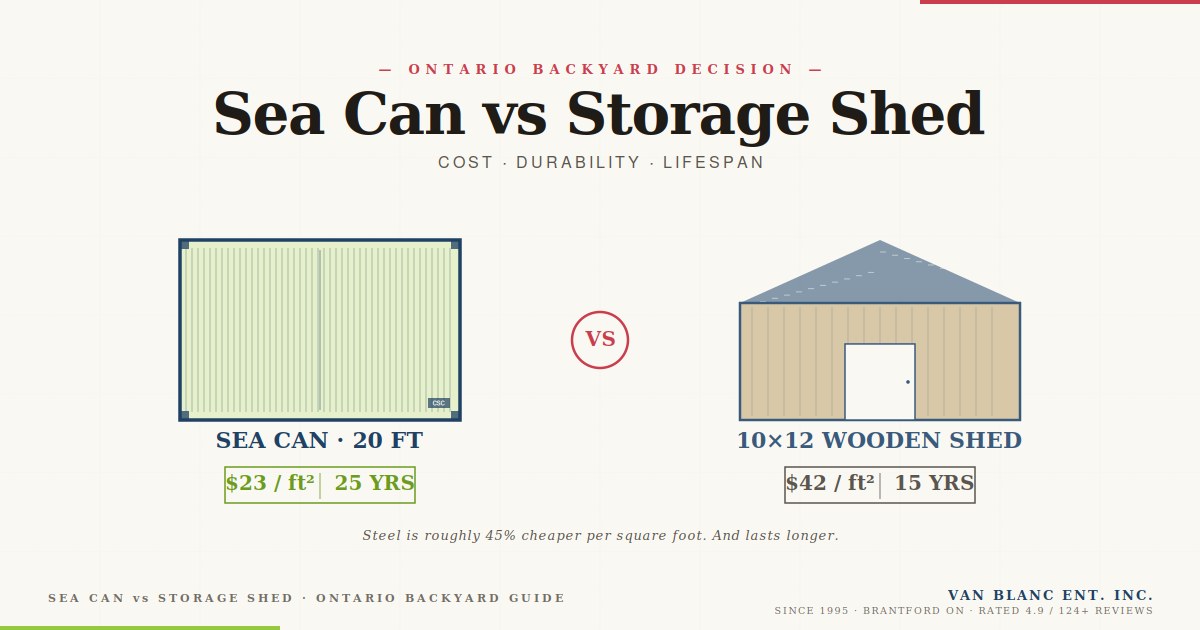
Quick Answer: Per Wikipedia, Intermodal container. A 20 foot sea can in Ontario costs less per usable square foot than a comparable wooden shed once delivered, and it lasts 25 years with almost no maintenance. A wooden storage shed costs more per square foot installed and lasts 10 to 20 years with paint, repairs and pest control. The container wins on cost, durability and security. Sheds get picked for a cottage look and a small footprint, and a sea can takes paint or cedar cladding to suit the house. Real lead times and COD-honest pricing, quoted to your specific address, call us at 519-754-6844. 30+ years operating, 4.9 stars on 140+ Google reviews. 1-3 day delivery Ontario-wide from our Brantford yards.
What This Sea Can vs Shed Guide Covers
Reading Time: 13 minutes
Every Ontario homeowner who needs more storage eventually weighs the same two options. Buy a 10 by 12 foot wooden shed from the big-box store or order a custom build from a local shed builder, or buy a used 20 foot sea can from a Brantford container yard and have it delivered. Both will hold your lawn mower, your snow tires, your woodworking tools, and your fishing gear. The honest numbers reveal that one option is cheaper, more durable, and lasts longer than the other in almost every metric except aesthetics.
This article walks through the actual cost math, the lifespan difference, the pest and security comparison, and the yard questions (looks, footprint, access, board rules) worth settling on the phone first. The point is to put real numbers beside your specific yard so you can see what a steel box does on it.
Sea Can vs Shed Cost Per Square Foot
The cleanest way to compare is dollars per usable square foot of storage. Here are the real Ontario 2026 numbers.
| Option | Interior floor area | Relative cost per sq ft | What drives the price |
|---|---|---|---|
| 10 x 12 wooden shed, big-box kit, assembled | 120 sq ft | Mid | Lumber and shingle prices, assembly labour, foundation prep |
| 10 x 12 wooden shed, custom-built with doors and windows | 120 sq ft | Highest | Skilled-trade build time, finish carpentry, doors and windows |
| 12 x 16 wooden shed, custom-built | 192 sq ft | High | More materials and labour, larger footprint, custom finishing |
| Small metal shed kit, 6 x 8 | 48 sq ft | Lowest | Thin panels, light framing, small footprint, no insulation |
| 20 ft used cargo-worthy sea can, delivered | 160 sq ft | Low | Container grade, delivery distance from Brantford, market for used steel |
| 20 ft one-trip (new) sea can, delivered | 160 sq ft | Mid | New-build steel cost, single overseas voyage, delivery distance |
| 40 ft used cargo-worthy sea can, delivered | 320 sq ft | Lowest of the cans | Twice the floor area for one delivery, container grade, distance |
A used 20 foot sea can comes in at a noticeably lower cost per usable square foot than a custom wooden shed once it is delivered to your driveway. A 40 foot used sea can drops the per-square-foot math even further, because you get twice the floor area for a single delivery. The only option that beats a sea can on price-per-sq-ft is a small metal kit shed under 100 square feet, which is a different product entirely (limited durability, no insulation possible, mostly suitable for garden tools).
The kit-shed math is worth noting separately. A 10 by 12 kit shed from a big-box store can land in the same per-square-foot range as a used sea can. But kit sheds typically come with thinner walls, lighter framing, smaller doors, lower-quality roof shingles, and no built-in pest sealing. Comparing kit shed to sea can on price alone misses that they are not the same product class. We itemised what the warehouse-club kits actually put in the box in our guide to Costco’s shed lineup. The best-specified wood kit in the category, with the floor in the box, is covered in the Cedarshed review. For the steel kit specifically, the Arrow shed write-up puts the panel gauge and the assembly weekend beside the box.
Lifespan of Sea Cans vs Wood Sheds
This is where the long-term math diverges sharply. A sea can outlives a shed by a generation.
| Option | Expected lifespan | Maintenance over lifespan |
|---|---|---|
| 20 ft used sea can | 25 years or more | Surface rust spot-treatment once or twice; gasket replacement if needed after 20 years; no painting required |
| 20 ft one-trip sea can | 30 years or more | Negligible for first 10 to 15 years; light surface care after that |
| Custom wooden shed | 15 to 20 years | Repaint or restain every 5 to 7 years; replace shingles after 15 to 20 years; check for pest entry annually; replace rotted boards as needed |
| Kit wooden shed (big-box) | 10 to 15 years | Earlier deterioration of roof and floor; mouse and squirrel intrusion common after 5 to 7 years; structural sag possible by year 10 |
| Small metal kit shed | 10 to 15 years | Rust at panel seams; door alignment drifts; replace panels as they corrode |
Over a 30-year horizon, you would buy and install two wooden sheds (year 0 and year 18) versus one sea can. Each shed carries its own install cost, and on top of that you pay for paint and repairs across its service life. One used sea can is a single purchase with negligible maintenance over the same 30 years. Tally the two builds plus their upkeep against the one container, and the container works out to roughly one third the lifetime cost for almost the same floor area.
Paul LeBlanc, Van Blanc owner: “I have delivered sea cans to Brantford-area farms and homes that are still sitting on their original pad 25 years later. Same gravel. Same container. Customer paid for it once. The same property a hundred metres down the road that bought a wooden shed in 2000 has replaced it twice and is asking about a sea can now. Nineteen years selling containers, I have watched that pattern repeat in every Ontario community we serve.”
Steel vs Wood: Durability and Security
This is where steel walls and tight-gasket doors do work that wood cannot.
- Walls: A sea can has Corten weathering steel walls about 1.6 mm thick. A wooden shed has 5/8 inch plywood or T1-11 siding over a wood frame. A determined burglar can saw through shed siding in a few minutes. Sea can walls require oxy-acetylene or a thermal lance, which most thieves do not own.
- Doors: Sea can cargo doors are double-gasketed steel that swing on industrial hinges. Standard shed doors are framed plywood with residential hinges. Lockbox installation on a sea can is a 30-minute job that produces a near-vault-grade closure. Shed locks defeat with a crowbar.
- Roof: Sea can roof is corrugated steel, rated for cargo stacking and 25 years of weather. Shed roof is asphalt or metal shingles over plywood sheathing. Shingles need replacement every 15 to 20 years. Shed roofs leak under ice damming. Sea cans do not.
- Floor: Sea can floor is 27 mm marine plywood treated to resist pest entry and water. Shed floor is typically 3/4 inch plywood on joists over an unheated crawl space, which is where mice nest. Sea can floors are mouse-proof from below by design.
- Wind and snow: Sea cans are designed for stacking nine units high on ocean-going ships. They handle Ontario wind and snow load without thinking. Sheds need engineered truss reinforcement to survive heavy snow loads in cottage country, and many do not.
For backyard storage that holds anything of value (lawn tractor, motorcycle, contractor tools, hunting gear, collector items, ammunition, anything that would hurt to lose), the security difference is the deciding factor for many buyers. A wooden shed signals that valuables might be inside. A sea can on a residential property signals that they are protected by industrial steel.
What a Squirrel Does to a Wood Shed
Paul sent these three photos over in September 2026. They’re from an ordinary wood-framed garden shed with OSB sheathing on a stud frame and a plywood floor, the kind sold as a kit at every building centre in Ontario. A squirrel decided it wanted in, and it got in.
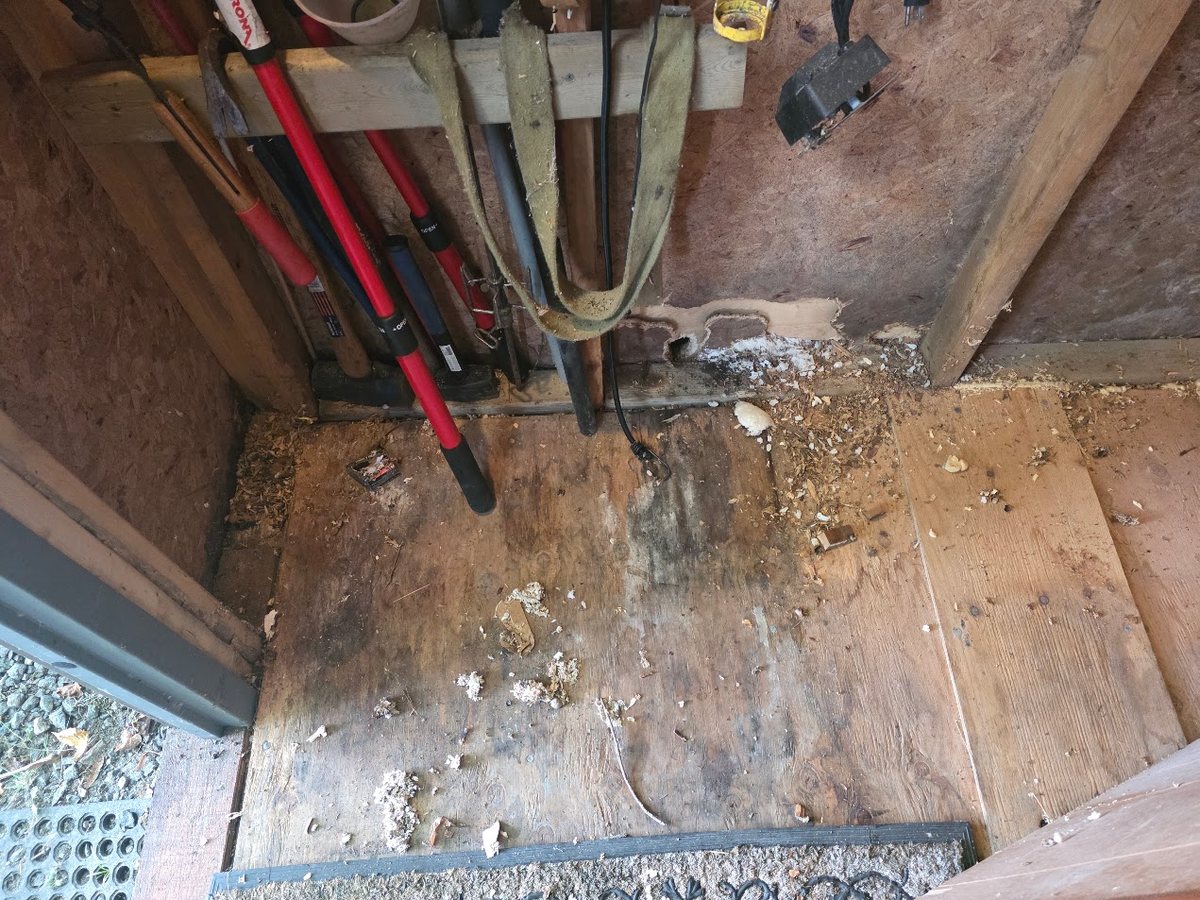
The first shot is the view from the door. The rakes and shovels still hang where the owner left them. Below them the sheathing is open at floor level, and the plywood is covered in what the squirrel left behind: chewed flakes of OSB and shredded insulation it pulled out of the wall.
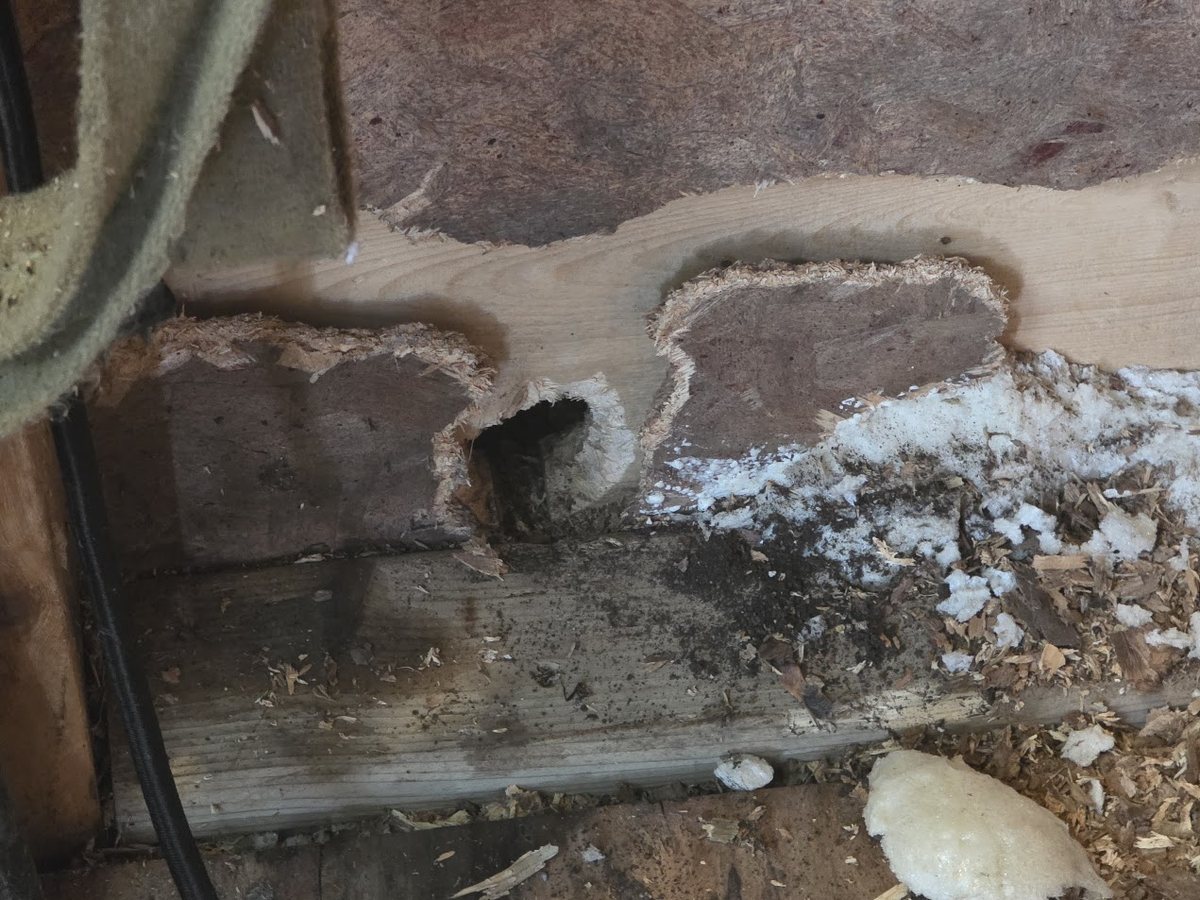
Up close, the hole is about the size of a fist. OSB is wood chips and resin pressed into a sheet, and a squirrel’s front teeth go through it the way they go through a walnut. Once it was through the sheathing it kept working sideways along the bottom plate, opening the panel wider and dragging the insulation out behind it for a nest.
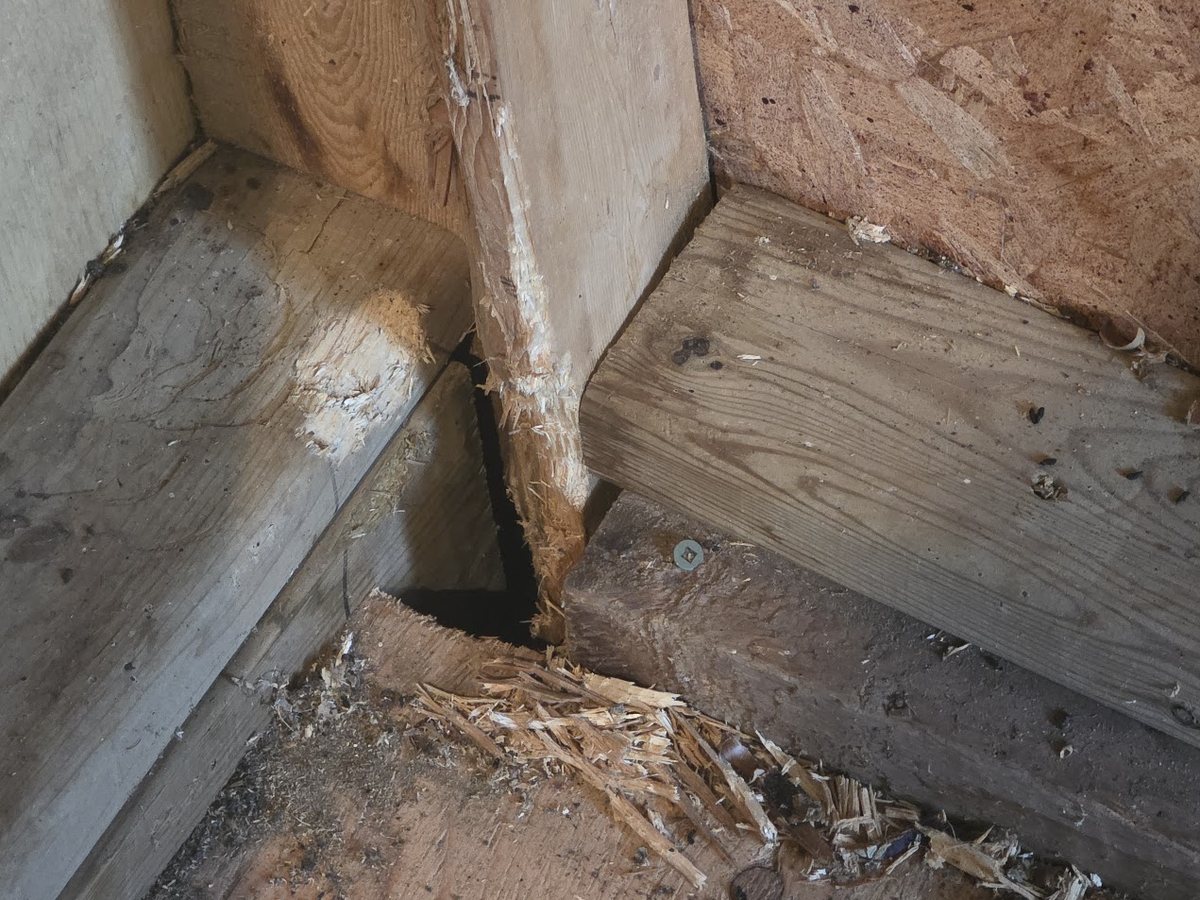
The third photo is the corner of the building. The bottom of the corner stud has been chewed down to bright wood, and there’s now a gap between the framing and the floor wide enough for the next squirrel to use without chewing at all. Nothing is falling down yet. But the shed is open to every mouse in the neighbourhood, the corner carries less than it did the day it was built, and the fix is a saw, new sheathing and a new stud. The squirrel will try the next panel over.
A sea can gives a squirrel nothing to start on. The walls are 1.6 mm Corten steel, the floor is 27 mm marine plywood on steel cross-members, and the doors close on a rubber gasket. It can gnaw at a container all winter and the container won’t notice. The one way mice do get into a sea can is a torn door gasket, which is a cheap part and a ten-minute swap. That is the durability difference in three photos.
Site Prep and Delivery Access for Sea Cans
Both options need a level foundation. The site prep workload is different.
| Site prep task | Wooden shed | Sea can |
|---|---|---|
| Foundation type | Concrete pad, gravel pad, or pressure-treated skids | Gravel pad, railway ties, or concrete blocks at four corners |
| Foundation effort (typical) | Higher if hiring out a poured pad or skid base | Lower, usually just leveling and a gravel pad |
| Site survey time | 2 to 4 hours of buyer-DIY prep | 1 hour to level four corner spots |
| Assembly time | 1 to 3 days of build time | 10 minutes once the delivery truck arrives |
| Need for professional install | Usually yes for custom; DIY possible for kit | No, container arrives ready to use |
| Access path required | Pedestrian; lumber can be hand-carried | Tilt-deck trailer (about 70 feet of straight approach for a 20 ft) |
The sea can wins on speed and total install cost (foundation plus assembly) by a wide margin. A 20 foot sea can on a level gravel pad is fully usable within 10 minutes of the delivery truck leaving. A custom shed needs a week of build time, often with multiple trades, before you can use it.
Access is the one thing to check before you order. A 20 foot sea can needs a clear approach for a tilt-deck trailer to back into position. Wooded properties, narrow lots, fenced back yards with no rear access, and houses on hills with steep driveways can complicate sea can delivery. Sheds, by contrast, can be assembled on site from materials hand-carried through a residential garden gate.
Most Ontario residential sea can deliveries land in suburban back yards via the driveway, sometimes after we remove a fence panel temporarily. Acreage and rural properties are simpler because the trailer can swing freely. Townhouses, semi-detached homes with no side access, and inner-city lots with shared driveways are the cases where the trailer approach needs a closer look. We site-survey before booking delivery so we can flag access constraints early.
Storage Shed or Sea Can: Looks, Footprint and Access
Five yard situations come up when buyers set a shed beside a sea can. Here is what each one means for the container.
1. Yards Where Looks Come First
Garden-feature back yards, manicured residential lots in mature neighbourhoods, or properties where the storage building is visible from the curb and the homeowner wants a coordinated cottage-style look. A wooden shed paints to match the house. A sea can stays a steel box. The un-clad sea can is industrial-looking by default, so buyers who want the cottage look have it painted to match the house or clad in cedar or pine boards. Under the finish it is still Corten steel that keeps the squirrels out and lasts 25 years or more.
2. Storage Needs Under 100 Square Feet
The smallest sea can is the 20 foot, with a 160 square foot footprint and a 20 by 8 foot floor plan. A 6 by 8 kit shed holds 48 square feet of garden tools. A 20 foot sea can gives you more than three times that floor in one delivery, so the rakes share the space with the snow tires, the bikes and the patio set. How that footprint compares with an 8×10, a 10×12 and a 12×16 shed, door widths included, is the subject of shed sizes decoded.
3. Lots With Only Garden-Gate Access
If your only access to the storage location is a 36-inch garden gate or a hand-carry path through landscaped beds, you cannot deliver a sea can. Period. The container will not pass. A shed kit can be carried in piece by piece and assembled on site. Our wood shed buying notes cover what those kits put in the box. Before you rule the container out, have us look at the lot: we site-survey before booking, and a fence panel lifted out for the day sometimes opens a driveway approach the gate never could.
4. Townhouse and Condo Board Rules
Many townhouse and stratified-condo back yards have HOA or condo-board rules that effectively prohibit industrial-looking structures. Sheds usually clear these rules. Sea cans usually do not. Check the rules before you order. Where a rule targets the industrial look, ask the board whether a painted or cedar-clad sea can meets it.
5. Short-Term Storage Needs
For a few months of storage (during a renovation, after a move, while you sort and downsize), a sea can bought outright can be sold on after, and a rental bills by the month until it goes back.
Resale Value of Used Sea Cans
One thing buyers do not always consider is what each option is worth when you no longer need it.
A used 20 foot cargo-worthy sea can holds about 60 to 80 percent of its purchase value 10 years later, depending on condition. Steel does not become obsolete, the container market always wants used inventory, and the resale market in Ontario is active. You can sell a 10-year-old sea can in a week through any container yard or classified site.
A 10-year-old wooden shed has almost no resale value. It is part of the property. When you sell the house, the shed conveys with the land. If you remove it before selling, you usually scrap it because the wood is too weathered for re-use and the cost of disassembly and transport exceeds the value of the materials.
Adjust the original cost math for resale. A sea can that you sell 10 years later returns most of its purchase value, so its true net cost over a decade is only a fraction of what you paid. A wooden shed that you abandon at year 15 has cost you the full purchase price plus all the maintenance, with nothing recovered at the end. The lifetime gap widens further than the sticker price suggests.
Can a Sea Can Be Insulated Like a Shed?
Sheds are sometimes pitched as “warmer” because the wooden construction has natural insulating value. The honest answer on a sea can is that you can spray-foam the interior to R-25 or higher and end up with a meaningfully more insulated structure than any uninsulated wooden shed. Spray foam adds an insulating layer to a 20 foot container, brings the interior to year-round usable temperatures with a small electric heater, and pays back in usability if you plan to spend time inside (workshop, art studio, home office). A wooden shed in Ontario without insulation is uncomfortable below 0 degrees Celsius and unusable below minus 10. The container after spray foam is warmer than most uninsulated garages.
Sea Can or Storage Shed: Which Fits Your Yard?
Here is the simple, honest summary.
| Your situation | Better fit |
|---|---|
| You need 100+ sq ft of storage for 10+ years, accessible by tilt-deck | Sea can |
| You need under 100 sq ft of garden-tool storage | 20 ft sea can, with 160 sq ft of room for the list to grow |
| You value aesthetic coordination with a heritage-look home | Cedar-clad or painted sea can |
| You need security for tools, vehicles, or valuables | Sea can |
| You have no rear access for a delivery truck | Shed (sea can will not fit) |
| You want a one-time purchase that lasts 25+ years | Sea can |
| You are comfortable repainting and re-shingling every 5 to 7 years | Sea can (no repainting or re-shingling needed) |
| You want resale value if you sell or move | Sea can (active resale market) |
| Your property has condo or HOA aesthetic restrictions | Check the rules first; ask about a painted or clad sea can |
| You need refrigerated or insulated storage | Sea can (reefer or insulated build) |
Frequently Asked Questions
How much does a 20 ft sea can cost compared to a 10 by 12 shed in Ontario?
A used cargo-worthy 20 foot sea can delivered in Ontario costs less per usable square foot than a 10 by 12 custom wooden shed installed. The sea can gives you 160 square feet of usable interior, while the wooden shed gives you 120 square feet at a higher cost per square foot. What moves either price is size, grade or build quality, and the delivery or install distance, not a fixed sticker number.
How long does a sea can last in an Ontario backyard?
A used cargo-worthy sea can on a level gravel pad lasts 25 years or more with almost no maintenance. The Corten weathering steel develops a natural surface patina that protects the structural steel underneath. A one-trip (new) sea can can last 30 years or more in the same conditions.
Is a sea can secure for storing valuables?
Yes. The 1.6 mm Corten steel walls and double-gasketed cargo doors are meaningfully more secure than wooden shed walls and residential hinges. A lockbox installed over the door handles produces a near-vault-grade closure. Burglars who can defeat a residential shed in minutes cannot defeat a sea can without industrial cutting tools.
Can a sea can be delivered to a fenced backyard?
Sometimes. Sea cans require a tilt-deck trailer with about 70 feet of straight-line approach for a 20 foot container. Most suburban driveways accommodate this, sometimes with temporary removal of a fence panel. Townhouses, narrow inner-city lots, and properties with steep driveways or rear-only access are the cases where delivery may not be possible. We site-survey before booking.
Does a sea can need a concrete pad?
No. A level gravel pad, four concrete blocks at the corners, or four railway ties are all adequate. The container has a structural steel frame that distributes weight to the four corner castings, which is what carries the load. Concrete pads are an option but not a requirement. Most Ontario residential sea cans sit on gravel.
Will mice get into a sea can?
Almost never. The 27 mm treated marine plywood floor, the double-gasketed cargo doors, and the lack of attic crawl space all make sea cans far more pest-resistant than wooden sheds. The most common mouse entry into a sea can is when the owner has run electrical or ventilation cables through unsealed penetrations, which is preventable with proper seal-around installation.
Can I paint or clad a sea can to look less industrial?
Yes. Sea cans can be painted any colour with industrial steel paint, cladded with cedar or pine boards on the exterior, or finished with insulated panels for a more residential look. The cladding option is increasingly popular for cottage and acreage properties where the buyer wants the durability of steel and the visual of a wooden structure.
Sources
- International Organization for Standardization. (2022). ISO 6346:2022 Freight containers, Coding, identification and marking. iso.org/standard/82754.html
- Reno Quotes. (2026). Shed Price Guide. renoquotes.com/en/blog/shed-price-guide
- Boxhub. (2026). Shipping Containers vs Storage Sheds: Choosing the Perfect Storage Solution. boxhub.com/blog/shipping-containers-vs-storage-sheds
- Conexwest. (2026). Shipping Container vs Shed: Which is a Better Storage Solution. conexwest.com
- Natural Resources Canada. (2025). Backyard Storage: Building Material Lifespan. nrcan.gc.ca
See a 20 Foot Sea Can at Our Brantford Yards
Van Blanc has been delivering sea cans into Ontario back yards, farms, and small businesses since 1995. If you are weighing a 20 foot sea can against a 10 by 12 wooden shed for your specific yard, the easiest 10 minutes you can spend is a phone call where we walk through your access, your use, and your aesthetics preference before the truck is booked.
Van Blanc Ent. Inc. 90 Morton Ave E Unit 1B, Brantford, ON N3R 7J7. 519-754-6844 (cell) or 1-888-509-6658 (toll-free).
Worth the drive to our Brantford yards to see a used cargo-worthy 20 foot in person, walk inside, run your hand along the wall. The sea can reads differently in person than in photos, and that two-minute walk usually settles the question for buyers who have been weighing it for weeks.
Container Buying and Cladding Guides
- Shipping Containers for Sale in Ontario
- 20 ft Shipping Container Specs and Pricing
- 20 ft vs 40 ft Shipping Container Comparison
- New vs Used Shipping Container in Canada
- Container Modifications and Cladding
- Container Modification Options
Quote a Sea Can to Your Postal Code
Tell us the size and your postal code and we’ll send back an honest, all-in number, container, delivery, and placement, usually within 1-3 days. No pressure, no mystery fees.
Family-run in Brantford since 1995 · 200+ containers in stock · 4.9★ across 140+ Google reviews · every box graded by a person, walk it before it lands.