
Quick Answer: Cheese ripens in a narrow window: roughly 8-14 C at 80-95% relative humidity, held stable for weeks. An insulated container is a right-sized aging cave, but a reefer’s factory airflow is too strong and dries the rind. The honest build calms the air and adds humidity. Delivered in 1-3 days.
In This Guide
Reading Time: 10 minutes
The Wheel That Dried Out Before It Ripened
A farmstead cheesemaker producing a few wheels a week faces a storage problem the recipe books skip. The cheese needs to age somewhere cool and very humid, held steady for weeks or months, and the options all fail differently. A domestic fridge runs too cold and bone-dry, so the rind cracks and hardens before the paste ripens. A basement drifts ten degrees with the seasons. A purpose-built masonry cave is a capital project a small creamery cannot justify against a few dozen wheels.
The shell that comes closest is a reefer, though emphatically not in the way most suppliers would sell you one.
Between the mini-fridge and the masonry cave sits a gap nobody has named for cheesemakers: a right-sized, sealed, insulated room that can hold cool temperature and very high humidity at the same time. That description is an insulated shipping container, and the practitioner literature on aging caves has been quietly describing container-scale rooms for years. The one thing that literature is emphatic about is the part most people get wrong, and it is about air, not cold.
What Affinage Actually Requires
The aging window across cheese types runs roughly 8 to 14 C (about 46 to 57 F) at 80 to 95 percent relative humidity, and the practitioner reports stress that a good room holds a tight sub-band inside that range because different cheeses want different points in it. Commercial affinage rooms are cited running 48 to 57 F at 88 to 98 percent RH. The numbers are not exotic; holding them together, cool and very humid at once, is what defeats improvised setups.
| Parameter | Target for cheese aging |
|---|---|
| Temperature | 8-14 C (46-57 F), held within a ~5 F sub-band per cheese |
| Relative humidity | 80-95%, sub-banded 80-85 / 85-90 / 90-95 by type |
| Air exchange | Only about 1-3 air volumes per hour |
| Air speed | Roughly 0.2-0.5 m/s, deliberately gentle |
| Low-humidity failure | Rind dries, cracks, hardens; paste never ripens right |
That air-exchange line is the whole game, and it is where a container conversation gets honest.
The Reefer Trap: Why Factory Airflow Is the Enemy
Here is the counterintuitive engineering fact that decides the build, straight from the aging-cave research: cheese wants almost no moving air. The target is roughly 1 to 3 air changes per hour at 0.2 to 0.5 metres per second, a barely perceptible drift. A standard walk-in cooler, and a reefer container out of the factory, moves air far harder than that, and in a humid room that airflow does exactly the wrong thing: it dries the rind and fights the humidity you are trying to hold. Conventional refrigeration also has an inherent drying effect, pulling moisture out on the cold coil, with condensation constantly forming on cool surfaces.

So the honest pitch for a cheese cave is not plug-and-play refrigeration. It is a stable, cold, insulated shell with the airflow deliberately calmed down and humidity actively added back. The insulated envelope is the hard part to build and the part we supply: sealed, foam-insulated walls that hold a steady cool temperature without the swings a bare box suffers. The affineur then tunes a gentle-air, high-humidity climate inside it with a humidifier and low-speed fan control. Any supplier who tells a cheesemaker a reefer is a ready-made cave has not read the cheesemakers’ own guidance.
Christian LeBlanc, second-generation operator: “Cheese people are the only buyers who ask me to make the box move less air, not more. Once you know that, the whole build makes sense: we give them the cold, sealed shell, and they turn the wind down and the moisture up.”
Building the Cave Inside the Box
The build starts from the insulated shell and adds the affineur’s kit. Food-safe wipe-down wall and ceiling surfaces so the room sanitizes properly. A humidifier or fogger to push and hold the 80-95 percent band, because refrigeration alone will always run too dry. Low-speed, controllable air movement instead of the factory blast, so the room refreshes gently without desiccating rinds. Shelving in food-grade wood or coated wire for the wheels, and a logging thermometer-hygrometer so the numbers are proof, not guesswork.
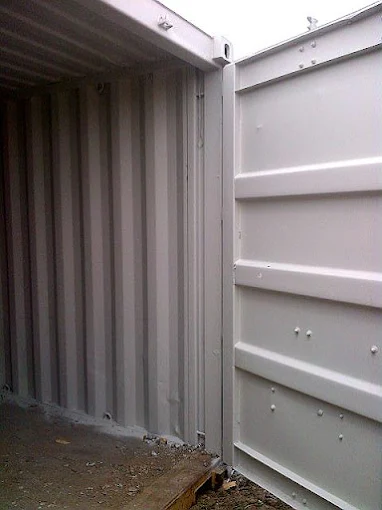
Sizing is friendly to small makers. The aging-cave studies model rooms around 20 feet by 20 feet, but a single 20ft container aging a few dozen wheels at a time suits a farmstead operation, and a 40ft scales to a serious creamery’s inventory. We fit the insulation, the surfaces, and the shelving at our yard as a standard insulated conversion; the humidity and airflow gear is the maker’s to spec and dial in.
Different Cheeses, Different Corners of the Band
The reason the room needs a tight sub-band rather than one average setting is that cheese families ripen at different points. Bloomy-rind and washed-rind cheeses, the Camembert and Brie and washed-curd styles, want the top of the humidity range, around 90 to 95 percent, to grow their surface moulds and bacteria properly. Cheddar and hard natural-rind cheeses sit cooler and drier, roughly 10 to 13 C at 80 to 85 percent, and cheddar styles often start cool and rise as they age. A maker running more than one style either dedicates a room per band or works one band at a time, which is exactly the kind of decision a right-sized container makes affordable: two 20ft caves cost less than one built room, and each holds its own climate.
A Cave Sized to Your Wheels
Tell us your cheese styles and how many wheels you age at once. We will spec the insulated shell and the surfaces, and the humidity-and-airflow honest truth, in a same-day quote.
What We Build and What Stays Yours
The honest line, because cheese for sale is regulated food. We supply and deliver the insulated room and its surfaces; we do not supply the dairy-plant licence, the preventive-control or HACCP plan, or the affineur’s craft. Cheese sold in Canada runs under provincial dairy-plant licensing, and raw-milk cheeses carry mandatory minimum aging and testing rules you confirm with CFIA and your province. The container is the controlled environment, temperature, humidity, insulation, airflow. The setpoints, the sanitation, the rind management, and the legal right to sell are yours. We build the cave; you hold the licence and the setpoints.
If you are weighing this against a built room or a rented cold space, the hub that compares a container to every alternative lays out the trade-offs, and the reefer machine itself is covered in our refrigerated container guide. An insulated build reaches the creamery in one to three days, on a date we hold rather than hope for., and cheesemakers are welcome to walk an insulated build at the yard with a hygrometer in hand.
Another hygroscopic product with a hard number: green coffee storage lives or dies on a 12.5 percent moisture ceiling.
Growers want the opposite climate again: a mushroom fruiting room pushes humidity up while flushing CO2 out.
Barrel aging is the drier cousin of the cave: a distillery or cidery barrel room wants stable warmth, not cheese-cave cold.
The same physics runs a stricter cousin: dry-cured meat chambers add a hard food-safety fork on top of the climate control.
Frequently Asked Questions
What temperature and humidity does cheese need to age?
Broadly 8 to 14 C (46 to 57 F) at 80 to 95 percent relative humidity, held stable, with the exact point set by cheese type. Bloomy and washed rinds want the humid top of that band; cheddar and hard cheeses sit cooler and drier.
Can a shipping container be used as a cheese cave?
An insulated container makes an excellent aging cave shell, but not as plug-and-play refrigeration. A reefer’s factory airflow is too strong and dries rinds, so the build calms the air and adds a humidifier. The insulated, sealed envelope is what makes holding 90 percent humidity possible.
Why can’t I just use a regular fridge or walk-in cooler?
Standard refrigeration runs too cold, too dry, and moves too much air for cheese. It pulls moisture out on the coil and desiccates the rind. Aging needs gentle airflow, about 1 to 3 air changes per hour, and active humidification, which a domestic fridge cannot provide.
What size container suits a farmstead creamery?
A 20ft insulated unit ages a few dozen wheels at a time, which fits most farmstead output, and a 40ft scales to a larger creamery. Running two styles at once, a maker often uses two smaller caves so each holds its own humidity band.
Is a container cheese cave legal for selling cheese?
The container is just the room. Selling cheese in Canada requires the appropriate provincial dairy-plant licensing, and raw-milk cheese has mandatory aging and testing rules. We supply the controlled environment; the licence, the food-safety plan, and the setpoints are the cheesemaker’s, confirmed with CFIA and the province.
Sources
- Betancourt, J. / Silvery Moon Creamery. Current Options in Cheese Aging Caves: An Evaluation, Comparison and Feasibility Study. SARE
- American Cheese Society. (2016, rev. 2017). Best Practices Guide for Cheesemakers. cheesesociety.org
- University of Guelph. Cheese Making Technology e-Book, Ch. 5.2 Ripening and Packaging. uoguelph.ca
- Canadian Food Inspection Agency. Dairy products inspection and licensing. inspection.canada.ca
- International Organization for Standardization. (2019). ISO 1496-2, Series 1 freight containers: thermal containers. iso.org
Reach Van Blanc in Brantford
We have supplied and converted insulated containers across Ontario since 1995, and an aging cave is one of the more satisfying briefs to build. Bring your cheese styles, your wheel counts, and your hygrometer.
Van Blanc Ent. Inc., 90 Morton Ave E Unit 1B, Brantford, ON N3R 7J7. +1 888-509-6658
Cheesemakers should see a sealed envelope in person before trusting it with months of aging.