
Last updated: May 25, 2026
Quick answer. The Canadian Anti-Fraud Centre recorded hundreds of millions of dollars in reported fraud losses in 2023, with merchandise scams (containers, vehicles, equipment) one of the fastest-growing categories. Canadian container scams concentrate on Facebook Marketplace, Kijiji, and Craigslist with listings priced 50-70% below market. The seller takes an e-transfer deposit and disappears. Real yards have physical addresses you can verify on Google Maps, CRA business numbers, multi-year review histories, and serial numbers on every invoice. If any are missing, do not send money. Honest delivered pricing, confirmed before payment: get a real quote from Paul or Christian. Van Blanc has shipped containers across Ontario since 1995. Honest 4.9-star service, 1-3 day delivery from 4 Brantford yards.
How common are shipping container scams in Canada?
The Canadian Anti-Fraud Centre tracks online marketplace fraud across Canada. The Toronto Police Service has an active and growing fraud file specifically on shipping container deposit scams since 2023. CBC News and Global News have covered Ontario container fraud cases multiple times in the last two years. The Better Business Bureau Canada scam tracker maintains regional incident reports. The pattern is consistent and the volume is substantial.
At Van Blanc Ent. Inc. we get scam-victim calls almost every week. The caller has wired a deposit to a Facebook Marketplace listing offering a 20ft or 40ft container at a price well below the real market floor. The seller stopped responding after the deposit cleared. The “yard” the seller listed turned out to be a residential address or a vacant lot. The phone number stopped working.
This guide explains the patterns Canadian buyers should recognize, the verification steps that prevent fraud, and the recovery playbook when fraud has already happened. Each section links to the deep-dive article that goes further into the specific scam type.
Which five fraud patterns target Canadian container buyers?
1. The Facebook Marketplace ghost-yard listing
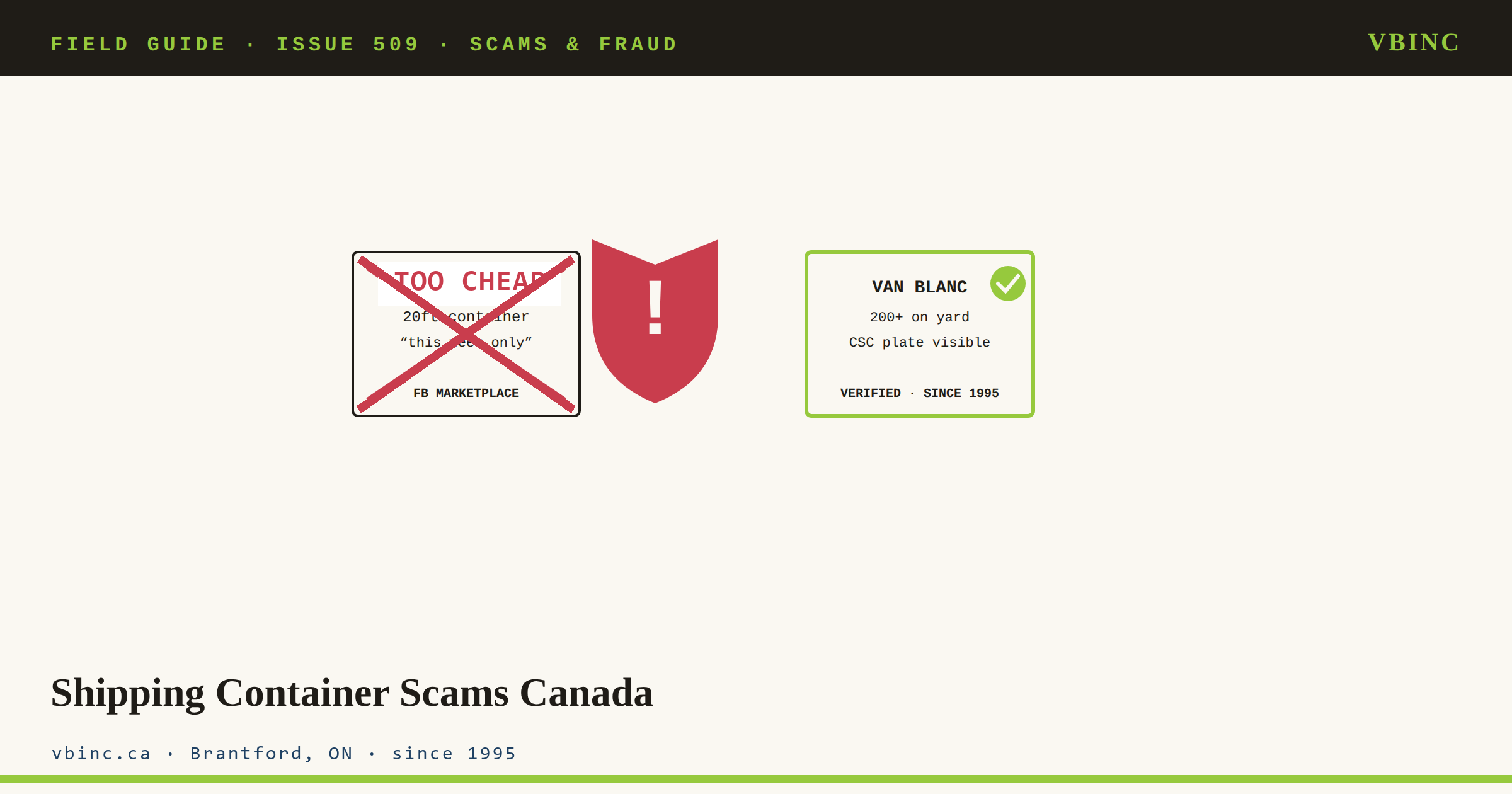
The most common Canadian container scam. The listing shows a clean 20ft or 40ft container priced 50-70% below the real market floor (an asking price that sits at roughly a third to a half of what that size and grade actually costs to deliver). Photos are crisp and professional – usually lifted from a real yard’s inventory page months earlier. The seller responds quickly with friendly messaging. They offer free or cheap delivery anywhere in Ontario “this week only.” They ask for an e-transfer deposit, sometimes the full amount.
That container does not exist. The photos were stolen. The deposit goes to a numbered company that closes within sixty days and reopens under a new name. Toronto Police has been documenting this pattern at increasing volume since 2023.
2. The too-good-to-be-true bait-and-switch
A variant where the seller does exist but the unit on the invoice is not what gets delivered. The listing price is below the real market for the stated grade. The buyer sends a deposit, gets a delivery date, and a truck arrives – but with a much lower-grade container than what was specified. The seller’s reasoning is some variation of “we ran out of that grade, this is the closest we have, the price stays the same.” The buyer either accepts (because they have already committed) or has to fight a refund battle that often does not succeed.
3. The deposit-then-add-fees pattern
The listing price looks competitive. The buyer sends a deposit. Then the seller adds new fees that were not in the original quote – delivery surcharges, “regulatory fees,” “fuel adjustments,” “permit fees” – until the total is significantly higher than the buyer would have paid at a legitimate yard. By the time the buyer realizes, the deposit is gone and the unit has not arrived. Walking away means losing the deposit.
4. The cross-border non-existence scam
The seller claims to be a U.S. yard that can deliver to Canada cheaply. The listing references container brands and yards that sound plausible. The buyer wires a U.S. dollar deposit. The U.S. yard either does not exist or has no record of the unit. Cross-border recovery options are minimal. The Canadian Anti-Fraud Centre has limited reach into U.S. listings.
5. The fake escrow service
A more sophisticated variant. The seller proposes “escrow protection” through a service that looks legitimate. The escrow company is fake – a website created days before the transaction, designed to mimic a real escrow service. The buyer’s funds go straight to the seller. Real escrow services for container transactions are extremely rare in the Canadian market.
What questions verify a legitimate Canadian container seller?
Before sending any money to any container seller, verify all of these. Any seller who refuses to provide these answers is not a legitimate yard. For the named suppliers buyers ask about most, our company-by-company verdicts save you the homework.
Physical yard address. A real container seller has a real physical yard at a real address. Drive past it. Or verify via Google Maps street view (look for actual containers on the property, not just a generic address). The yard should have multiple containers visible, not zero containers and a “office” sign on a residential house.
CRA business number. Real Canadian businesses have a CRA business number you can verify is active. Ask for it. If the seller refuses, walk away.
Phone number history. Ask how long the phone number has been the business’s. Real container yards have phone numbers that have been theirs for years (we have used ours for thirty years). Fraud listings often have mobile numbers that activate days before the listing posts.
Review history depth. Real businesses have reviews going back years across Google, BBB, and industry directories. Fraud listings have either zero reviews or a burst of reviews concentrated in the last few weeks (all fake). Look at the date span on the reviews. If they are all from the last month, the business is either brand new (and you should verify even harder) or fraudulent.
Serial number on the invoice. Real container yards put the specific CSC plate serial number on every invoice. The serial that arrives matches the serial on the invoice. Fraud sellers refuse to provide serial numbers because the units do not exist. This is the single most discriminating verification question.
In-person visit option. Real yards welcome buyer visits. If a seller refuses to let you visit before paying, that is signaling the inventory does not exist. Our Brantford yard at 90 Morton Avenue East is open Monday to Thursday 9:30-5, Friday 9:30-4, with roughly 200 containers on the ground.
If you have already been scammed: the recovery playbook
The first 48 hours matter most. If you have just sent money to a container listing and the seller has stopped responding or you suspect fraud:
Hour 1. Contact your bank immediately and request an e-transfer recall or wire transfer recall. If the receiving account has not been emptied, the bank may be able to reverse. The window is small (usually 30-60 minutes after send) but worth attempting.
Hour 1-24. Document everything: screenshots of the listing, all messages with the seller, the deposit receipt, the phone number, the listing URL, any photos shared. The Canadian Anti-Fraud Centre report you will file requires this documentation.
Day 1-2. File reports with: – Canadian Anti-Fraud Centre (the national fraud reporting database) – Your local OPP detachment or Toronto Police Service if Ontario-based – Your bank’s fraud department (different from the e-transfer recall – the fraud claim creates a paper trail for insurance and chargeback purposes) – The platform where the listing was posted (Facebook, Kijiji, Craigslist) – they will not refund you but they may take down the listing and prevent further victims
Day 2-7. If the deposit was a substantial sum, consider engaging a civil lawyer. Recovery odds for online container fraud are low but not zero – some cases have resulted in arrests and partial restitution. Time-sensitive.
External authoritative sources we recommend
For independent verification of the scam patterns described here:
The Canadian Anti-Fraud Centre publishes monthly fraud bulletins including container and online marketplace fraud trends. Their public reports cite the same patterns we see in customer calls. The Toronto Police Service fraud bureau has been vocal on Marketplace-driven container scams since 2023. The OPP consumer fraud bulletins have addressed rural Ontario container fraud specifically. CBC News investigations have covered Ontario container scams multiple times – WebSearch “CBC shipping container scam Ontario” for the most recent coverage. The Better Business Bureau Canada scam tracker maintains regional reports including container industry complaints.
Featured deep-dives in the scams family
The Suspiciously Cheaper Facebook Marketplace Container Scam: Pattern, Examples, How Van Blanc Sees It Every Week
The single most-common Canadian container scam pattern documented in detail. The listing characteristics, the messaging patterns, the deposit-to-disappearance timeline, and the real examples we have helped customers untangle after they fell victim.
Shipping Container Scam Red Flag Checklist 2026
The 2026 updated red-flag checklist for evaluating any Canadian container listing. The price-floor math (why a listing is automatically suspect), the seller-verification questions, and the in-person inspection options every real yard offers.
How to Spot a Fake Shipping Container Company: 9 Red Flags Before You Wire a Deposit
The nine red flags that signal a fake container yard. Domain age, phone number history, review-history depth, yard-visit availability, CRA business number presence, and the other verification questions that take fifteen minutes and prevent thousands of dollars of loss.
Shipping Container Deposit Scams in Canada: Wire Fraud, Fake Yards, Vanishing Sellers
The deposit-fraud pattern documented in depth. Why scammers prefer e-transfer over credit card, the legal framework that makes recovery hard, and the specific bank-side and law-enforcement steps that improve recovery odds when fraud has already happened.
Why Is That Shipping Container So Cheap? The Real Reason a Discount Means Trouble
The price-floor math that exposes fraud listings. Why a real Canadian container at any grade has a hard cost floor below which legitimate yards cannot operate, and why listings below that floor are almost always fraud.
The full scams spoke index
- The Suspiciously Cheaper Facebook Marketplace Container Scam
- Scam Red Flag Checklist 2026
- How to Spot a Fake Shipping Container Company
- Container Deposit Scams in Canada
- Deposit Fraud Canada: 2026 Pattern
- Why Is That Container So Cheap?
- 9 Red Flags When Buying Online
- Is Buying a Shipping Container Online a Scam?
- Recovery Playbook: When Delivery Never Shows
- Beware of Shipping Container Scams
Is that container company legit? The supplier review series
Buyers search a company name plus the word legit for a reason. We wrote the page that search deserves for the Canadian suppliers people actually ask about, applying the same public-record checks to every company on the list, including ourselves.
- Is BigSteelBox legit?
- Is ATS Containers legit?
- Is Boxhub legit?
- Is Cantrans legit?
- Is Coast Containers legit?
- Is Secure Container Solutions legit?
- Is Sigma Container legit?
- Is Storstac legit?
- Is TargetBox legit?
- Is Van Blanc legit? Our own yard through the same lens
What customers actually say
“Amazing, legit and honest company. After nearly being scammed by another company I contacted Paul as they were local to me. I was able to meet Christian and see the containers they had. After selecting the one I needed it was delivered the next day.”
– Kat B., 2023, Google review
The “after nearly being scammed by another company” pattern appears in dozens of our customer reviews. Most Canadian container buyers do not encounter a real yard first – they encounter a scam listing first, recognize the pattern, then call a verifiable supplier. That recovery-from-near-miss is the path we see most often. The defence is not getting close to the scam in the first place.
Frequently asked questions about shipping container scams in Canada
Are shipping container scams common in Canada?
Yes. The Canadian Anti-Fraud Centre tracks online marketplace fraud and container scams have been a documented and growing category since 2023. Toronto Police Service has an active fraud file specifically on container deposit scams. Our yard fields scam-victim calls almost weekly. The patterns are consistent across the country, concentrated on Facebook Marketplace, Kijiji, and Craigslist.
How do I tell if a shipping container listing is a scam?
Five signals. Price 50-70% below the real market floor (a 20ft listed at roughly a third of what a deliverable unit of that grade actually costs). No physical yard address you can verify. Phone number that has been active for days rather than years. Review history that is zero or burst-concentrated in recent weeks. Refusal to provide a CSC plate serial number on the invoice. Any one of these is a yellow flag. Two or more is a fraud listing.
What is the cheapest real price for a 20ft shipping container in Canada?
A deliverable Wind-and-Watertight 20ft in Ontario in 2026 has a real market floor set by steel value, ocean-freight repositioning, inland trucking, and yard handling. Below that floor, the seller is either selling As-Is (real but rare, with documented defects) or running a fraud listing. The deeply discounted used 20ft listings on Facebook Marketplace are almost universally fraud, because the real market floor for a deliverable sound container is roughly double what those listings advertise.
What do I do if I have been scammed buying a shipping container?
Hour 1: contact your bank to request an e-transfer or wire recall. Hour 1-24: document everything (screenshots, receipts, messages, listing URL). Day 1-2: file reports with the Canadian Anti-Fraud Centre, your local police (OPP or Toronto Police), your bank’s fraud department, and the platform where the listing was posted. Recovery odds are low but not zero – the first 48 hours matter most.
Can I get my deposit back after a container scam?
Sometimes, depending on speed and payment method. If you used e-transfer and act within the first 30-60 minutes, your bank may be able to recall. If you used credit card with chargeback protection, the chargeback process has decent odds. Wire transfers and cash are largely unrecoverable. The Canadian Anti-Fraud Centre report does not directly recover funds but can support insurance and legal claims.
Why are container scams so common?
Three reasons. Containers are expensive enough to make fraud worthwhile but affordable enough that most buyers cannot justify extensive due diligence. The product looks generic – a steel box is hard to differentiate in photos. And the delivery distance to most buyers (rural Ontario, Western Canada, Maritimes) makes in-person inspection inconvenient, which scammers exploit.
How can I verify a Canadian container seller is real before paying?
Six checks. Ask for the physical yard address and verify on Google Maps street view (look for actual containers, not just a generic property). Ask for the CRA business number and confirm it is active. Ask how long the phone number has been theirs (real yards have multi-year history). Look at review tenure – real businesses have reviews spanning years, not months. Ask for the CSC plate serial number on the invoice. Offer to visit the yard in person before paying. Any seller refusing these answers is not a real yard.
Is buying a shipping container online safe?
Buying from a verified online catalog of a real container yard with a physical address is safe. Buying from an unverified Facebook Marketplace, Kijiji, or Craigslist listing is the highest-risk transaction category in the Canadian container market. The platform itself is not the problem – the lack of seller verification on those platforms is.
Where should I report a shipping container scam in Canada?
Canadian Anti-Fraud Centre (national database, antifraudcentre-centreantifraude.ca), local police (OPP for rural Ontario, Toronto Police for GTA, your municipal force elsewhere), your bank’s fraud department, the platform where the listing appeared, and the Better Business Bureau Canada scam tracker. All five reports take about an hour total and create the paper trail needed for any subsequent recovery action.
What is the most-common Canadian container scam pattern?
The Facebook Marketplace ghost-yard listing: clean photos (stolen from a real yard), price 50-70% below real market, friendly fast-responding “seller,” request for e-transfer deposit, optional free delivery offered. After the deposit clears the seller stops responding. The “yard” address is residential or vacant. The phone number stops working. The deposit goes to a numbered company that closes within sixty days.
Want to verify a Canadian container seller? Here is what real looks like
Van Blanc Ent. Inc. has been at 90 Morton Avenue East in Brantford since 1995. CRA business number active for thirty years. Phone numbers (519-754-6844 and 1-888-509-6658) unchanged for decades. Roughly 200 containers on the ground at any time across our four Brantford yards – you can walk through them, read the CSC plates, and pick the specific unit by serial. The 4.9-star Google rating across 140-plus reviews spans six years of customer voice. None of this is unique to us – any real Canadian container yard has equivalent verifiable history. The fraud listings have none of it.
If you are to send a deposit and have any doubt, call us first – even if you are not buying from us. We will walk through the verification questions you should be asking your seller. 519-754-6844 or 1-888-509-6658. Browse our current inventory if you want to compare a real listing against a suspect one.
Where Van Blanc delivers across Ontario
We hear from buyers burned by online scams across the GTA and beyond. We deliver from our four Brantford yards to communities right across the province, including Toronto, Mississauga, Brampton, North York, Scarborough and Vaughan. See the full Ontario service-area map to find your town.
Established dealers sit on the right side of this line. We assess one of them in the Northern Container Sales write-up.
Ready to price your container?
Tell us the size and your postal code and we’ll send back an honest, all-in number, container, delivery, and placement, usually within 1-3 days. No pressure, no mystery fees.
Family-run in Brantford since 1995 · 200+ containers in stock · 4.9★ across 140+ Google reviews · every box graded by a person, walk it before it lands.
Van Blanc is part of this story. When CBC News covered the container scam wave, Paul’s experience was in it: a visitor photographed our Brantford yard, and days later our own containers appeared in fake ads across Ontario priced well under what any real yard could charge. The defence is everything this page teaches: verify the yard, walk it in person, and never wire a deposit to a seller you cannot visit.
The Red Flags With Names
The legacy version of this guide named the tells that still hold in 2026: stolen branding lifted from legitimate yards, listing copy with the grammar of a rushed translation, an email domain that does not match the company name, and a review profile that is sparse, recent, and oddly uniform. Each one alone is survivable; two together is the pattern. They join the bigger list above, and the defence has not changed since Paul first said it on camera: walk the yard before money moves.
Deeper in the Scam-Prevention Field Guide
The scale of this problem is documented, not anecdotal. The Canadian Anti-Fraud Centre recorded its worst year of reported fraud losses on record in 2025, and the CAFC estimates only 5 to 10 percent of victims ever report. Container fraud is a small, ugly corner of that number, and it follows patterns you can learn in ten minutes. Christian puts it plainly: “Every fake listing we have ever been sent has failed the same test. Ask to walk the yard. The real sellers say yes before you finish the sentence.”
The Patterns
Policies Worth Reading
Sources & References
Authoritative external sources cited or referenced in this guide:
- Canadian Anti-Fraud Centre: Scam Database & Reporting
- Royal Canadian Mounted Police: Online Fraud Resources
- Ontario Provincial Police: Anti-Rackets Branch
- Better Business Bureau Canada: Container Scam Alerts
- CBC Marketplace: Container Fraud Investigations
- Reddit r/ShippingContainers: Community Scam Reports